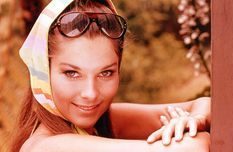
 Paige Young in Los Angeles
1969 January. Playboy Magazine. Playmate of the Year Contest. Winner: Connie Kreski. Anthony Newley. Roman Polanski. Can Heironymus Merkin Ever Forget Mercy Humppe…..? 1970s James Caan. Under Construction. Victor Lownes and Marilyn Cole. NSFW. 2-9-26
Posted on July 15, 2020
NSFW
PMOM = Playmate of the Month. PMOY = Playmate of the Year.
This photo of Paige Young appears in the January 1969 issue of Playboy magazine.
A brief update about her life is included, which was truthful I learned, if incomplete.
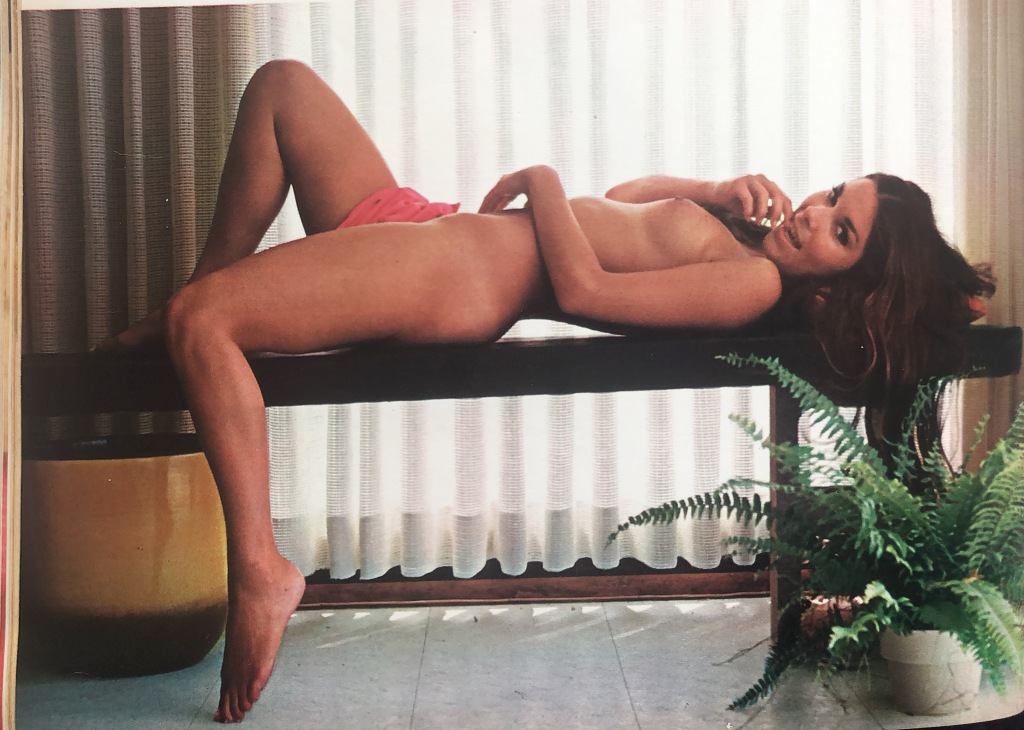
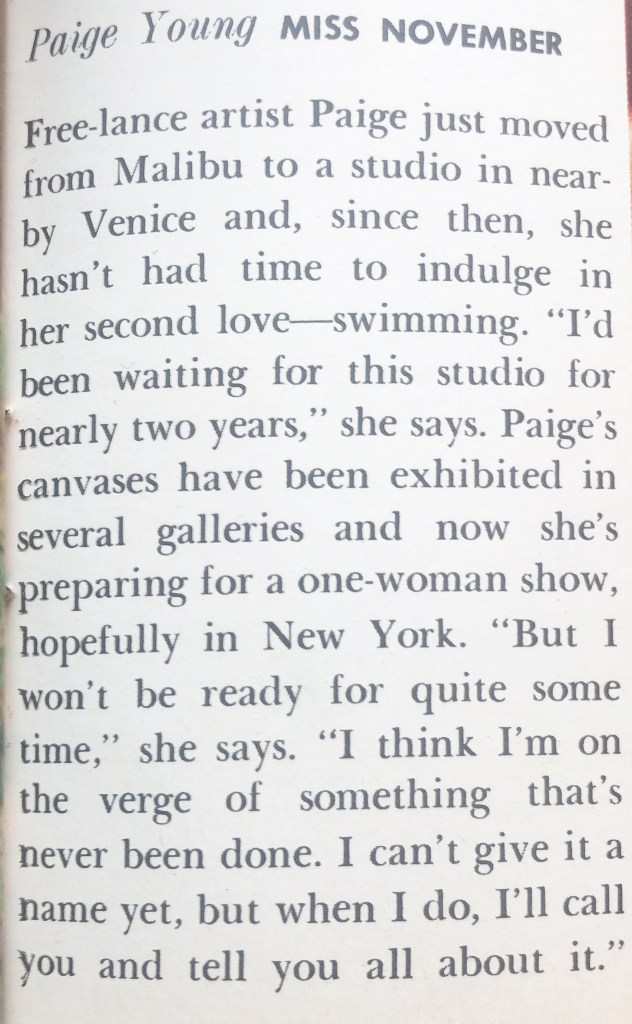
Update on Paige Young shown with her photo. Jan. 1969 Playboy Magazine.
More specifically than Malibu, which was always printed in Playboy, Paige lived in Topanga Canyon/ Topanga Beach. At that time, an area of artists, musicians, hippies, surfers and Hollywood celebrities. She knew Bill Cosby at the time and he may have helped her obtain her home there.
The January 1969 Playboy magazine issue shows all 12 Playmates of 1968.
A brief update accompanies each one, as we read in Paige’s entry.
Standard protocol for this annual issue.
It means the PMOY title will be announced soon.
1969 is also the 15th anniversary issue of the influential and wildly successful magazine.
Hugh Hefner became famous for his publishing and business empire.
Besides the magazine, the trendy Playboy Clubs Playboy Bunny cocktail waitresses were instantly iconic.
Successful enough to have created scores of imitators in the magazine publishing world during the 1950s and early 1960s.
Titles like Escapade, Nugget, Modern Man, Adam, Dude and Rogue, to name only a few. An easy Google image search.
The imitators experienced varying degrees of success.
The Playmate of the Year
has a higher status than Playmate of the Month (PMOM) obviously.
Kind of like, the “elite of the elite.“
Or the “creme de la creme.“
A PMOY title is akin to winning a beauty contest, much like Miss America or Miss USA. The winner reigns for one year and is then replaced the next.
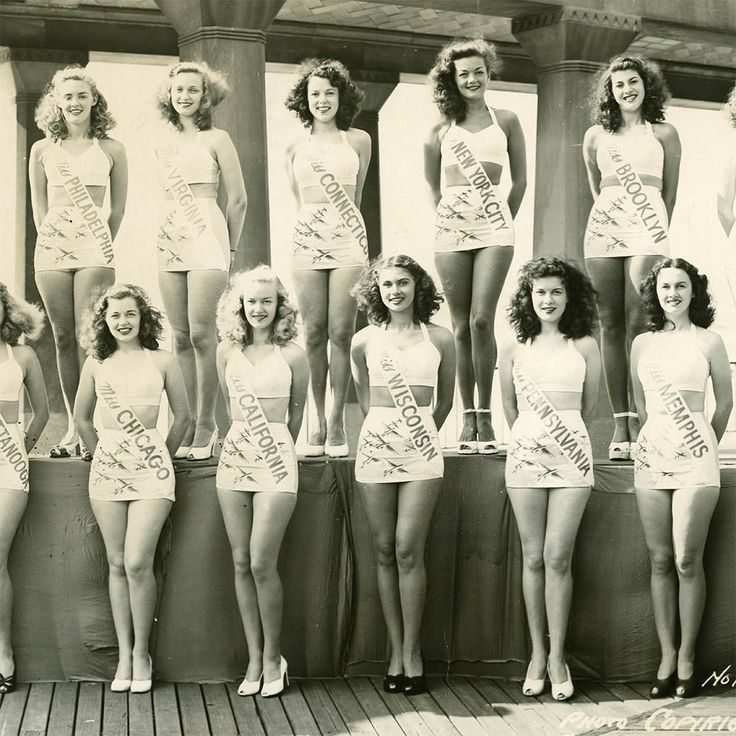
The 12 finalists are the 12 PMOMs.
The yearly 12 have already cleared a major hurdle by winning over many other young women for the coveted monthly spot.
Round 2: the 12 finalists compete for the PMOY title.
PMOY means more of everything you have already experienced as a regular PMOM: public appearances, photo sessions, media interviews, a modeling fee, career opportunities.
(However, a pink car is reserved exclusively for the PMOY.)
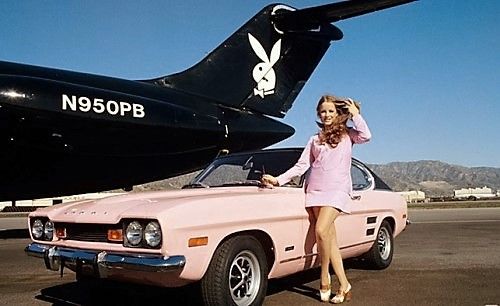
PMOY 1970 Claudia Jennings with her prize of a “Playmate Pink” color Mercury Capri. Behind it is Hugh Hefner’s favorite mode of transportation the few years he owned his jet called “The Big Bunny.”
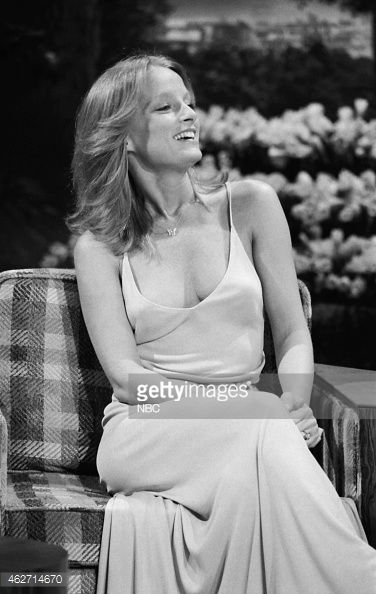
Claudia Jennings, an aspiring actress, is seen here being interviewed on the Tonight show, sitting on Johnny’s famous couch around the time she was given the title PMOY 1970.
She did become a successful actress in films like: Truck Stop Women, Gator Bait. and Unholy Rollers.
More about Jennings in my Start Here page.
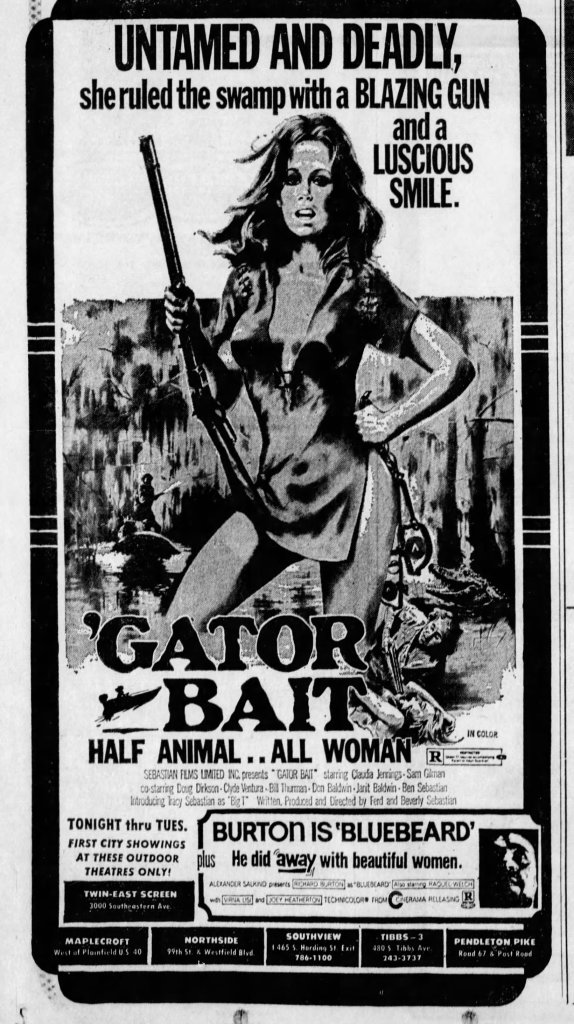
The PMOY gets a big party thrown in her honor, often at Hef’s Chicago mansion, later LA. Attendees include press, various celebrities including good looking film actors, Playboy and Hollywood big-wigs and assorted VIPs.
You would meet 100s of men in particular I imagine.
How was PMOY chosen?
I wonder if reader feedback influenced the decision, was it up to Hugh Hefner alone, or decided by committee?
Paige Young did not win and I doubt if she was even in the top 3.
The winner was Connie Kreski seen here on the cover of her PMOY issue
June 1969

Winner Connie was the girlfriend of Victor Lownes, head of the London Playboy Club & Casino, Chicago friend of Hugh Hefner.
Both are forgotten figures of the 1960s.
More on Victor Lownes coming up.
By the time of her PMOY title was announced in 1969, Connie had already filmed a movie directed by English singer, actor, composer Anthony Newley.
Newley wrote many classic songs like Goldfinger, What Kind of Fool and I?, Feeling Good and Candy Man!
Connie Kreski
born Constance Joanne Kornacki in Wyandotte, Michigan.


Connie said in several press interviews that she grew up in a “strict Polish Catholic family.”
Constance Kornacki was studying for a degree in psychiatric nursing at Mercy College in Detroit when Playboy came calling in the form of a man at a University of Michigan football game.

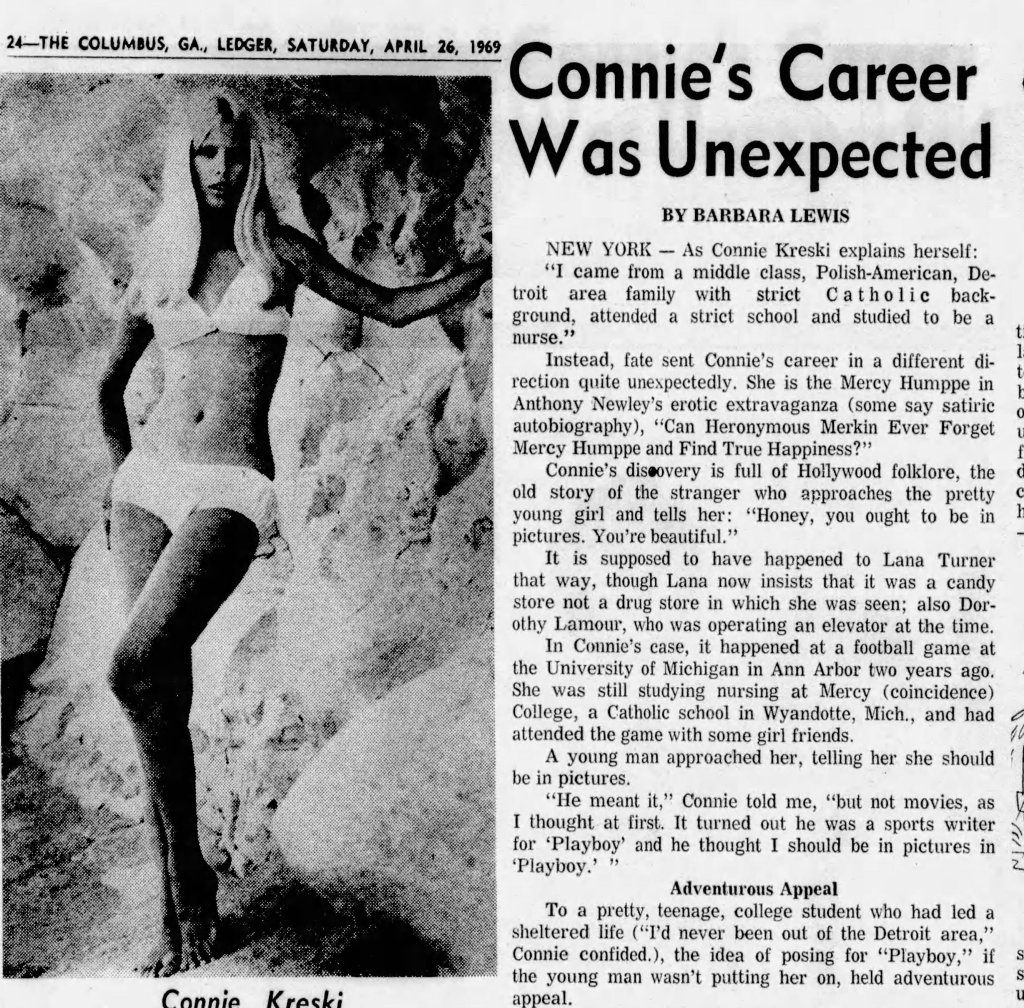
He worked for Playboy and told Connie he thought she had the ideal youthful face and figure required for Playmate candidates.
Connie appeared to look much younger than her 21 years.

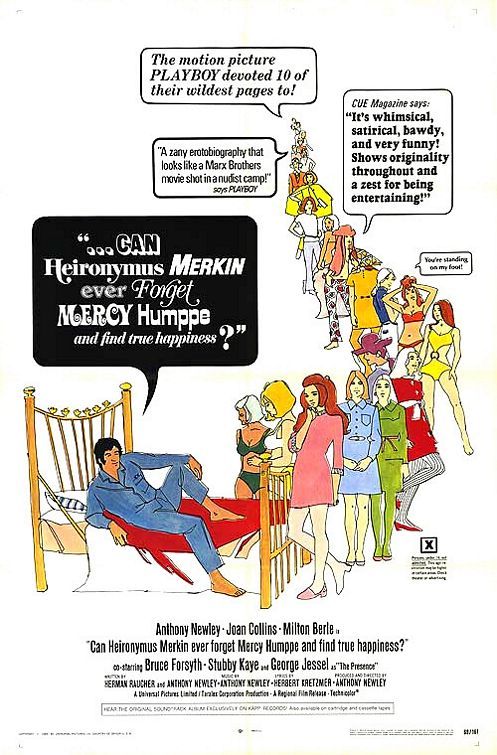
This is why Newley cast her as Mercy in his 1969 released film “Can Heironymus Merkin Ever Forget Mercy Humppe and Find True Happiness?”
Anthony Newley had married a beautiful Hollywood starlet in 1963.
She was a native of England named Joan Collins.
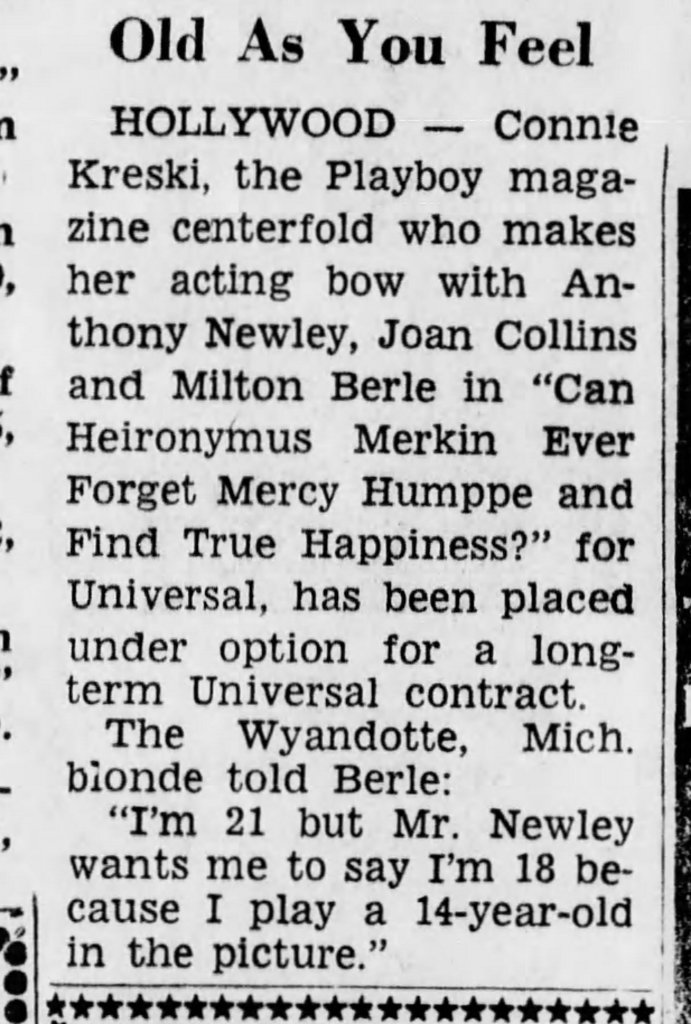
Anthony Newley plays himself in the title role of Heironymus, wife Joan Collins plays his wife in the film, named Polyester Poontang.
It was pretty much a flop and skewered by the critics.
Anthony and Joan were married in 1963 and this photo was taken around that time.
Credit Vintage Everyday Pinterest
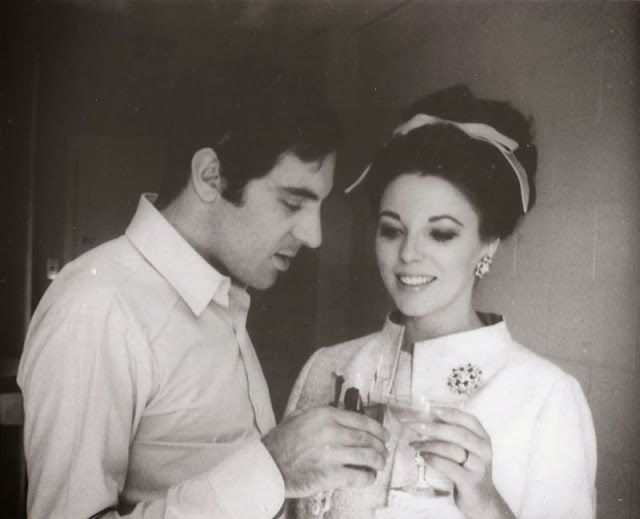
The article below was written before the disappointing reviews that followed the debut of the film in 1969.
It’s an interesting look at late-1960s popular culture by way of Newley’s film, filmed on the island of Malta in 1968.
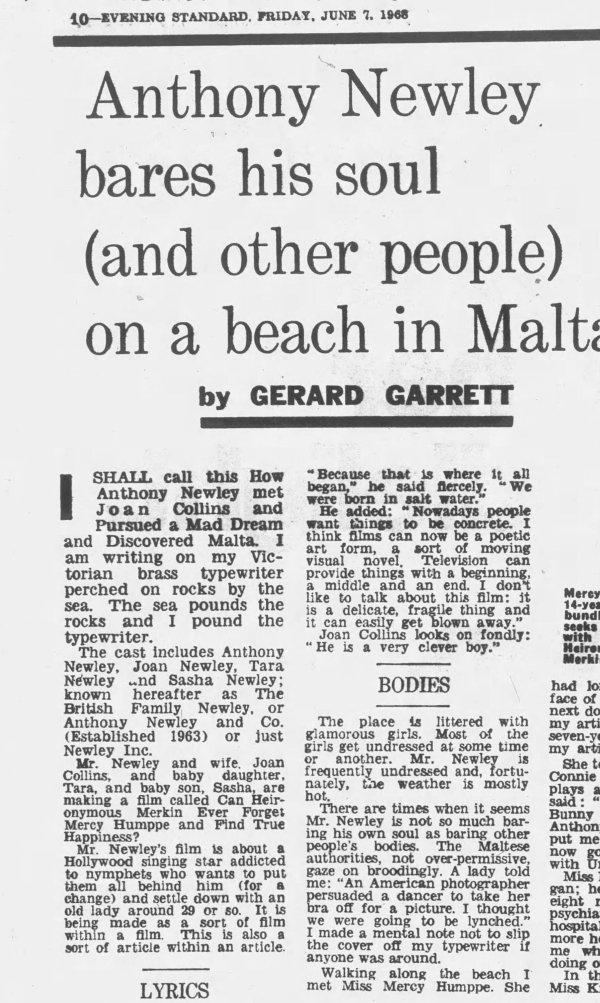
The Newley’s small children Alexander and Tara were in the film as well as and several starlets, models and dancers.
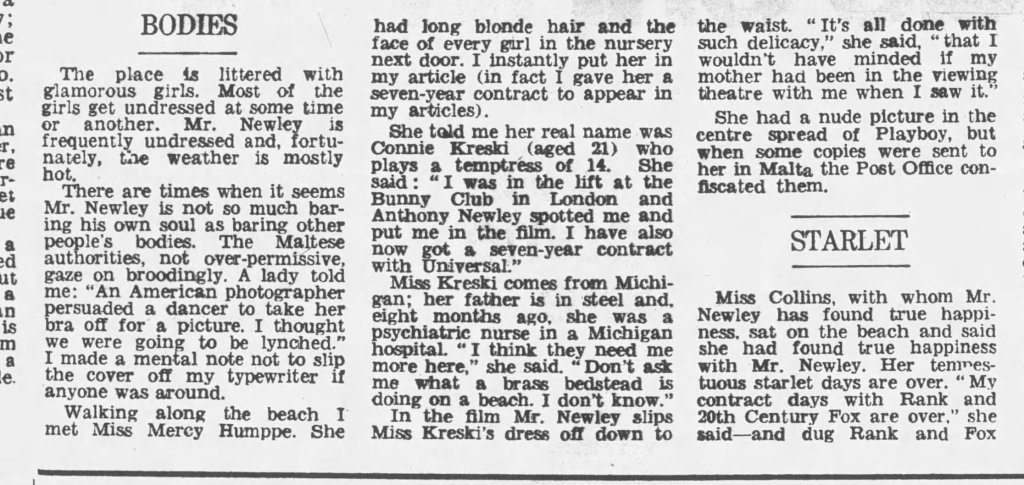
More likely, she met Lownes in Chicago and was invited by him.
Or perhaps, she followed him to London.
Note the part that Connie “plays a temptress of 14.” Paragraph 4.


Connie, just like Paige Young, had publicity all year long in 1969.
More than the 2 young women would ever have the rest of their short lives.
Connie had her picture in newspapers across the USA, England and Canada in ‘69
Connie appeared in many newspaper articles for her title role in Heironymus Merkin.
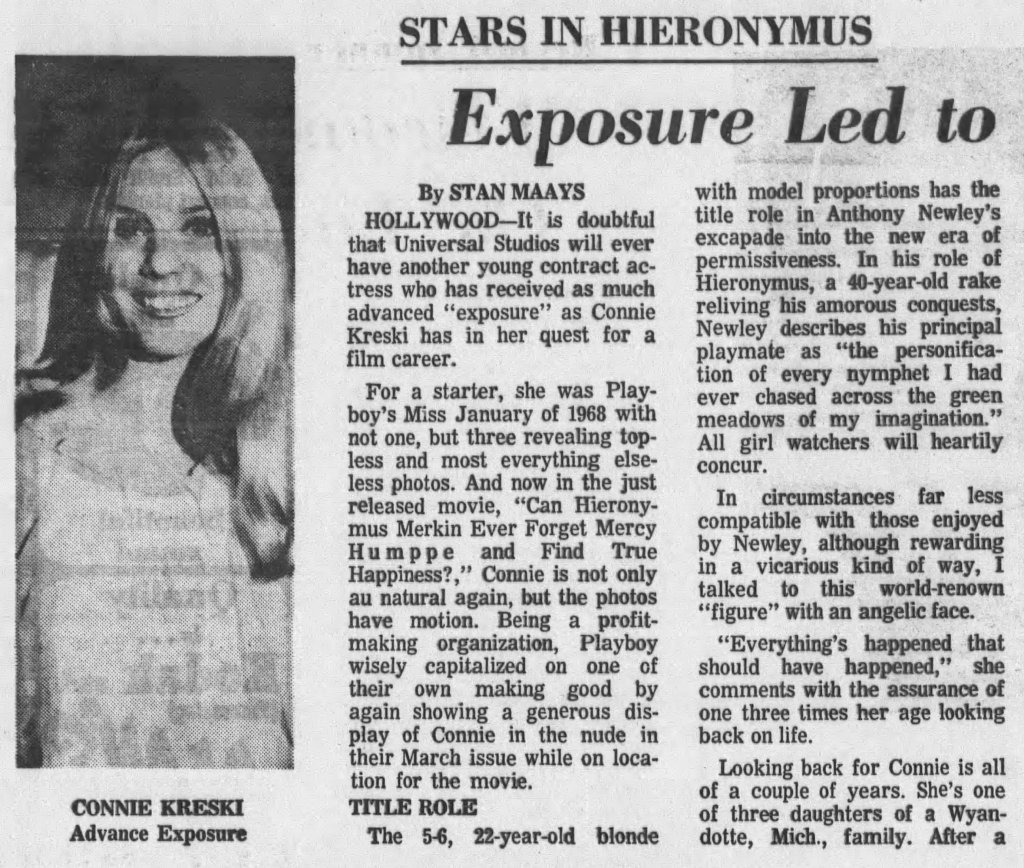
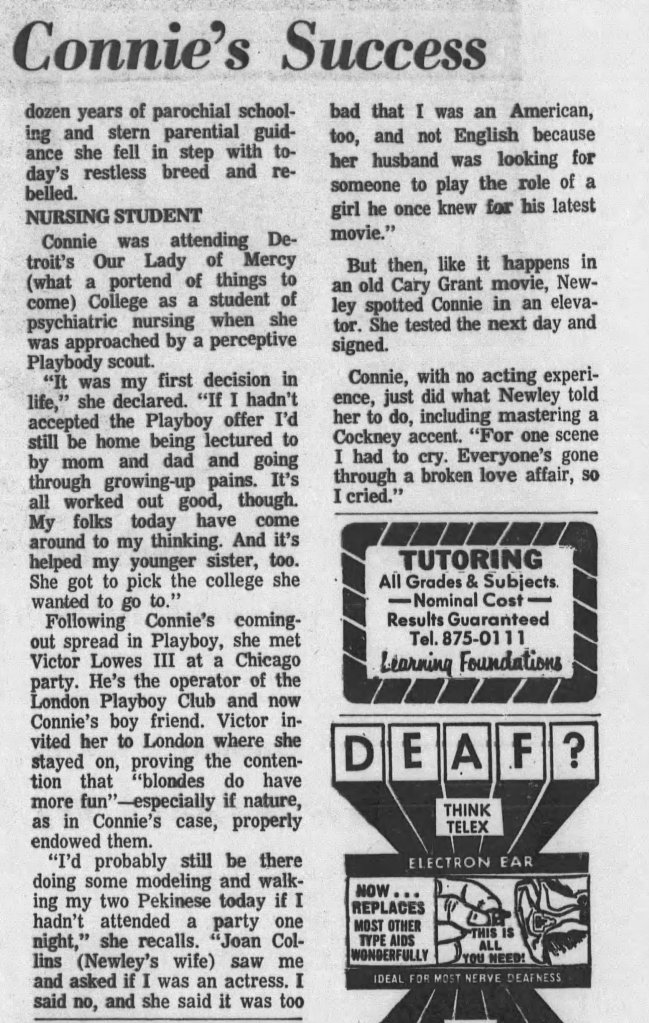

One issue of Playboy magazine featured a nine page photo spread, serving as a promo for Heironymus. And for Connie as their Playboy Star.
Newley was a great friend and appeared on Hugh Hefner’s show of 1968-1970 Playboy After Dark.
Connie has several nude shots in the issue and a nearly nude Joan Collins has one.
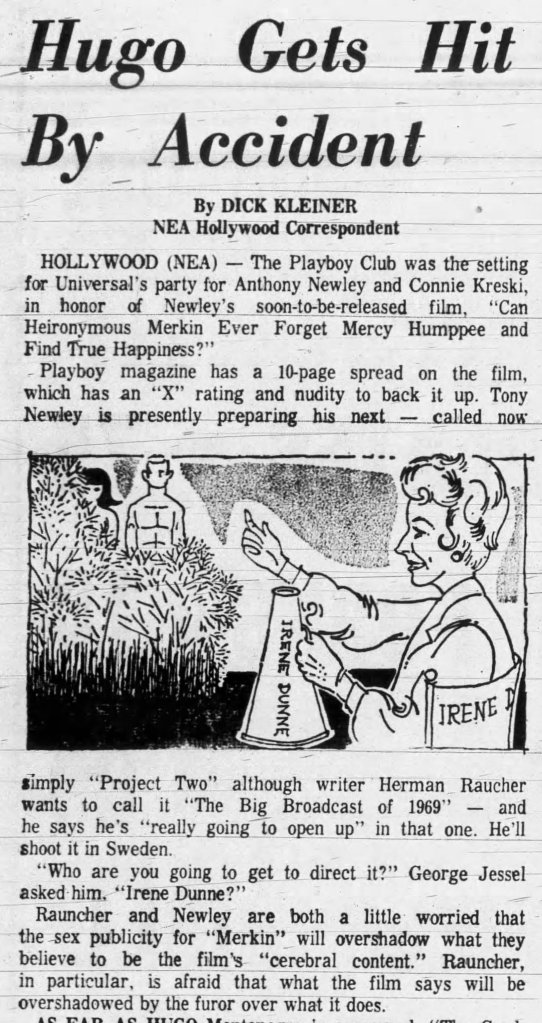
Victor Lownes
is a colorful and forgotten 1960s character.
Lownes was a close Chicago friend of Hugh Hefner.
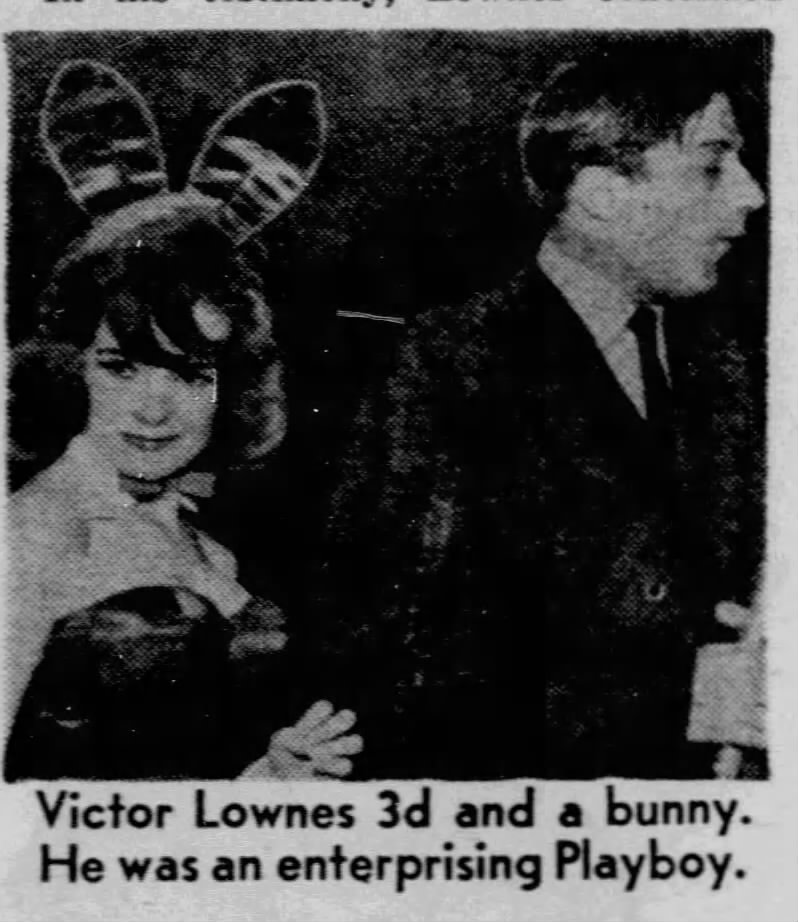
New York Daily News. Nov. 8, 1964.
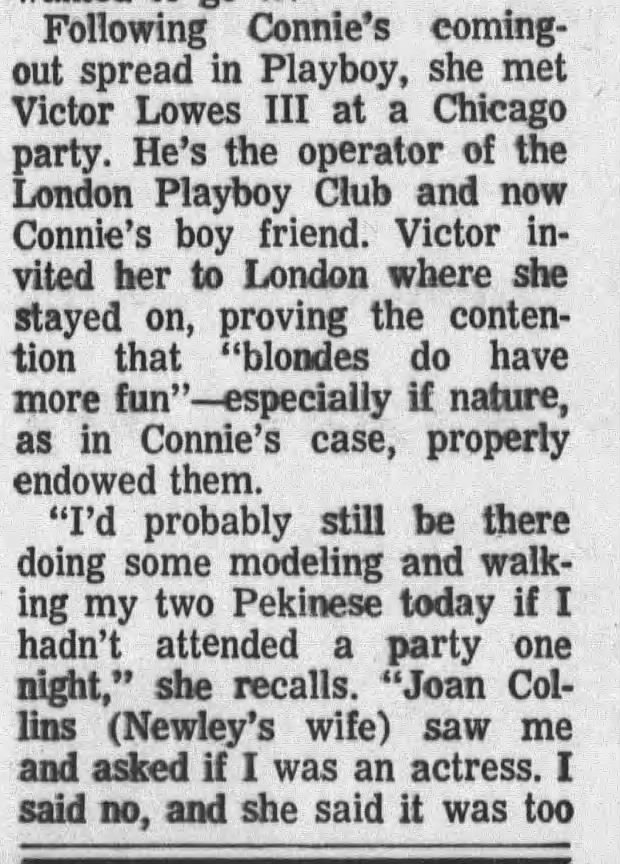
People said that Lownes, who moved to London to run the Playboy Club & Casino, embodied the“Playboy man” even more than Hugh Hefner.
He was also known to sexually harass Bunnies at the clubs.
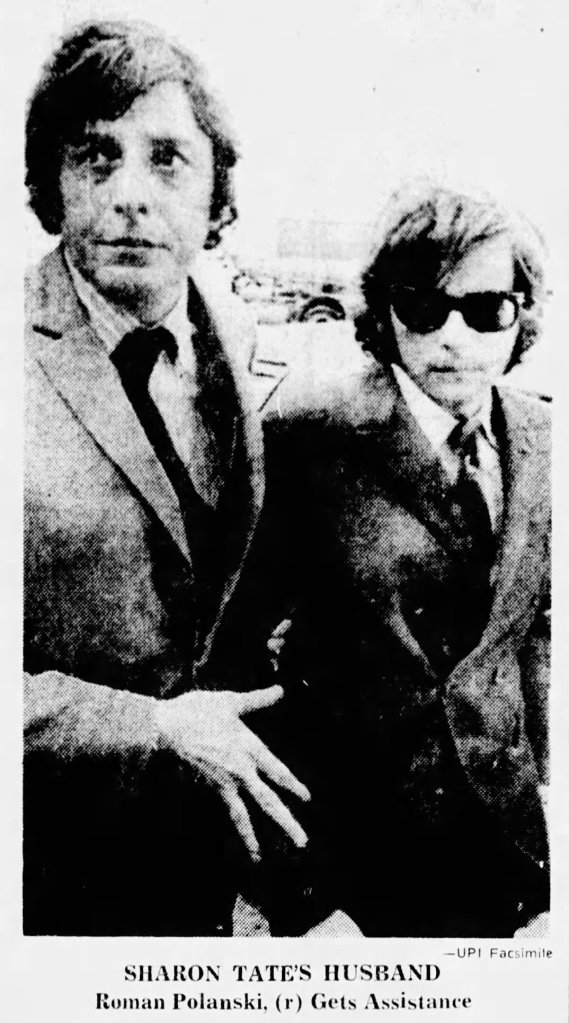
Victor and Connie are seen together in the much viewed film footage of the Tate (and maybe Jay Sebring?) funerals on youtube. However, they are never identified.
Little Known connection to Charles manson killings
Victor Lownes, Hefner and directorRoman Polanski, Anthony Newley, were close friends in the late 1960s and 1970s.
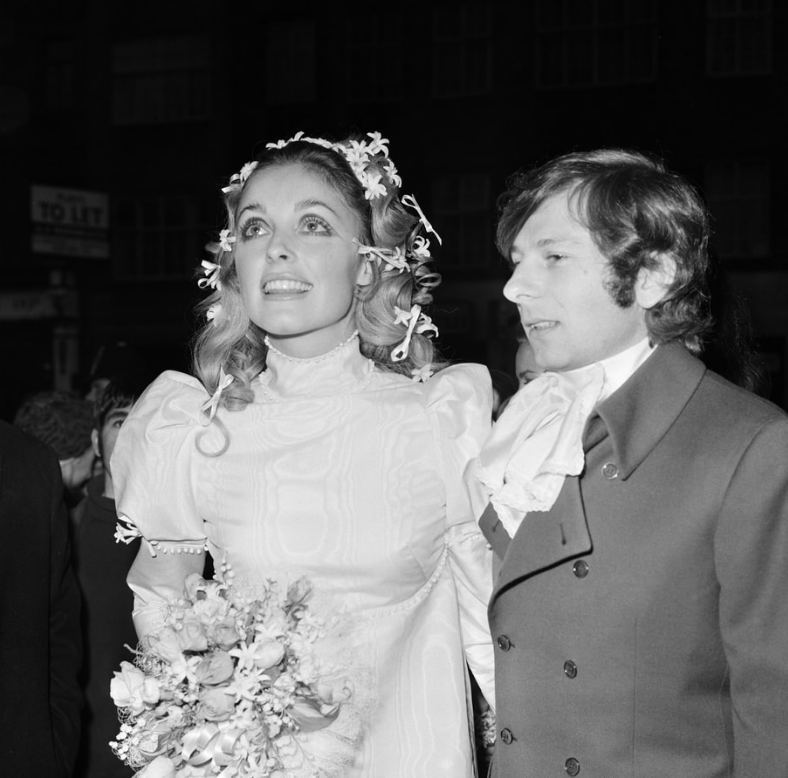
Polanski and actress Sharon Tate lived together in London for a time and had their wedding reception at the London Playboy Club in 1968. A party hosted by Victor Lownes.
Connie and Victor appear together with several mourners at Sharon Tate’s funeral in Los Angeles, on film footage seen on youtube.

Roman and Sharon also appeared together on an episode of Playboy After Dark, a show Connie appears on several times.
The couple was interviewed by host Hef; Roman does most of the talking. (Available on youtube and tiktok.)
Paige Young traveled the USA, Canada and Japan to promote the show in 1969 She may or may not have appeared on the show.
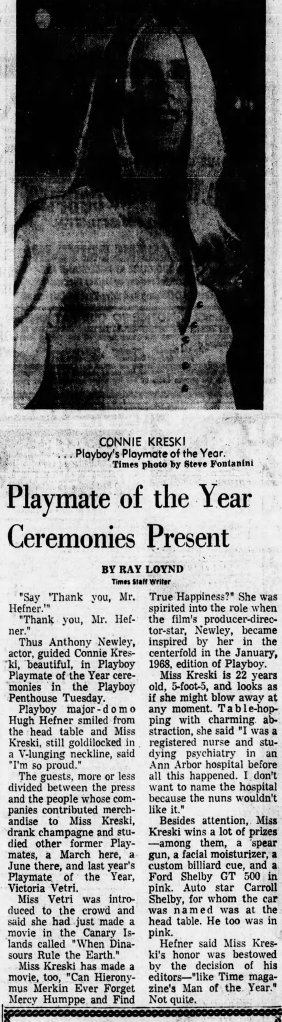
Victoria Vetri, PMOY 1968, and starlet is mentioned in left column. Her reign of ‘68 was honored at the party. The opening of her film, now a cult classic, When Dinosaurs Ruled the Earth, was also celebrated. Victoria Vetri had a small part in the Roman Polanski-directed hit film “Rosemary’s Baby.” Victoria was known as Angela Dorian when she was the September Playmate of the Month in 1967. and Playmate of the Year 1968 as Victoria Vetri. Roman Polanski convinced her to use her real name. of Victoria Vetri, where she had a bit part in Rosemary’s Baby.
The Manson murders would occur just a few months after this article appeared.


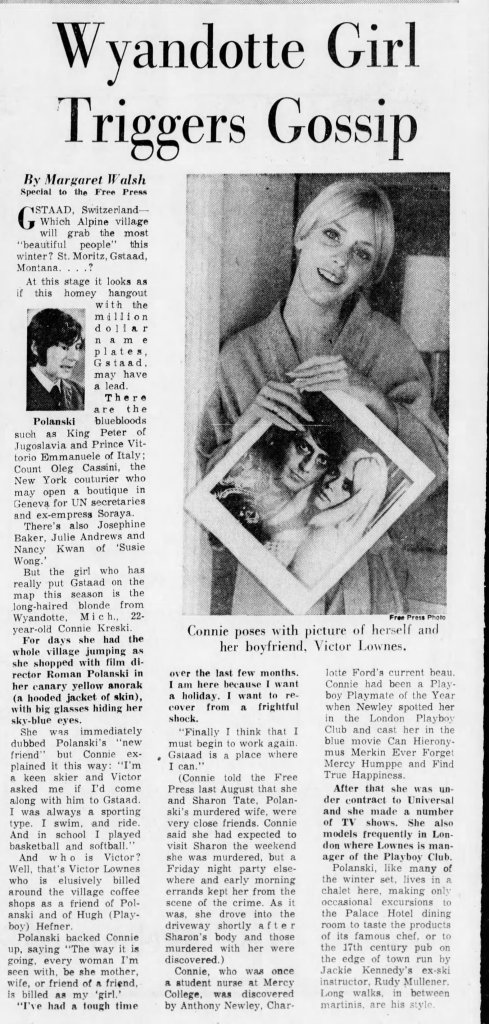
Connie holds photo of herself and Victor, who would dump her in about 2 years for the force of nature that was Marilyn Cole. Connie claims there is nothing romantic going on between her and Roman Polanski. This article is only months after the horrific murders.
Victor dumped Connie after he fell hard for a new Bunny at the London Club.
The aforementioned Marilyn Cole.
She has her own story to tell and has done so in interviews. But she’s never been asked about her love triangle involving Connie and Victor, other than the book Bunny by Russell Miller.
Marilyn Cole appears briefly in Secrets of Playboy.
This Bunny was quickly promoted PMOM in 1972 and PMOY in 1973.
Marilyn Cole’s Playboy centerfold is famous/infamous for being the first obvious straight-on view of a PMOM with full frontal nudity. Not subtle or hidden as in earlier photos.
Cole’s issue came at a time when Playboy magazine experienced a drop in readership, due to competition from the new and more explicit Penthouse magazine.
The Marilyn Cole issue provided a huge sales boost for Playboy which she talks about in Secrets of Playboy documentary.
Penthouse magazine featured more explicit and forward photography of their centerfold called a “Penthouse Pet.” In particular full-frontal nudity.
The viewer is more of a voyeur to the private bedroom of the “Pet,” than he may have seen in the Playboy centerfold.
Playboy was “forced” or pressured into publishing the centerfolds in the Penthouse style. This was to keep up with the new standards in popular culture, the more open nudity standards Playboy helped to bring in.
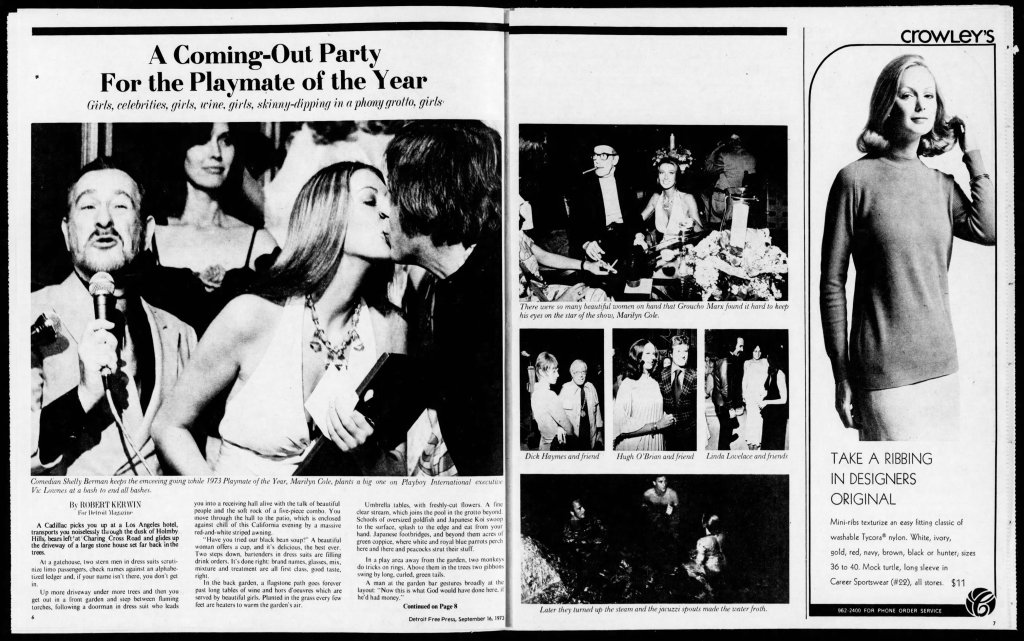
Detroit Free Press. Marilyn is Playmate of the Year and is thrown a big party. Here she kisses boyfriend Victor Lownes.
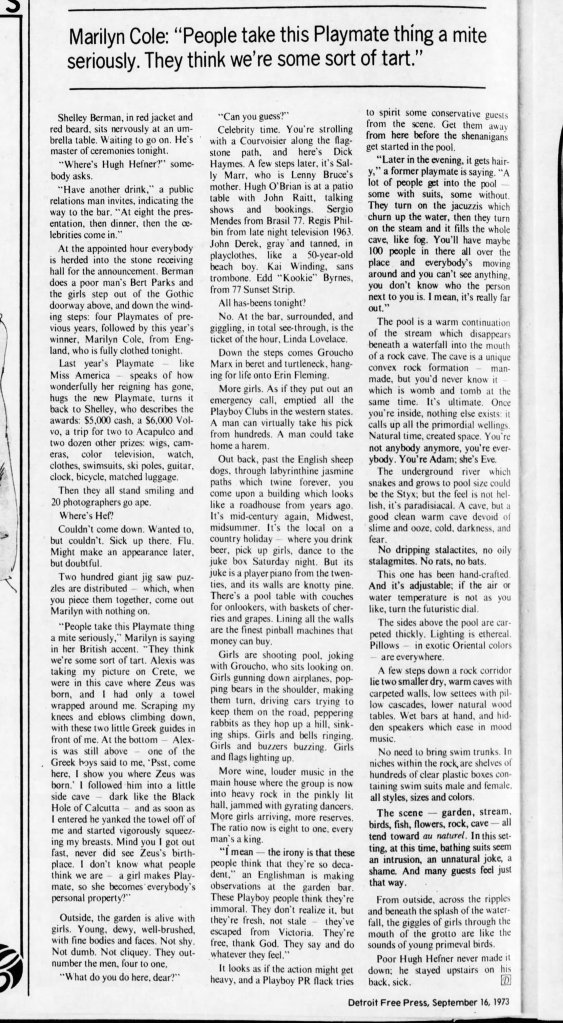
More on Marilyn Cole soon.

Connie during her time on Malta.
Connie Kreski has about 10 TV and film appearances after “Hieronymus.“
April 6, 1969. Long Beach Press Telegraph
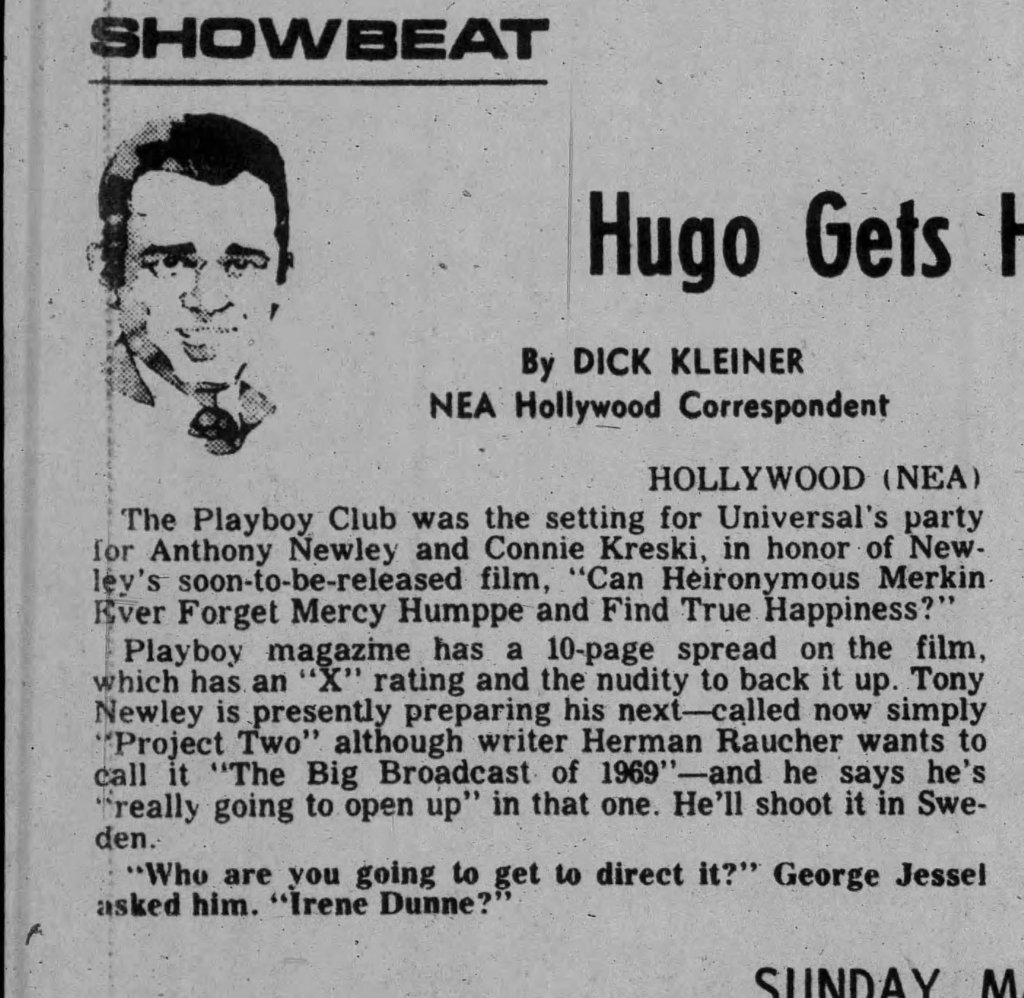

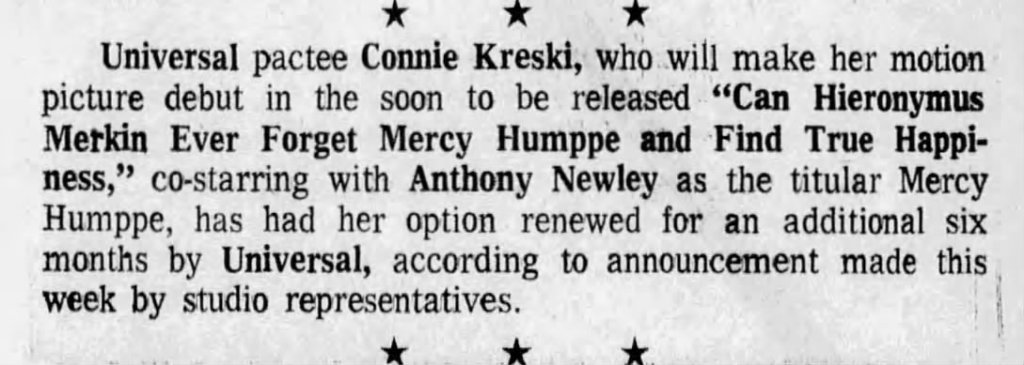
From 1969
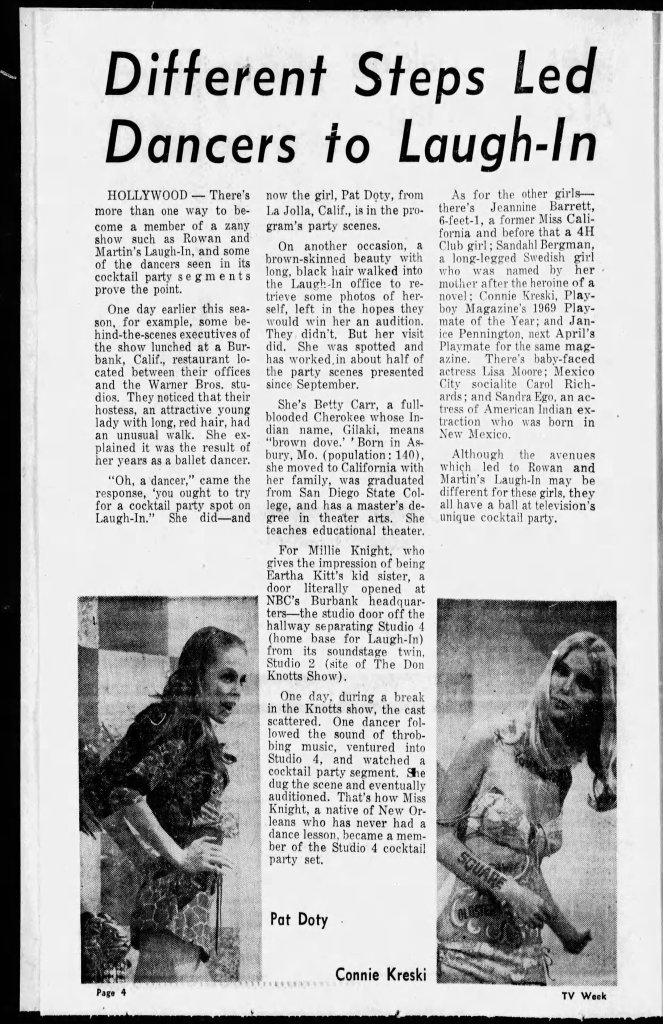
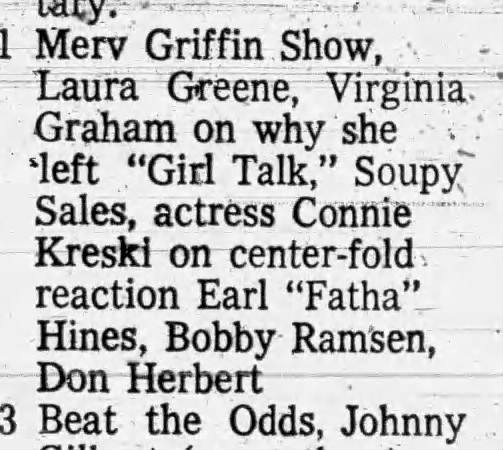
Connie appeared as a guest on the Merv Griffin and Joey Bishop talk shows.

From the Fremont Tribune, June 21, 1973
In a 1969 episode of Playboy After Dark, Connie is introduced by Hugh Hefner as “Connie Kreski, our Playmate of the Year.” Connie does not say one word the entire show.
She does have more lines on other episodes of PAD, mostly the ones from 1970, the last year of the program.
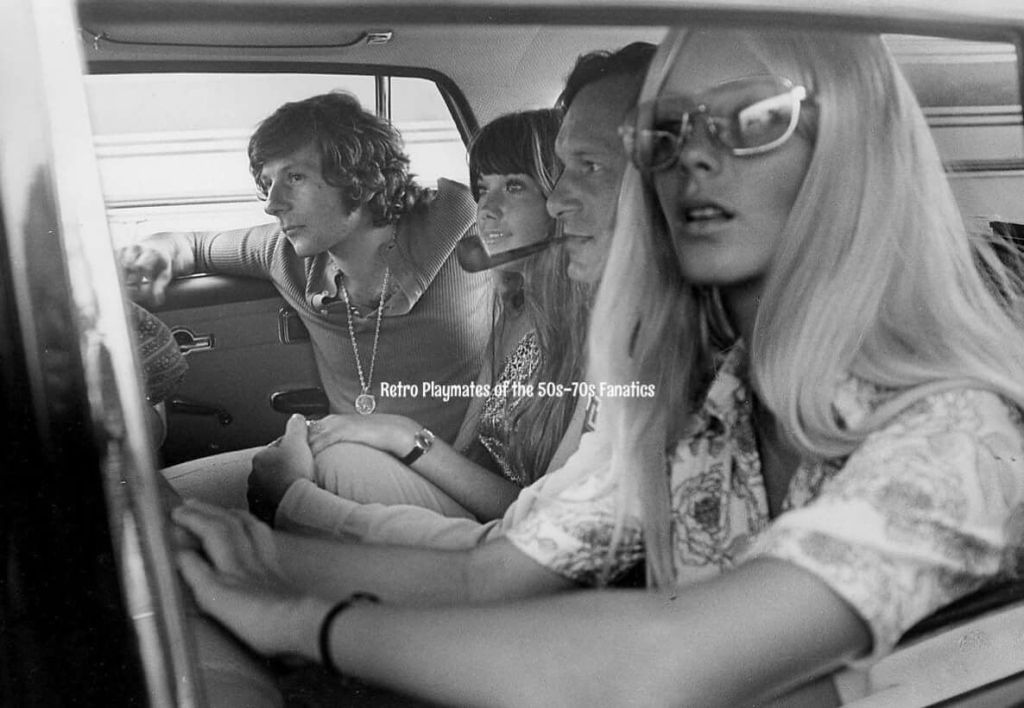
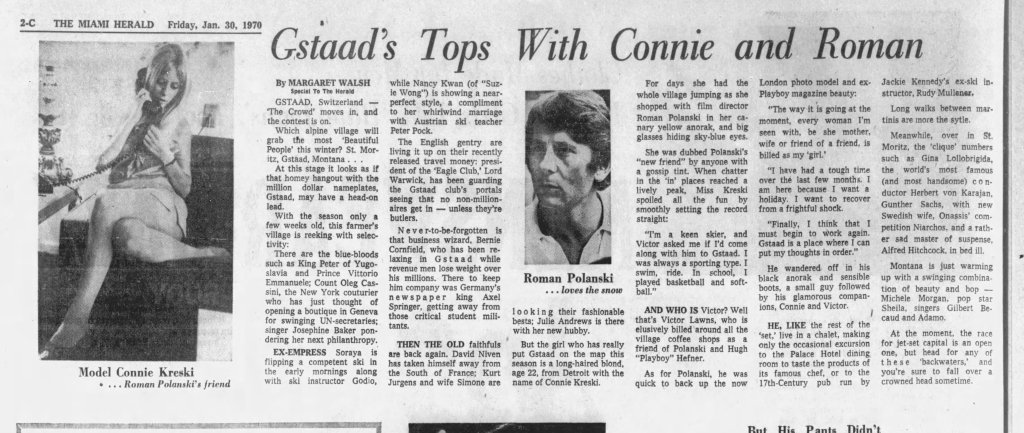

The People, London. Aug. 23, 1970 A little over a year since Sharon Tate and the others were murdered, Connie remains friends with widower Roman Polanski. Sorry for poor quality.
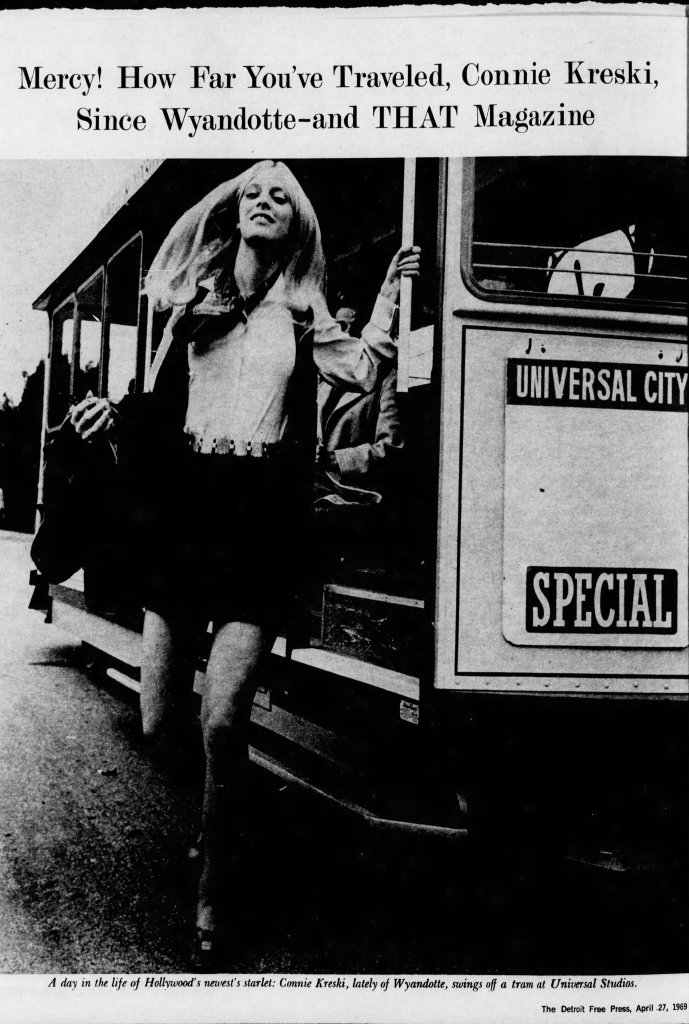
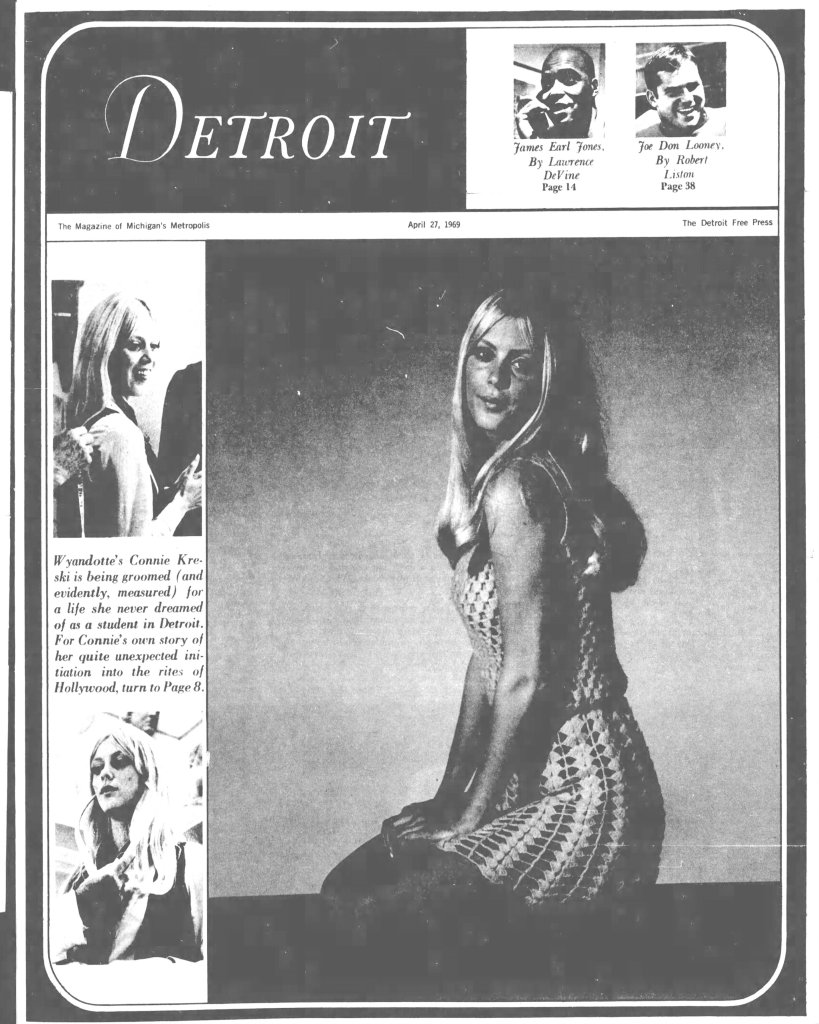
Kreski’s newspaper press indicates she was signed to a contract with Universal Studios.
Universal signed an extraordinary number of pinup models, beauty contest winners and starlets in the 1950s and 60s.
Detroit Free Press April 27, 1969 The hometown/homestate paper covered their Hollywood star.
It seems Connie had about 15 minutes of fame as an actress.
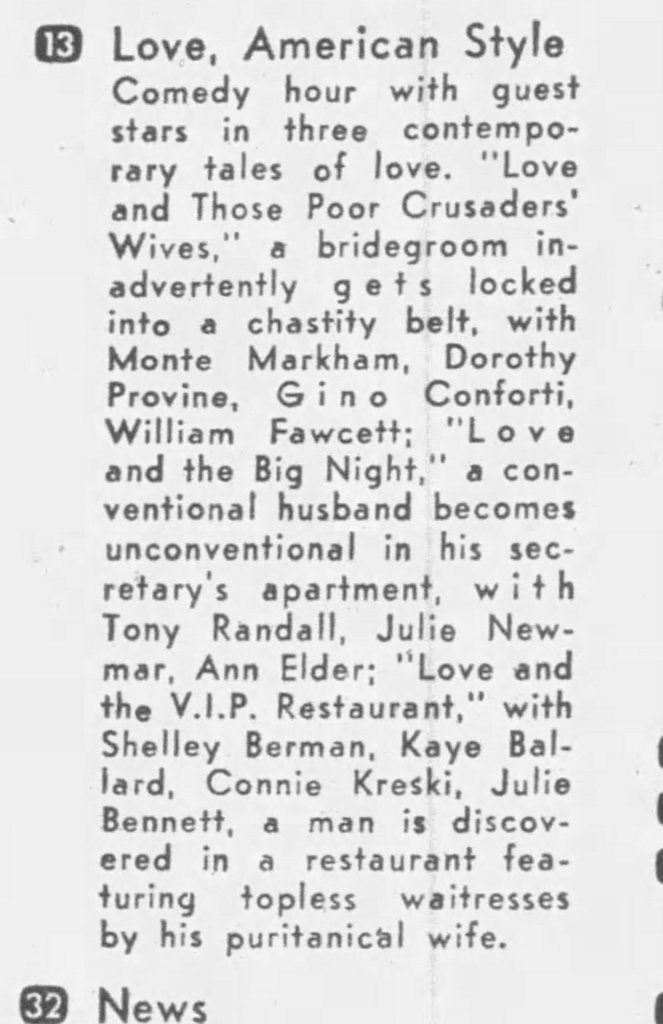
She appeared on a memorable 1970 episode of Love American Style starring Kaye Ballard, playing a topless waitress: Love and the V.I.P. Restaurant.
After a few years Connie’s contract with Universal was dropped which merited one sentence in a Hollywood gossip column I read.
Her last credit is a TV mini-series Aspen in 1976. Unavailable.
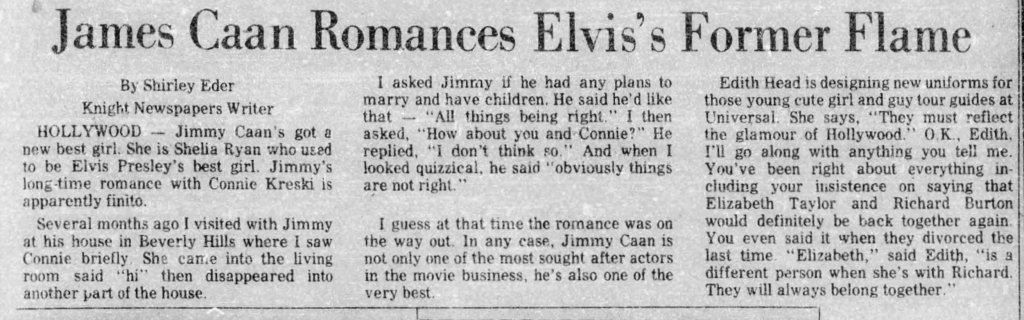
Boyfriend James CaaN
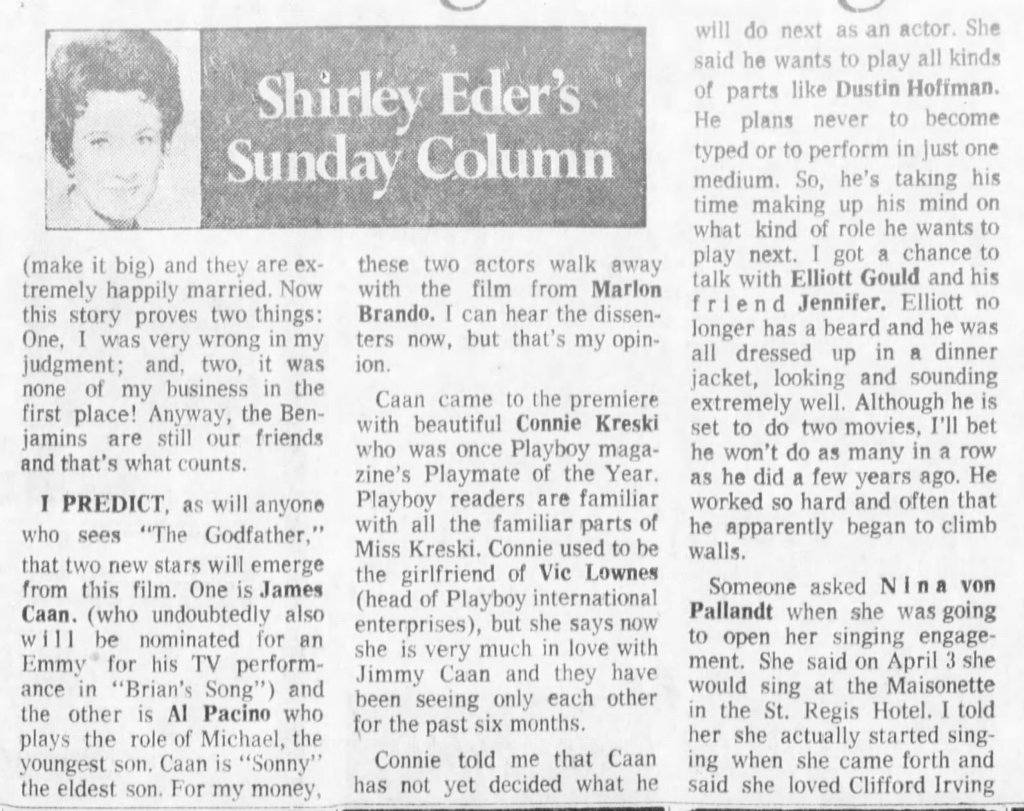
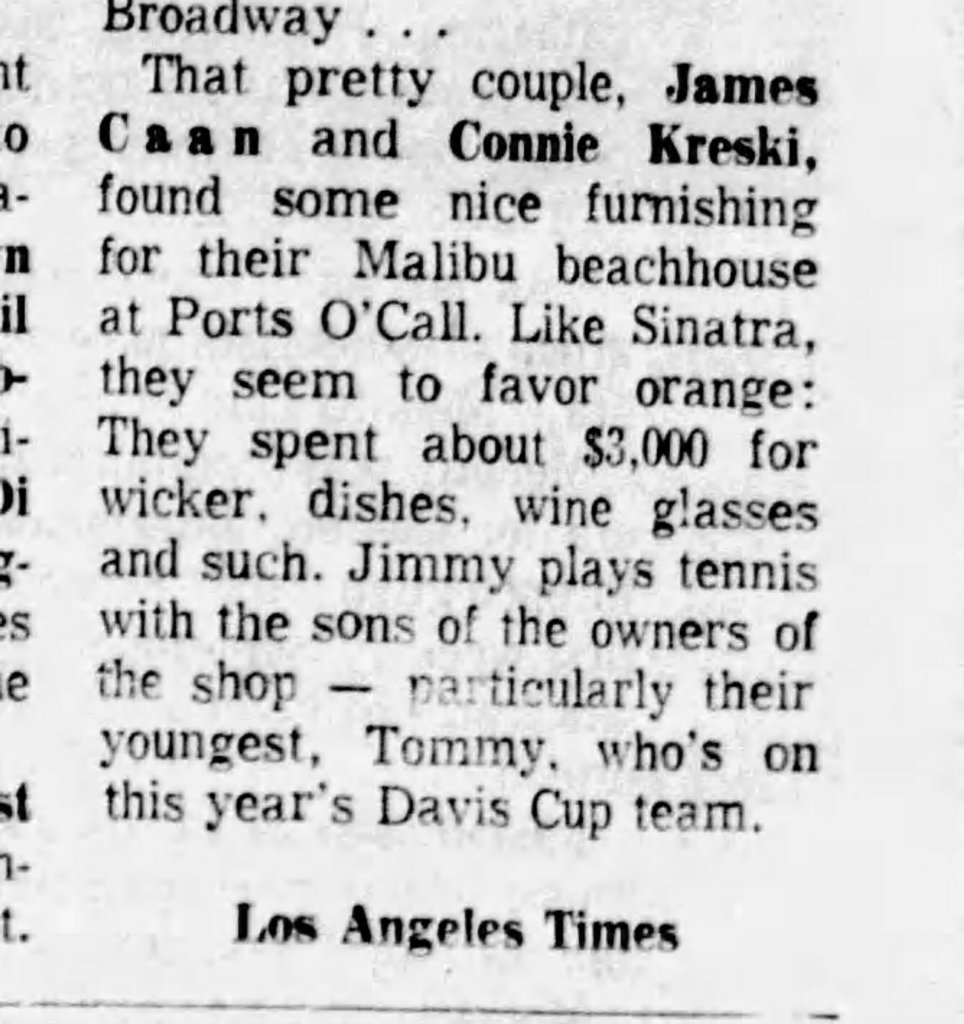
Connie had a high profile romance with actor James Caan beginning in the early 1970s and lasting around 4 years.
She was identified in Hollywood news articles as his “girlfriend” and “ex-Playmate.”
The two got together soon after Caan’s star making turn in The Godfather; he was much in demand by directors and studios.
And by many beautiful young women, according to several interviews at the time.
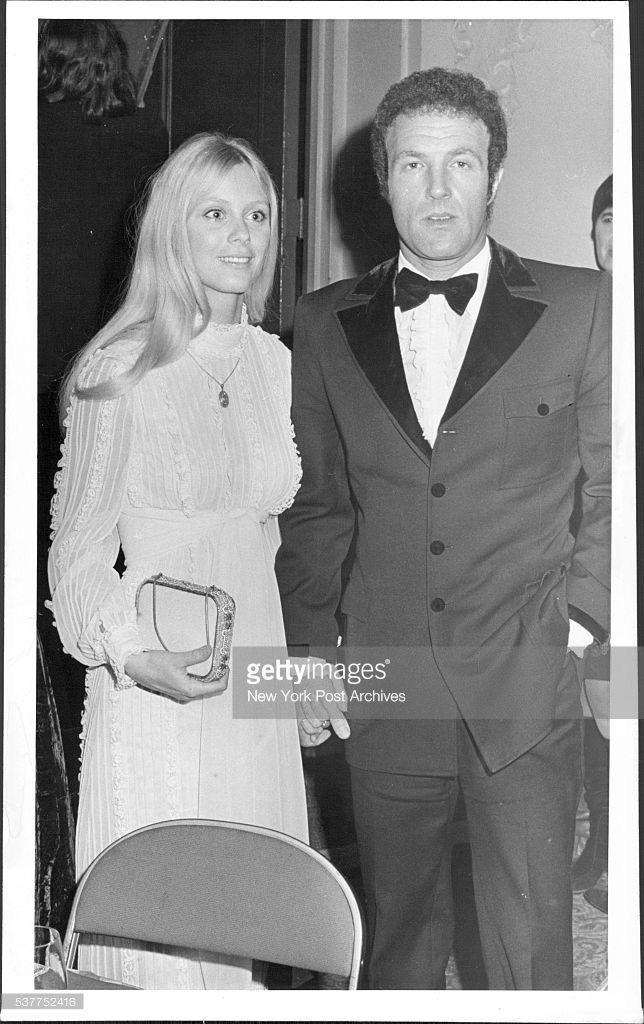
Playboy Mansion regular James Caan speaks about girlfriend Connie Kreski in NY Daily News Oct. 8, 1972
>>>>>>>>>>>>>>>>>>>>>>>>>>>>>!!!!!!!!
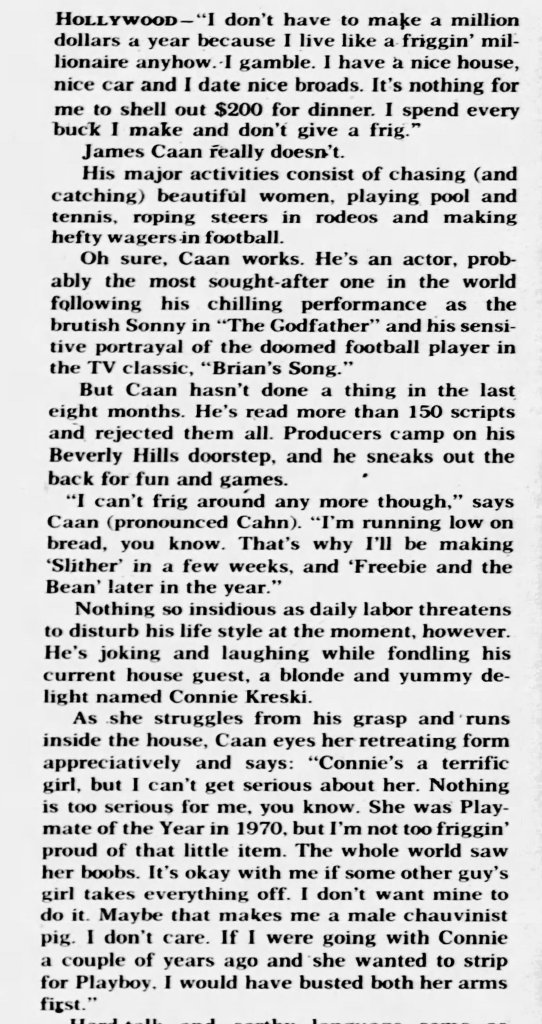
Below image is from 1970s Playboy article on men’s jewelry featuring Caan and girlfriend PMOY Connie.

It was determined that Connie Kreski died of cirrhosis of the liver at age 48 in 1995. Laennec’s is a cirrhosis most associated with alcohol abuse over time.
What happened in her life that caused it to end this way at the age of 45?
What happened to her friendships with Hefner and Polanski and that crowd? And James Caan?

Connie Kreski is rarely mentioned in any pop culture forum.
I find that strange, given the people that she was seen hanging out with: Roman Polanski, Sharon Tate, Hugh Hefner, Anthony Newley and James Caan.
Many of these people continue to generate attention and conversation. Some are still alive, many dead.
Most recently, Connie’s ex and Playboy mansion regular and good friend of Hefner, James Caan passed away on July 6, 2022. His death drew numerous accolades and a film festival is in the works.
Unusually, Caan lacks a dedicated biography.
This will likely be forthcoming.
Caan hadn’t been asked about Connie since the 1970s, that I have ever seen.
Like Fellow 1968 Playboy Playmate Paige Young, Connie’s cause of death is incorrectly identified on the internet. It usually says “blocked carotid artery” or “cancer.” Connie’s entry in The Playmate Book, mentions her death in Beverly Hills, 1995, but doesn’t state a cause. I have included closeups of her death certificate.
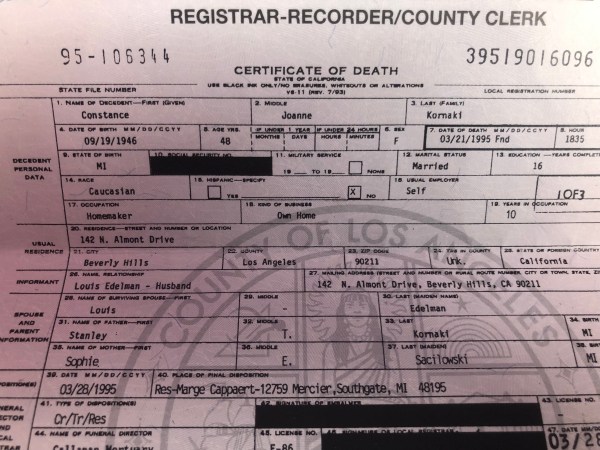
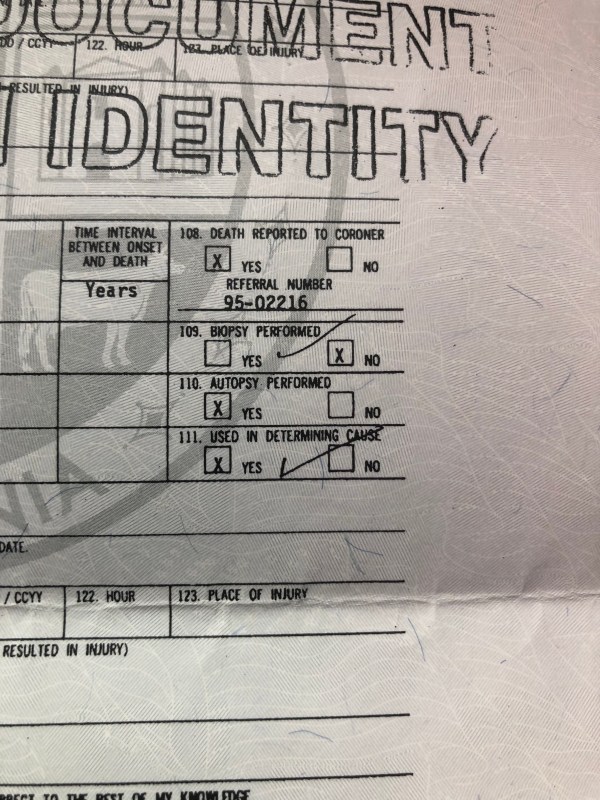
Connie died in March of1995 at the young age of 49. She died before her about 10 years older husband, Louis Edelman.
I had long wondered what happened to Connie so I ordered her death certificate.
And after seeing it, of course I wondered how she had become an alcoholic with all her seeming advantages in life.
Beauty and a budding career in movies and TV and the potential for money.
Cirrhosis of Liver is clearly stated as the cause of Connie’s premature death. Interval between onset and death says years.
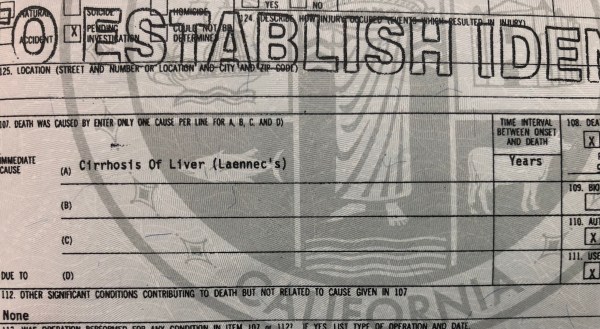
Connie and a man named Louis Edelman were married in New York in 1986 per records seen on ancestry.com.
They set up a marital home in Beverly Hills. Connie was pregnant at the time but unfortunately lost the baby.
I was lucky to get some answers by correspondence with Connie’s stepdaughter Barbara Cooper. Her father was Louis Edelman, husband to Connie.
To sum it up, Barbara told me that Connie was very nice and sweet and wonderful to her step-granddaughter.
However, she seemed to eat very little, often just picking at her food. She also witnessed Connie working out on a treadmill with saran wrap tightly covering her body, in order to promote sweating out extra calories.
Barbara wrote that her Dad would hide liquor bottles from his wife.

Barbara Cooper told me that after the loss, Connie began an obsession with calorie counting and losing weight. On top of that she abused alcohol and her husband Louis felt compelled to hide liquor bottles from his wife.
With those two illnesses, it’s no wonder that Connie died so young and before her older husband.
Barbara’s daughters spent vacations with “Grandpa and Connie in California.” Barbara told me how consistently kind and sweet Connie was to her daughters and to everybody.
She said that Connie did not talk about Playboy, Hefner, any of the Playmates, or her days in Hollywood.
More on Connie Kreski and her brief time in the spotlight

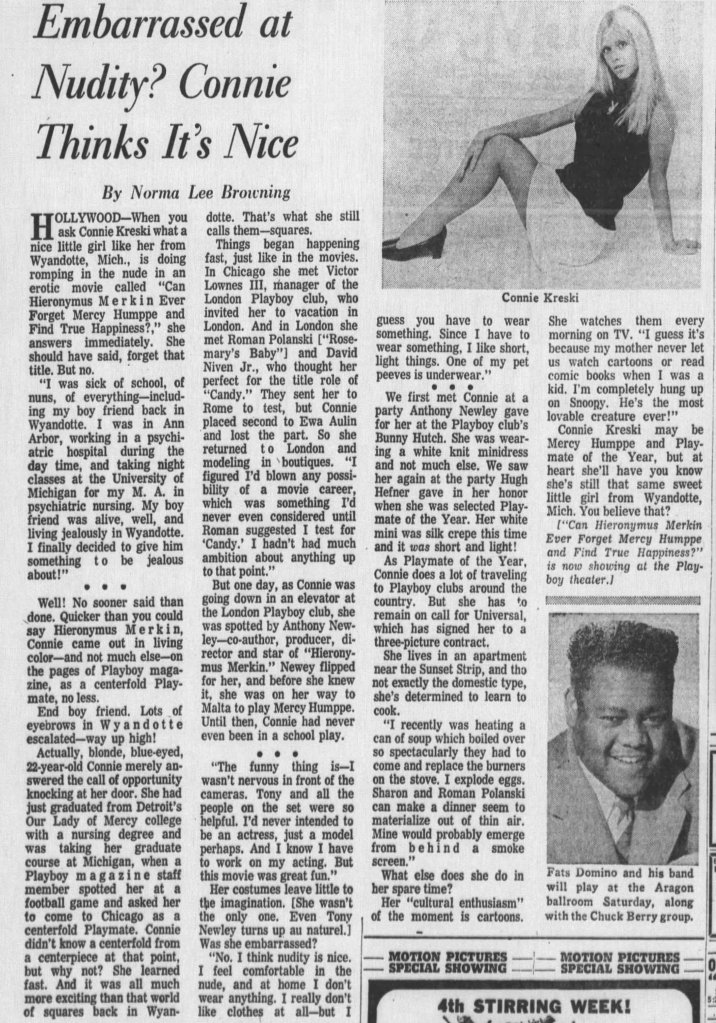
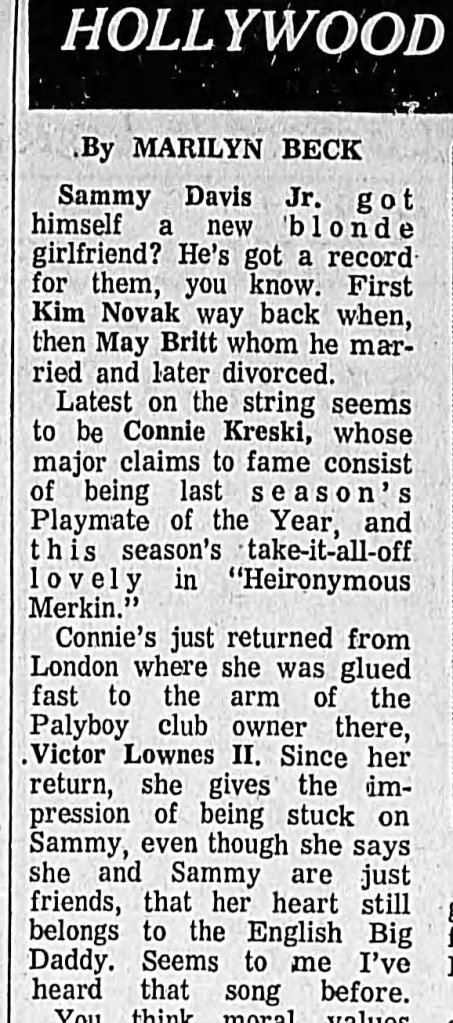
Telegraph Journal New Brunswick. July 10, 1969
Still a couple years away from meeting Marilyn Cole and giving Connie the heave-ho.
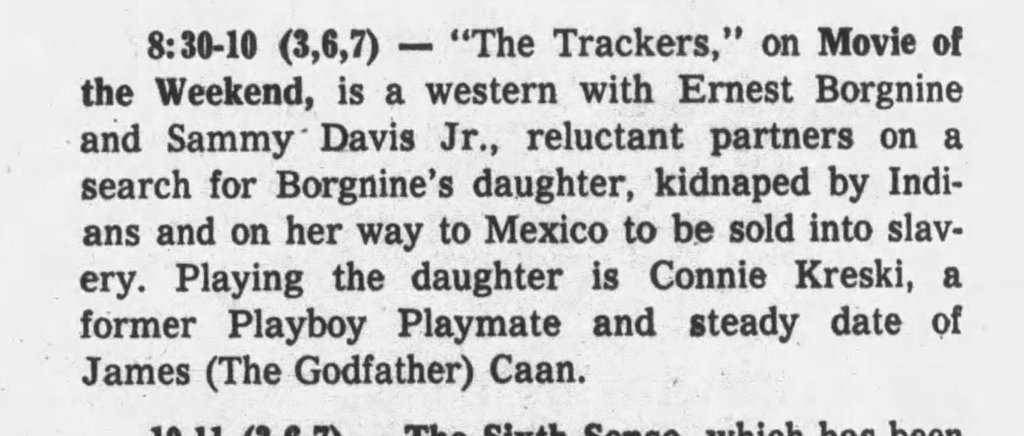
Another famous gossip columnist of the era: Marilyn Beck. Here, she dispels any truth to the rumors of a romance with Connie and Sammy Davis Jr.
She was Sammy’s type in that era given the physical qualities of Sammy’s women mentioned here.
I doubt that Victor Lownes remained faithful to Connie. She was in LA working on her new career as an actress.
Connie had a fair amount of press on and off, for about 6 years. Press for projects and Hollywood gossip due to her relationships with Victor Lownes, Roman Polanski (denied as a relationship) and later James Caan.
I’ll be posting several of all kinds.
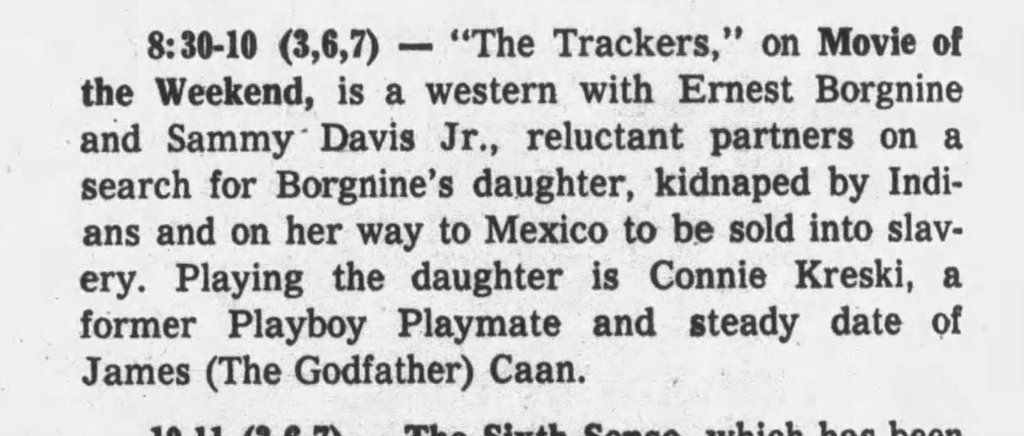

She was wafer thin with proportions of being tall; she could have been a perfect commercial model, if not a high fashion one. There are many fashion shots of Connie that I haven’t yet published.

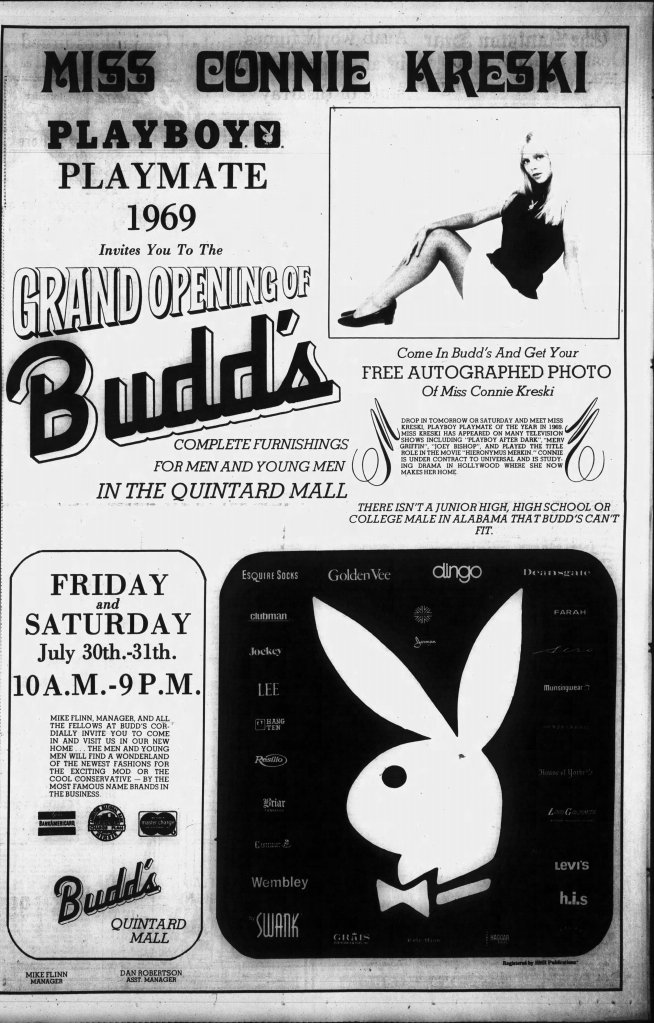

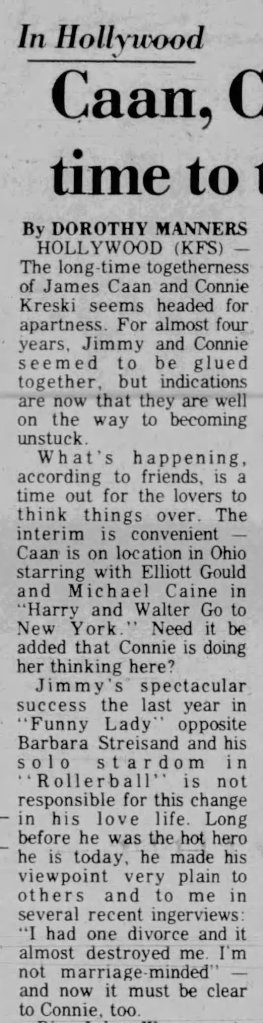
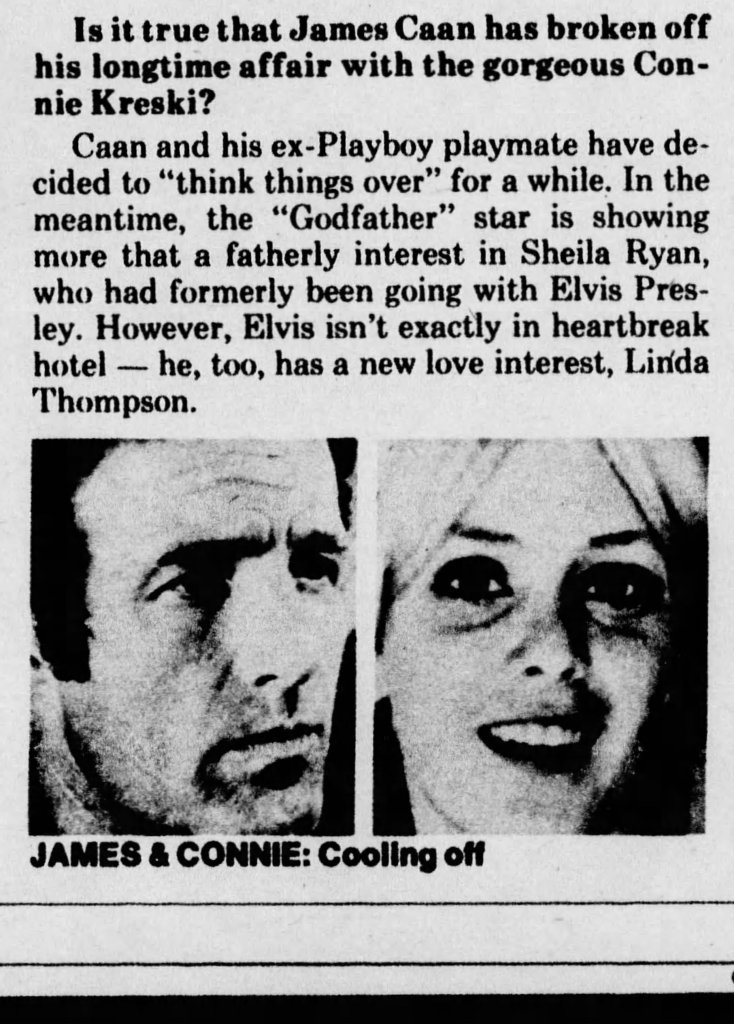
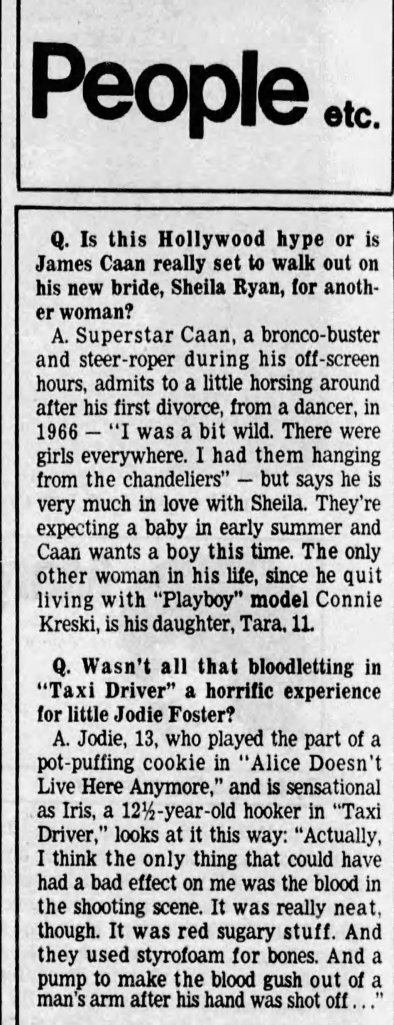
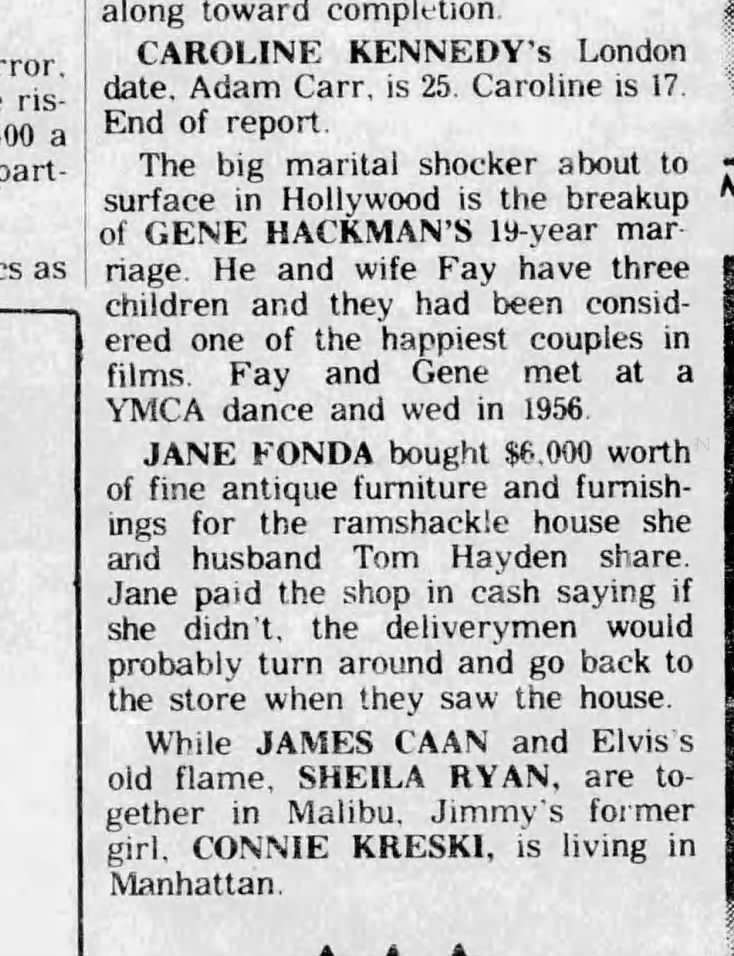
1976. Looks like Connie Kreski was discarded.
Caan and Playboy cover girl Sheila Ryan were married after Caan eschewed marriage to Connie during their time together.
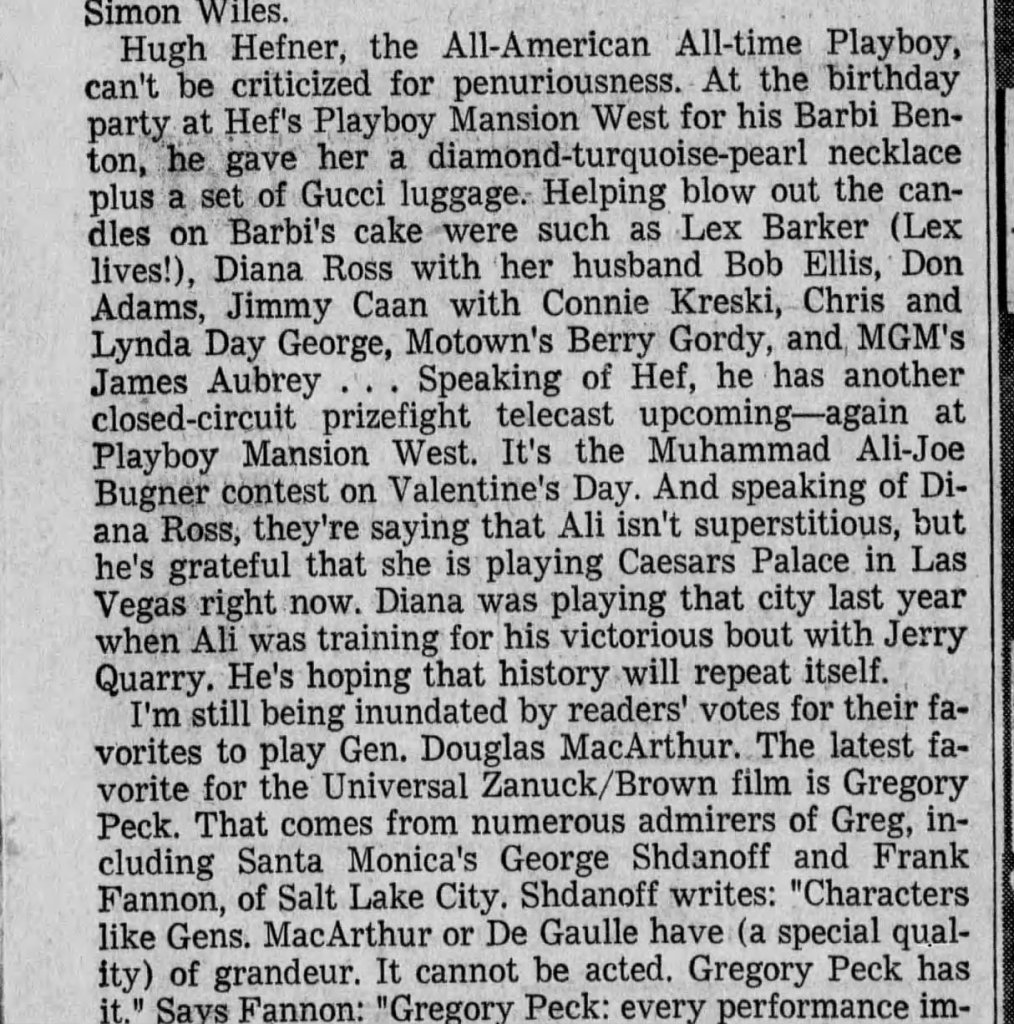
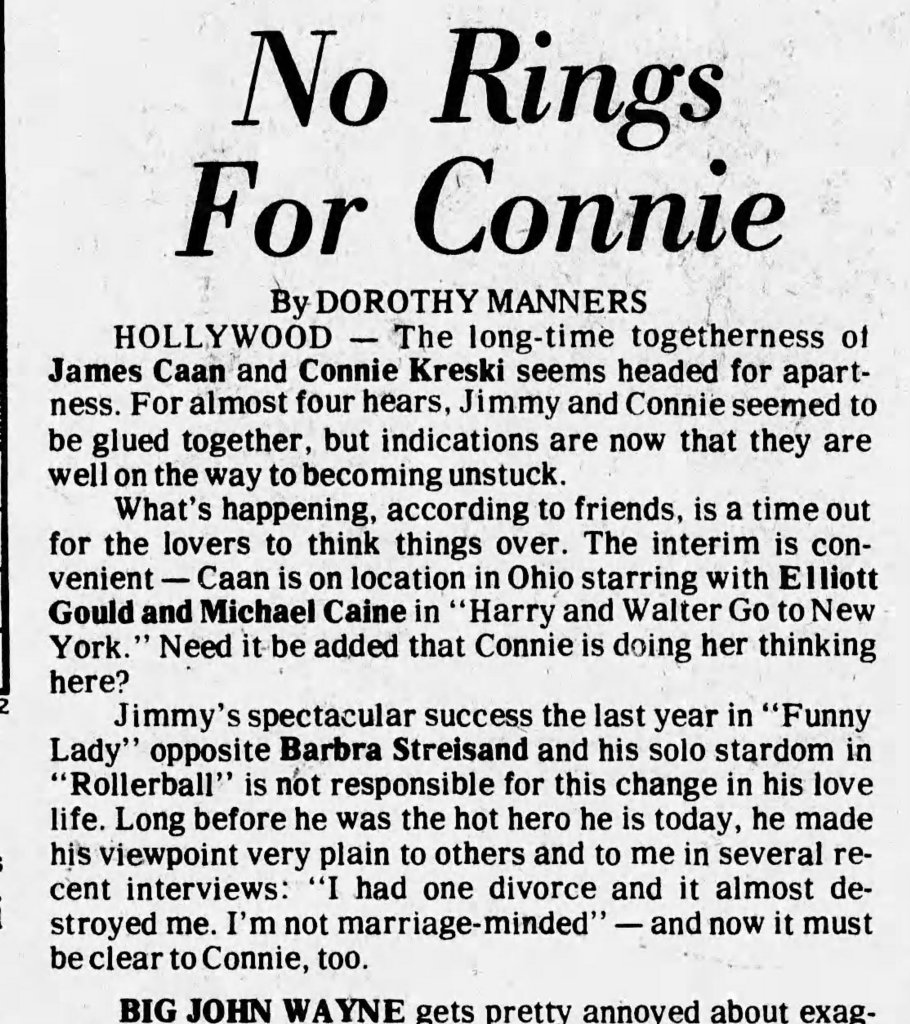
Patriot News 9/12/1975

BACK TO 1969



Family History #2. 1930s & 1940s. The Great Depression. Peoria. Move To LA. Frank & Rose. Marinellos. Radio City. Sunset and Vine. KNX. CBS. Architecture. Tom Breneman. Jane Harker #2 Warner Brothers. Samuel Lanier. Updated 1/6/2026
Posted on May 6, 2020
Frank LaRocca was a violinist and
brother of Diana Cotterell’s grandfather and defacto father Ned.
Frank worked as a music director in Decatur, Illinois during the 1920s.

Frank’s wife was named Rose. The rest of the LaRocca family still lived in nearby Peoria, Ill., where the LaRocca children of Sal and Anna had grown up.

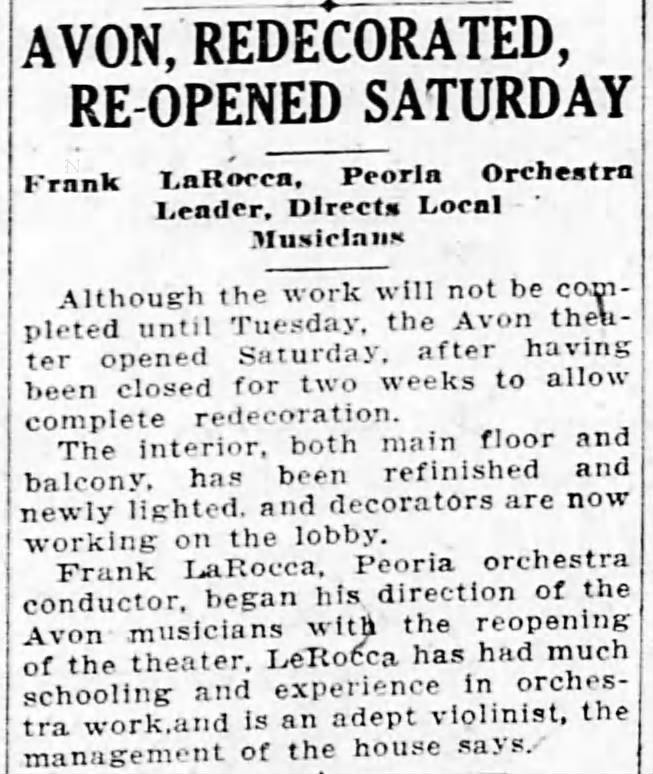
Decatur Herald Aug. 23, 1925
Mildred Marinell”o”
was a first cousin of Donna LaRocca, Diana/Paige’s mother. She was introduced in Family History #1.
Mildred and Donna lived next door to each other in Peoria, Ill., in the 1920s and 1930s, (see below) and later in Sherman Oaks, CA. in the 1950s. Mildred appears as a witness at the Hollywood wedding of Donna to Robert M. Cotterell in 1940. (See other 1940s chapter.)
Below
shows the 1930 census of Ned, “Jeanette” and Donna LaRocca listed as “Lodgers.” Lena Buckley listed as the “Head of House.”
That’s strange as the LaRocca Home on Martin St. has census records going back to the 19–teens when Salvatore LaRocca bought the home. Or maybe they rented?
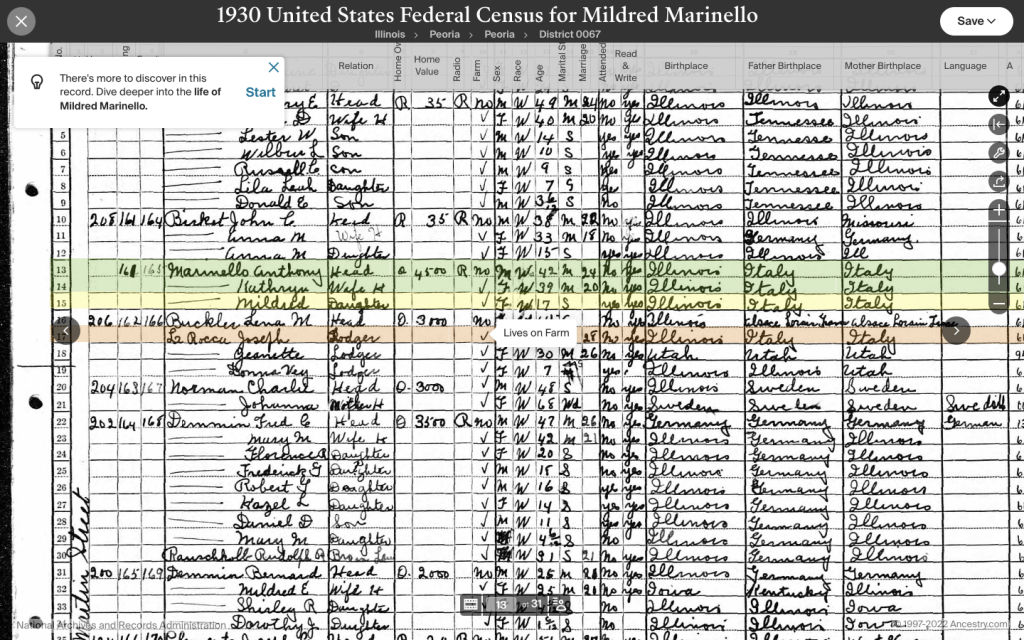
Look right above the LaRoccas green and yellow highlighted. We see that Donna’s cousin Mildred lives next door with her parents Anthony and Kathryn LaRocca Marinello. There is no Roxy, Paul or Frank LaRocca listed as they were previously.

Mildred dropped the O or I from her last name. She was a singer in the 1930s.
Frank and Rose may have departed for the West Coast by this time.
Paul and Roxy remained in their hometown of Peoria until their deaths. One son named Nikolas died as a young man of about 20 years.
1931 and 1932 Los Angeles phone directories list Frank LaRocca and wife Rose in Los Angeles. The couple are listed at 2303 Gatewood.
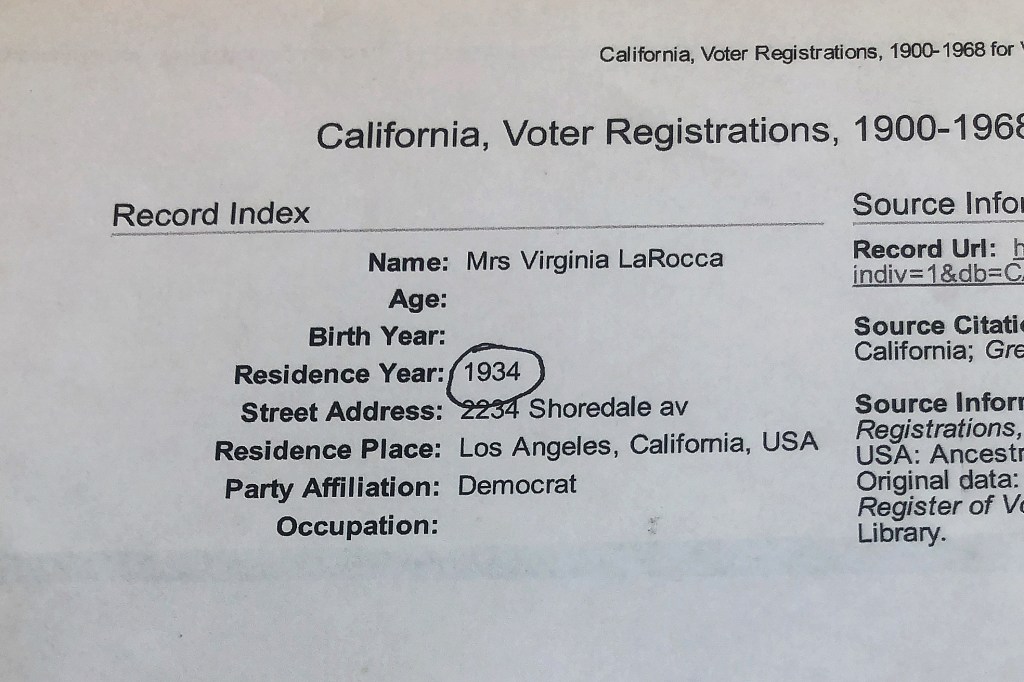
Ned, his wife Virginia LaRocca and 9-year-old Donna, join Frank and Rose in Los Angeles by 1934.
The family moved into a house located at 2234 Shoredale Ave. It’s located about 2 blocks away from Frank and Rose on Gatewood.
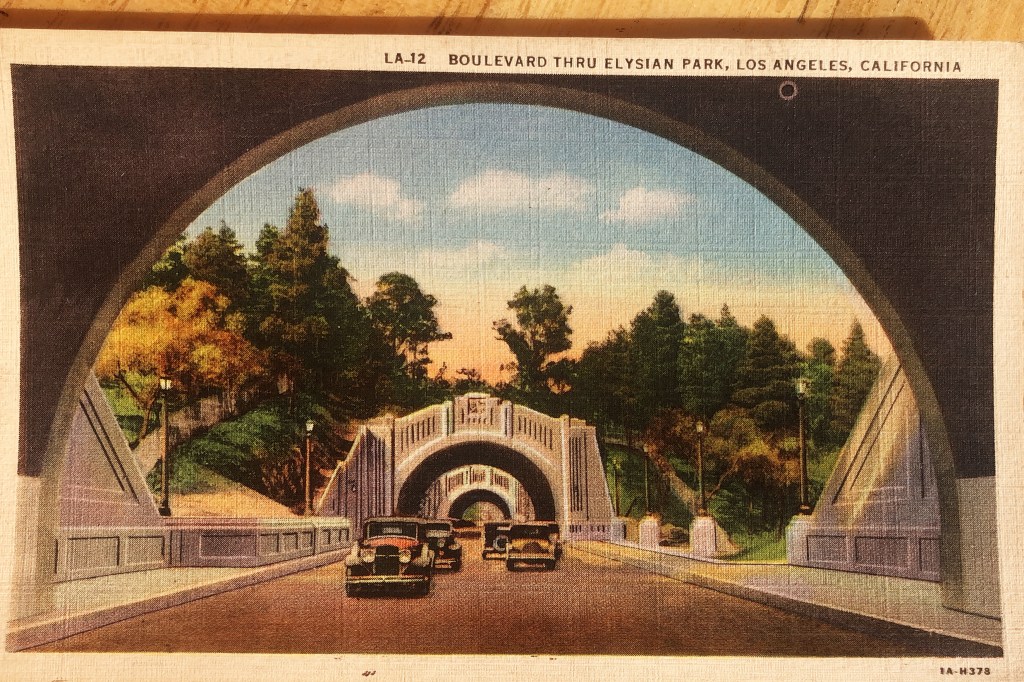
The Shoredale and Gatewood houses were in a neighborhood very close to Elysian Park. This location is near the LA River and Riverside Drive.
This was well before “the 5” freeway was built.
Brothers Frank and Ned LaRocca are listed as “music teachers” in the LA phone directory in the mid–1930s.
Ned and “Gin” on Shoredale and Frank and Rose not even 3 streets away on Gatewood.
Ned and Virginia LaRocca performed in Vaudeville tour acts in Los Angeles during the teens, 1920s, and 1930s. The green line is the LA River, grey with white stripe is the 5 Freeway, and light grey is the aptly named Riverside Dr. From what I observe on google maps, the buildings they lived in are still standing.
The LaRoccas were familiar with LA due to their Vaudeville touring.
Additionally, both Ned and Virginia had siblings already settled in Los Angeles.
As we have seen, Frank LaRocca and his wife Rose.
And, Virginia’s sister and sometimes partner in Vaudeville, Josephine Young Harker and her husband George Truman Harker.
Harker was a businessman from San Francisco by way of South Dakota. Jo and George were living in South Pasadena with their family of 2 children, Mary Jane and Jack Truman, and a live-in housekeeper.
Ned, Virginia and Donna wintered in Santa Monica one year during the Great Depression, according to a Mormon family history website. The story went that Ned LaRocca was supporting a houseful of women on a meager salary during the Depression.
Perhaps Ned played in a dance band on the famous Santa Monica Pier. Some write ups say he was a “Jazz Harpist.“
1937 January
According to his death certificate, Frank LaRocca is admitted to Methodist Hospital with peritonitis/perforated duodena. After one week in the hospital, Frank dies, having contracted pneumonia two days earlier.
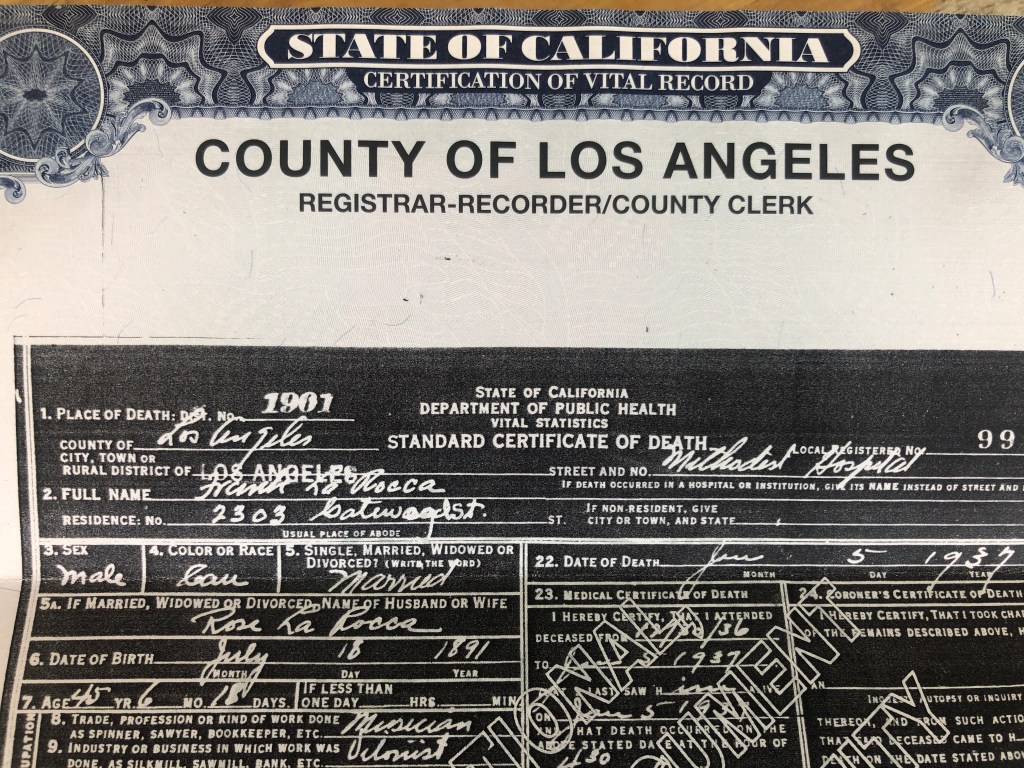
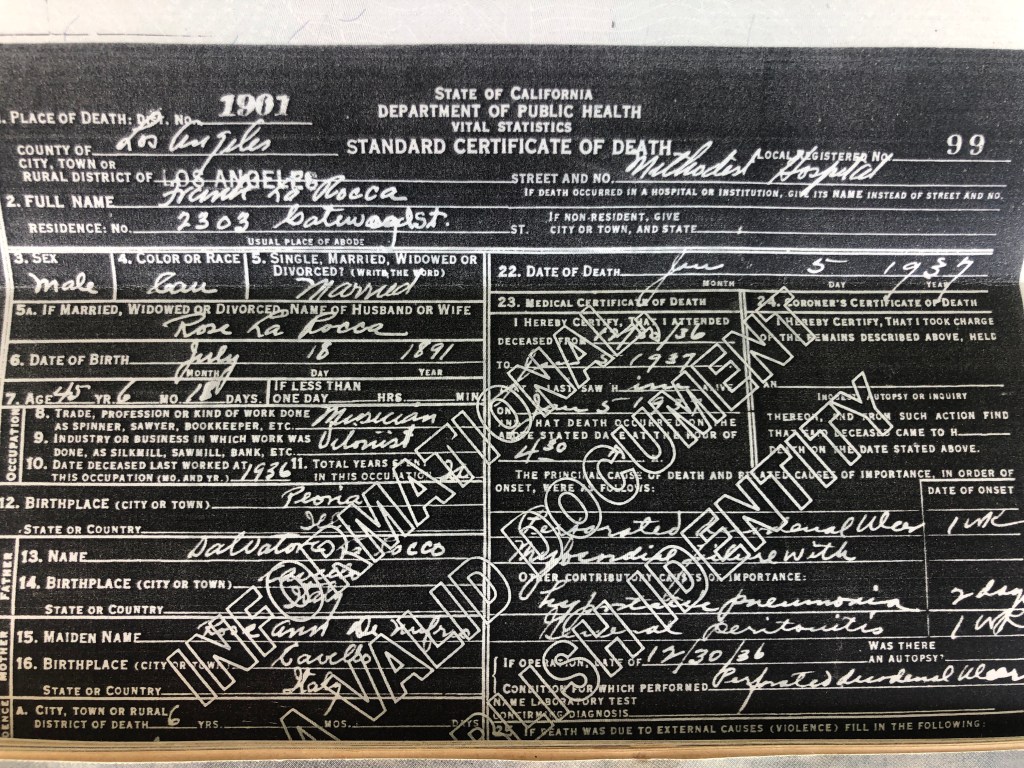
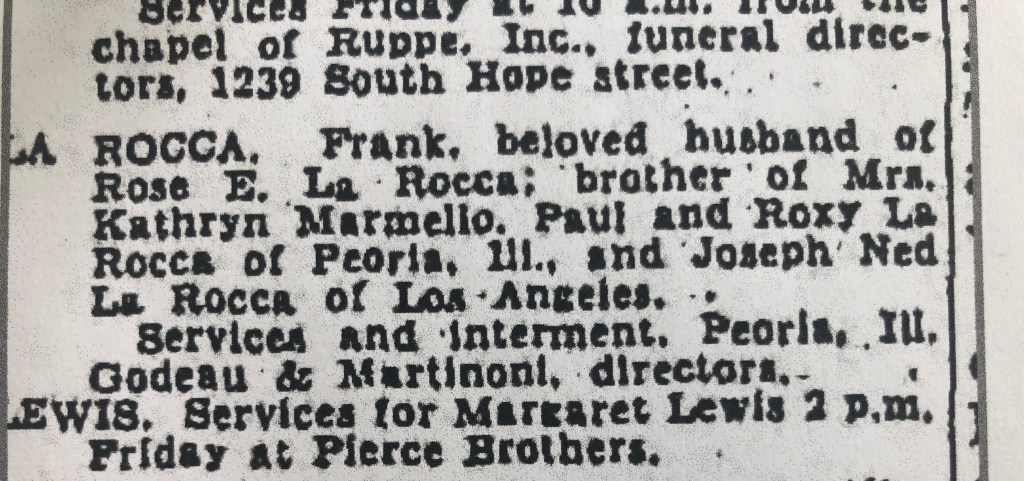
LAT obit. January 1937 Frank and Rose did not have children.
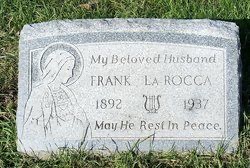
From find-a-grave. Frank’s tombstone in Peoria, Illinois.
His find-a-grave page includes an obituary from the Peoria newspaper, stating that Frank’s brother: Ned LaRocca lives in LA, is a harpist in a “Hollywood radio orchestra.“
Ned played at the famous Hollywood Hotel in the 1930s.
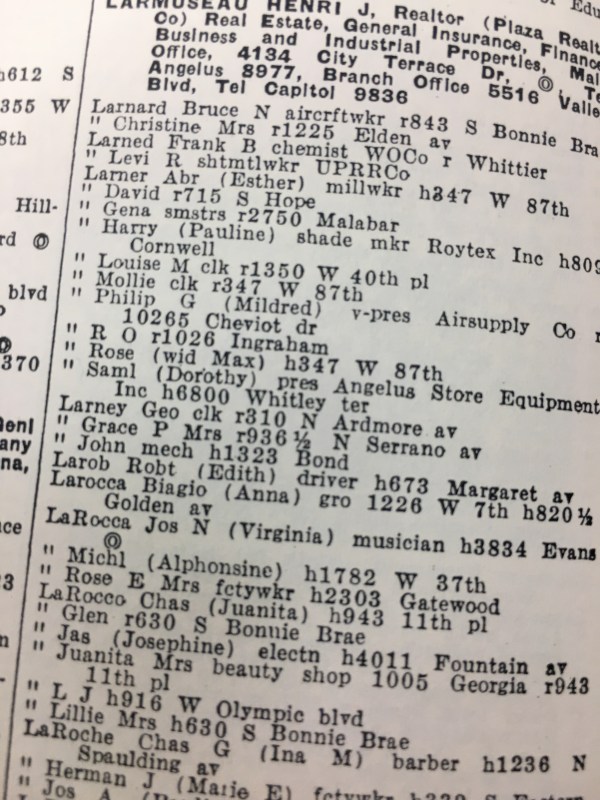
Late 1930s LA residence directory.
Ned and “Gin” are at 3834 Evans St. a single family dwelling. This new home is located a stone’s throw from well known Marshall High School.
Joseph’s sister-in-law Rose is now a widow to Frank. She is listed as a factory worker this year.
Rose LaRocca was also an Illinois native.
She returned to Los Angeles after her husband’s burial in the family plot in Peoria.
In other directories in the years directly after Frank’s death, I saw Rose listed as a cook. In another year, she was a seamstress.
I don’t think imagine this was an easy road.
Biagio LaRocca may be a family member. He was also listed in the Oakland directories in the late 1920s, when Ned and Virginia spent two years.
In the late 1930s, A “Radio Row,” was forming along the section of Vine Street between Hollywood Blvd. and Sunset Blvd. The anchors were NBC, CBS, ABC.
Moving pictures and radio replaced Vaudeville as the entertainment offering to the masses in the 192os and 1930s.
Technology created and distributed the new medium.
Music was needed for Radio dramas, comedies, advertisements and news shows.
A Streamline Moderne building was the new west coast headquarters of NBC radio. on Sunset & Vine in Los Angeles, opening in 1938.


*Below, I’m attributing radiocityhollywood.com below for several historic descriptions and explanations.
The National Broadcasting Company originally used the phrase Radio City to describe their studios at Rockefeller Center in New York City. When NBC opened their new Hollywood studios at Sunset and Vine in 1938, they placed the words Radio City prominently on the front of their new building. However, the area between Hollywood Boulevard and Sunset Boulevard on Vine Street became known as Radio City for tourists and locals alike who visited the many radio studios and radio themed cocktail lounges and businesses in the area.
radiocityhollywood.com
CBS radio aka “Columbia Square” opened just down the street from NBC, and also in 1938, either months or weeks before NBC.

Architect is Swiss-born William Lescase. CBS Columbia Square is the official moniker. The legendary Brittingham’s Restaurant existed in Columbia Square. This building and NBC were major tourist attractions in 1938 throughout the 1940s in Los Angeles.
Veteran performing artist Ned LaRocca found employment for his harp skills at both these NBC and CBS buildings
This building is the new home to KNX Radio, where Ned LaRocca found work in the late 1930s and 1940s.
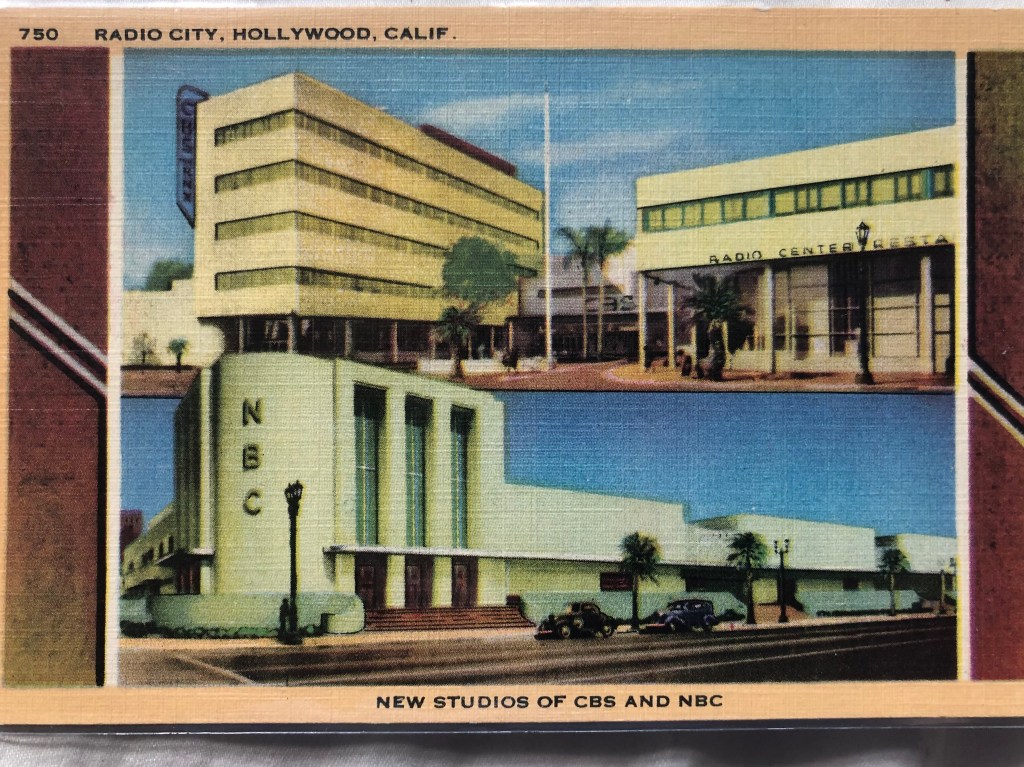

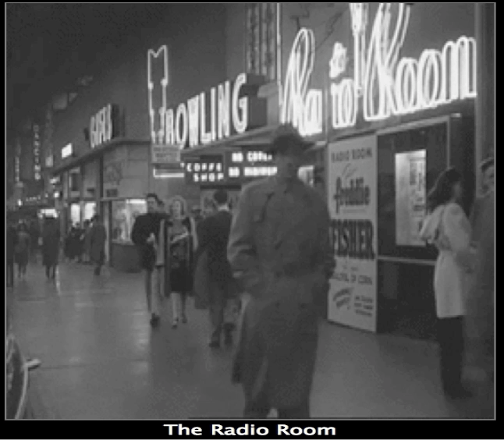
Radio Row in LA must have been a scene overflowing with human activity. Many people needed wanted or both, to be in the area.
The buildings contained employees of the many different businesses, their friends and families, audience ticket holders, tourists from near and far, “Big wigs” in the Industry, interns, janitorial staff, waiters, waitresses, hosts, cooks, caterers, and owners were present on the scene.

Los Angeles Evening News, April 29, 1938
Ad for famous Knickerbocker Hotel.
<<<<<<<Sunset & Vine, Radio City and CBS.
Professional radio performers like Tom Breneman and musicians like harpist Ned LaRocca also had a job in Radio City.

More on Jane Harker coming up below. In the 1940 census, Ned is listed as a Harpist on the radio.
The Hollywood Palladium opened two years later between NBC and CBS, with the Tommy Dorsey Orchestra, featuring band singer Frank Sinatra. Across Vine Street, on the northwest corner of Sunset and Vine, sat Music City and Capitol Records, operated by bothers Glenn and Clyde Wallich.
A block away, the Columbia Broadcasting System opened its new modern studios at Columbia Square. Across the street, on December 26, Earl Carroll opened his premier nightclub and restaurant, with the glamorous neon sign proclaiming, “Through these portals pass the most beautiful girls in the world.”
The National Broadcasting Company, after moving from New York to San Francisco, opened its’ new Moderne studios at the intersection of Sunset and Vine in Hollywood, California.
radiocityhollywood.com
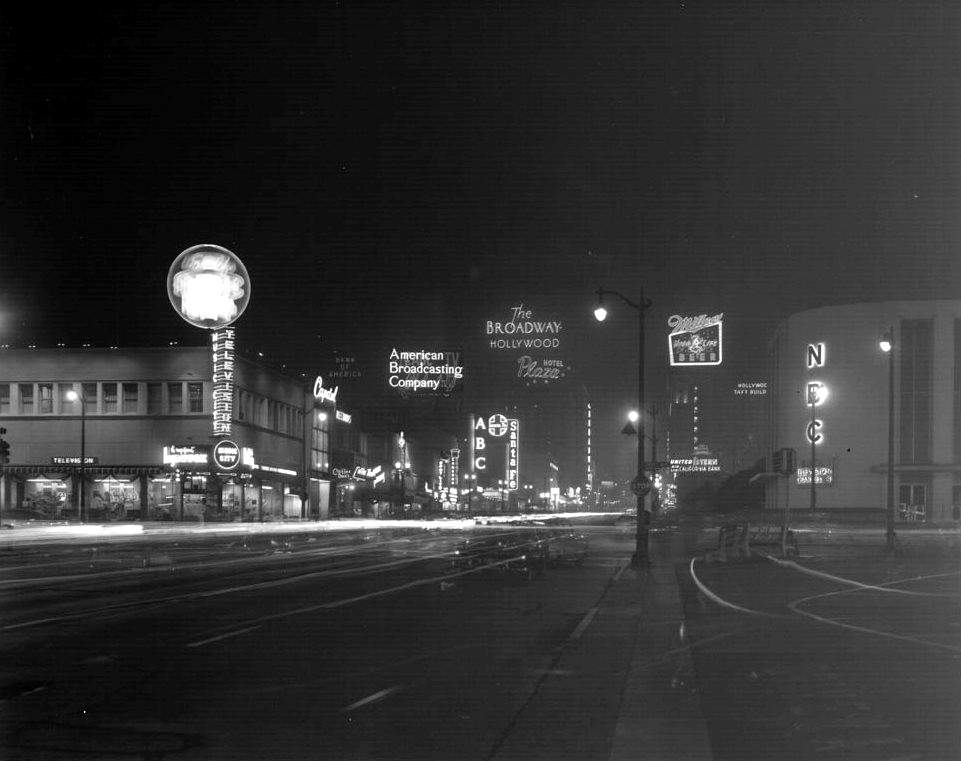
Film-Noirish image at Sunset & Vine, found on the internet. Looking at NBC from Vine St.
NBC on the right. 1940s. Capitol Records on the left, before the iconic new location, the “Stack of Records” building, was built at nearby 1750 Vine St. by Welton Becket and Assoc. (Opened in 1956)
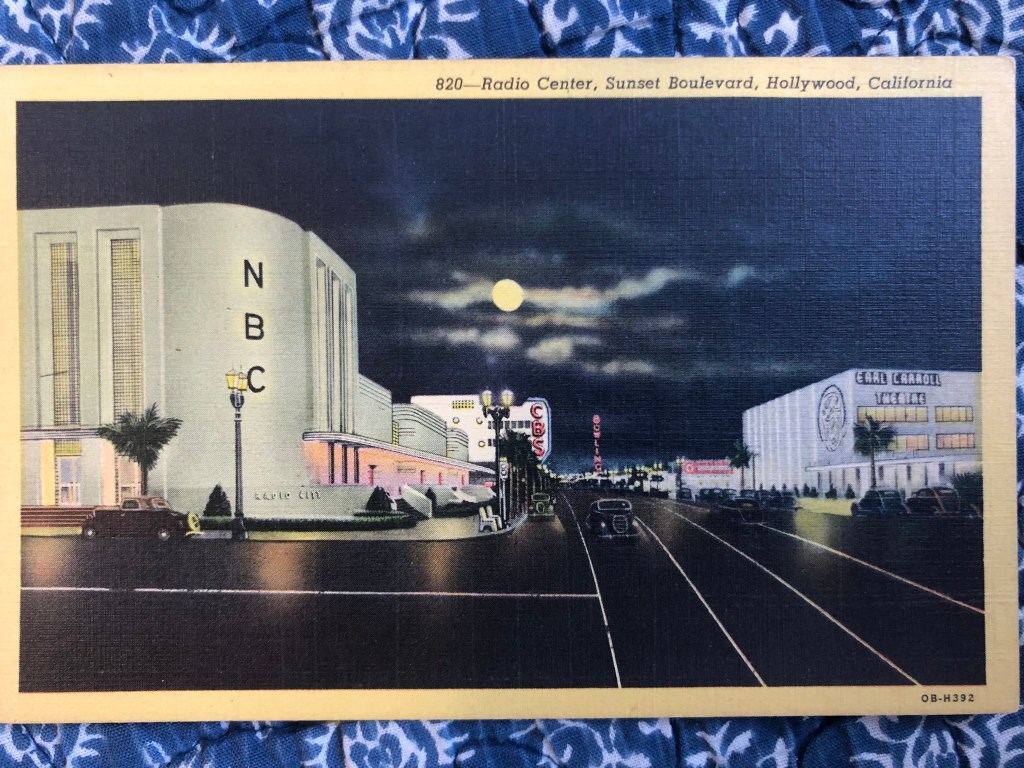
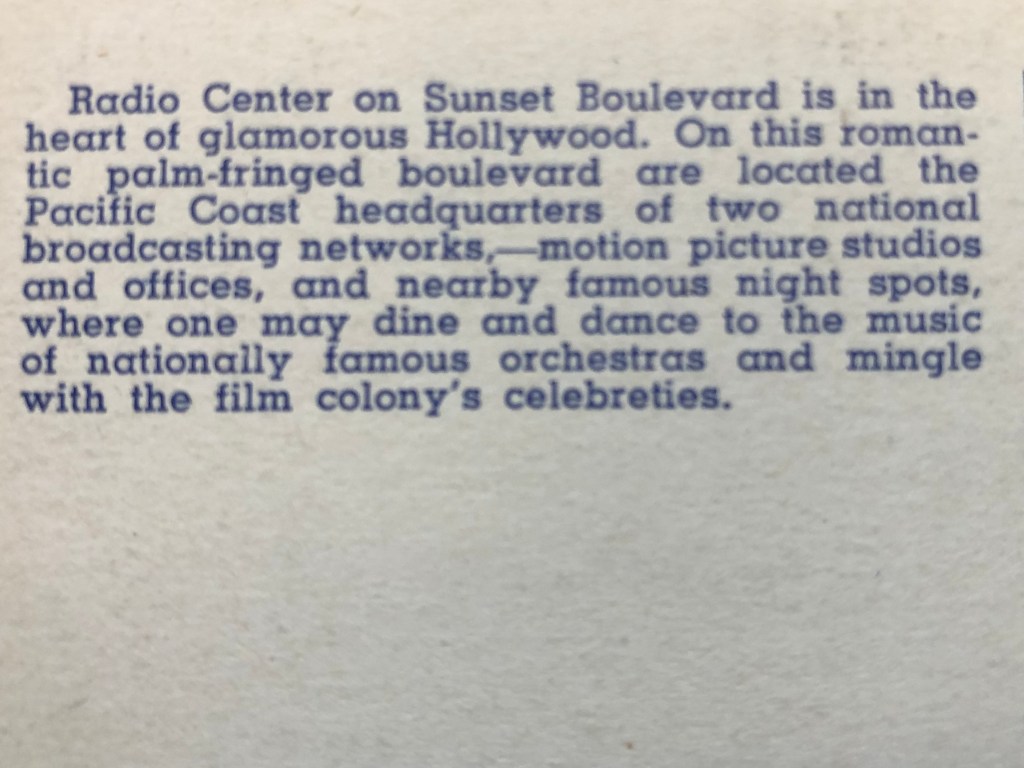
The radio industry in Los Angeles was at its’ zenith in the 1930s through the 1940s.
There was a radio industry presence before the iconic NBC and CBS buildings in 1938. And I wonder in Ned found work there upon his relocation to Los Angeles.
Roughly the 1930s and 1940s was the Golden Age of Radio.
Television would soon replace radio as the mass entertainment medium of choice during the 1950s.
More from Radio City Hollywood:
The American Broadcasting Corporation set up shop a few doors north on Vine Street. Up the street was the Radio Room, Club Morocco, Mike Lyman’s and the famous Tom Breneman’s Breakfast in Hollywood restaurant. Even further up Vine, just before Hollywood Boulevard, Clara Bow operated her restaurant, the It Cafe. Across the street, south of the Boulevard, was the world famous Vine Street Brown Derby, more restaurants and bars, and at Selma Avenue, the RCA building. Further south, at the end of the block, at the intersection of Vine Street and Sunset Boulevard stood the radio flagship studio, NBC Radio City.
It was a glorious year, 1938, for Hollywood and for radio. And, while NBC called their new studios Radio City, the entire area became famous across America and around the world.
Radio City Hollywood website.
Tom Breneman broadcast his mega popular show “Breakfast In Hollywood” from his restaurant on Vine off Sunset Blvd.
I have listened to a few of his radio broadcasts on YouTube. Breneman often asked audience members, “Where are you from?” The answers come from a combination of tourists and locals, from my observation.

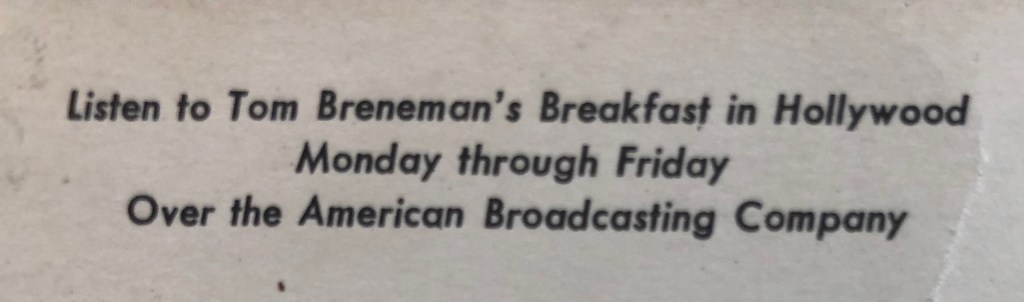
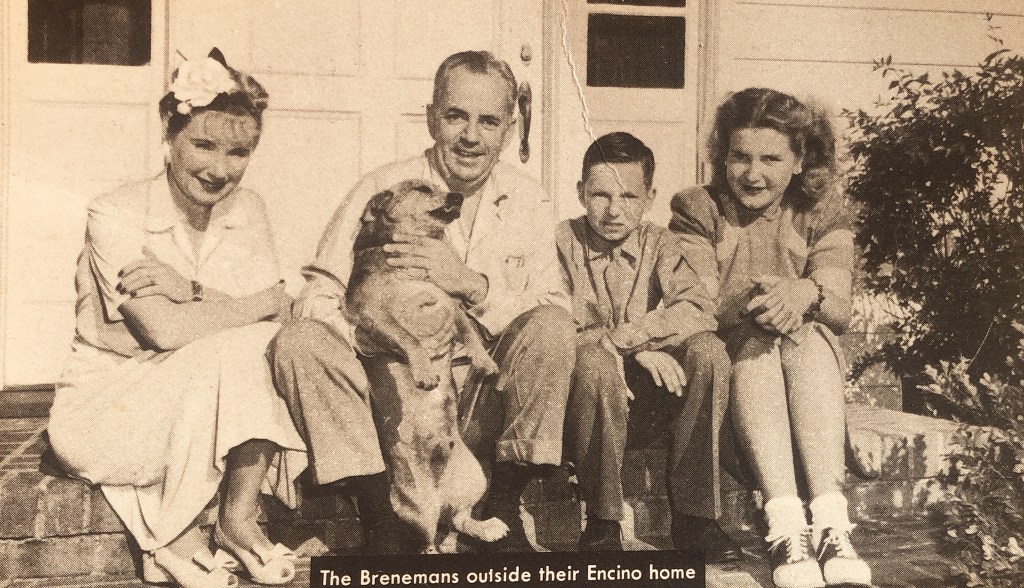
Mr. Breneman was known as the Mayor of Encino. Here we see Tom’s family in the 1940s. Breneman made the commute from the Encino in the SanFernando Valley to Hollywood for his show.
Ned LaRocca made the same trek in the 1950s from Studio City.
Tragically, Breneman died of a heart attack in 1948.
Ned LaRocca continued to work at NBC and CBS throughout the 1940s. He made an important contact with Leith Stevens, a conductor and composer who worked in Radio for years in NYC.
More on Stevens in the 1950s chapter.
1938, 1939 & 1941 LA phone directory, Joseph LaRocca is listed as a musician and living at 3834 Evans.
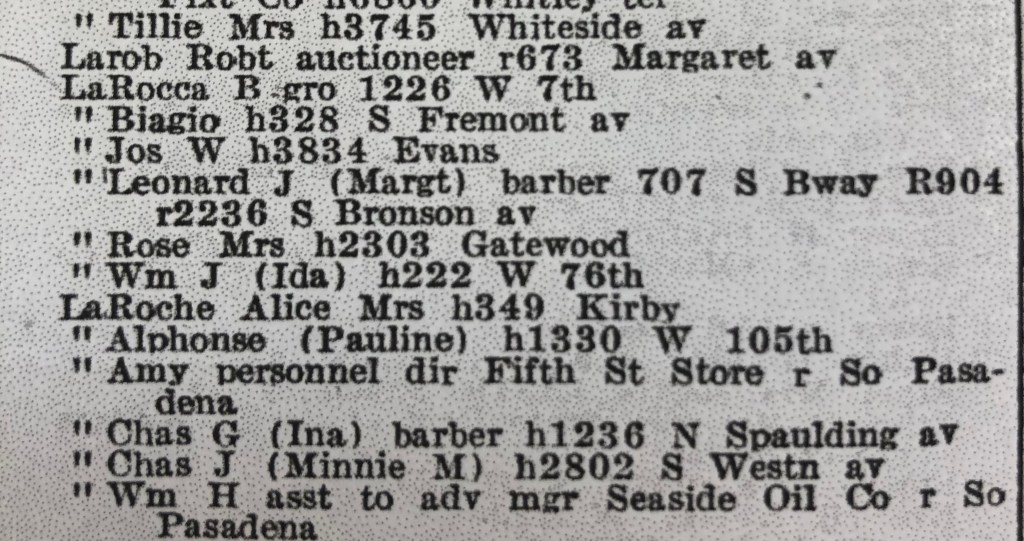
Rose’s home state was Illinois.
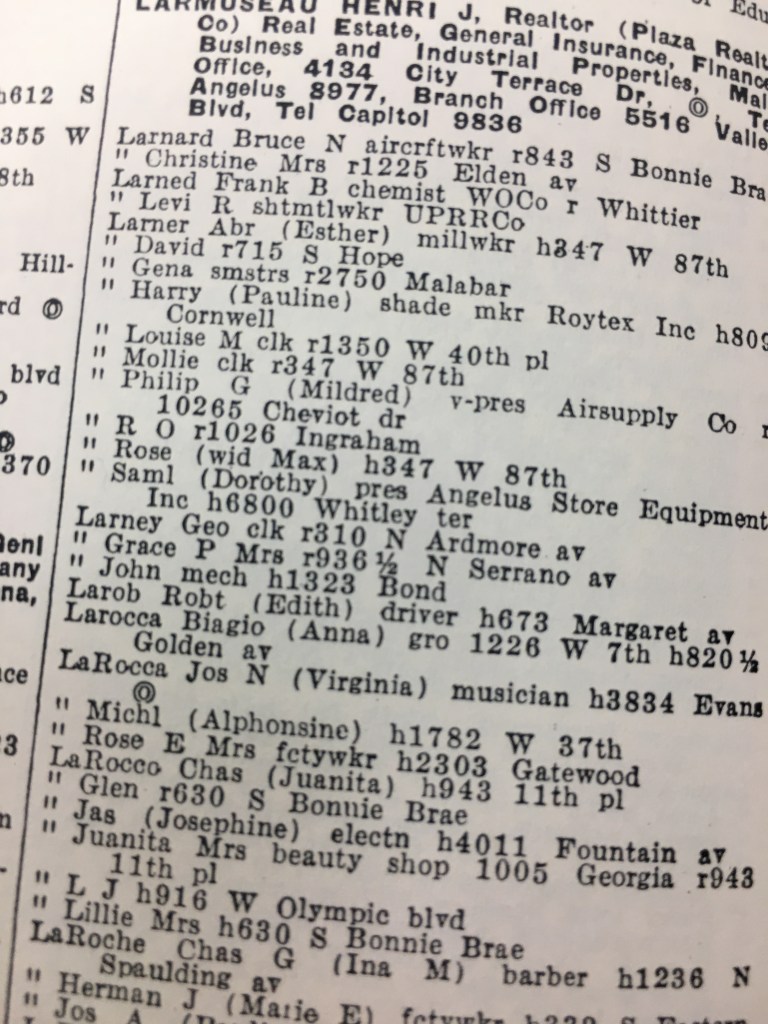
Late 1930s Los Angeles directory. Joseph’s sister-in-law Rose, widow to his brother Frank, is a factory worker this year. One year she was listed as a cook and another year, a seamstress.
Biagio LaRocca may be a family member. He was also listed in the Oakland directories in the late 1920s, along with Ned LaRocca.
Besides Mildred Marinell, Donna LaRocca had another female cousin named Mary Jane Harker, born two years after Donna, in San Francisco.
Jane had a very short lived Hollywood career, from 1945-1947, contracted to Warner Brothers studio.
Please see new chapter on Jane Harker.
Jane Harker was the daughter of Josephine Young, Virginia Young LaRocca’s sister. Her father was named George Truman Harker.
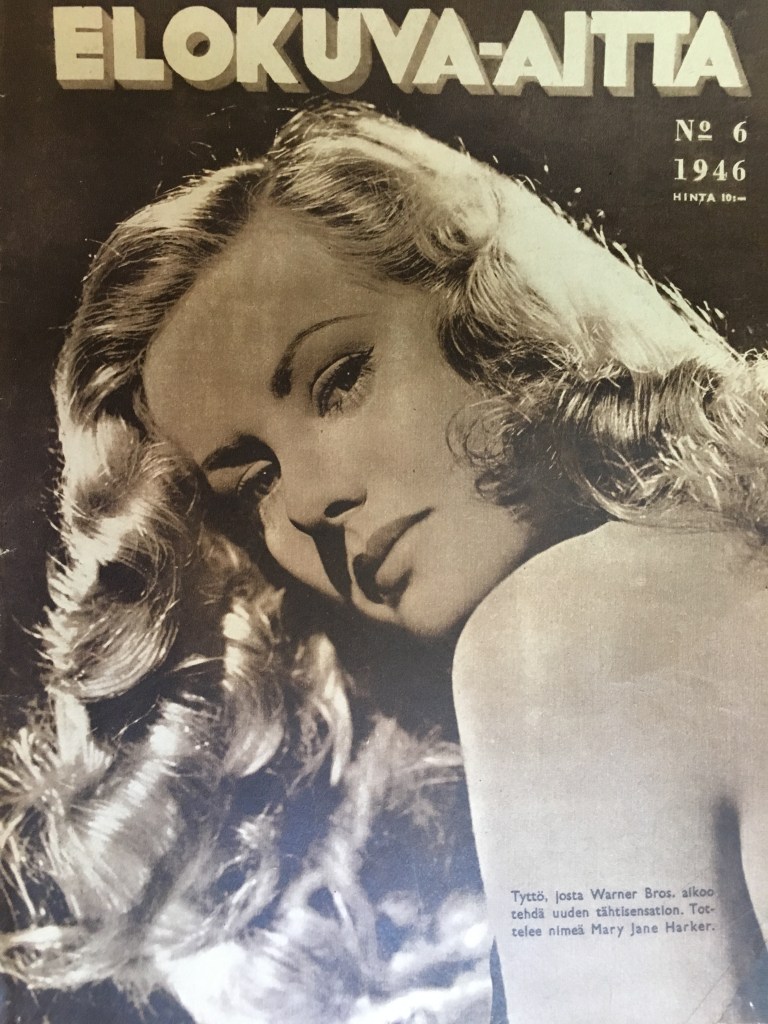
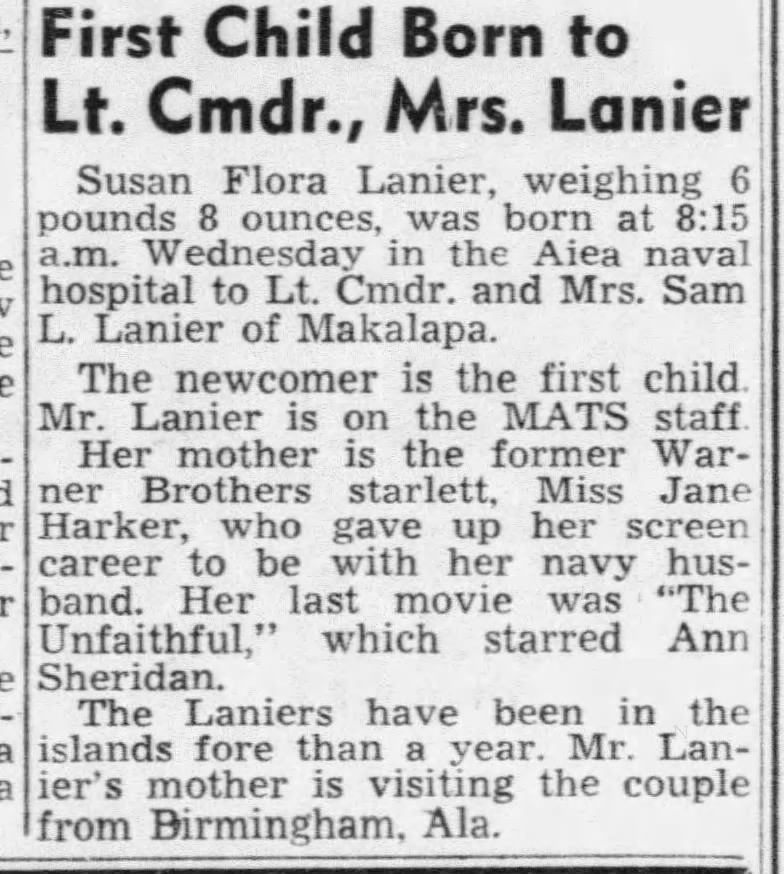
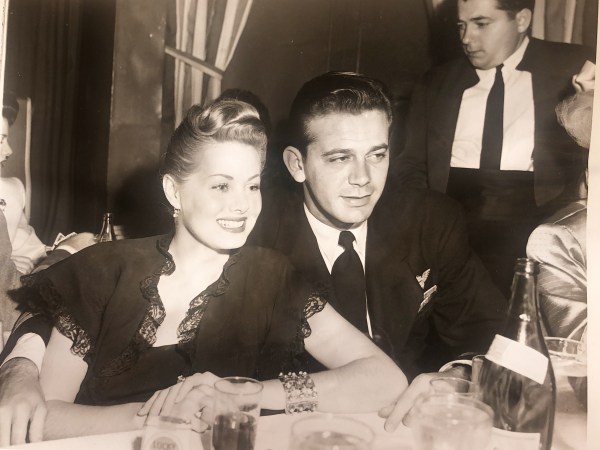
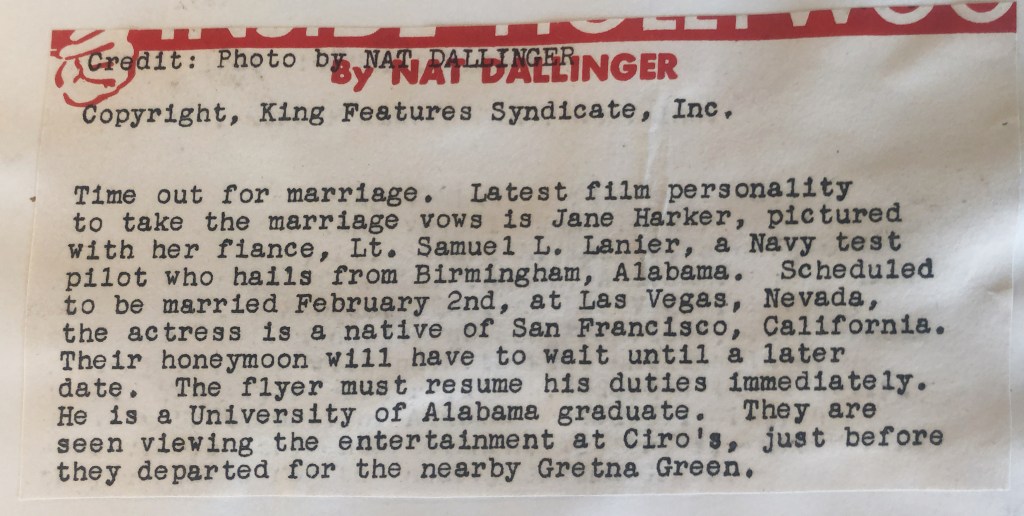
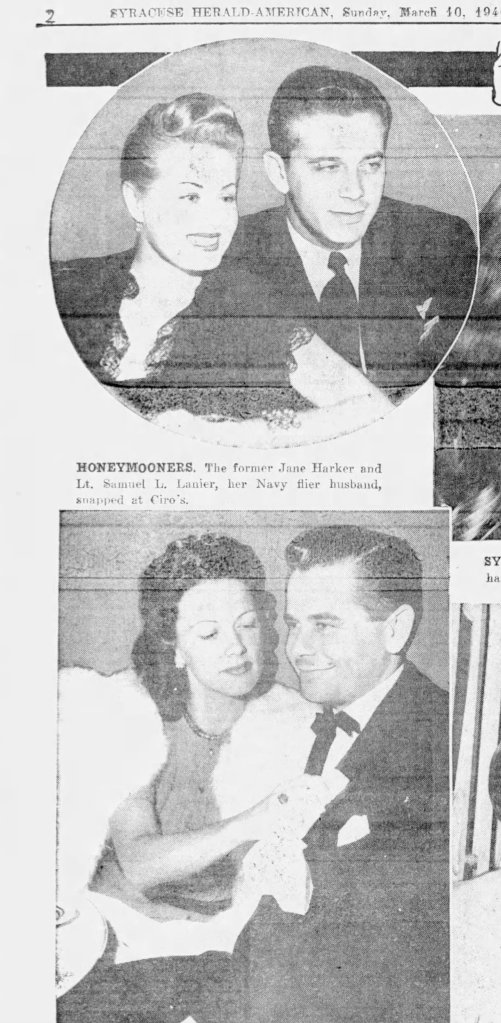
She was out of Hollywood, both the industry and LA, by 1947, after marrying war hero, Navy pilot Samuel L. Lanier.
Military life moved the couple and their 4 children around a lot, Hawaii and San Diego, but eventually they settled in Jacksonville, Florida.
.
Salt Lake City Tribune July 19, 1945. Paige Young’s 2nd cousin. “Mary” would soon be dropped.
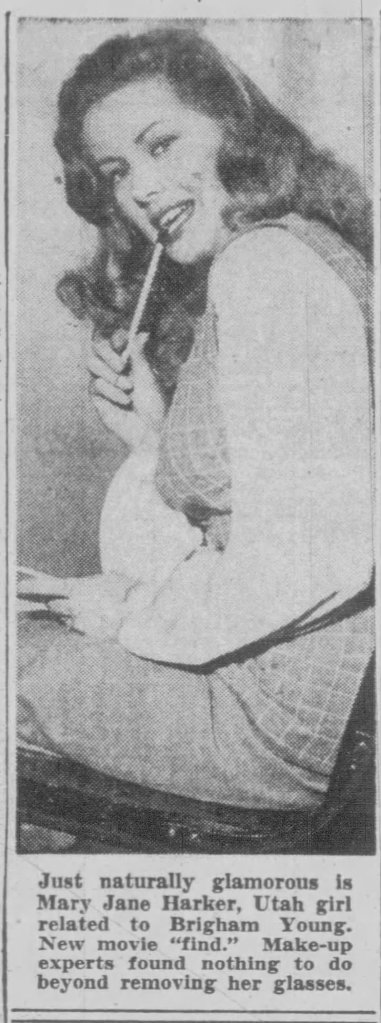
The information about Jane Harker that you see on websites imdb and Warner Brothers wiki, is incorrect.
I hope to establish the correct biographical information on this forgotten Warner Brothers contract player.
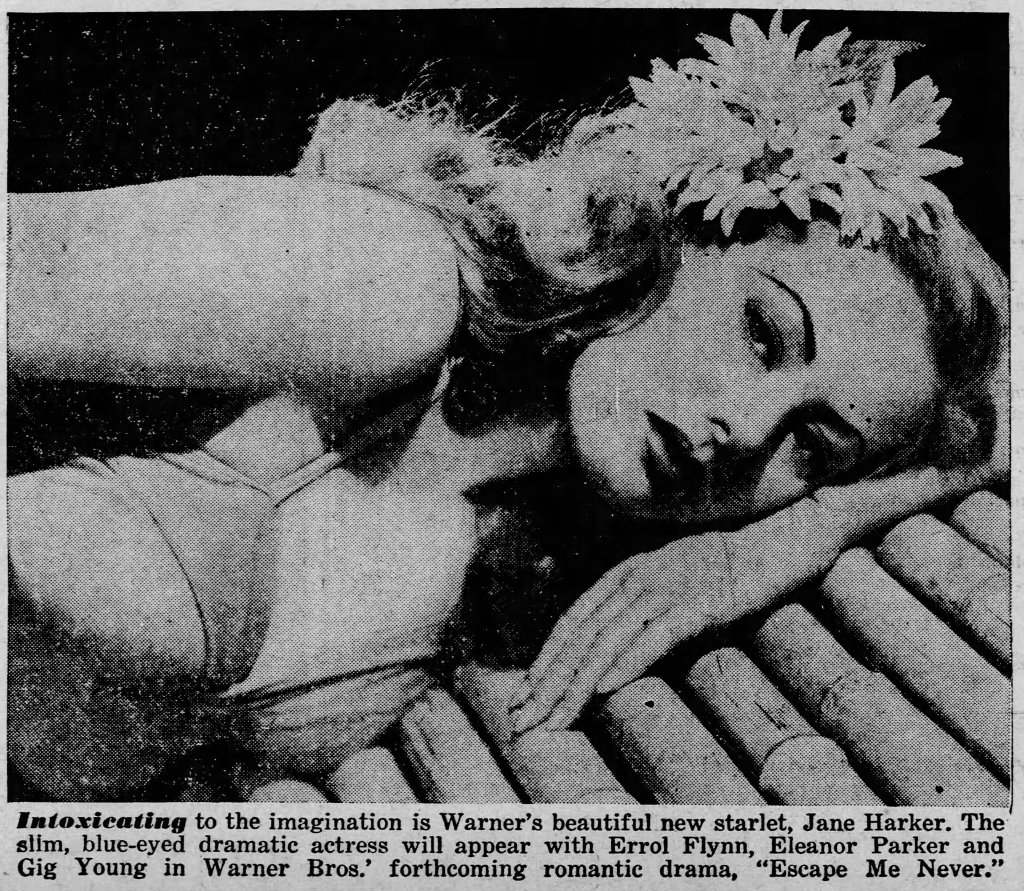


Article announces a hometown war hero’s engagement to a beautiful Hollywood starlet and native Californian: Jane Harker.


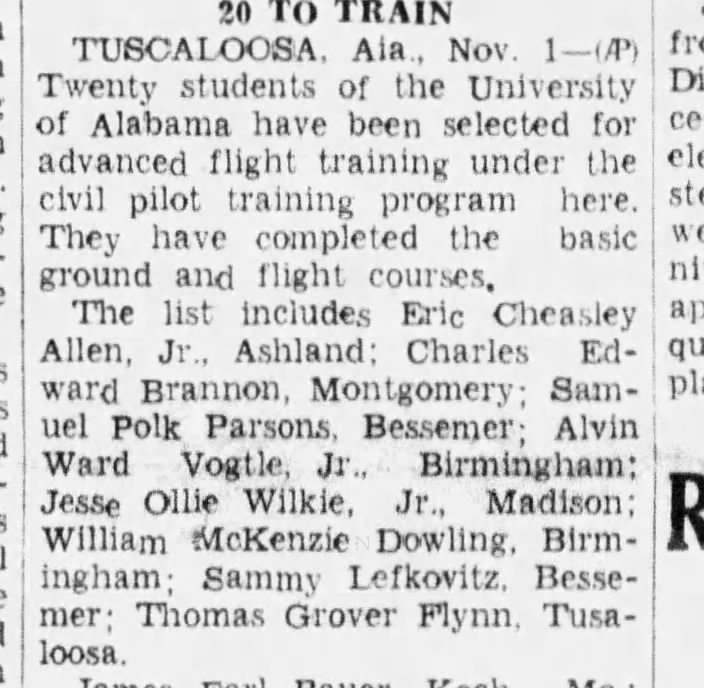
A little about Samuel Lefkovits Lanier:
Lefkovits was the family name. Sometimes it is spelled with a z, like this article. Samuel Lefkovits was known as “Sammy” and hadn’t yet changed his surname to Lanier but he would in within the next 16 months. Looks like Sammy was just beginning his training as a pilot, 13 months before Pearl Harbor. Alabama Daily Decatur Nov. 1, 1940
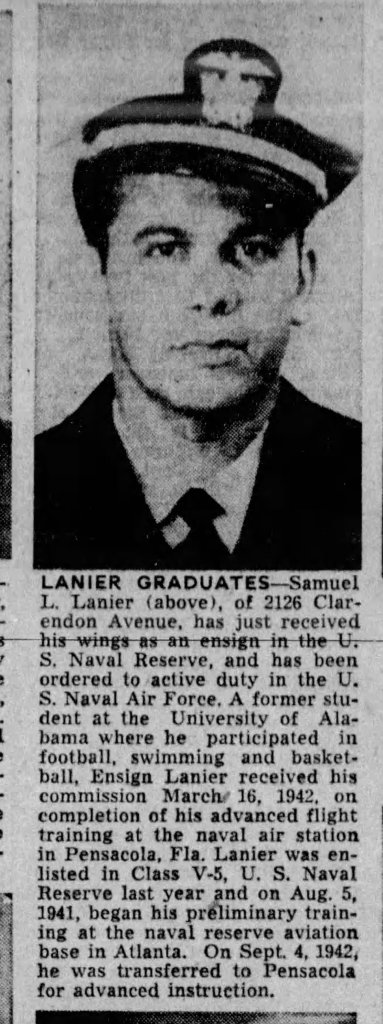
Birmingham News Apr. 19, 1942 Pearl harbor was just 4 months earlier, when this article and photo of Samuel L. Lanier was published.
His parents were Norman and Ida Lefkovits, active members of a thriving Jewish community in Bessemer. (And Birmingham)

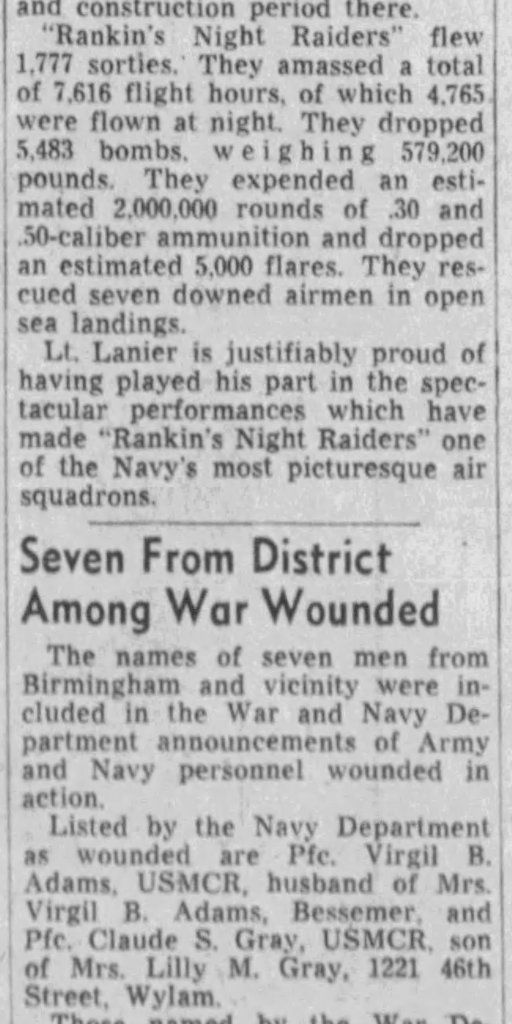


Why Grow Old? was a long running beauty and health column written by Josephine Lowman. Jane Harker was the model for the column for several years in the 1940s. I’ll include a few more (of dozens I saved) sometime in the future.
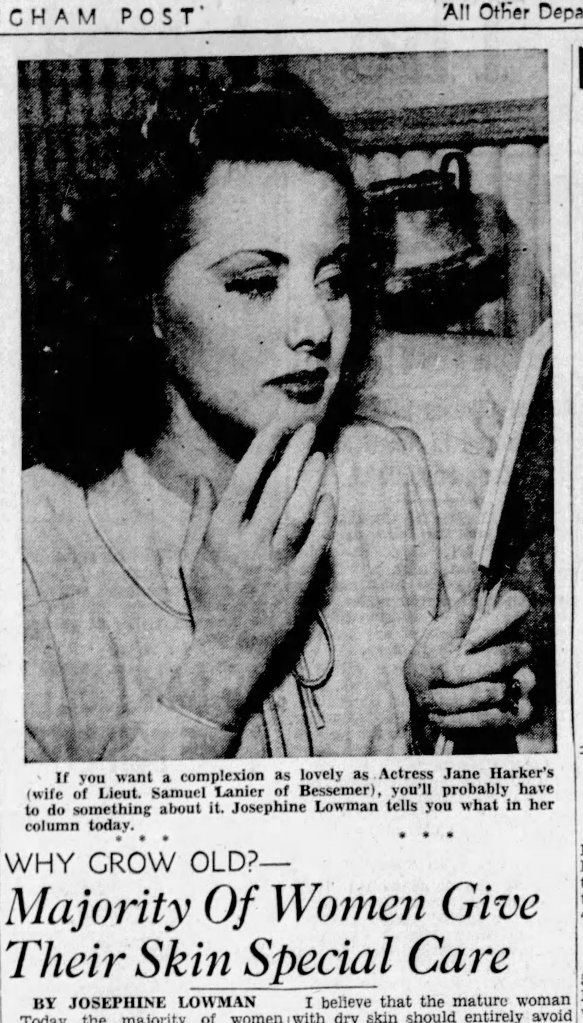
Birmingham Post Feb. 12, 1946. The Lowman Why Grow Old? column, makes use of Bessemer’s connection to glamorous Hollywood.
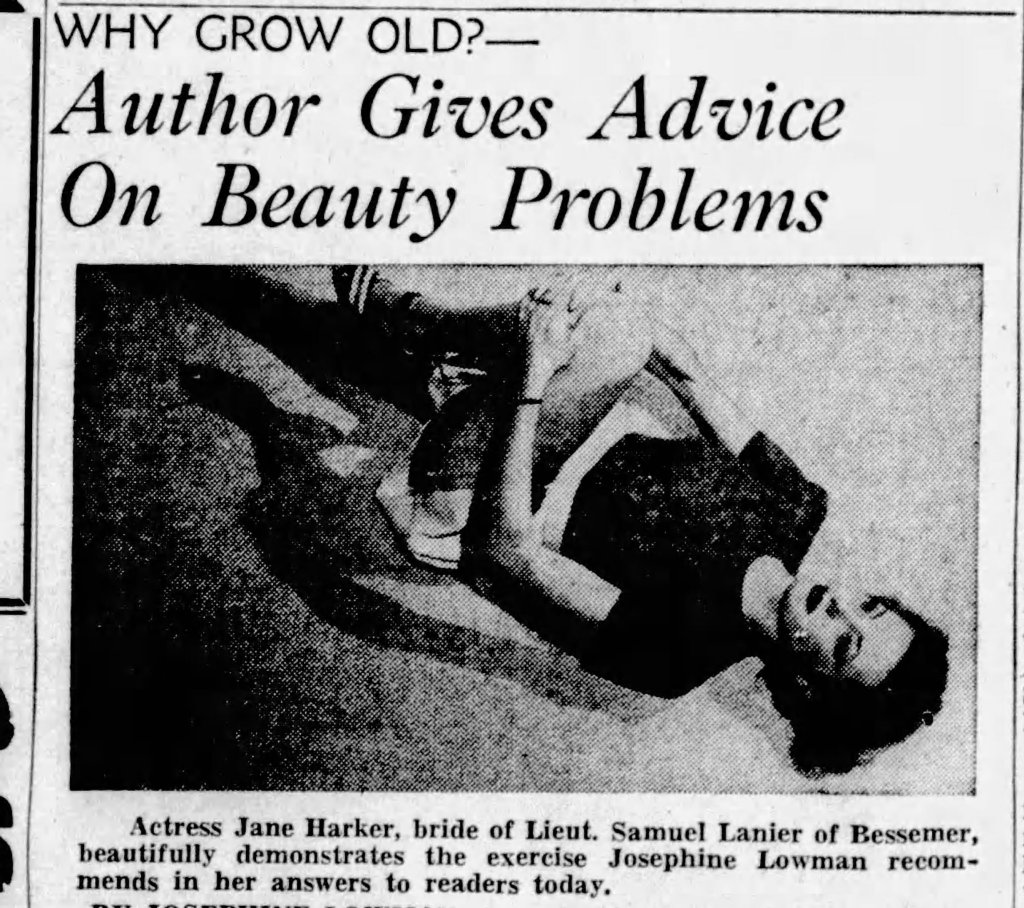
There were dozens of short articles in newspapers across the US even been hundreds, that appeared when Jane Harker left a burgeoning film career in LA.
The reason was to marry and relocate with her military husband Lt. Samuel L. Lanier.
Below is a small sampling of these announcements.
I will be adding more in the future along with Jane Harker’s many fashion photographs published. “High fashion” as opposed to studio publicity pin-up shots.

Martinez News Gazette Apr. 15, 1947

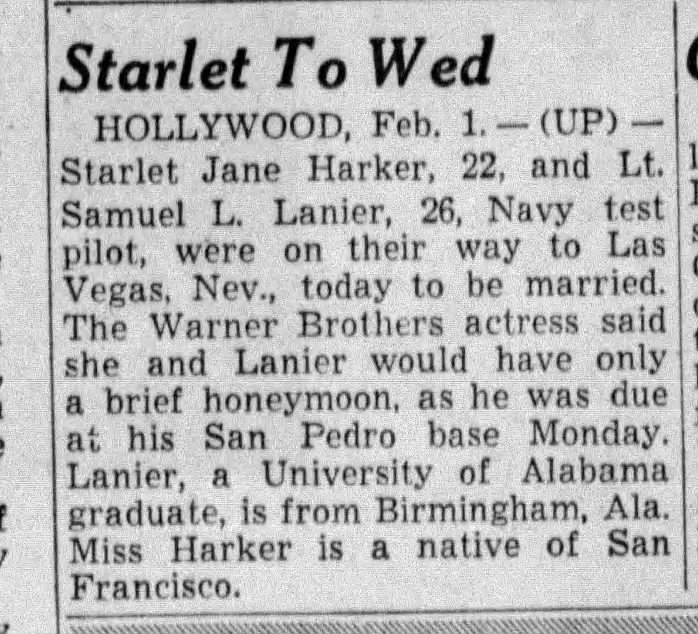
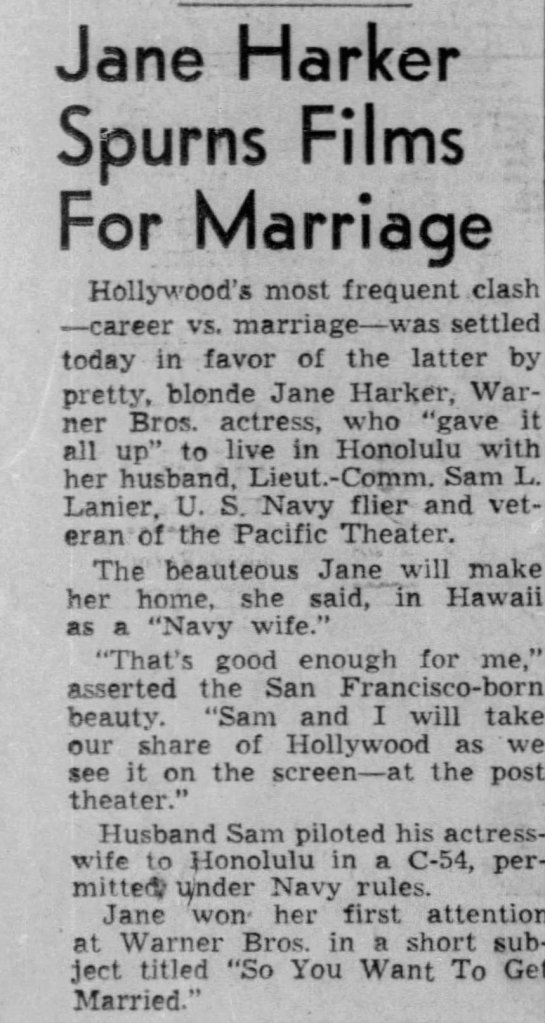
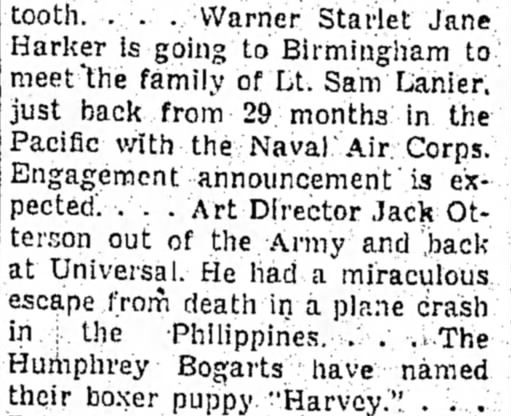
From Harrison Carroll,a Hollywood gossip columnist. Bradford Era (PA.) Nov. 23, 1945.
.

 Paige Young in Los Angeles