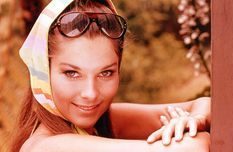
 Paige Young in Los Angeles
1969 January. Playboy Magazine. Playmate of the Year Contest. Winner: Connie Kreski. Anthony Newley. Roman Polanski. Can Heironymus Merkin Ever Forget Mercy Humppe…..? 1970s James Caan. Under Construction. Victor Lownes and Marilyn Cole. NSFW. 2-9-26
Posted on July 15, 2020
NSFW
PMOM = Playmate of the Month. PMOY = Playmate of the Year.
This photo of Paige Young appears in the January 1969 issue of Playboy magazine.
A brief update about her life is included, which was truthful I learned, if incomplete.
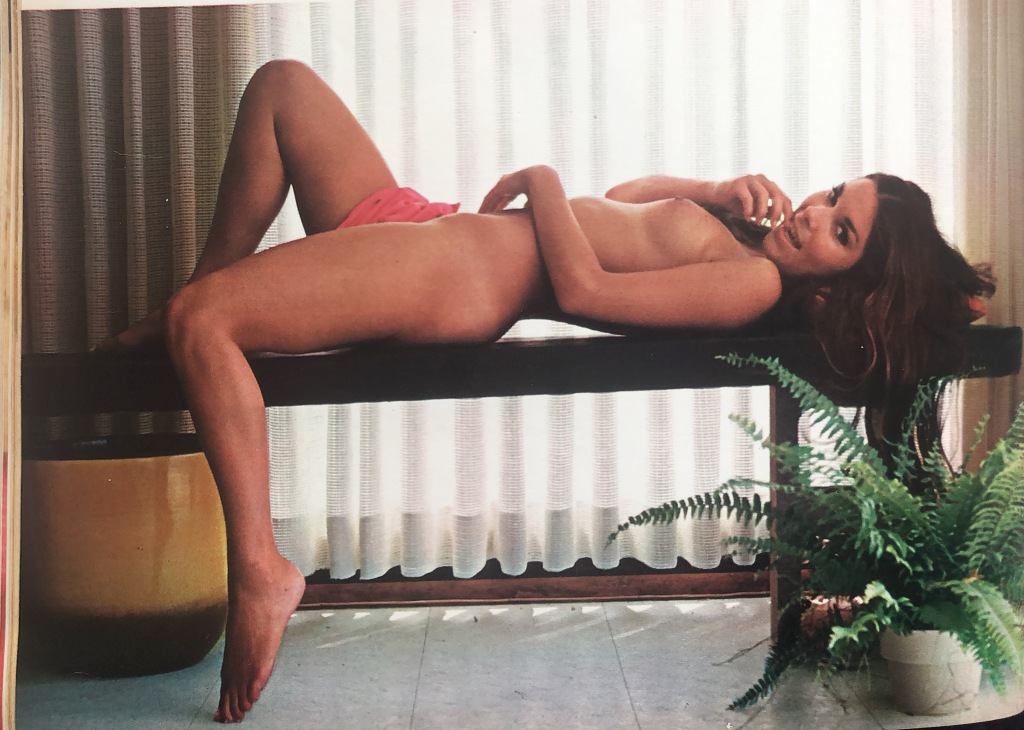
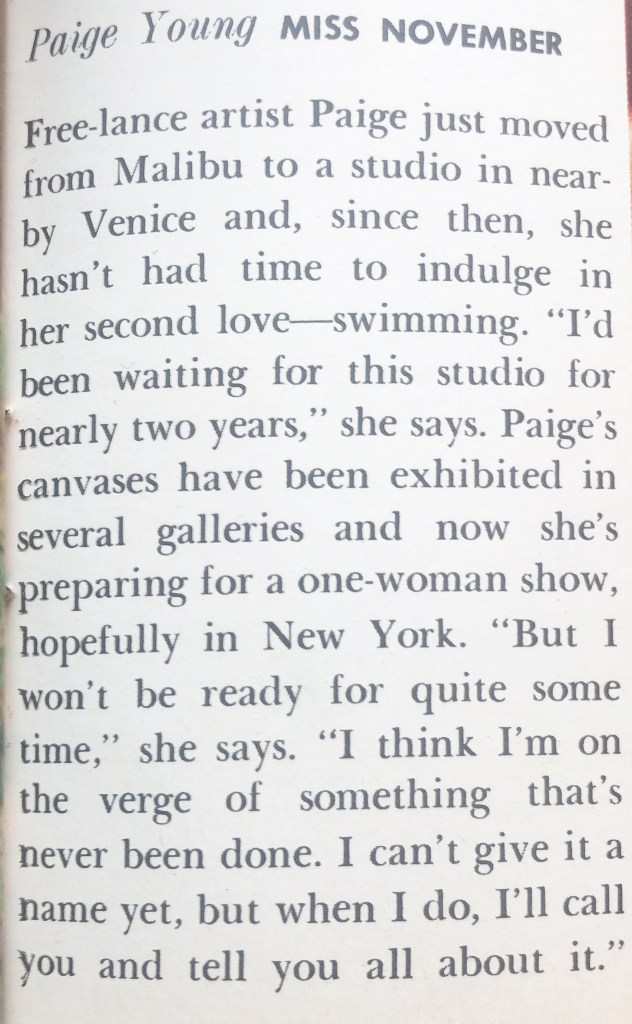
Update on Paige Young shown with her photo. Jan. 1969 Playboy Magazine.
More specifically than Malibu, which was always printed in Playboy, Paige lived in Topanga Canyon/ Topanga Beach. At that time, an area of artists, musicians, hippies, surfers and Hollywood celebrities. She knew Bill Cosby at the time and he may have helped her obtain her home there.
The January 1969 Playboy magazine issue shows all 12 Playmates of 1968.
A brief update accompanies each one, as we read in Paige’s entry.
Standard protocol for this annual issue.
It means the PMOY title will be announced soon.
1969 is also the 15th anniversary issue of the influential and wildly successful magazine.
Hugh Hefner became famous for his publishing and business empire.
Besides the magazine, the trendy Playboy Clubs Playboy Bunny cocktail waitresses were instantly iconic.
Successful enough to have created scores of imitators in the magazine publishing world during the 1950s and early 1960s.
Titles like Escapade, Nugget, Modern Man, Adam, Dude and Rogue, to name only a few. An easy Google image search.
The imitators experienced varying degrees of success.
The Playmate of the Year
has a higher status than Playmate of the Month (PMOM) obviously.
Kind of like, the “elite of the elite.“
Or the “creme de la creme.“
A PMOY title is akin to winning a beauty contest, much like Miss America or Miss USA. The winner reigns for one year and is then replaced the next.
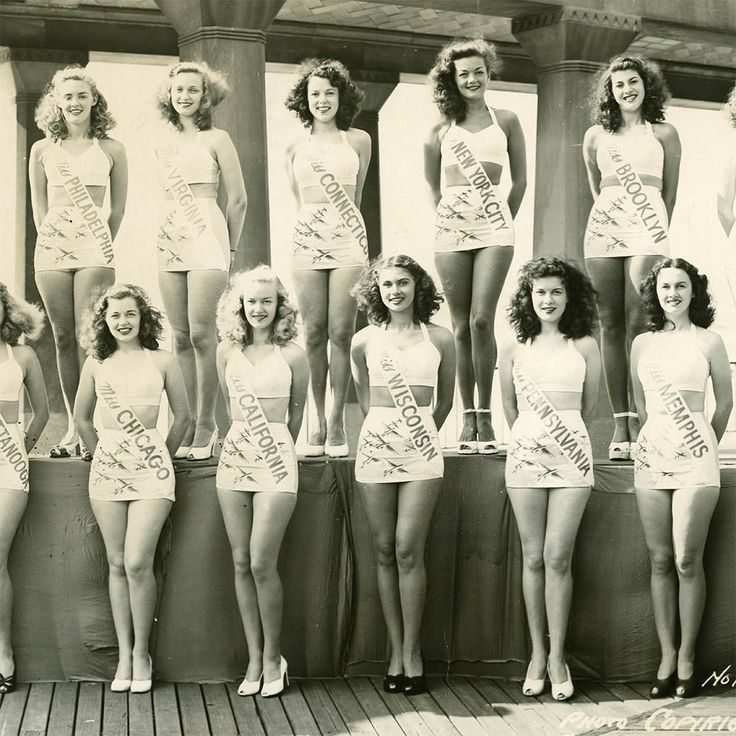
The 12 finalists are the 12 PMOMs.
The yearly 12 have already cleared a major hurdle by winning over many other young women for the coveted monthly spot.
Round 2: the 12 finalists compete for the PMOY title.
PMOY means more of everything you have already experienced as a regular PMOM: public appearances, photo sessions, media interviews, a modeling fee, career opportunities.
(However, a pink car is reserved exclusively for the PMOY.)
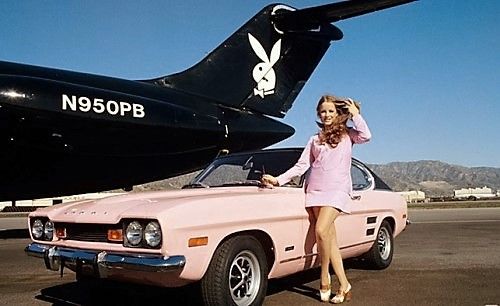
PMOY 1970 Claudia Jennings with her prize of a “Playmate Pink” color Mercury Capri. Behind it is Hugh Hefner’s favorite mode of transportation the few years he owned his jet called “The Big Bunny.”
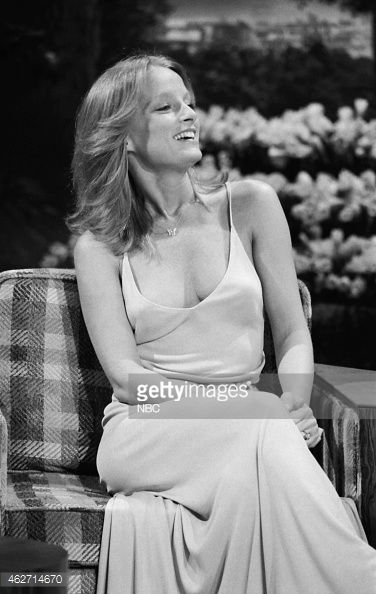
Claudia Jennings, an aspiring actress, is seen here being interviewed on the Tonight show, sitting on Johnny’s famous couch around the time she was given the title PMOY 1970.
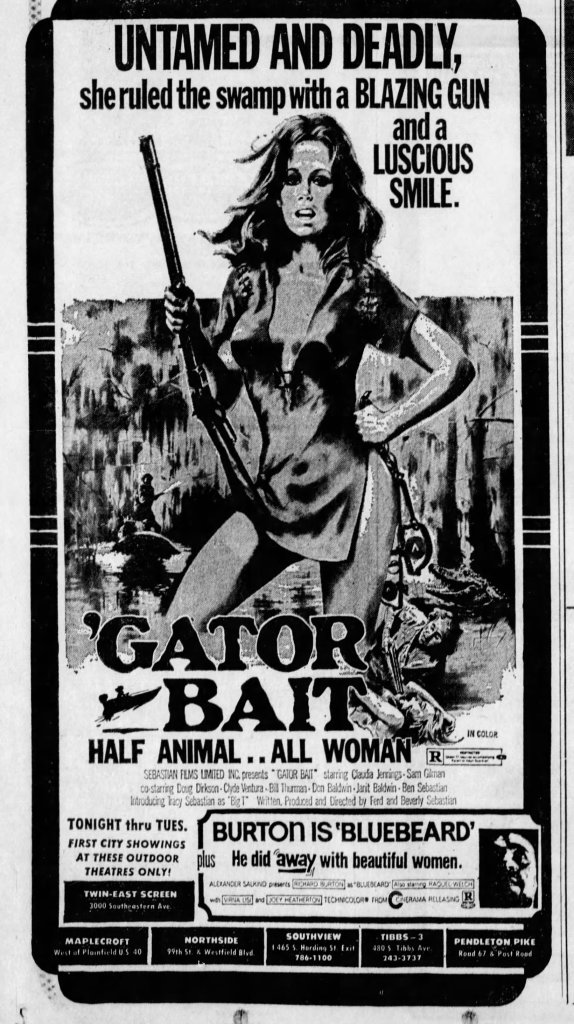
She did become a successful actress in films like: Truck Stop Women, Gator Bait. and Unholy Rollers.
More about Jennings in my Start Here page.
The PMOY gets a big party thrown in her honor, often at Hef’s Chicago mansion, later LA. Attendees include press, various celebrities including good looking film actors, Playboy and Hollywood big-wigs and assorted VIPs.
You would meet 100s of men in particular I imagine.
How was PMOY chosen?
I wonder if reader feedback influenced the decision, was it up to Hugh Hefner alone, or decided by committee?
Paige Young did not win and I doubt if she was even in the top 3.
The winner was Connie Kreski seen here on the cover of her PMOY issue
June 1969

Winner Connie was the girlfriend of Victor Lownes, head of the London Playboy Club & Casino, Chicago friend of Hugh Hefner.
Both are forgotten figures of the 1960s.
More on Victor Lownes coming up.
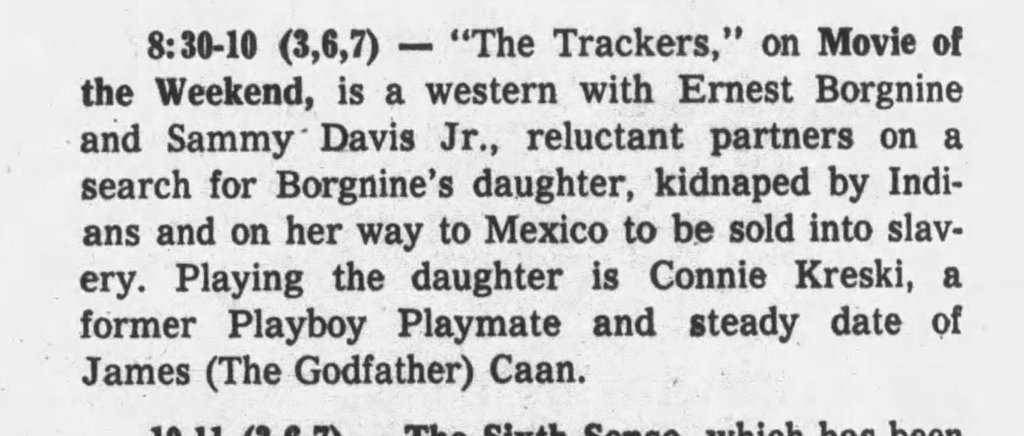
By the time of her PMOY title was announced in 1969, Connie had already filmed a movie directed by English singer, actor, composer Anthony Newley.
Newley wrote many classic songs like Goldfinger, What Kind of Fool and I?, Feeling Good and Candy Man!
Connie Kreski
born Constance Joanne Kornacki in Wyandotte, Michigan.


Connie said in several press interviews that she grew up in a “strict Polish Catholic family.”
Constance Kornacki was studying for a degree in psychiatric nursing at Mercy College in Detroit when Playboy came calling in the form of a man at a University of Michigan football game.

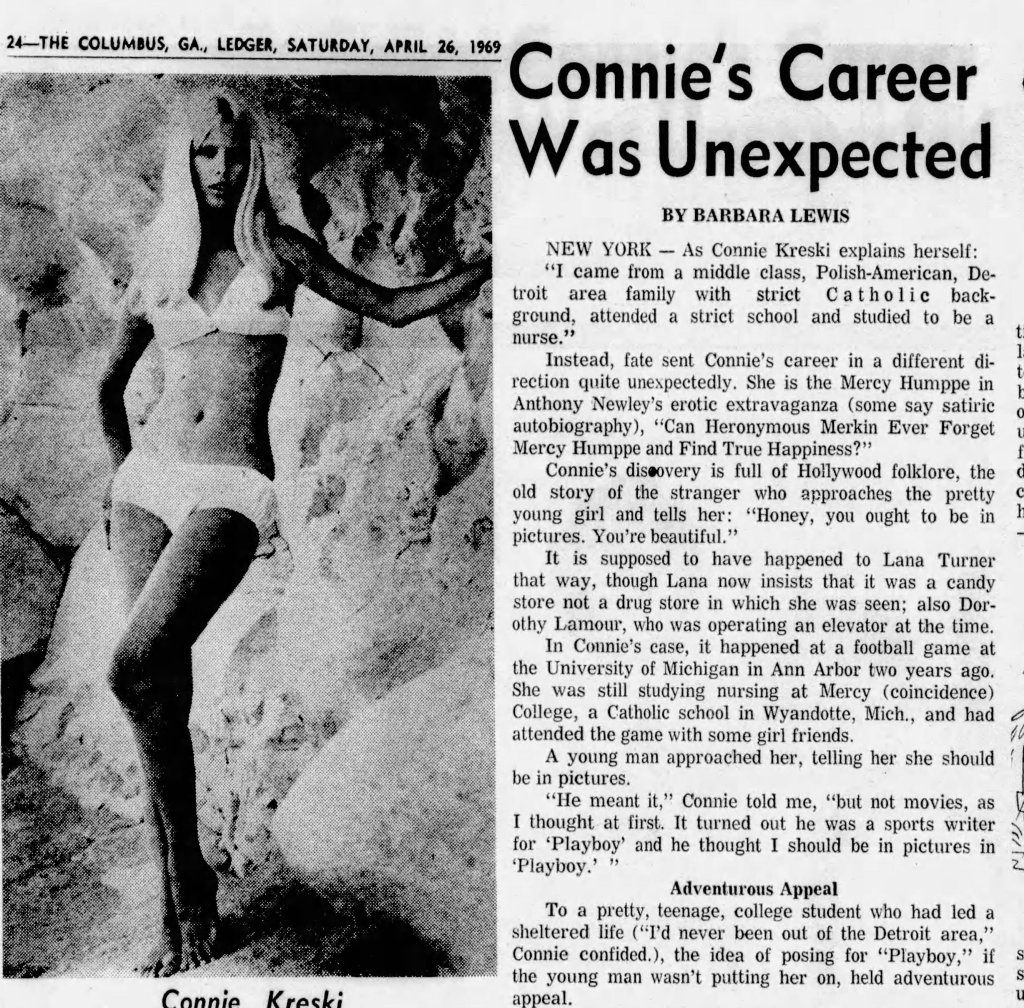
He worked for Playboy and told Connie he thought she had the ideal youthful face and figure required for Playmate candidates.
Connie appeared to look much younger than her 21 years.

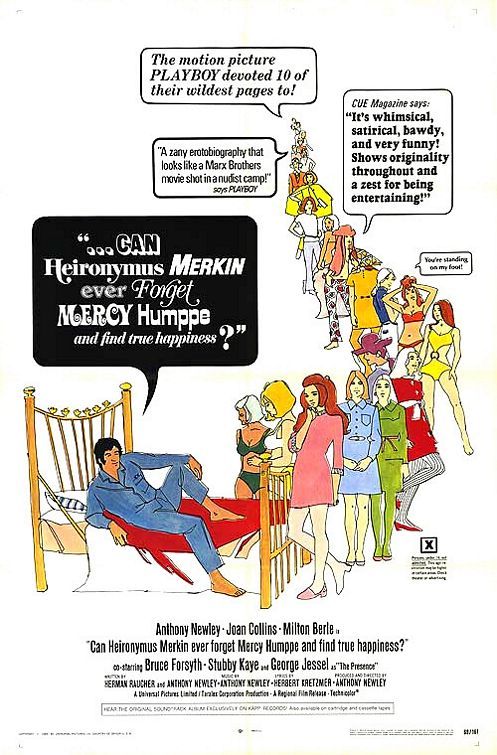
This is why Newley cast her as Mercy in his 1969 released film “Can Heironymus Merkin Ever Forget Mercy Humppe and Find True Happiness?”
Anthony Newley had married a beautiful Hollywood starlet in 1963.
She was a native of England named Joan Collins.
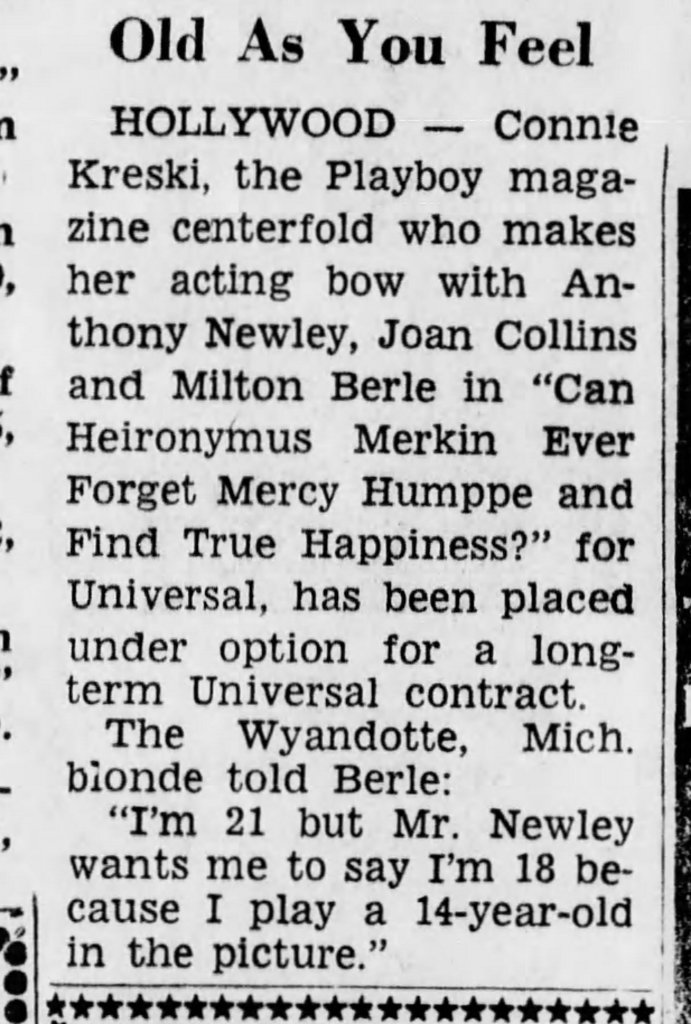
Anthony Newley plays himself in the title role of Heironymus, wife Joan Collins plays his wife in the film, named Polyester Poontang.
It was pretty much a flop and skewered by the critics.
Anthony and Joan were married in 1963 and this photo was taken around that time.
Credit Vintage Everyday Pinterest
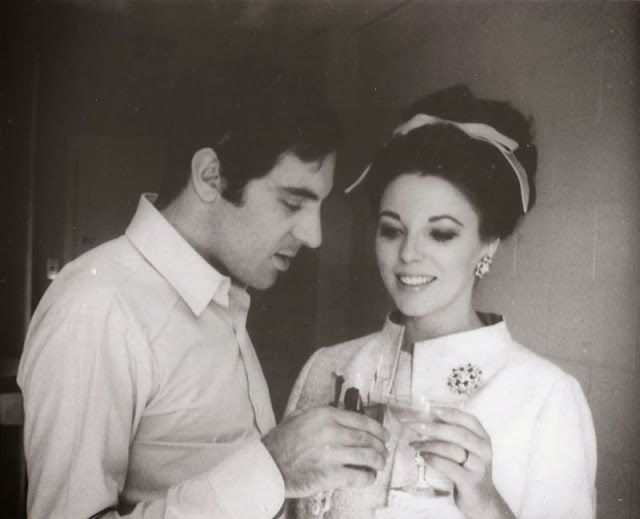
The article below was written before the disappointing reviews that followed the debut of the film in 1969.
It’s an interesting look at late-1960s popular culture by way of Newley’s film, filmed on the island of Malta in 1968.
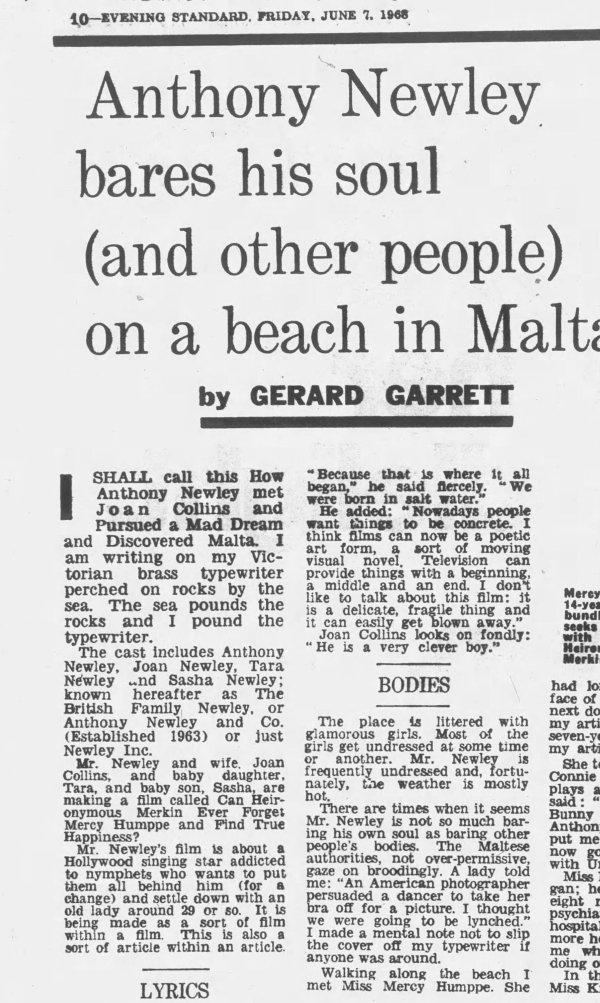
The Newley’s small children Alexander and Tara were in the film as well as and several starlets, models and dancers.
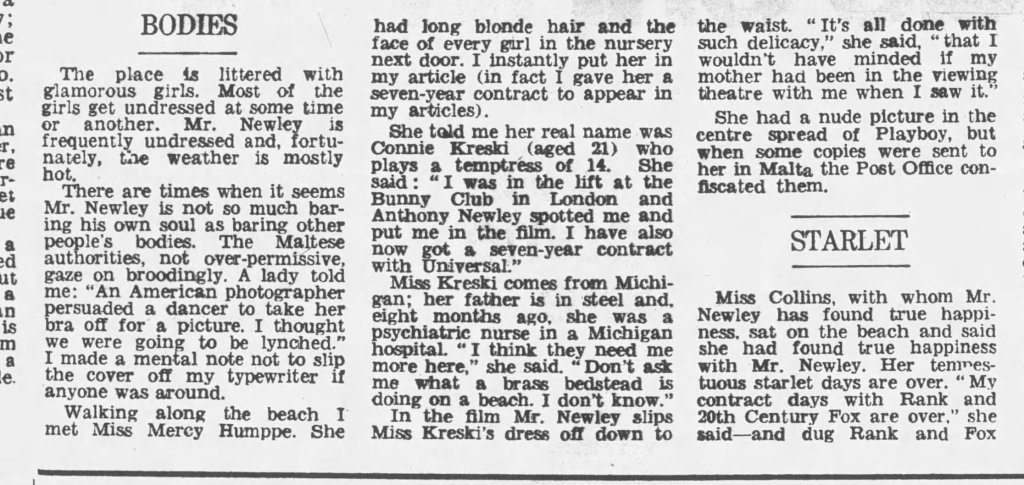
More likely, she met Lownes in Chicago and was invited by him.
Or perhaps, she followed him to London.
Note the part that Connie “plays a temptress of 14.” Paragraph 4.


Connie, just like Paige Young, had publicity all year long in 1969.
More than the 2 young women would ever have the rest of their short lives.
Connie had her picture in newspapers across the USA, England and Canada in ‘69
Connie appeared in many newspaper articles for her title role in Heironymus Merkin.
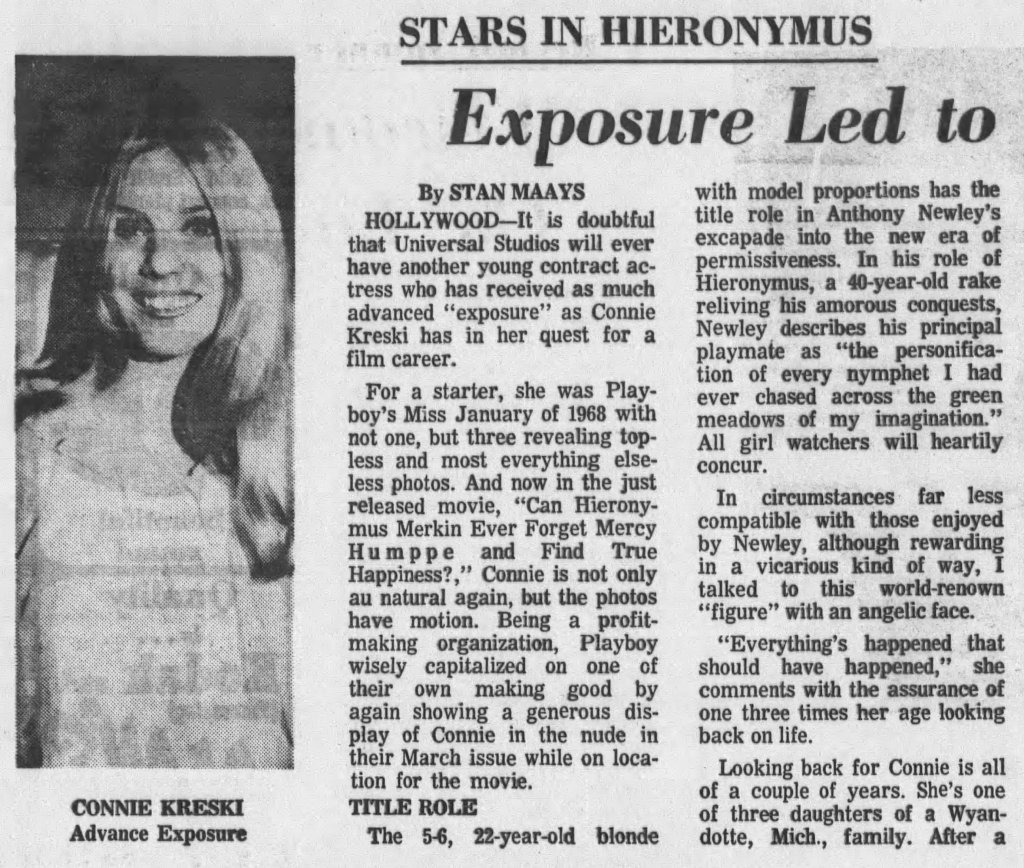
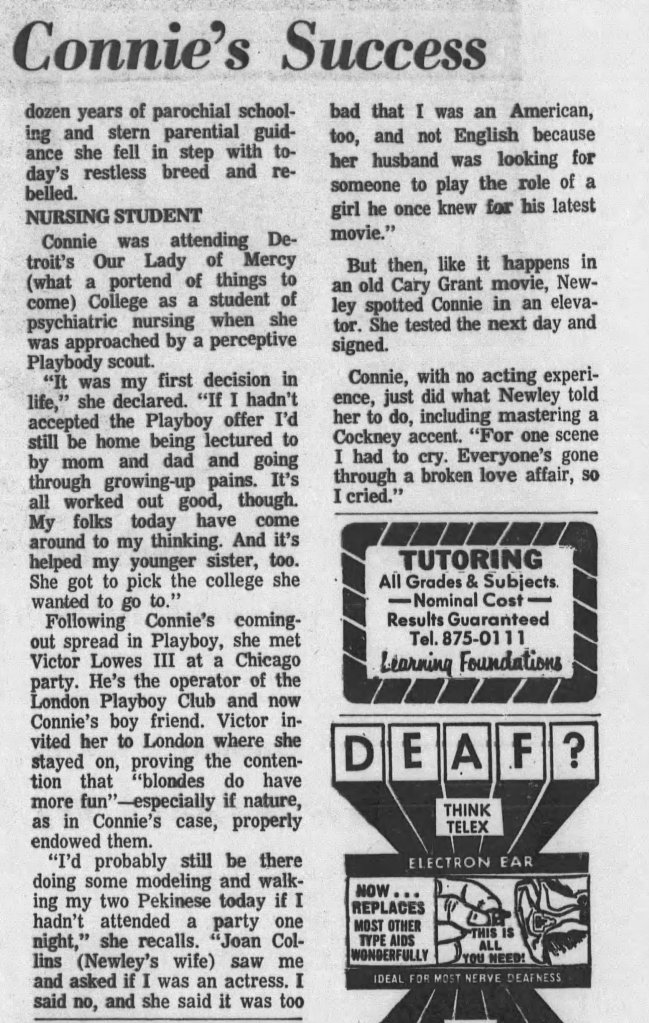

One issue of Playboy magazine featured a nine page photo spread, serving as a promo for Heironymus. And for Connie as their Playboy Star.
Newley was a great friend and appeared on Hugh Hefner’s show of 1968-1970 Playboy After Dark.
Connie has several nude shots in the issue and a nearly nude Joan Collins has one.
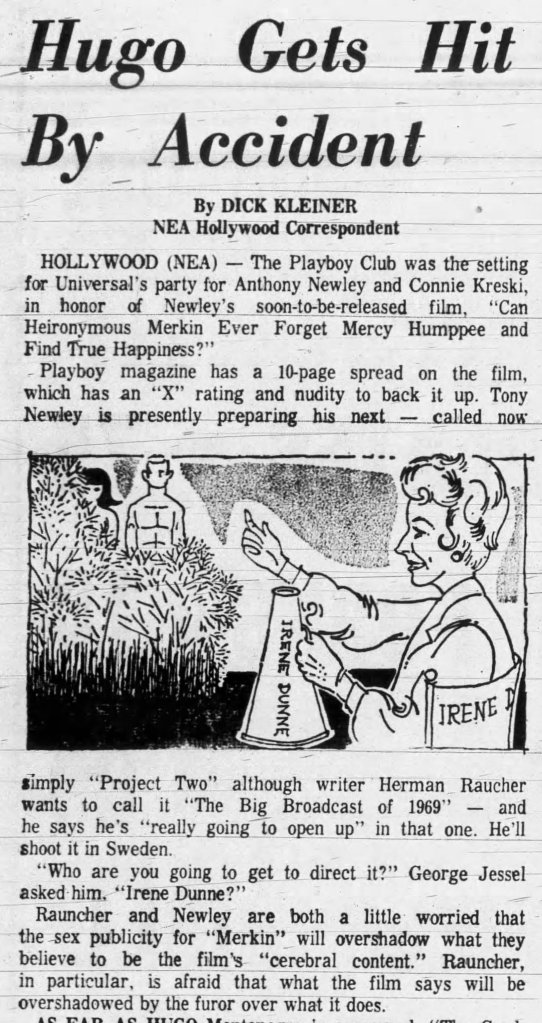
Victor Lownes
is a colorful and forgotten 1960s character.
Lownes was a close Chicago friend of Hugh Hefner.
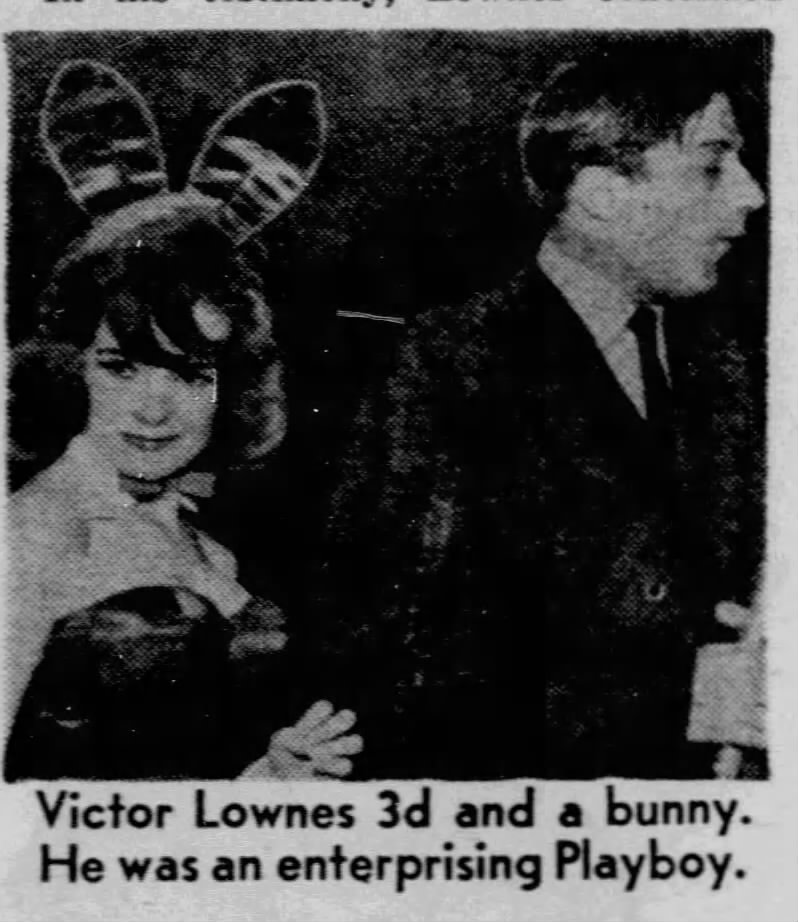
New York Daily News. Nov. 8, 1964.
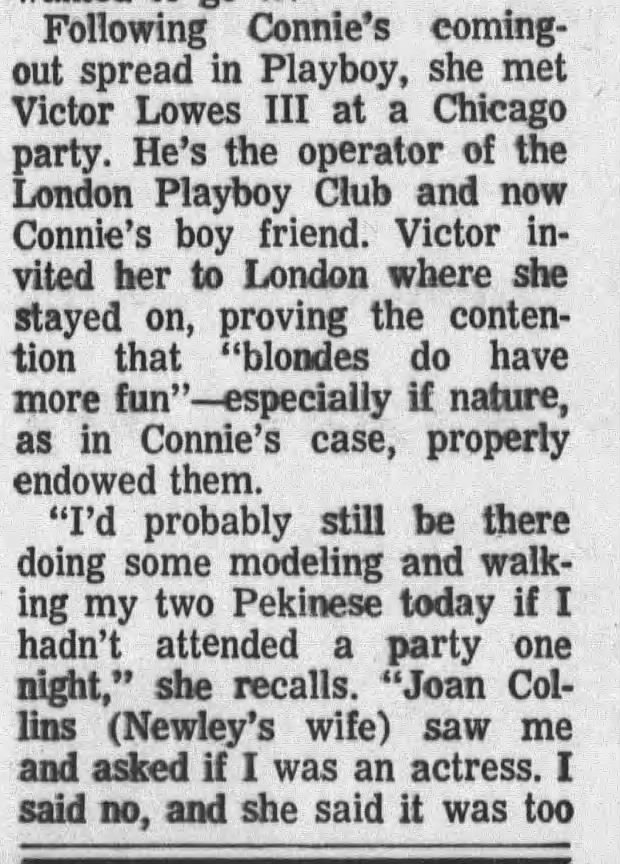
People said that Lownes, who moved to London to run the Playboy Club & Casino, embodied the“Playboy man” even more than Hugh Hefner.
He was also known to sexually harass Bunnies at the clubs.
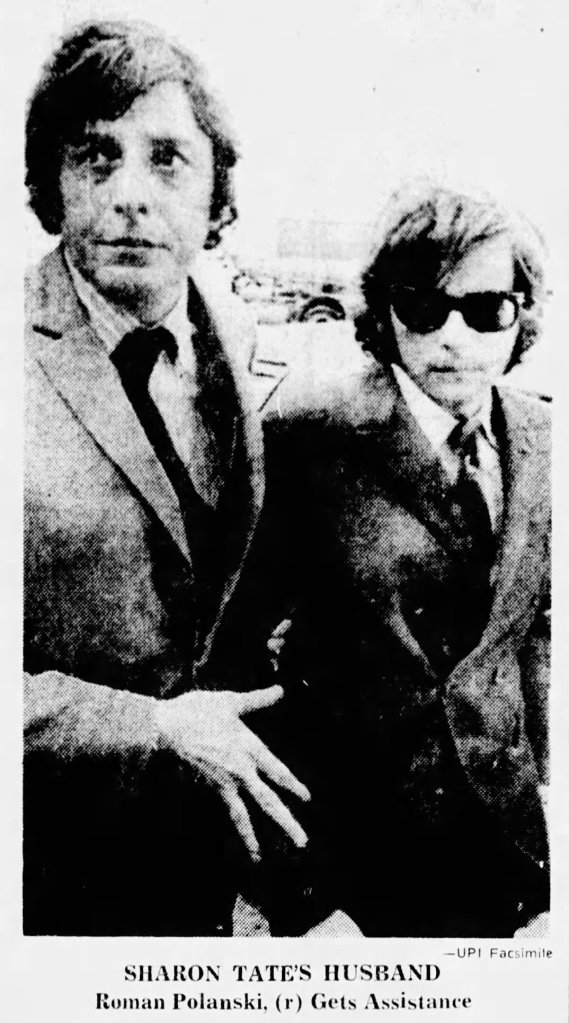
Victor and Connie are seen together in the much viewed film footage of the Tate (and maybe Jay Sebring?) funerals on youtube. However, they are never identified.
Little Known connection to Charles manson killings
Victor Lownes, Hefner and directorRoman Polanski, Anthony Newley, were close friends in the late 1960s and 1970s.
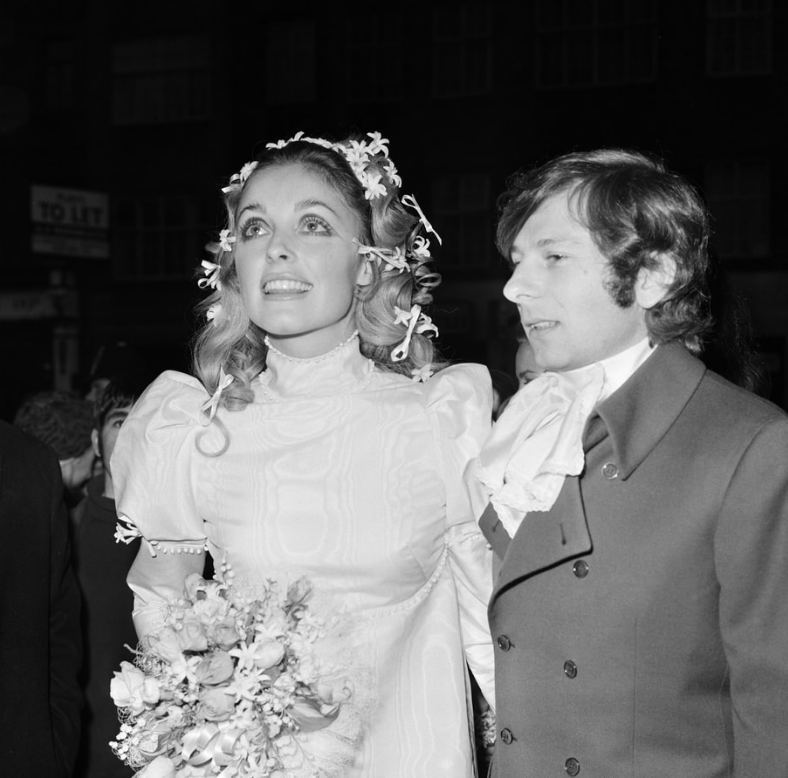
Polanski and actress Sharon Tate lived together in London for a time and had their wedding reception at the London Playboy Club in 1968. A party hosted by Victor Lownes.
Connie and Victor appear together with several mourners at Sharon Tate’s funeral in Los Angeles, on film footage seen on youtube.

Roman and Sharon also appeared together on an episode of Playboy After Dark, a show Connie appears on several times.
The couple was interviewed by host Hef; Roman does most of the talking. (Available on youtube and tiktok.)
Paige Young traveled the USA, Canada and Japan to promote the show in 1969 She may or may not have appeared on the show.
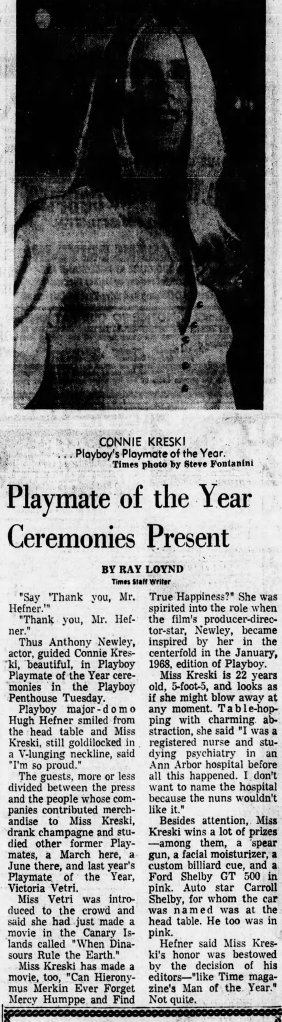
Victoria Vetri, PMOY 1968, and starlet is mentioned in left column. Her reign of ‘68 was honored at the party. The opening of her film, now a cult classic, When Dinosaurs Ruled the Earth, was also celebrated. Victoria Vetri had a small part in the Roman Polanski-directed hit film “Rosemary’s Baby.” Victoria was known as Angela Dorian when she was the September Playmate of the Month in 1967. and Playmate of the Year 1968 as Victoria Vetri. Roman Polanski convinced her to use her real name. of Victoria Vetri, where she had a bit part in Rosemary’s Baby.
The Manson murders would occur just a few months after this article appeared.


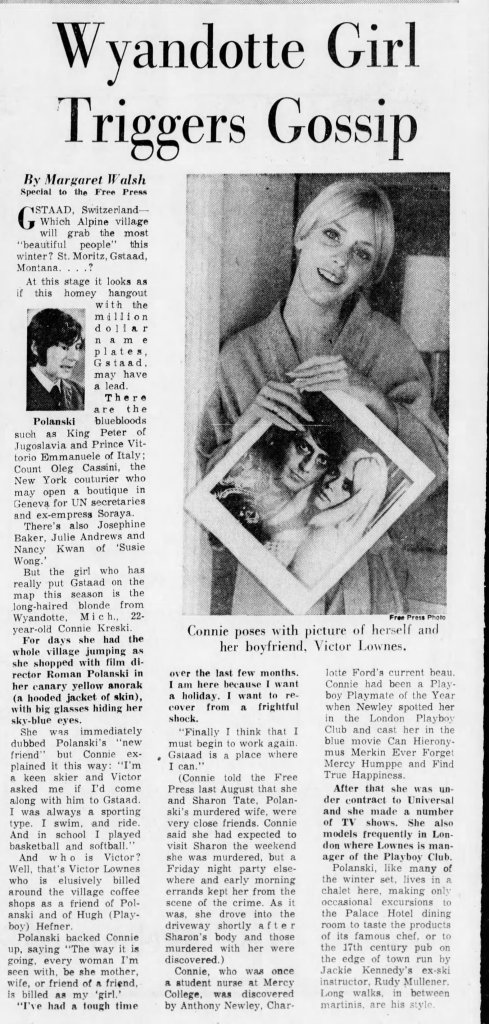
Connie holds photo of herself and Victor, who would dump her in about 2 years for the force of nature that was Marilyn Cole. Connie claims there is nothing romantic going on between her and Roman Polanski. This article is only months after the horrific murders.
Victor dumped Connie after he fell hard for a new Bunny at the London Club.
The aforementioned Marilyn Cole.
She has her own story to tell and has done so in interviews. But she’s never been asked about her love triangle involving Connie and Victor, other than the book Bunny by Russell Miller.
Marilyn Cole appears briefly in Secrets of Playboy.
This Bunny was quickly promoted PMOM in 1972 and PMOY in 1973.
Marilyn Cole’s Playboy centerfold is famous/infamous for being the first obvious straight-on view of a PMOM with full frontal nudity. Not subtle or hidden as in earlier photos.
Cole’s issue came at a time when Playboy magazine experienced a drop in readership, due to competition from the new and more explicit Penthouse magazine.
The Marilyn Cole issue provided a huge sales boost for Playboy which she talks about in Secrets of Playboy documentary.
Penthouse magazine featured more explicit and forward photography of their centerfold called a “Penthouse Pet.” In particular full-frontal nudity.
The viewer is more of a voyeur to the private bedroom of the “Pet,” than he may have seen in the Playboy centerfold.
Playboy was “forced” or pressured into publishing the centerfolds in the Penthouse style. This was to keep up with the new standards in popular culture, the more open nudity standards Playboy helped to bring in.
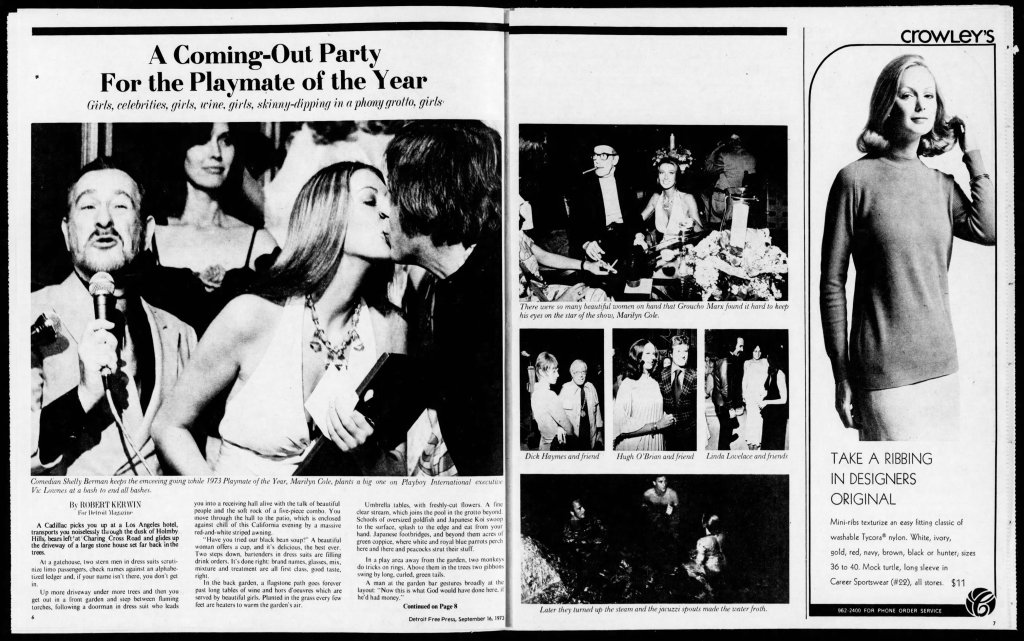
Detroit Free Press. Marilyn is Playmate of the Year and is thrown a big party. Here she kisses boyfriend Victor Lownes.
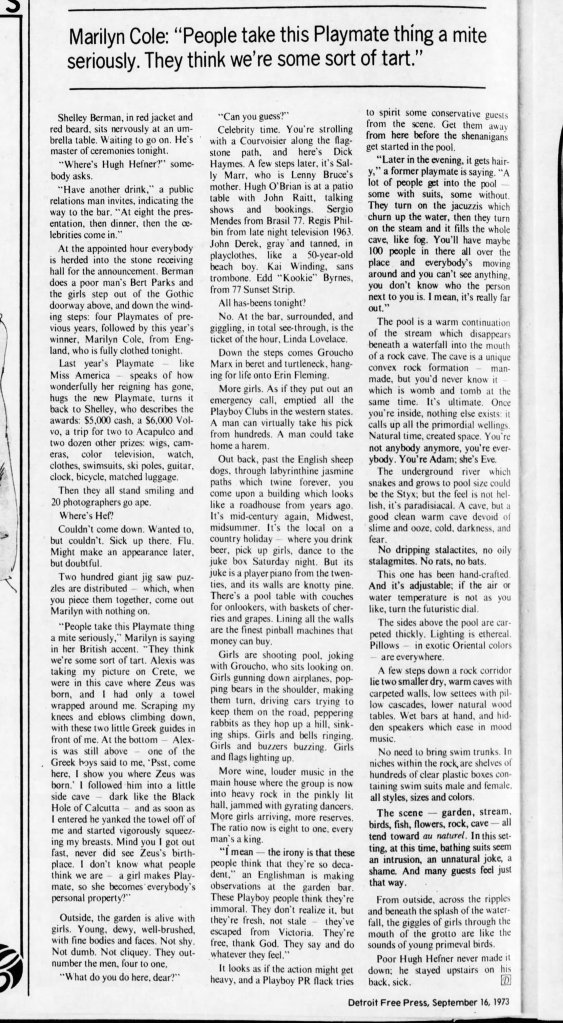
More on Marilyn Cole soon.

Connie during her time on Malta.
Connie Kreski has about 10 TV and film appearances after “Hieronymus.“
April 6, 1969. Long Beach Press Telegraph
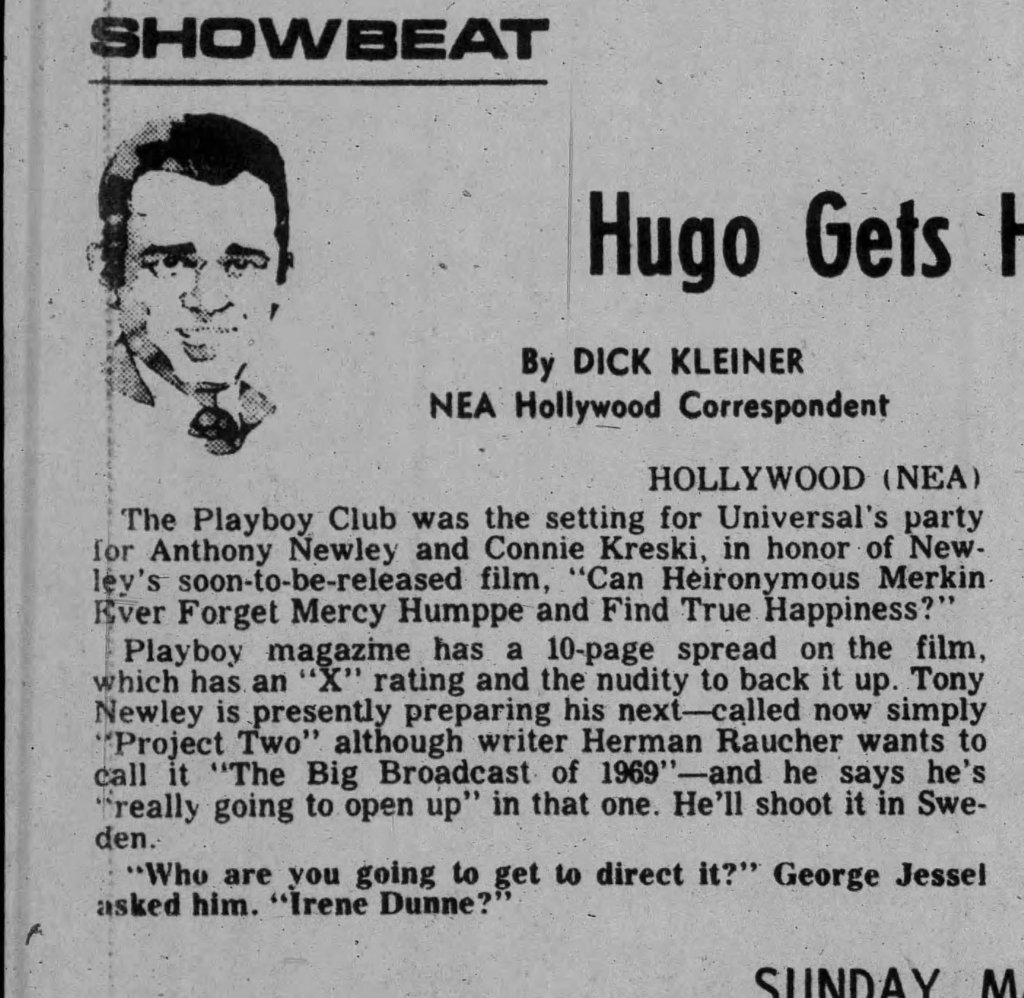

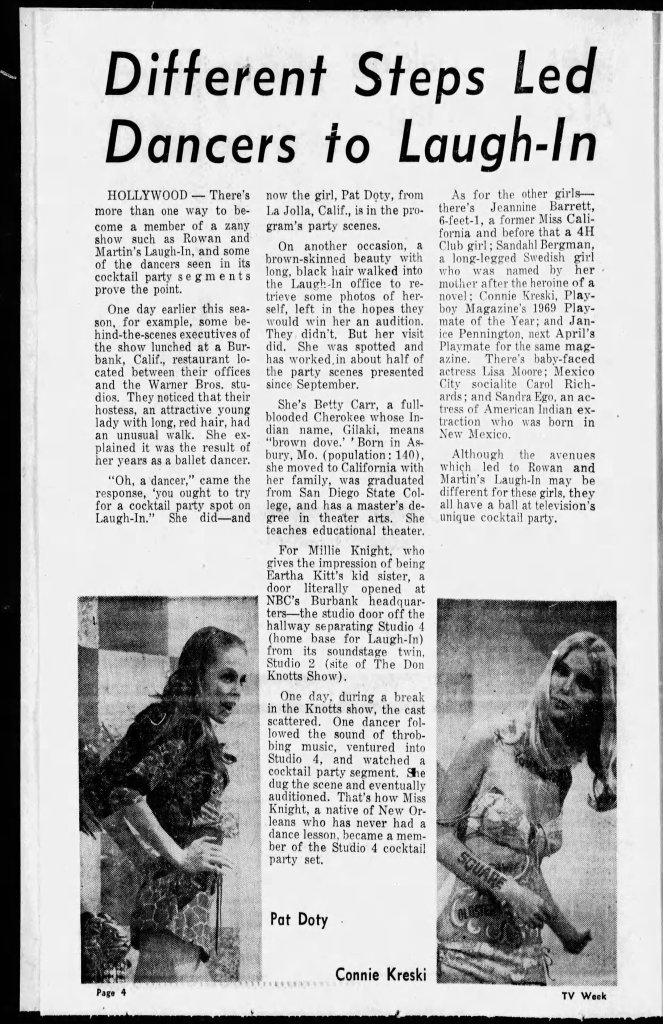
From 1969
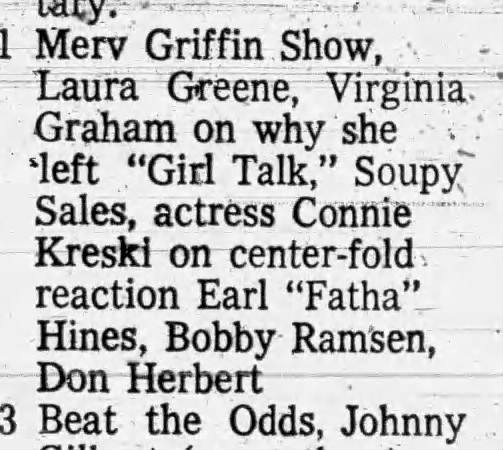
Connie appeared as a guest on the Merv Griffin and Joey Bishop talk shows.

From the Fremont Tribune, June 21, 1973
In a 1969 episode of Playboy After Dark, Connie is introduced by Hugh Hefner as “Connie Kreski, our Playmate of the Year.” Connie does not say one word the entire show.
She does have more lines on other episodes of PAD, mostly the ones from 1970, the last year of the program.
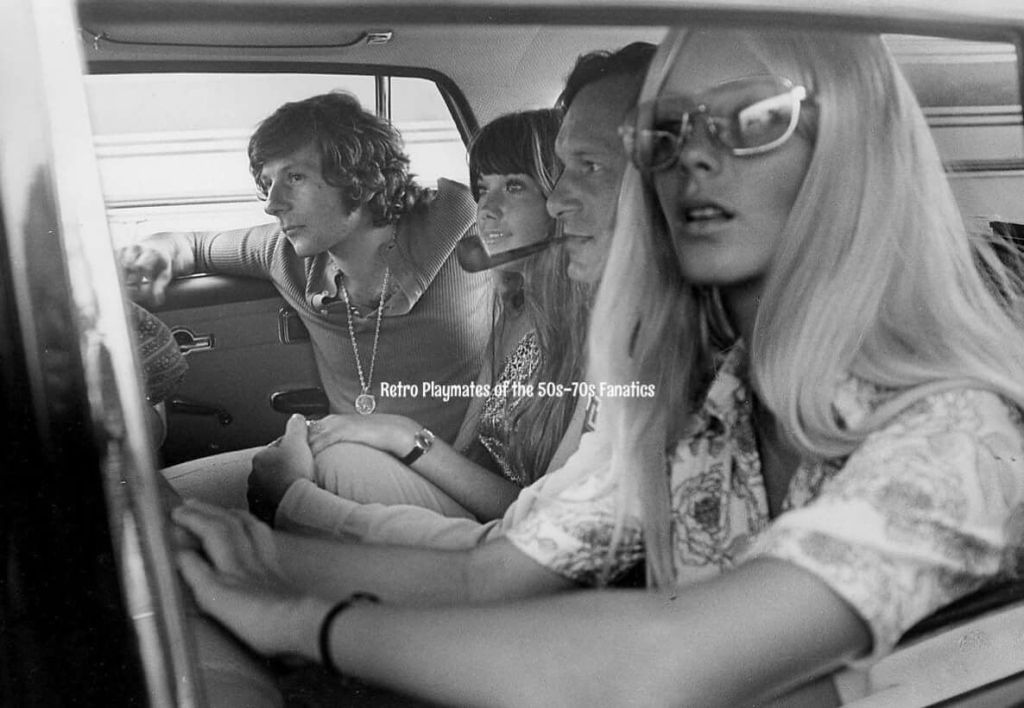
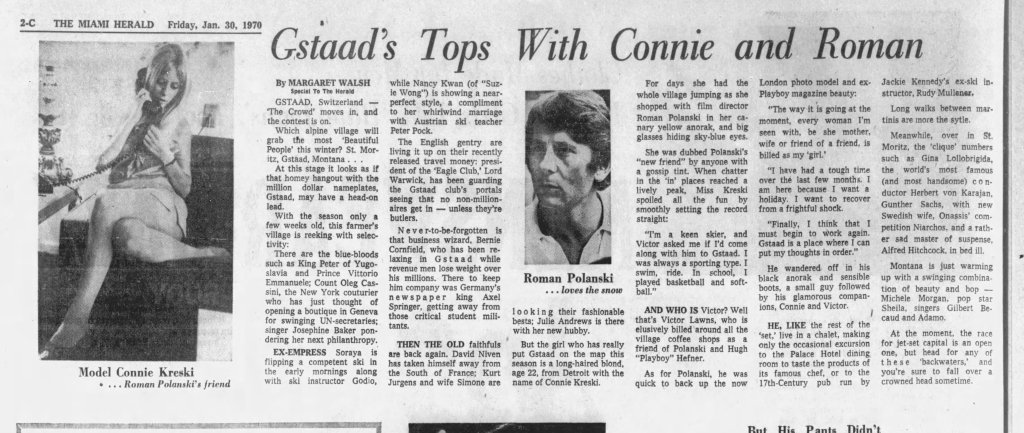

The People, London. Aug. 23, 1970 A little over a year since Sharon Tate and the others were murdered, Connie remains friends with widower Roman Polanski. Sorry for poor quality.
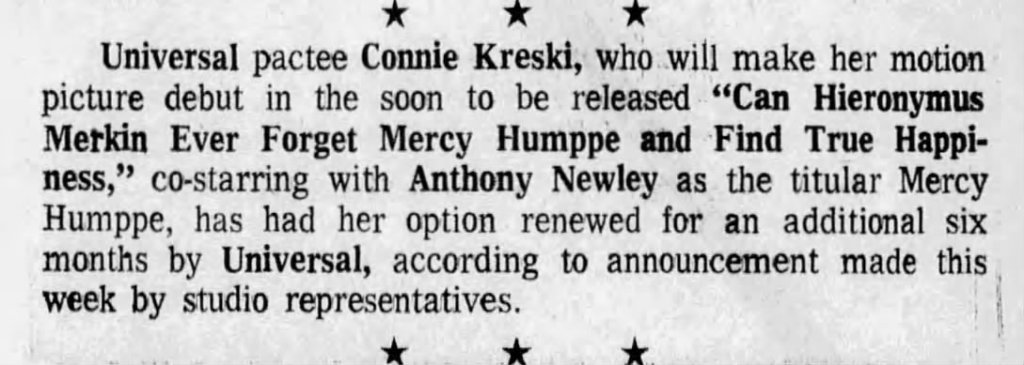
Kreski’s newspaper press indicates she was signed to a contract with Universal Studios.
Universal signed an extraordinary number of pinup models, beauty contest winners and starlets in the 1950s and 60s.
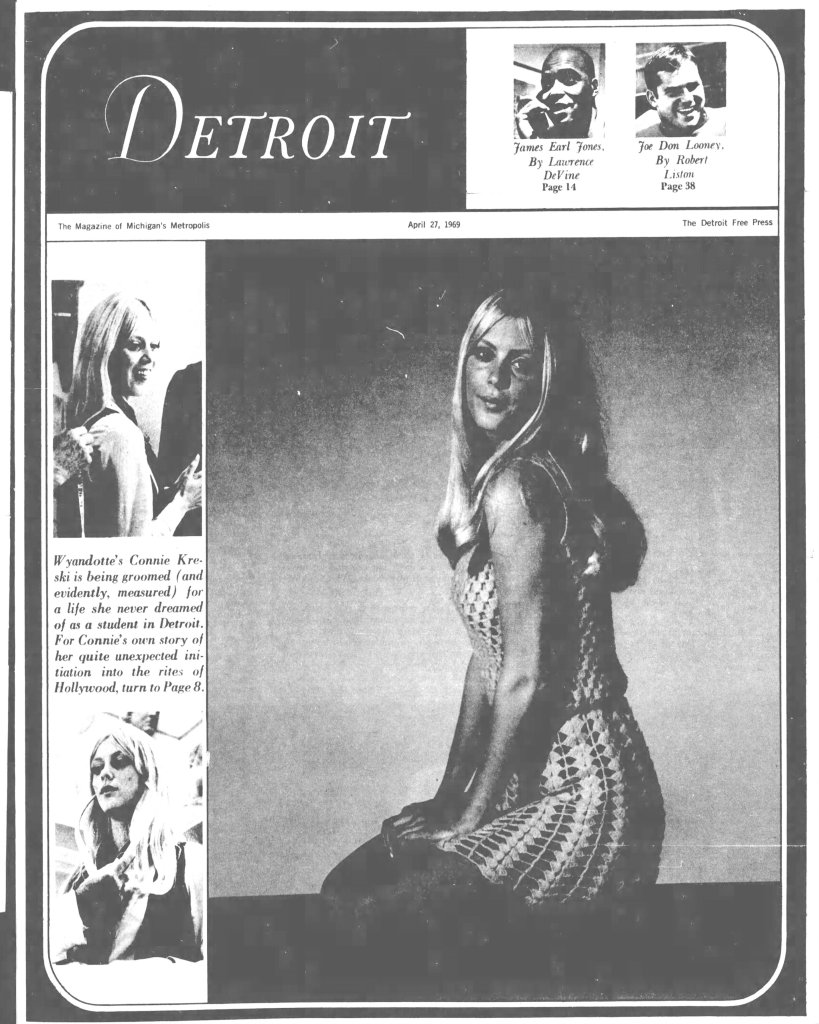
Detroit Free Press April 27, 1969 The hometown/homestate paper covered their Hollywood star.
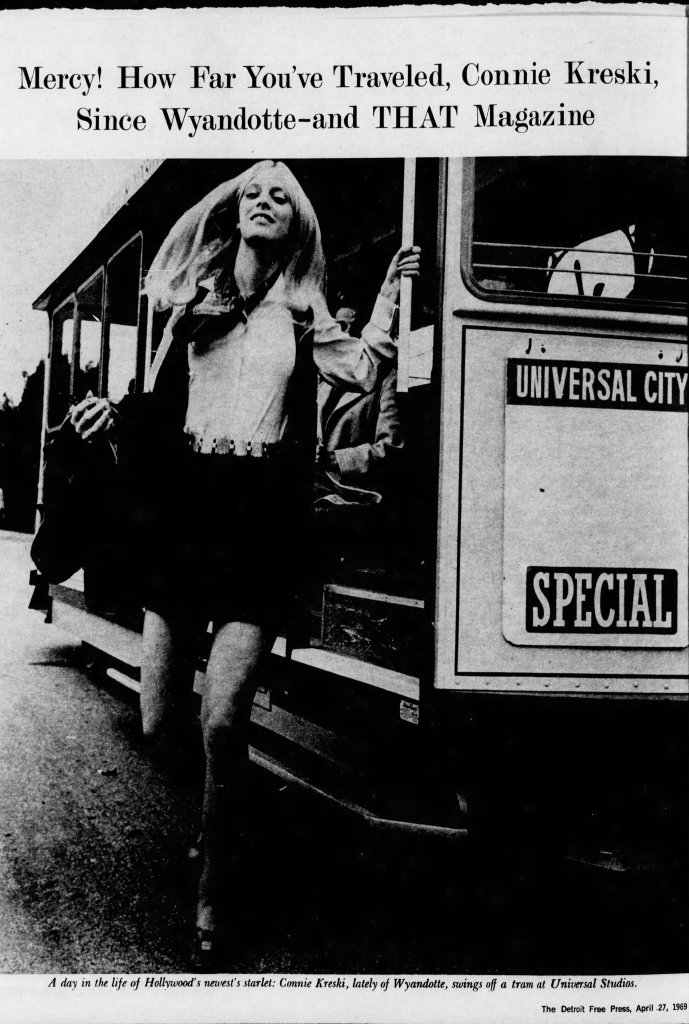
It seems Connie had about 15 minutes of fame as an actress.
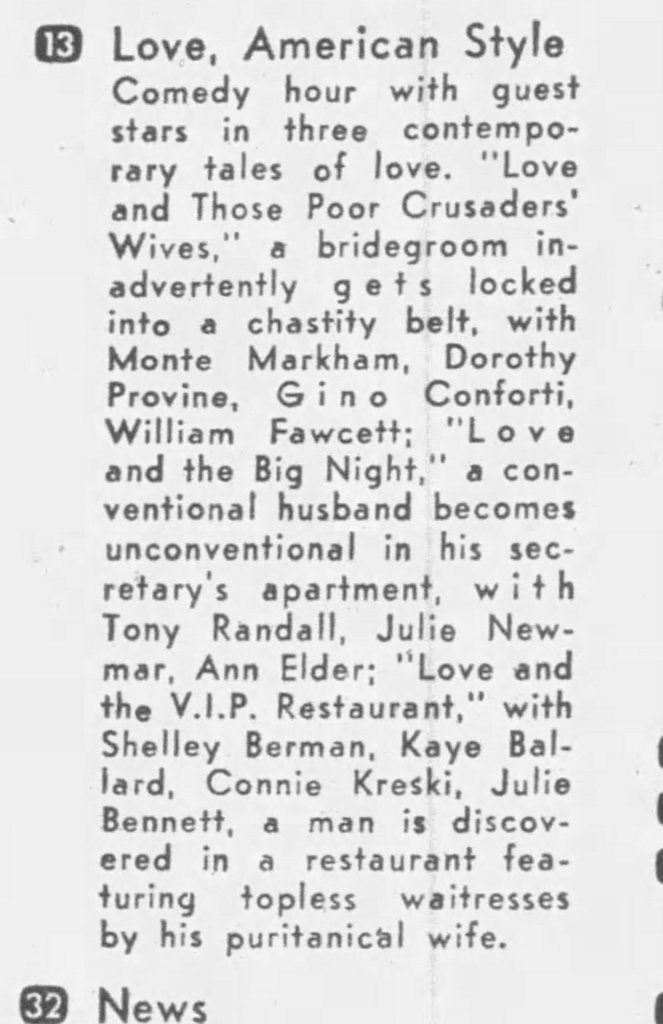
She appeared on a memorable 1970 episode of Love American Style starring Kaye Ballard, playing a topless waitress: Love and the V.I.P. Restaurant.
After a few years Connie’s contract with Universal was dropped which merited one sentence in a Hollywood gossip column I read.
Her last credit is a TV mini-series Aspen in 1976. Unavailable.
Boyfriend James CaaN
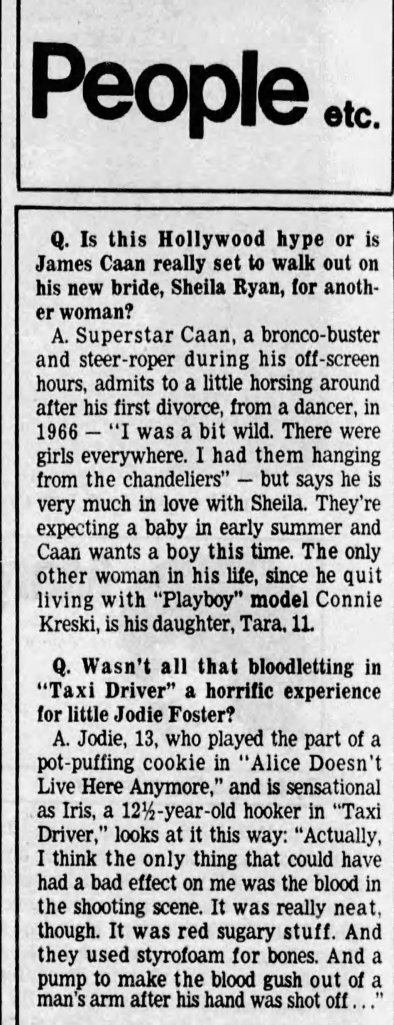
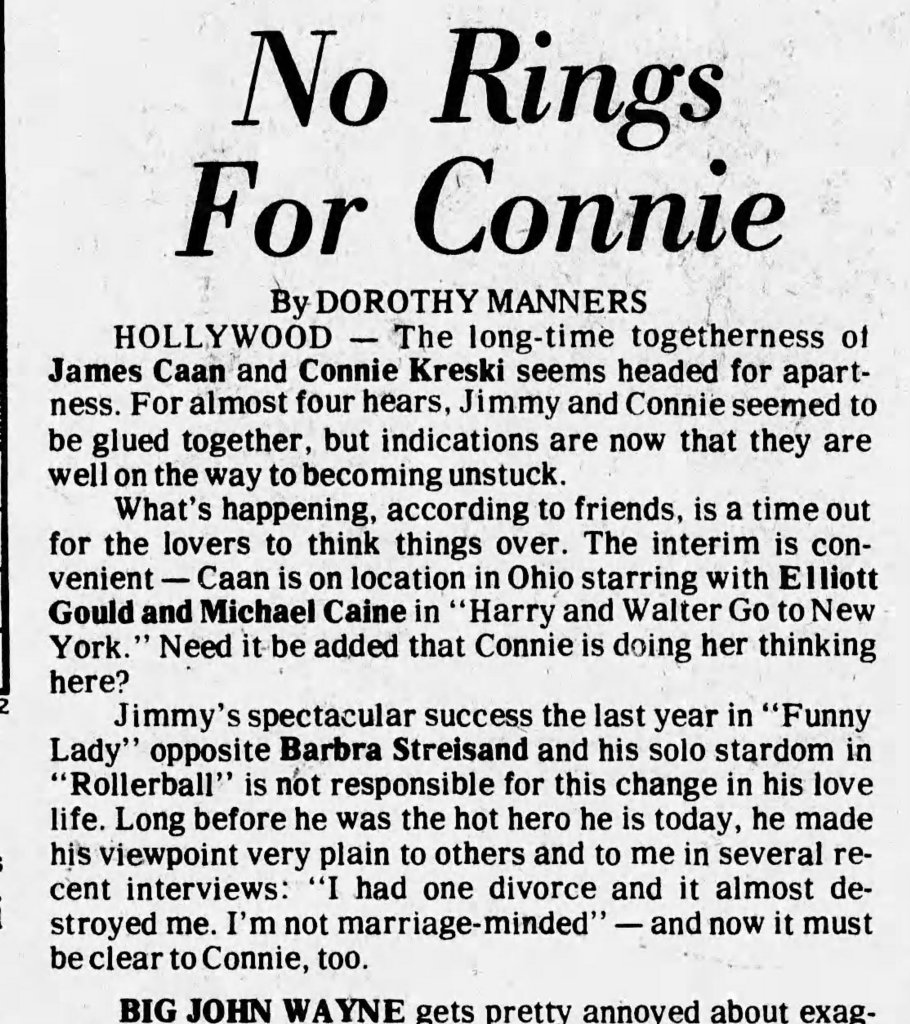
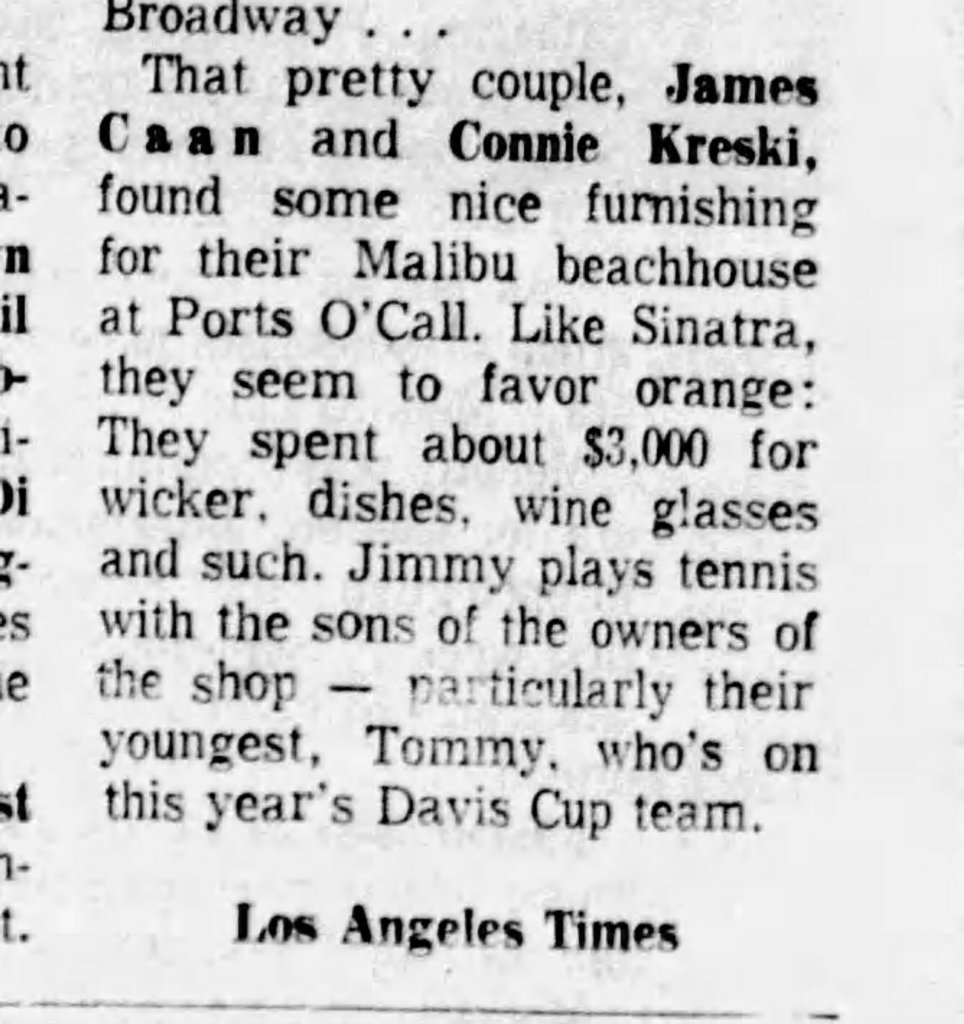
Connie had a high profile romance with actor James Caan beginning in the early 1970s and lasting around 4 years.
She was identified in Hollywood news articles as his “girlfriend” and “ex-Playmate.”
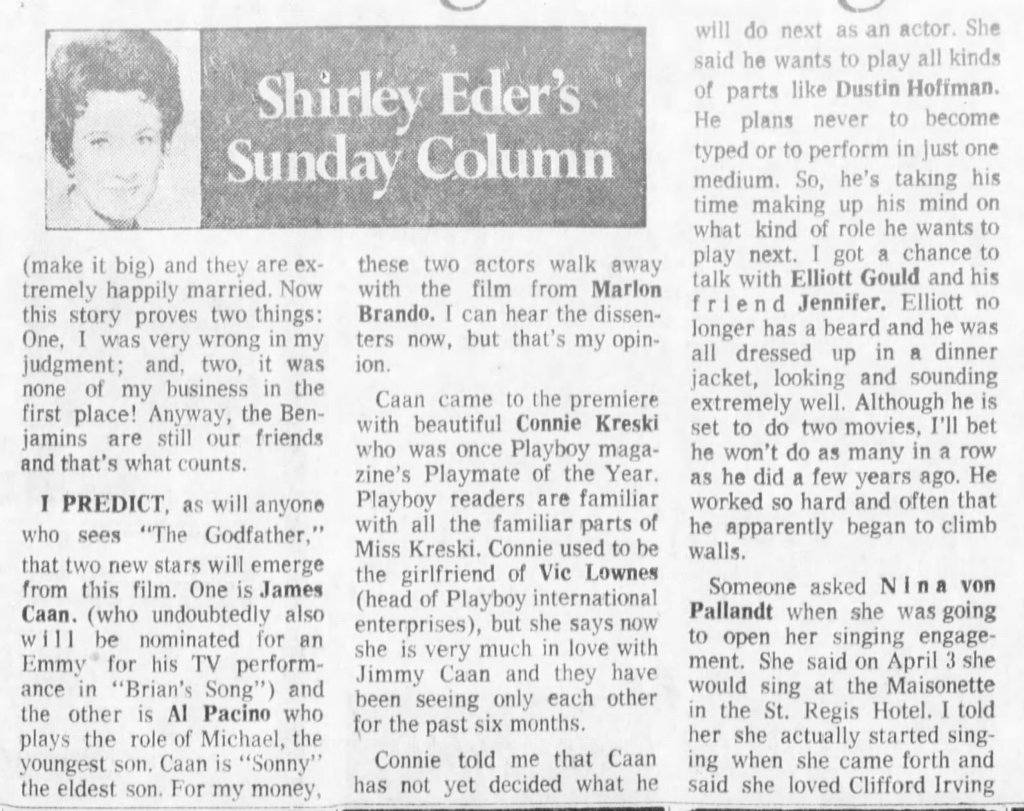
The two got together soon after Caan’s star making turn in The Godfather; he was much in demand by directors and studios.
And by many beautiful young women, according to several interviews at the time.
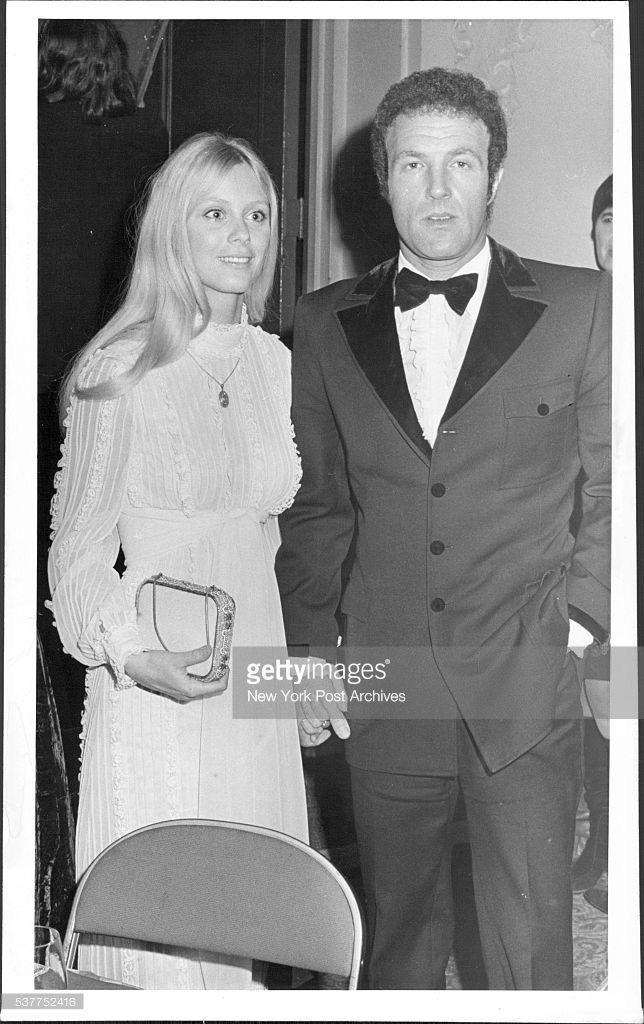
Playboy Mansion regular James Caan speaks about girlfriend Connie Kreski in NY Daily News Oct. 8, 1972
>>>>>>>>>>>>>>>>>>>>>>>>>>>>>!!!!!!!!
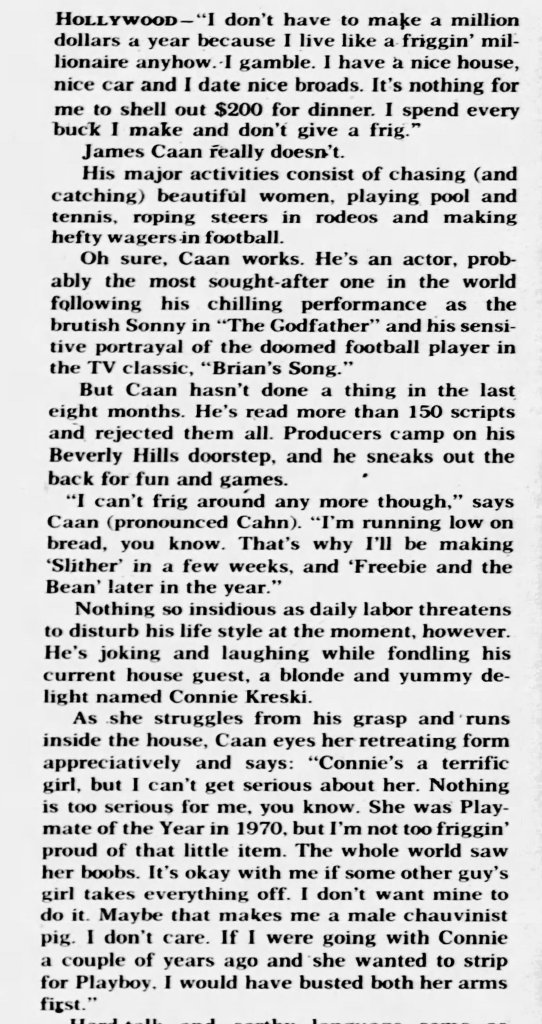
Below image is from 1970s Playboy article on men’s jewelry featuring Caan and girlfriend PMOY Connie.

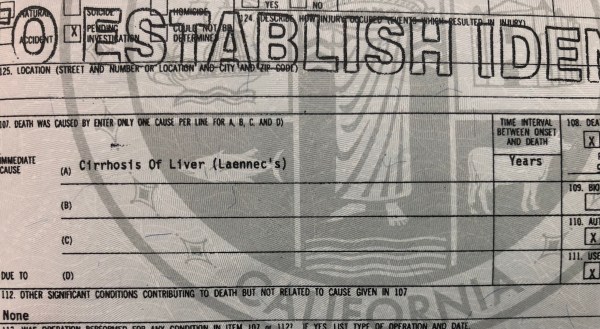
It was determined that Connie Kreski died of cirrhosis of the liver at age 48 in 1995. Laennec’s is a cirrhosis most associated with alcohol abuse over time.
What happened in her life that caused it to end this way at the age of 45?
What happened to her friendships with Hefner and Polanski and that crowd? And James Caan?

Connie Kreski is rarely mentioned in any pop culture forum.
I find that strange, given the people that she was seen hanging out with: Roman Polanski, Sharon Tate, Hugh Hefner, Anthony Newley and James Caan.
Many of these people continue to generate attention and conversation. Some are still alive, many dead.
Most recently, Connie’s ex and Playboy mansion regular and good friend of Hefner, James Caan passed away on July 6, 2022. His death drew numerous accolades and a film festival is in the works.
Unusually, Caan lacks a dedicated biography.
This will likely be forthcoming.
Caan hadn’t been asked about Connie since the 1970s, that I have ever seen.
Like Fellow 1968 Playboy Playmate Paige Young, Connie’s cause of death is incorrectly identified on the internet. It usually says “blocked carotid artery” or “cancer.” Connie’s entry in The Playmate Book, mentions her death in Beverly Hills, 1995, but doesn’t state a cause. I have included closeups of her death certificate.
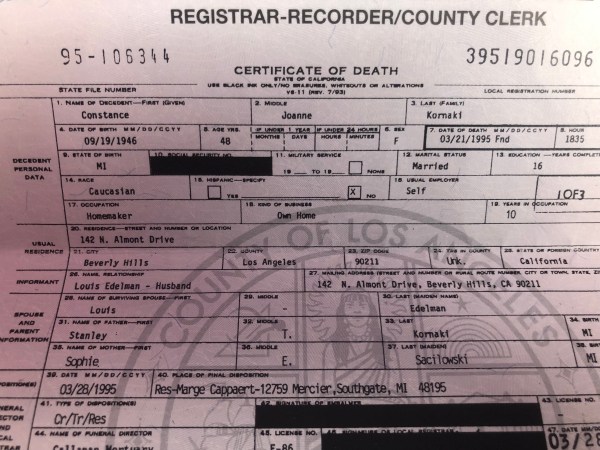
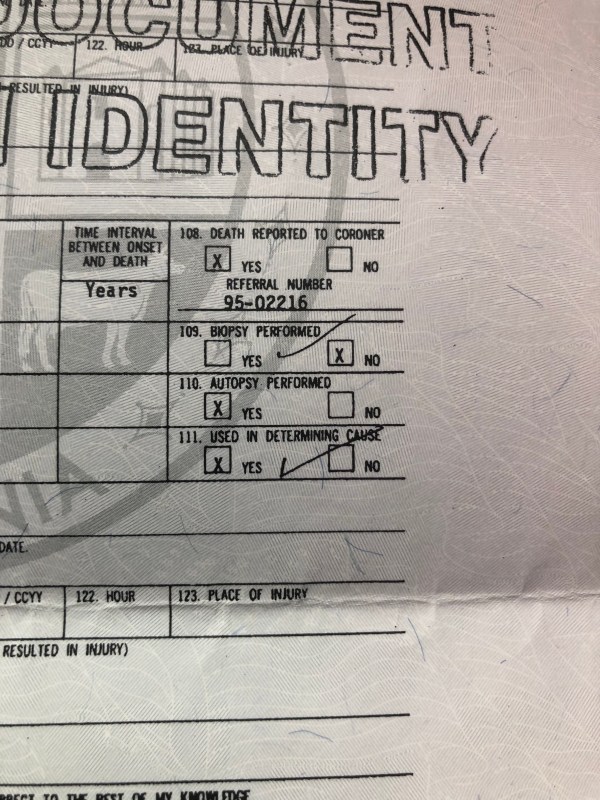
Connie died in March of1995 at the young age of 49. She died before her about 10 years older husband, Louis Edelman.
I had long wondered what happened to Connie so I ordered her death certificate.
And after seeing it, of course I wondered how she had become an alcoholic with all her seeming advantages in life.
Beauty and a budding career in movies and TV and the potential for money.
Cirrhosis of Liver is clearly stated as the cause of Connie’s premature death. Interval between onset and death says years.
Connie and a man named Louis Edelman were married in New York in 1986 per records seen on ancestry.com.
They set up a marital home in Beverly Hills. Connie was pregnant at the time but unfortunately lost the baby.
I was lucky to get some answers by correspondence with Connie’s stepdaughter Barbara Cooper. Her father was Louis Edelman, husband to Connie.
To sum it up, Barbara told me that Connie was very nice and sweet and wonderful to her step-granddaughter.
However, she seemed to eat very little, often just picking at her food. She also witnessed Connie working out on a treadmill with saran wrap tightly covering her body, in order to promote sweating out extra calories.
Barbara wrote that her Dad would hide liquor bottles from his wife.

Barbara Cooper told me that after the loss, Connie began an obsession with calorie counting and losing weight. On top of that she abused alcohol and her husband Louis felt compelled to hide liquor bottles from his wife.
With those two illnesses, it’s no wonder that Connie died so young and before her older husband.
Barbara’s daughters spent vacations with “Grandpa and Connie in California.” Barbara told me how consistently kind and sweet Connie was to her daughters and to everybody.
She said that Connie did not talk about Playboy, Hefner, any of the Playmates, or her days in Hollywood.
More on Connie Kreski and her brief time in the spotlight

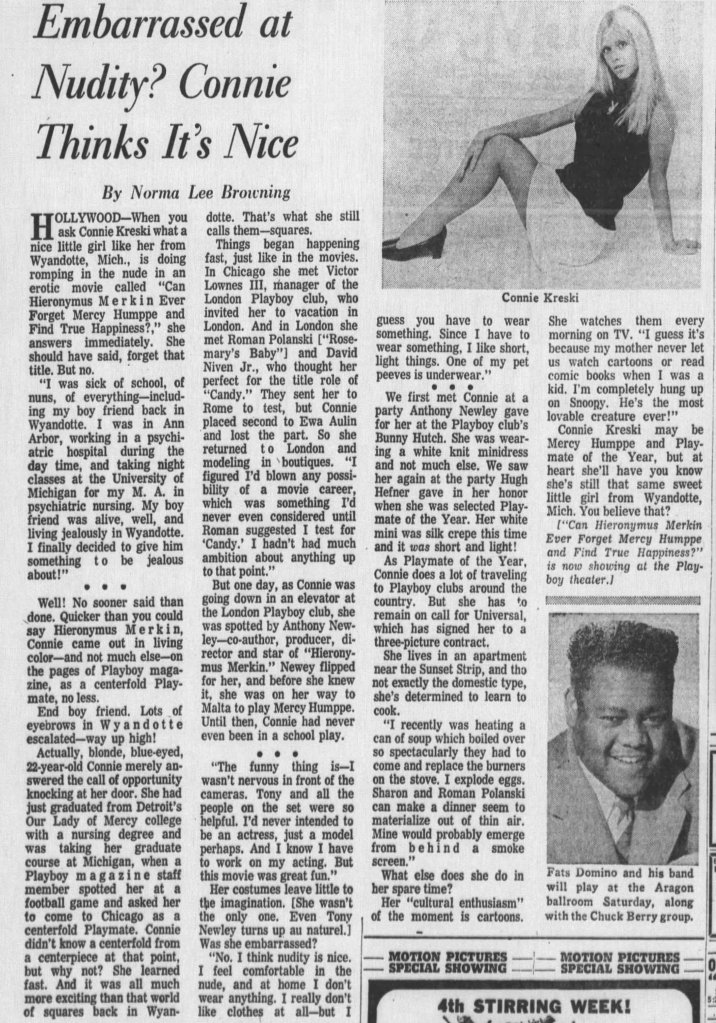
Telegraph Journal New Brunswick. July 10, 1969
Still a couple years away from meeting Marilyn Cole and giving Connie the heave-ho.
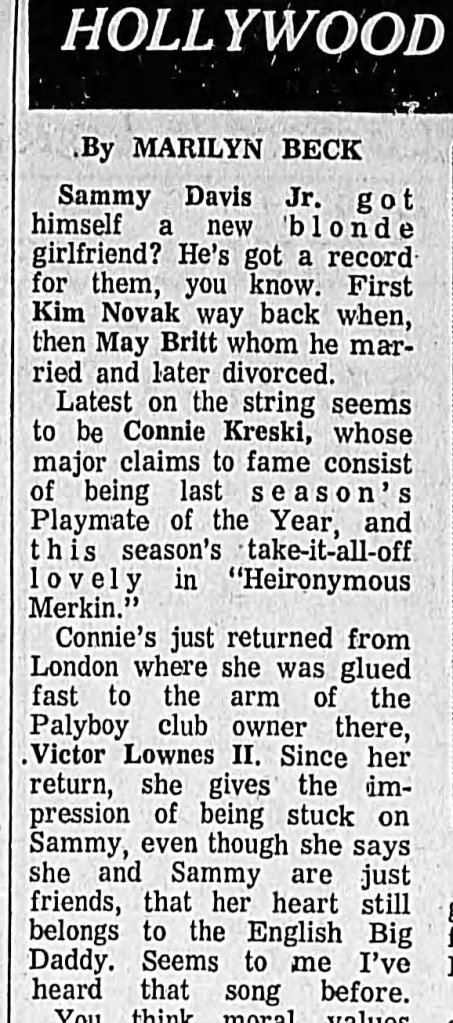
Another famous gossip columnist of the era: Marilyn Beck. Here, she dispels any truth to the rumors of a romance with Connie and Sammy Davis Jr.
She was Sammy’s type in that era given the physical qualities of Sammy’s women mentioned here.
I doubt that Victor Lownes remained faithful to Connie. She was in LA working on her new career as an actress.
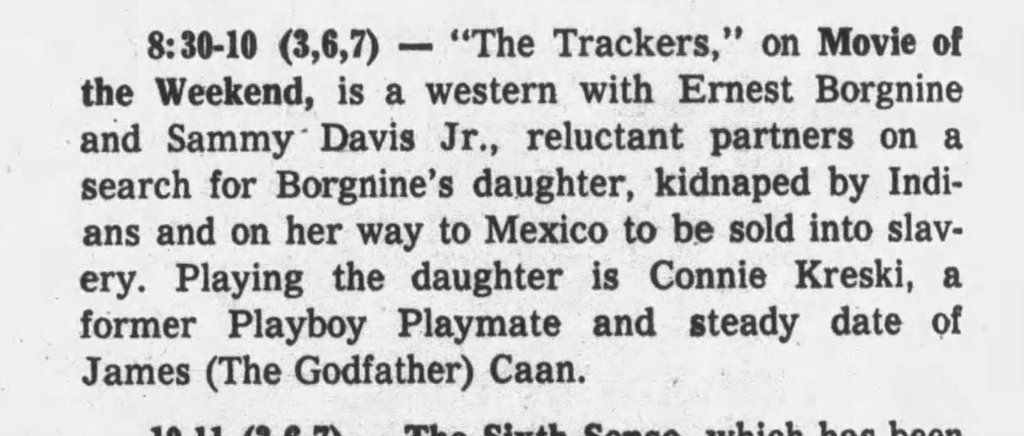
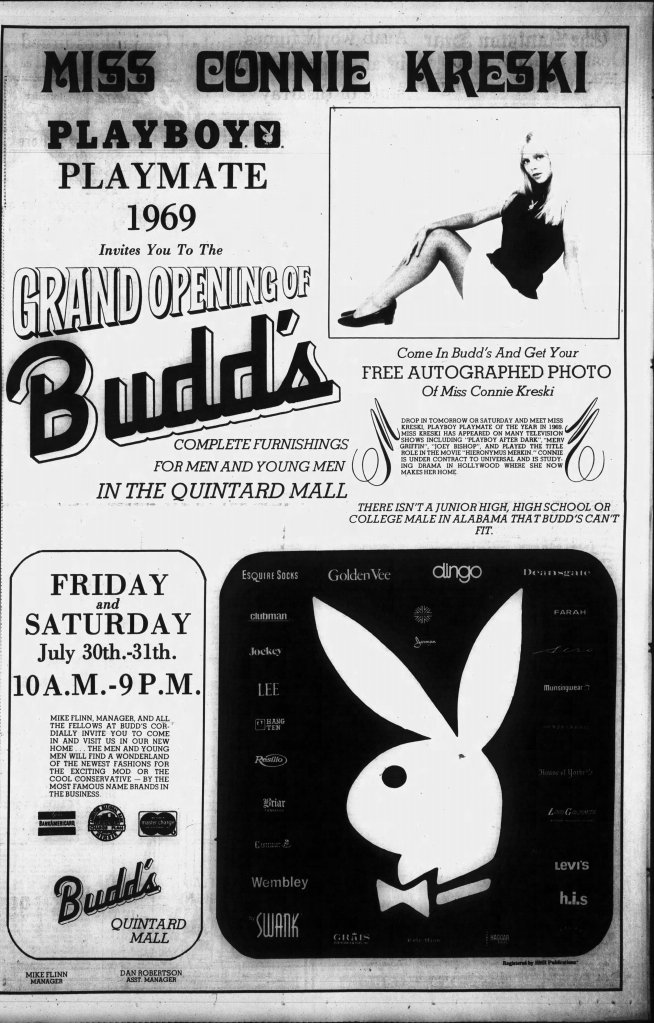
Connie had a fair amount of press on and off, for about 6 years. Press for projects and Hollywood gossip due to her relationships with Victor Lownes, Roman Polanski (denied as a relationship) and later James Caan.
I’ll be posting several of all kinds.

She was wafer thin with proportions of being tall; she could have been a perfect commercial model, if not a high fashion one. There are many fashion shots of Connie that I haven’t yet published.


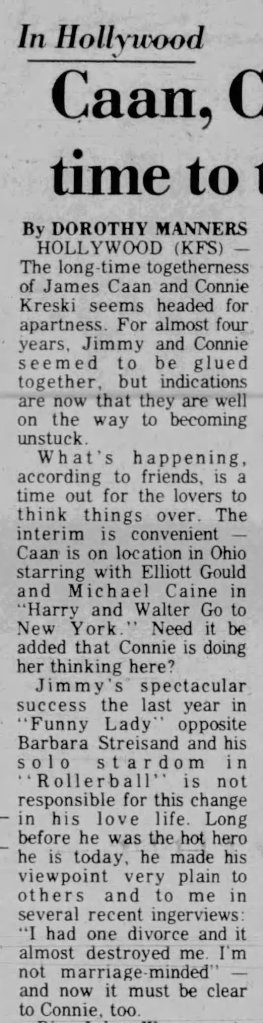
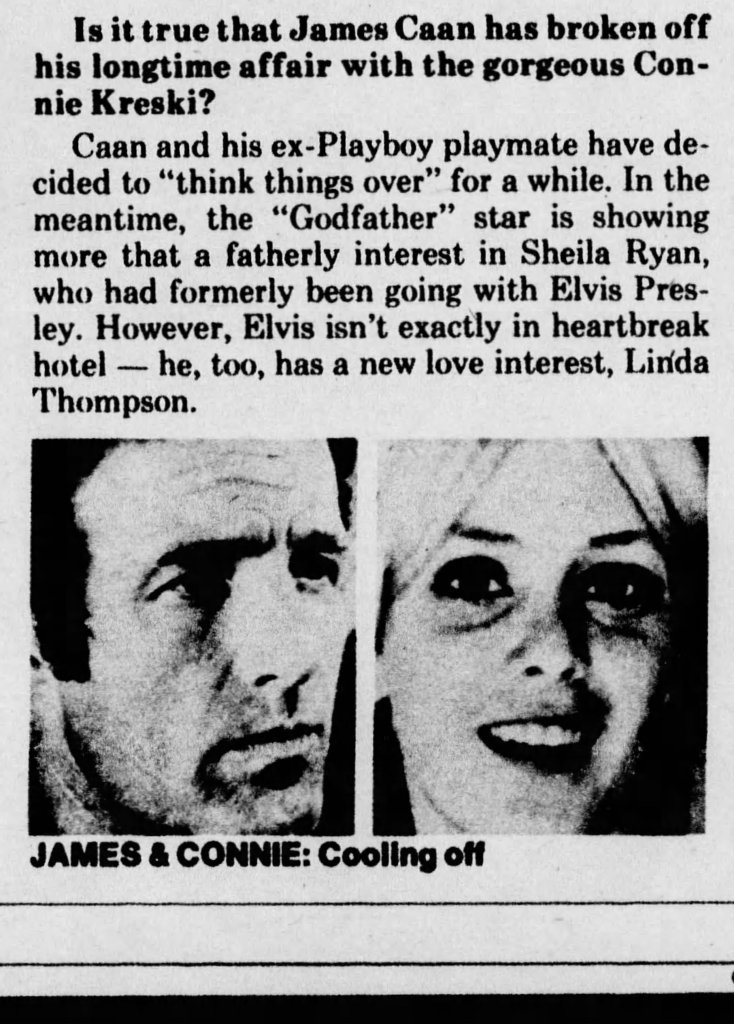
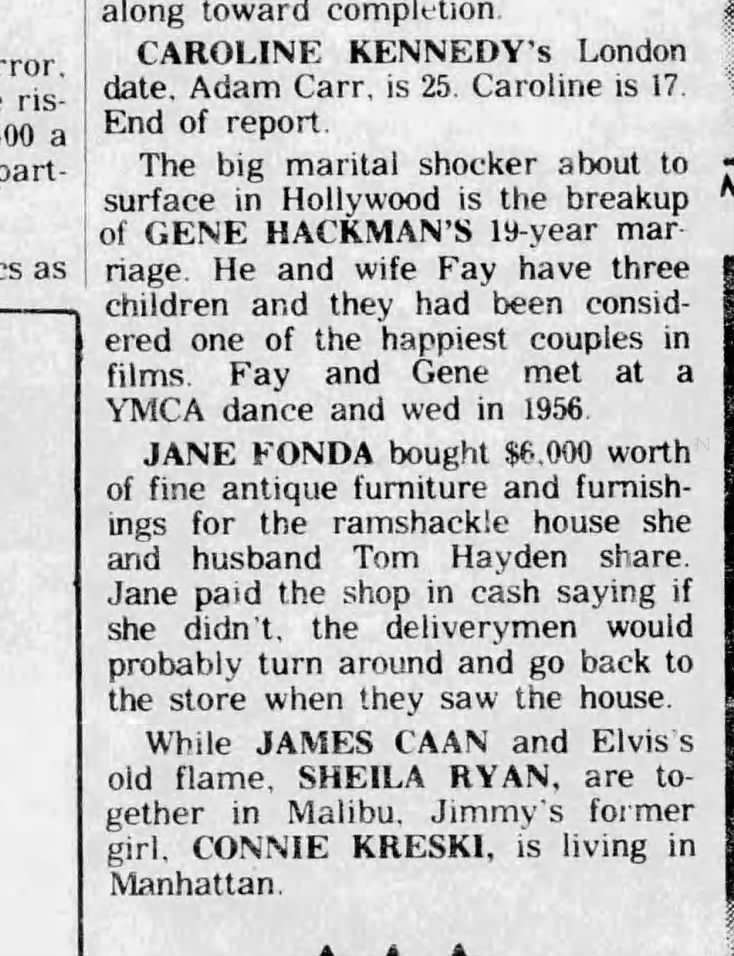
1976. Looks like Connie Kreski was discarded.
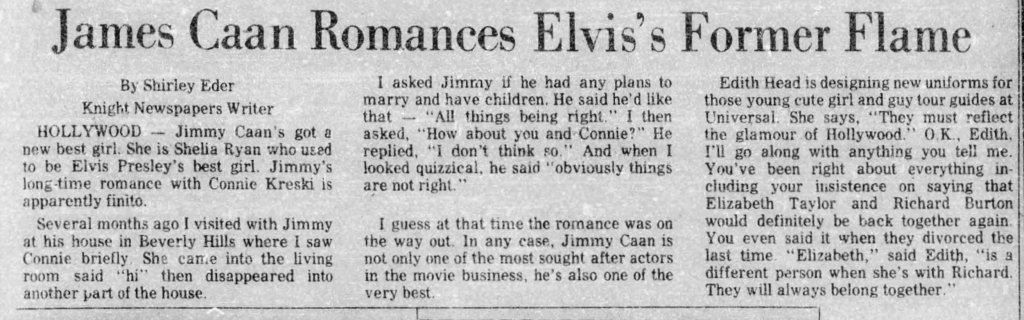
Caan and Playboy cover girl Sheila Ryan were married after Caan eschewed marriage to Connie during their time together.
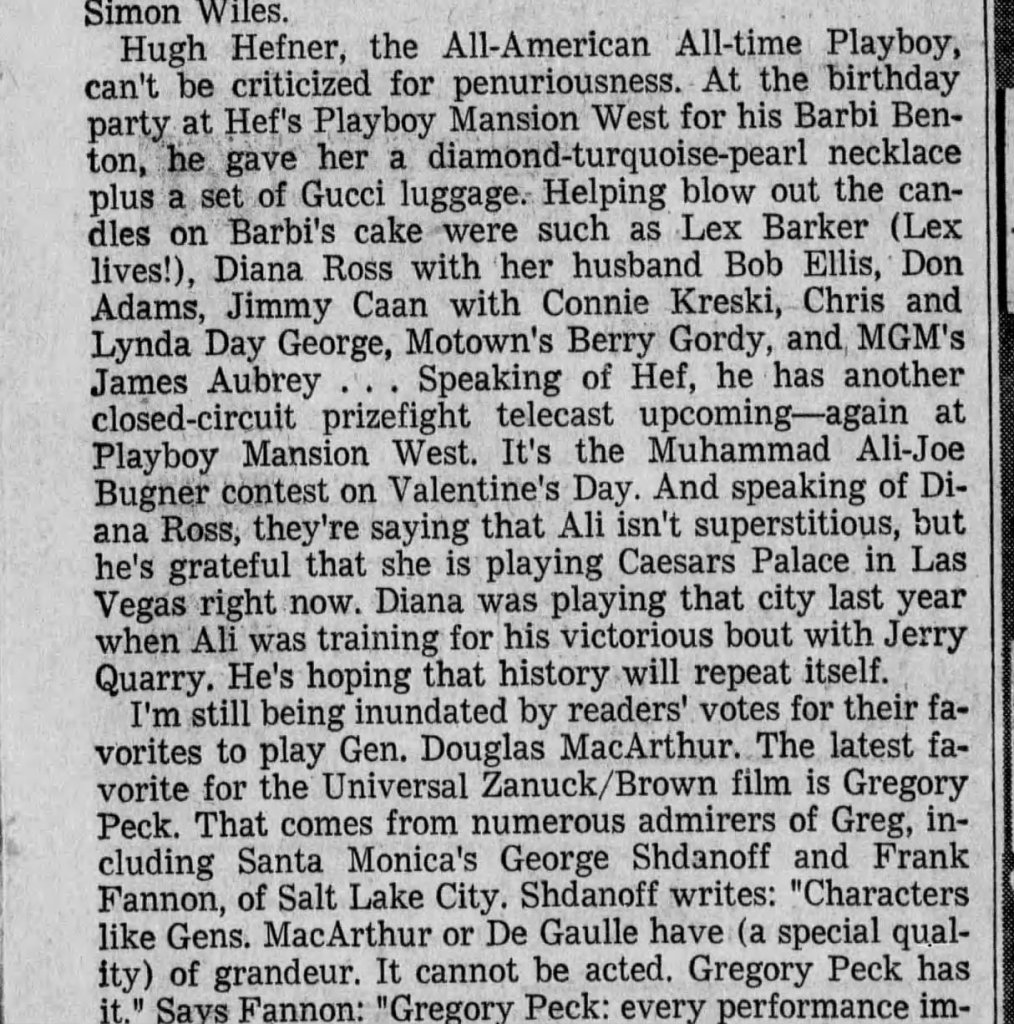
Patriot News 9/12/1975

BACK TO 1969



1963 Marriage & 1964 Divorce to Mark F. Segal. Meet Marvin M. Mitchelson, Beverly Hills Lawyer. Pamela & James Mason. Post Divorce Move To Beach. 1966. Updated 3/28/26 Long.
Posted on May 26, 2020
1963 October 1st Paige Young marries Mark Frederick Segal in Las Vegas, per impossible to read ledger records easily found on ancestry.com.
The record shows only the date and names.
It was likely an elopement in one of those 24-hour Las Vegas wedding chapels.
Paige’s mother Donna eloped for a Vegas wedding to marry her 2nd husband, Jack Holroyd, in 1958.
An old friend of Paige’s named Joan Edwards told me driving from LA to Las Vegas, getting married at one of several legal wedding chapels, “was a popular thing to do back then.”
Paige’s new husband was born in 1942, the son of WW2 veteran Harold Segal and his wife. Mark was a marine private who took combat training in 1961 at Camp Pendleton.
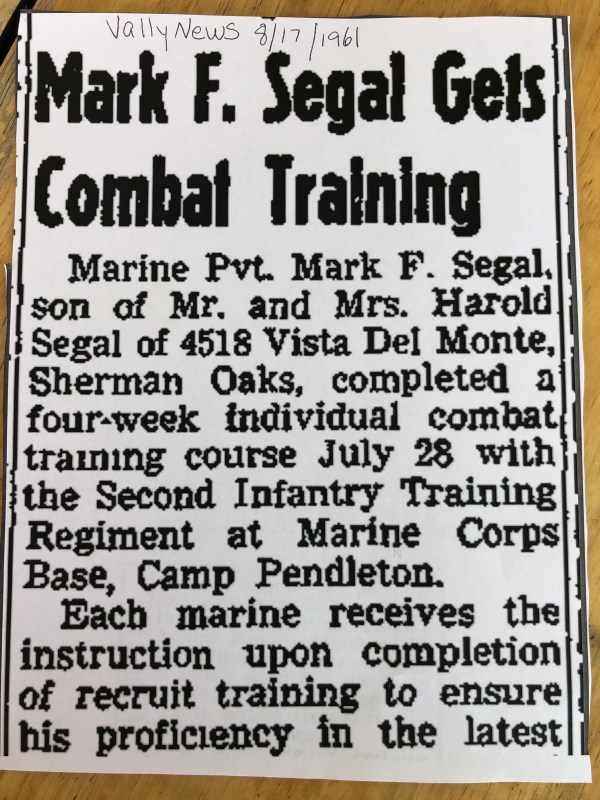
Mark F. Segal was also a car dealer at “Sea-Gull Motors,” a business started by his father, according to newspaper ads in the late 1950s, and Segal family friend Rex Ramsey.
Sea-Gull Motors either had several locations or moved locations several times in the Sherman Oaks/Van Nuys area in the 1950s and 1960s: 7211 Balboa Avenue, 4425 Van Nuys Blvd. and 6738 Sepulveda Blvd.


This is the only photo I’ve found of Mark F. Segal, Van Nuys News and Valley Green Sheet Aug. 17, 1961.

Rex Ramsey, a friend of Mark Segal’s, was a semi-successful race car designer and a Hollywood stunt driver in Herbie the Car.
He told me during our phone conversation that Mark’s father, Harold Segal, also owned the business Fox Auto Service, which “was like Triple A in the San Fernando Valley. Rex added that the Segal family had several brothers in addition to Mark and the family was “pretty well-off.”
1963-1964
Paige and Mark live together as husband and wife at 4133 Crisp Canyon Road in Sherman Oaks, “south of the boulevard.” Ramsey said that that the home was a cabin type, the kind that Hollywood stars would rent on the weekend “to get away from it all.”
This Crisp Canyon house was very close to the neighborhood where Diana Cotterell, as Paige was known back then, lived and attended elementary school: Dixie Canyon, and junior high school, Van Nuys Junior High.

From a notice in the Van Nuys News and Valley Green Sheet, Jun. 19, 1962.
After she married, Paige continues to board her horse Hamish at nearby Sepulveda Stables.
I corresponded with a woman who told me that when she was 12 years old, she met Paige at Sepulveda Stables where they both boarded a horse; Paige was about 19/20 years old and Paige drove her to the house on Crisp Canyon Rd., to hang out and drink lemonade, around 1962 and 1963. She is the one who tipped me off about the Paige living there.
August 28, 11 months after her Las Vegas marriage, Paige and her attorney file for divorce from Mark F. Segal.
Paige is represented by rising Beverly Hills attorney Marvin M. Mitchelson.

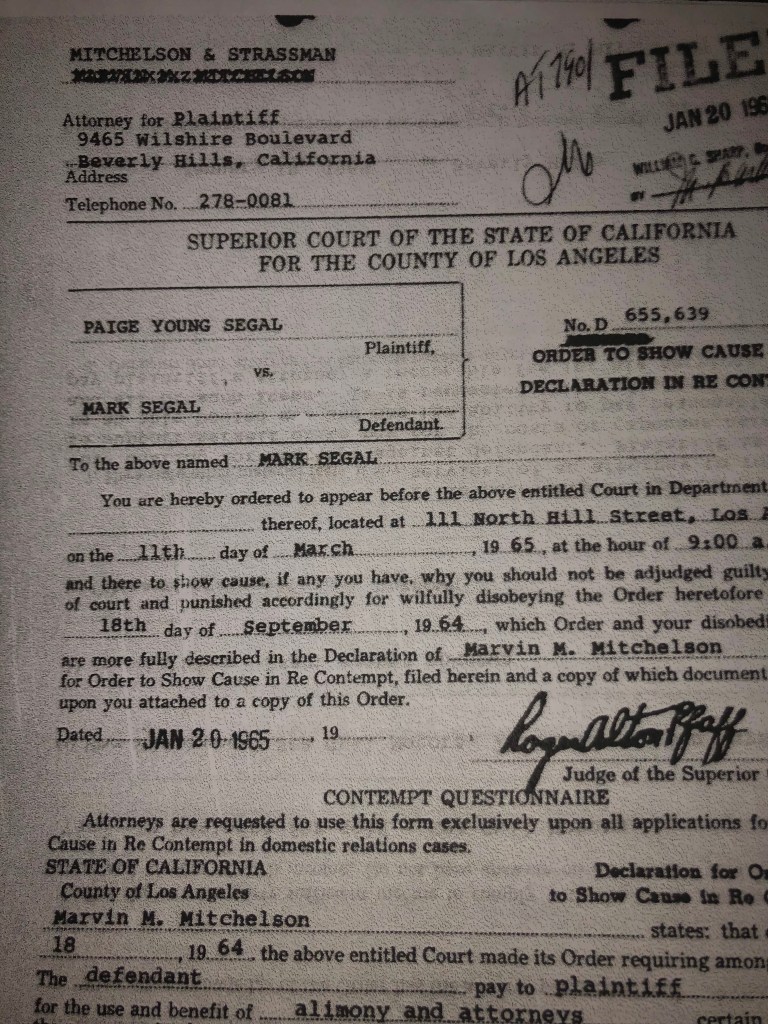
Below are just a few of the dozens of divorce documents I obtained from a records department located in Downtown LA. I picked out some key pages to post.
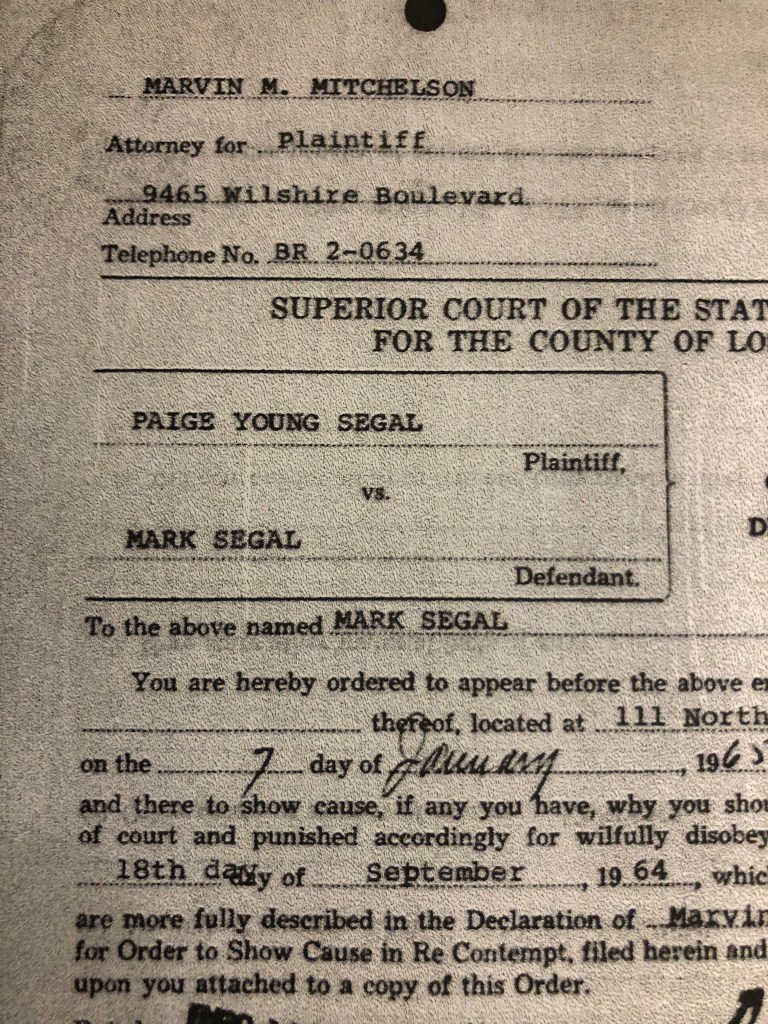
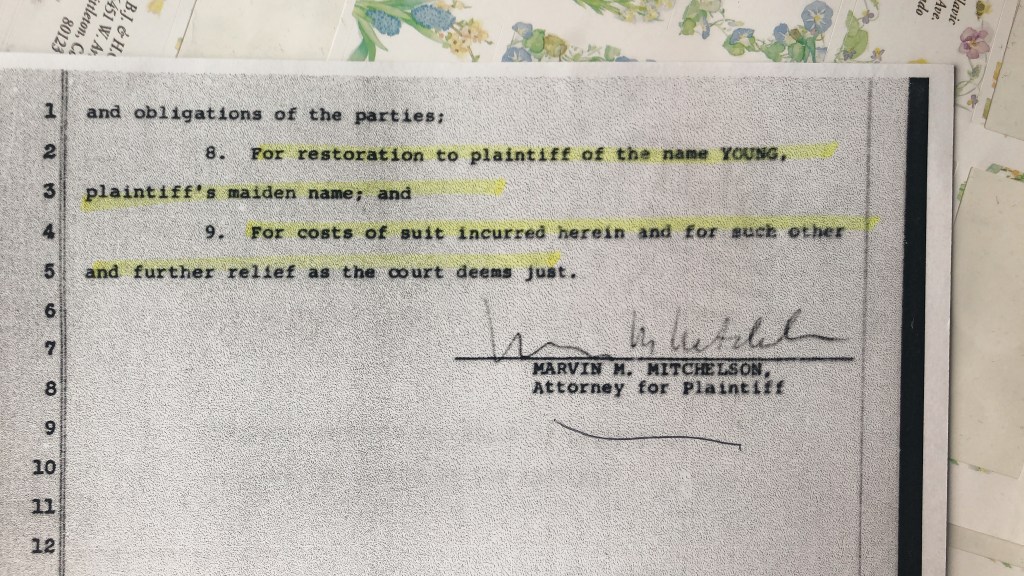

The filing states that Mark threatened Paige and her animals with bodily harm “on numerous occasions,” and on August 17, 1964, “brandished a knife in her presence,” and “Plaintiff’s profession is that of an artist and painter and on or about June 15, 1964, defendant maliciously and with intent to destroy plaintiff’s artwork drove nails through plaintiff’s prized paintings and further did mischievous damage by driving nails through plaintiff’s personal belongings including an expensive fur stole.”
Paige requests and is granted a temporary restraining order from the court.

Mark quickly countersues and denies all of Paige’s claims of abuse. He claims that she is the one who caused him mental anguish and suffering.
I do not find in the documents further explaining what Mark meant by that, no further details on what Paige did to him. With the exception of one complaint “She paid more attention to her animals than to me.”
Marvin Mitchelson, on behalf of client Paige, asks for alimony, lawyer’s fees and court costs: “Plaintiff is not employed and presently embarking on a career as a painter, therefore needs the money from Defendant who is able bodied and employed.”
Marks balks at this request and states he can’t afford it.
Paige sues Mark Segal for divorce after less than one year of marriage. She is represented by rising celebrity attorney Marvin M. Mitchelson.
The divorce filing was picked up by the wire service UPI and appeared in several newspapers across the country.


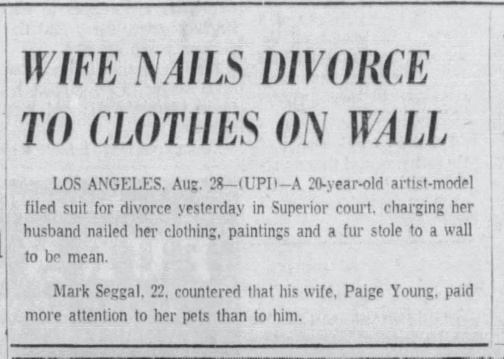

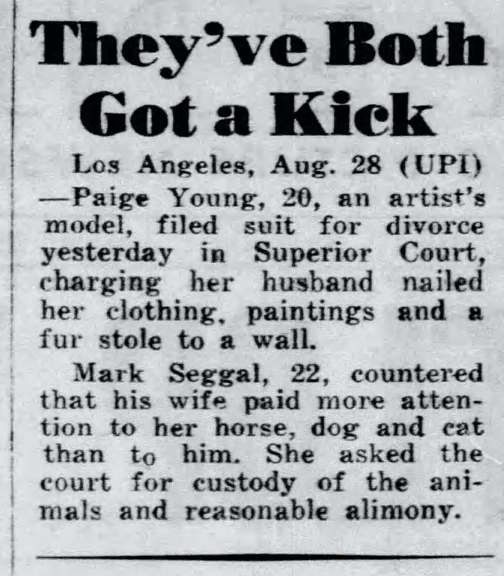

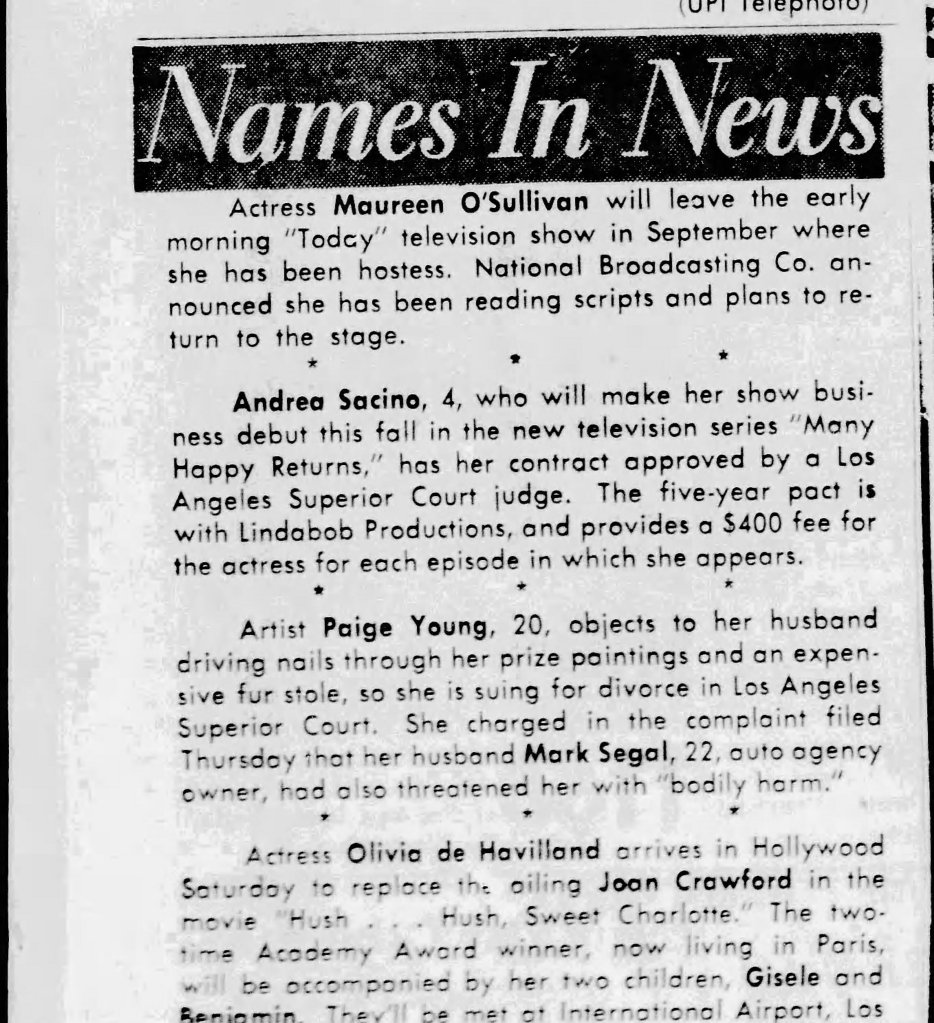
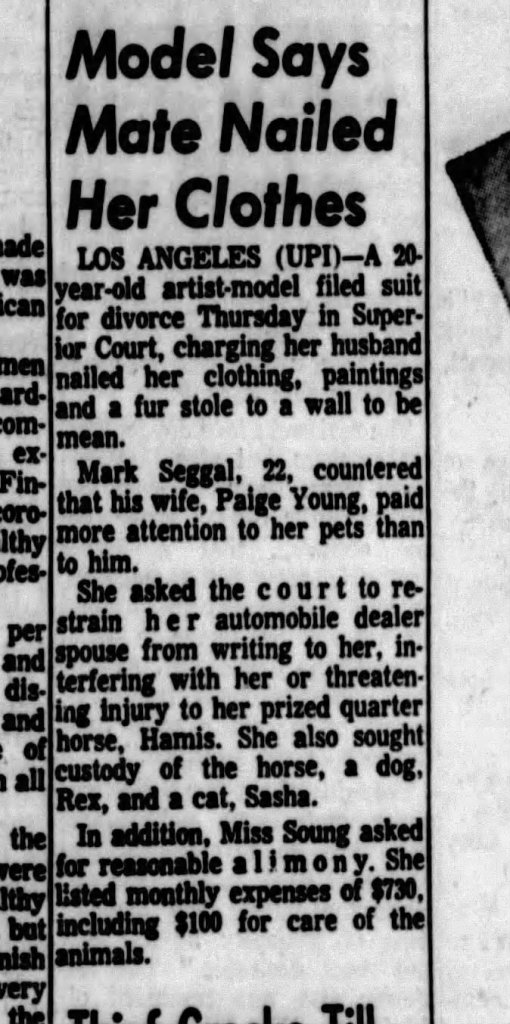
These headlines might be called “clickbait” today.
There is a high probability that Marvin M. Mitchelson was behind the above stories.
I found evidence for this in Mitchelson’s only biography which I will quote from extensively.
“Ladies Man, The Life and Trials of Marvin Mitchelson” by John A. Jenkins.
“Beginning early in his career, Marvin had a belief in the power of publicity and looked for ways to garner some for his cases.
No matter how trivial the cause of action, if he (M.M.M.) found an angle, he could turn it into a story. And in the early days when his client list was still thin, he could gin up publicity by filing an oddball lawsuit himself.”
…”But Mitchelson knew that Man Bites Dog was what sold papers…this was 1964 and he had to work with the material fate sent him.”
Patti Corman recalled that for her in 1976 divorce, Mitchelson “called AP, UPI and every other P there is!”
This is likely the reason Mitchelson took Paige’s case despite her lack of ability to pay him any upfront fees. Her case was unusual or “oddball” enough for it to be of use to him.
I would really like to know how Paige and Mitchelson may have met or who introduced them.
Hollywood History with Celebrity Connections
Only a few days after the articles about the Paige Young/Mark Segal divorce is published in several newspapers, more news breaks that Beverly Hills society matron and LA talk show host, Pamela Mason, has won an unprecedented amount of money in a divorce settlement from husband of 20 years: suave British-Hollywood actor, James Mason.
Mrs. Mason’s lawyer is Marvin M. Mitchelson.
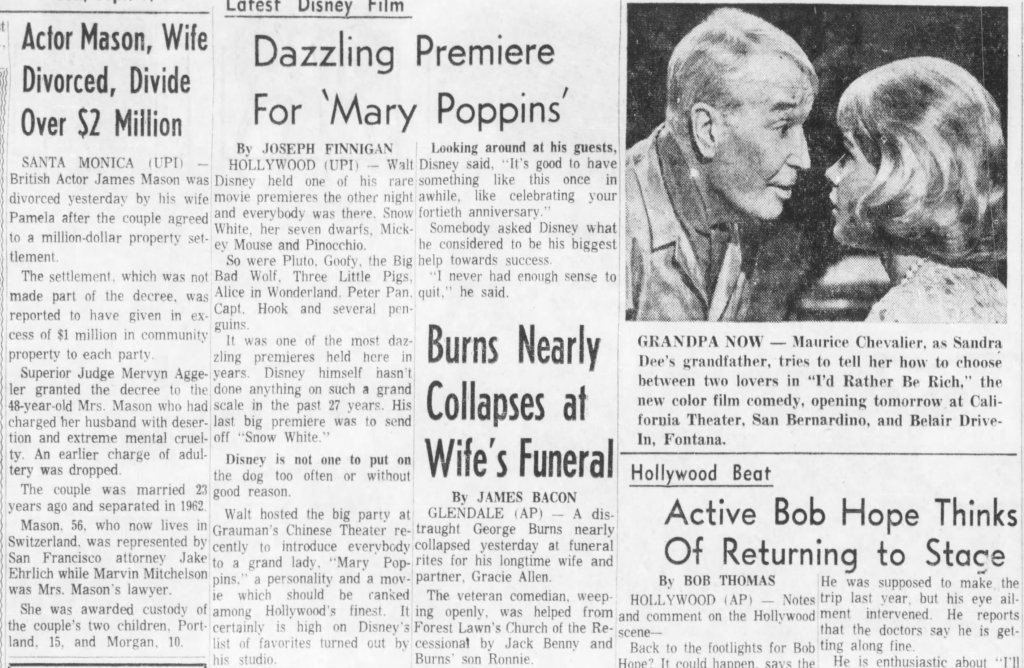


Sept.1, 1964 Pasadena Independent, Pasadena, California. 1.5 millions stated here.
Author Jenkins discusses the 1 million plus dollar settlement Mason case:
“Afterward in the courthouse corridor, “James (Mason) called the settlement ‘a flea bite.’ After all, he was getting off the hook without giving her any alimony at all. But Pamela was ecstatic. Her settlement was one of the first to break the magic million-dollar mark, and Mitchelson had gotten her, and himself, a ton of publicity about it.”
“The Mason case set the tone for the Hollywood divorces to come. Pamela was so grateful she did everything she could to make Marvin Mitchelson a household name. Pamela introduced Mitchelson to her divorcing friends…she became his entrée to those rarefied upper brackets of Beverly Hills and Hollywood. Pamela hired him eight months later for a 138, 500 breach-of-contract suit against actress Loretta Young on behalf of Pamela’s sixteen-year-old daughter Portland.”

“Pamela Mason introduced Mitchelson to her divorcing friends, all of whom were wildly delighted with the results, she later said.”
END
The Mason case was a first as far as Hollywood divorces go, and a major breakthrough for Mitchelson’s career.
He seemed to be on a roll in 1964.
Michelson represented legendary lyricist Alan Lerner’s estranged wife, Micheline, in the couples’ contentious custody fight.
Roy Cohn was Micheline’s divorce attorney in NYC. Yes, that Roy Cohn, who had a great admirer in Mitchelson. And later Donald Trump, who ditched him when he lay dying of AIDS.
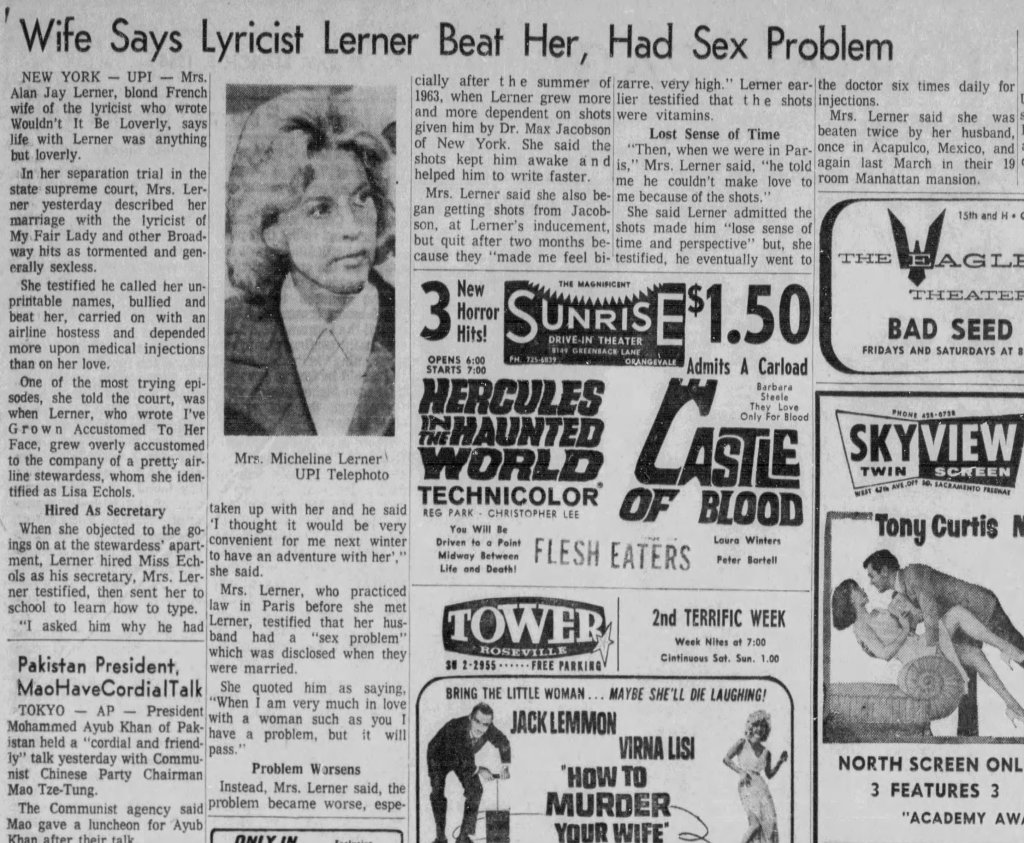

Mark F. Segal came from a fairly well off Sherman Oaks family according to Mark’s friend and stunt car driver Rex Ramsey, quoted above.
Still Mark Segal wasn’t anywhere near the league of My Fair Lady and Gigi composer Alan Lerner.
However, both men did have some things in common that most divorcing men that year did not, and that was estranged wives represented by rising lawyer Marvin M. Michelson.
The other is being found in contempt of court by failing to pay alimony to the estranged wives.
Mark’s attorney is Bernard Echt from Sherman Oaks. Echt, a few years down the road, would represent the milkman who was being sued by Vincent Bugliosi for suspected impregnation of his wife. Strange yet true.
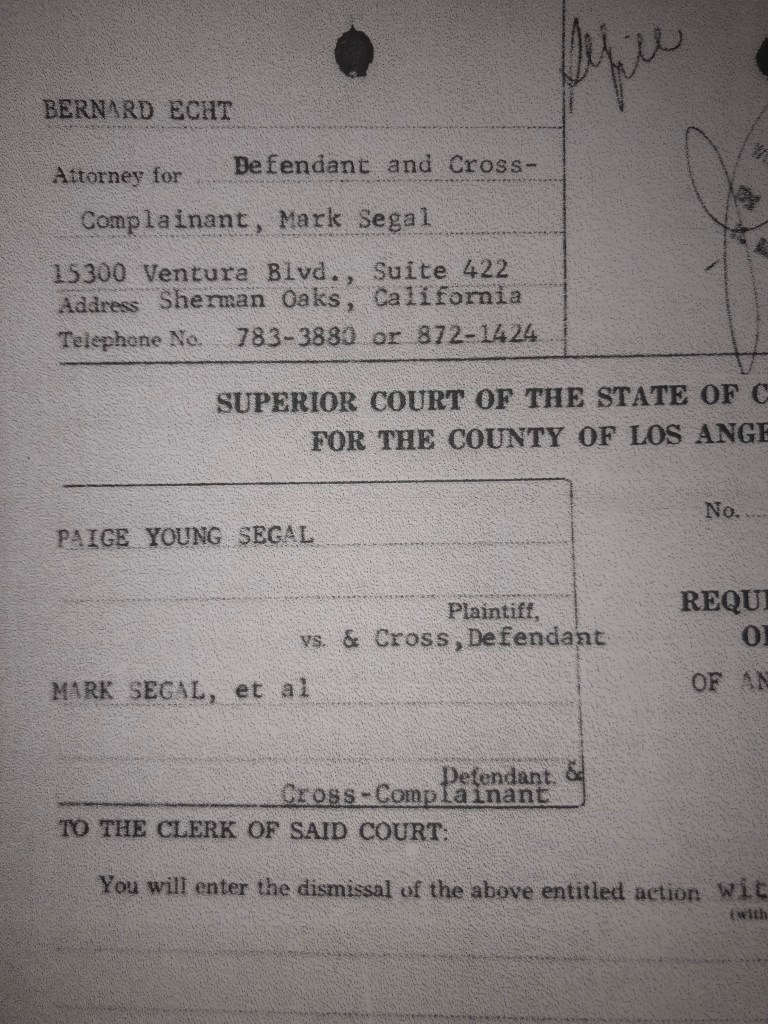
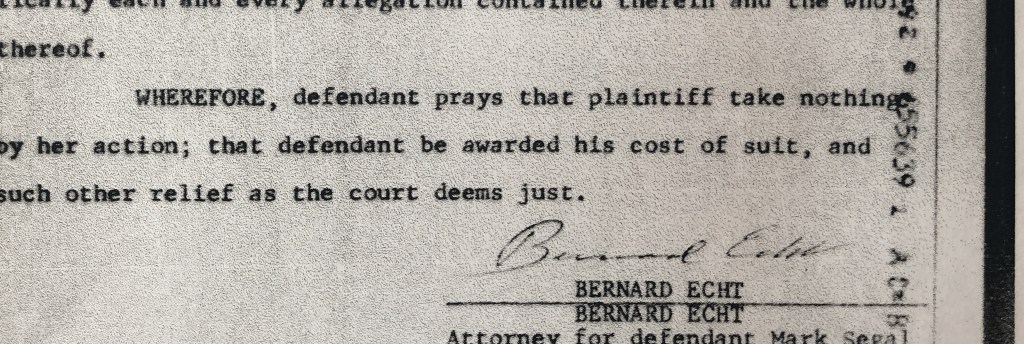
An initial agreement is reached quickly: Sept. 18, 1964. Mark is required to pay Paige alimony, but only for six months.

This would be about $1000 in 2017, so the equivalent of $6000 in 2017.
1964 November 24: Paige and her grandmother Virginia LaRocca are sworn-in for testimony in a Los Angeles courthouse, probably 111 Hill Street, for the divorce trial; Mark is a no-show.
Virginia LaRocca testifies for the plaintiff, her granddaughter Paige. An interlocutory decree of divorce is granted to Paige on grounds of extreme cruelty. But it was never finalized according to the clerk who helped me in DTLA, in a building across the street from Hill St, in a basement where they keep old hard copy records.
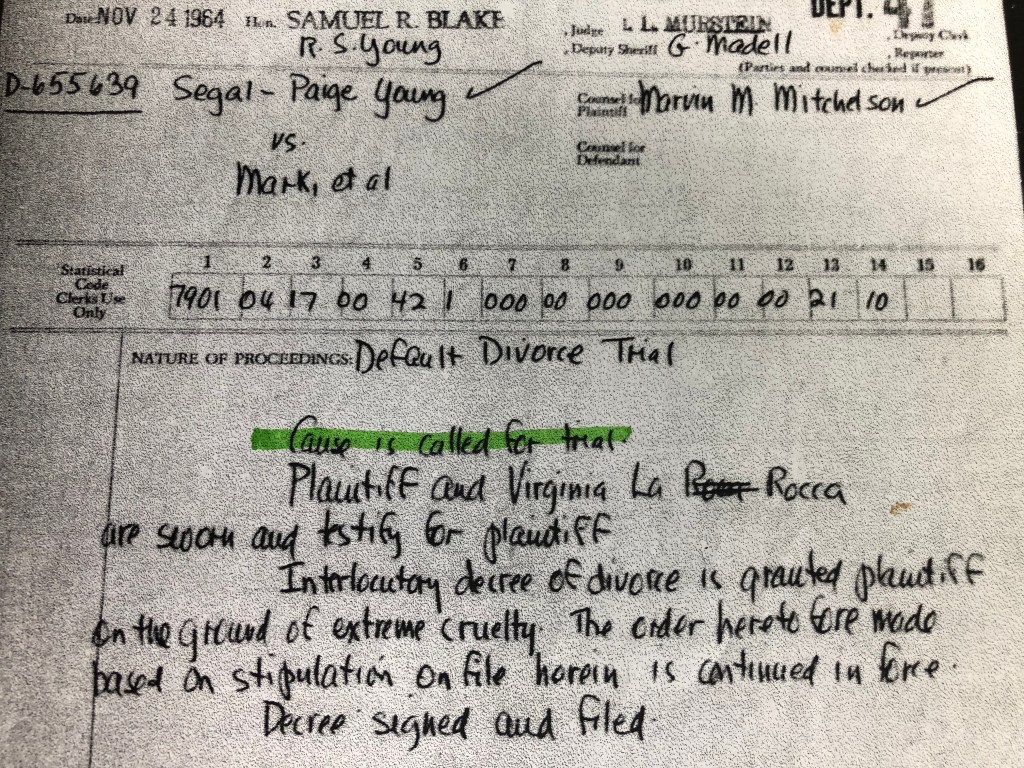
Paige waives her right to any further alimony payments beyond the six months. Mark is also ordered to pay Marvin Mitchelson $300 (about $2072 in 2017 dollars) and $15.00 in court costs around $100 today.

Paige is awarded a 1953 MG Roadster; Mark is ordered to sign the title over to her. Paige gets to keep certain antiques and wedding gifts. Mark gets to keep his home at 4133 Crisp Canyon Rd. in Sherman Oaks.
Both parties are ordered to not annoy, molest or harass the other.
1965
This year shows Mark has not been making his required alimony and lawyer’s fees since 1964.
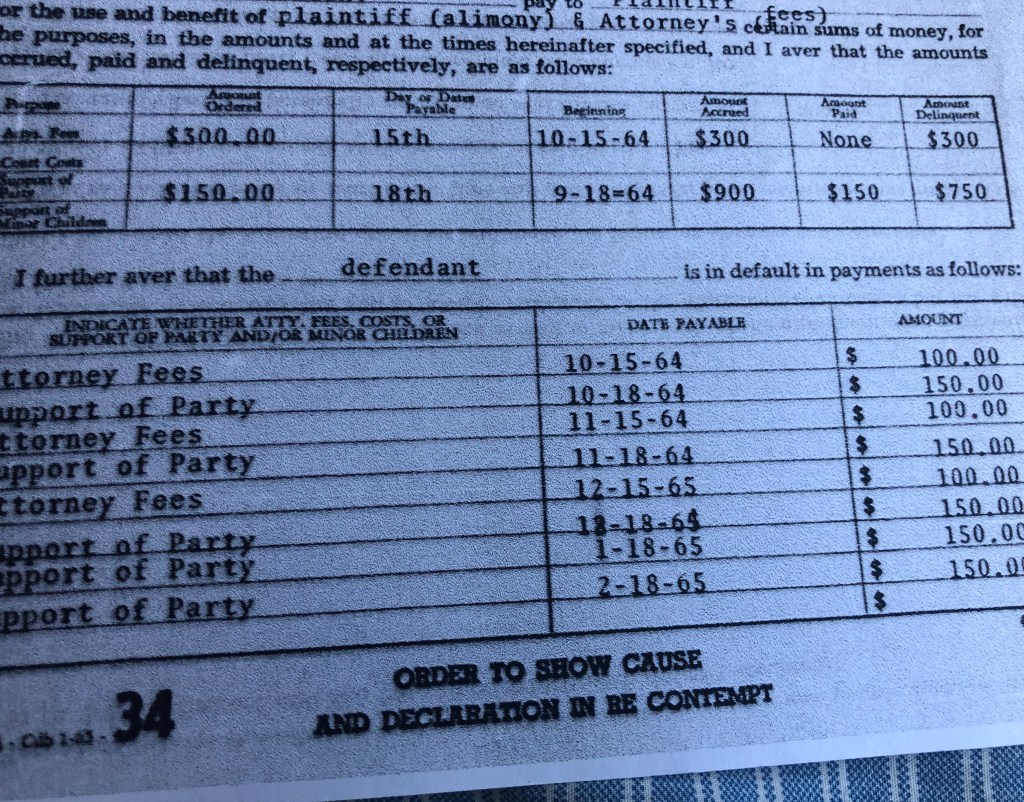
Marvin M. Michelson puts the hammer down on Mark Segal this year. For every month Mark fails to make his monthly alimony payment to Paige and the lawyer’s fees, Michelson goes to court files a suit for contempt.

It turned out to be all 12 months.
Paige’s cousin Chris told me about the last time he saw Paige.
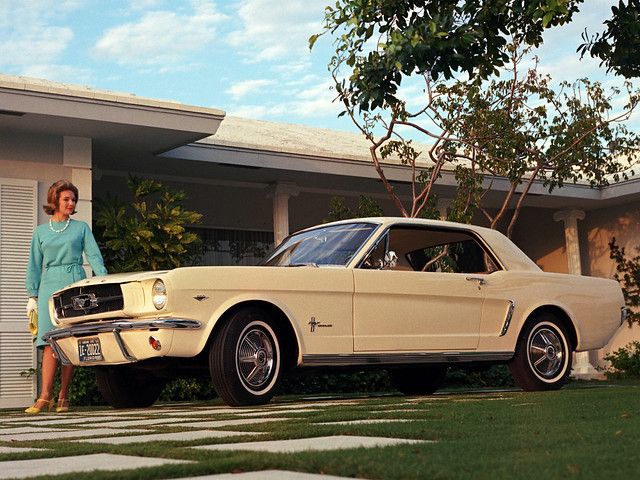
She had a brand new yellow Mustang outside her apartment in Sherman Oaks. I told Chris about the 1953 MG that Paige had won in the divorce. Chris thinks she sold the MG to buy the yellow Mustang.
Paige moves to Malibu in late 1964/early 1965.
Months before this conversation with Chris Young, Richard Sample told me he remembers Paige owning a yellow Mustang.
When she was living in her “chicken coop” house near the beach from 1964/5 to about 1968.
Richard and Chris Young never met.
By default Paige would have owned a 1964 or 1965 Ford Mustang in yellow. There were 2 yellows if it was 1964.
“Since 1964 the Ford Mustang has utilized a multitude of shades of yellow to adorn their famous pony car. Below is a year-to-year breakdown of the yellow shades (with paint code in parentheses, if available) we all have come to love so much.
1964: Ford unveils a couple different shades for the inaugural release of the Mustang, a pale hue called Phoenician Yellow (7) and a brighter hue of Sunlight Yellow (V).
1965: Phoenician Yellow (7) is kept while the Sunlight Yellow (V) is replaced with a lighter hue called Springtime Yellow (8, only available in the Spring of 1965.”) From the website Yellow Mustang Registry.

A 1964 Ford Mustang in Sunlight Yellow. yellowmustangregistry
Approx. 1968 is when Paige moved to a cabin-studio in Topanga Canyon, with financial help from Bill Cosby. According to Paige’s friend Veronika from Malibu beach and Topanga. On the topic of cars Veronika said Paige did not own one, she hitchhiked or asked friends for rides.
I will be publishing a chapter on this soon. Published and appears at the bottom of the main menu.
July 1966
Paige gets transferred from the Marvin Mitchelson law firm of Beverly Hills, to the law firm of Silverton, Ruderman and Graf of Studio City. Her new law firm is located at 12345 Ventura Blvd.; a 5 minute drive from her childhood home at 13055 Moorpark St.

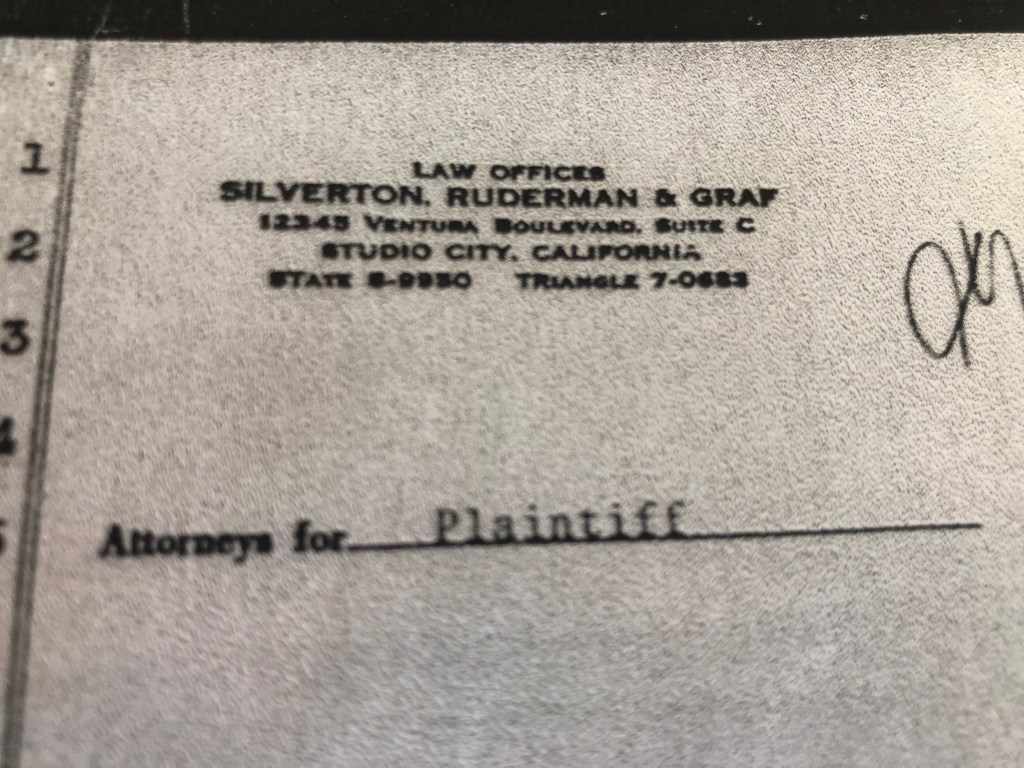
Marvin Michelson was busy climbing the ladder of success in 1966. He did not have time for or a need, for a non-paying client divorcing and her husband who was in contempt of court for non-payment.
In the divorce documents, (I own copies) dated all the way into 1969 showing Paige and her lawyers, Silverton, Ruderman & Graff, still trying to collect the unpaid, court ordered alimony and lawyer’s fees from Mark F. Segal.

From the Marvin Mitchelson biography Ladies Man by John A. Jenkins.
He continued to represent Hollywood and Beverly Hills “soon-to-be-divorced-wives.”
Marvin Michelson probably grew tired of Paige’s non-payment divorce case by 1966. Her “interlocutory” divorced ex-husband Mark F. Segal, had not paid more than the one initial payment in 1964.
Any publicity for “attention getting headlines” (see chapter on Segal-Young Divorce Makes Headlines) had long since ceased to be of any benefit to M.M.M.
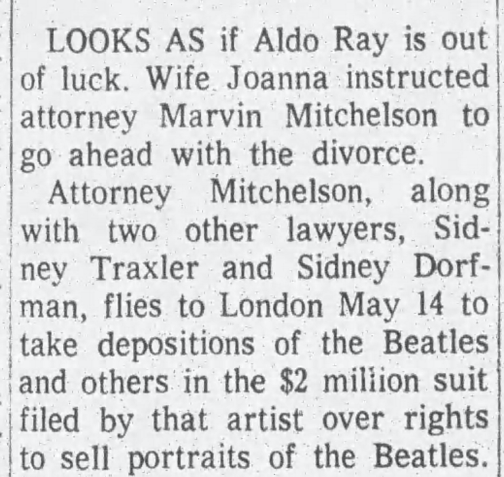
Aldo Ray spoke bitterly about his ex-wives. I have several more articles about him not included here.
(66 also brought Marvin international work in London from a rock band.)
Mitchelson gave it his all in 1965. He filed in court for contempt against Mark Segal for non-payment, every single month of this year, to no avail.
Also in 1966
Paige’s Mother, Donna Holroyd, and her grandmother, Virginia Young LaRocca, are listed in the phone directory at 5760 Hazeltine, an apartment building on the corner of Hazeltine and Hatteras in Van Nuys.
Jack Holroyd, husband of Donna, is not listed at this location. They may have been separated or even divorced, at this time.
Jack Holroyd went on to divorce two more women before he passed away in the early 2000s.
One of them was named JR, a successful realtor in the general area of Kalamazoo, Michigan.
The marriage began in 1970 and lasted only a few years.
I recently spoke with JR’s son who confirmed this and said that his mother had recently died at age 95.
The son said he has no idea how Jack Holroyd ended up in that area of Michigan from Los Angeles. He doesn’t remember a whole lot about him anymore but he does remember not liking him.
And called Jack Holroyd then called him a “shyster” and a “con-man.”
My mother, JR, said about Holroyd “The biggest mistake I ever made.”
1950s #1 Updated 11/4/25: 1950 Census. Gardena. Move to San Fernando Valley. Ned & Virginia LaRocca. The Marinello/Bartletts. Recording Industry LA. Leith Stevens.
Posted on May 12, 2020
San Fernando Valley abbreviated SFV.
The 1950 census
gives more information about the LaRocca/Cotterell family unit.
We seem the family listed at a residence in Gardena at 1830 W. 147th.

Enlarge the document and you see that Joseph’s occupation is Radio Orchestra Manager, Virginia, a Christian Science Practitioner.
Donna has an empty box for occupation, her daughters Constance S. is listed as 7 years and Diana L. as 5 years.
Constance would have been in the second grade and Diana, kindergarten, if she went.
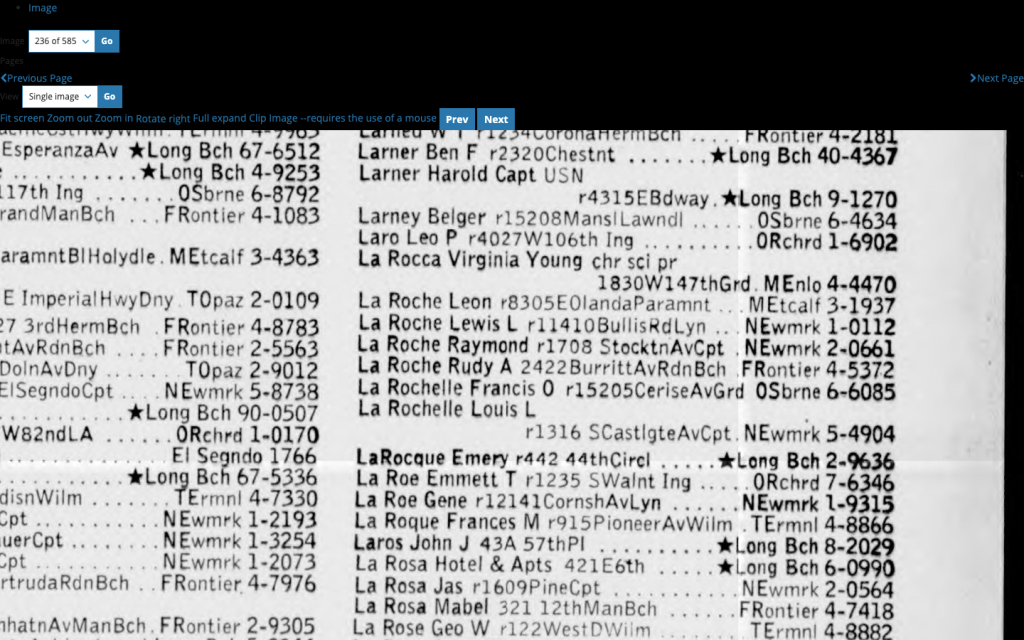
See the listing for Virginia LaRocca, CSP, at this same address but no Joseph is listed.
It’s unusual that Joseph and Virginia weren’t listed together. The married couple had been listed together every other year for decades, both in directories and voter registrations.
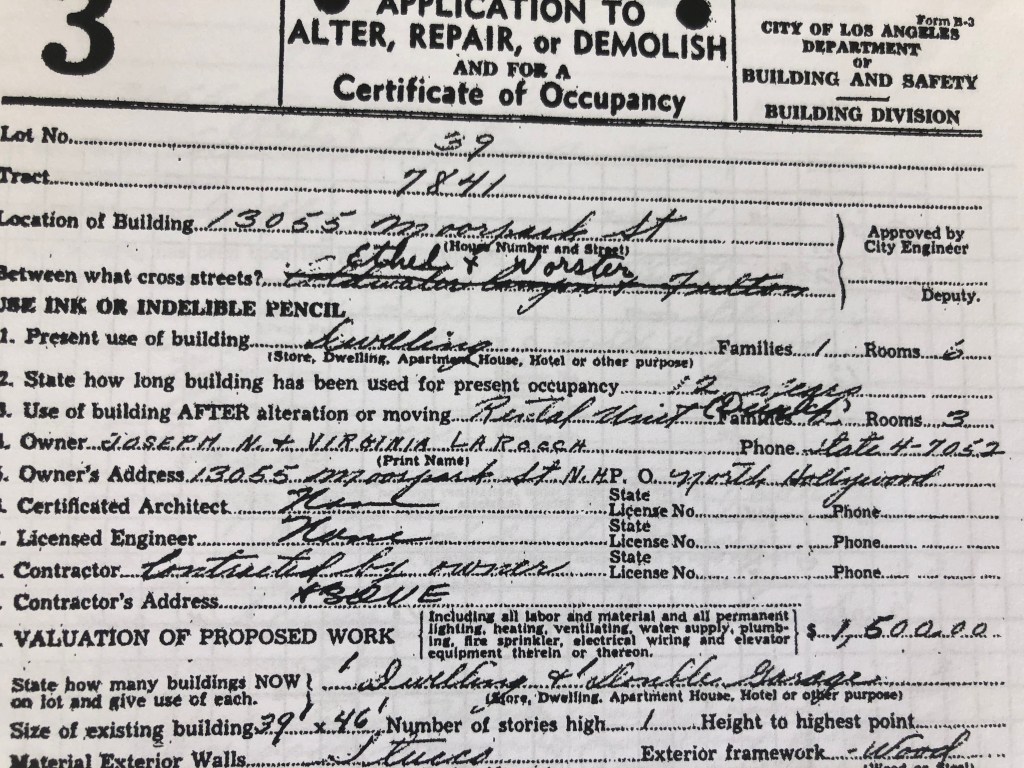
I first connected the family to 13055 Moorpark St. address by a city building permit dated Dec. of 1952.
Christian Young, a relative of Paige Young’s, told me in a phone conversation about a memory from his childhood.
“The house on Moorpark had a cabinet you could crawl through and get to their grandparents’ side (of the house).”
It seems reconstruction was made into a duplex, Ned and Virginia are on one side, Donna and the girls are on the other.
More specifically, off of the intersection of Coldwater Canyon and Ventura Blvd.
The duplex on Moorpark & Ethel, is located on the west side of Studio City, close to the eastern border with Sherman Oaks.
The Los Angeles River is nearby the house, as is Sportsman’s Lodge; a classic Hollywood and SFV landmark.
It’s recently been totally or partially demolished.
Ned & family were aware of this part of the SFV area for some time before their move.
Joseph’s only sister of many brothers was named Kathryn Marinello.
She and her husband Anthony, opened a food store at 13251 Moorpark in 1947, seen below.

“New Business Filings in the Valley” Van Nuys News
There is a 1947 City document I have been unable to download; indicating a “food store” at 13251 Moorpark St. The building was not owned by the Marinellos but a business announced, as seen here.


Mildred and Clifton’s first child James is recorded as 1 year old.
Their daughter Donna Lee was born only a few years later. Looks like she was named for Donna LaRocca Cotterell, and Diana Lee Cotterell.


Meanwhile……Diana’s father Robert Morgan Cotterell also moved to the SFV around this time, but further west of his daughters and ex-wife.
His new wife (1949) Patricia/Pat Frick and their two children born in 1950 and 1951, started out in the Canoga Park/Winnetka area.
Robert’s daughters by Donna V., were living in Gardena when “Bob and Pat” were parenting 2 toddlers on Lurline Ave.
I can’t imagine they saw each other that often but who knows?
It’s the first of many moves around LA for the Cotterell family due to Bob Cotterell Sr.’s career at Douglas Aircraft.
We do not know exactly why the LaRocca family moved to the SFV.
However, we know they were part of a massive migration to the area after World War 2, from both inside and outside California.
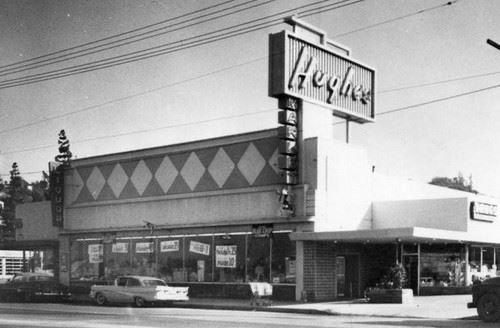
“The end of WW2 transformed the Valley and vastly accelerated its growth
with: vast tracts of suburban housing, shopping centers and industrial parks where chicken ranches, orchards and cattle ranches and wheat fields once existed. The 1940s and 50s, when I was growing up, the Valley was full of movie cowboys, beautiful ranches and fine horses.”
Jerry England at cowboyup.com
“In the five years after the war, the population (of SFV) more than doubled to 402,538 residents-the pastoral San Fernando Valley was suddenly the ninth-busiest urban area in the nation. Valley society was a mix of young suburbanites, older families who had come west to try their luck as engineers, animators, or pioneers in the new field of television, and ranchers trying to hang on in the face of the new hordes.”
The San Fernando Valley: America’s Suburb by Kevin Roderick
I discovered that Ned LaRocca spent most of the 1950s working as an “orchestra manager.”
He worked for composer/conductor Leith Stevens.
I saw this information through Ned’s death certificate, seen below.
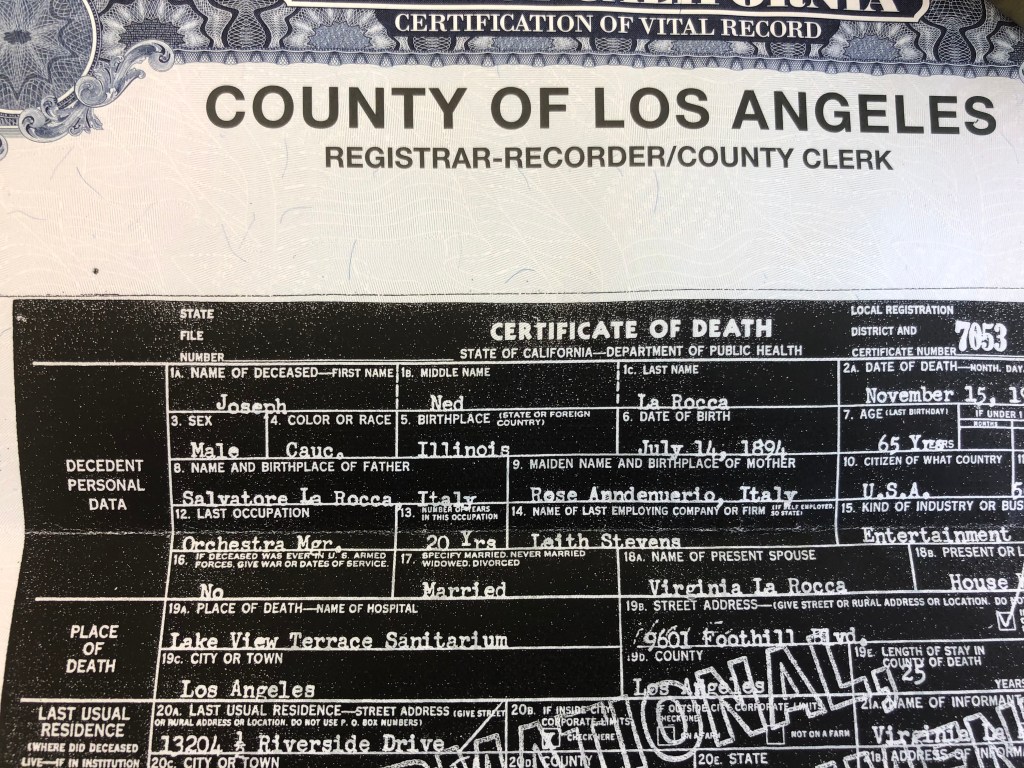
I can confirm two Leith Stevens projects that have a credit as “contractor” for Ned LaRocca: A Doris Day album recorded in 1951 at 1032 Sycamore Street.
It was a studio known at that time as “The Annex.”
The website careerexplorer.com defines an orchestra contractor is: “He or she has the job of finding the appropriate musicians for Broadway shows, television episodes and commercials.”
Ned had experience adapting to a new mass medium.
In his first industry performing on the Vaudeville stage performing the harp. (See related chapters)
Vaudeville died in the early 1930s during the Great Depression and Radio programming became a mass entertainment form.
One significant factor that changed the popularity of radio programming was the rise of TV in the 1950s.
Drama, comedy and musical variety and interview shows moved to TV.
In the 1950s Los Angeles had a burgeoning music recording industry scene.
Ned worked in each of these mediums. Performing on radio broadcasts and orchestra managing for films.
In 1950, just under 20 percent of American homes contained a TV set. Ten years later, nearly 90 percent of homes contained a TV—and some even had color TVs. The number of TV stations, channels, and programs all grew to meet this surging demand.
encyclopedia.com
Ned LaRocca has a credit on Leith Steven’s 1953 score to the Marlon Brando movie “The Wild One.”
This record was a hit, released by Decca records, it remains Stevens’ most widely known work. J. Ned LaRocca is credited as “Contractor” on the project: Per Discogs.com.
As I understand, the Wild One was the first soundtrack entirely made up of Jazz music.
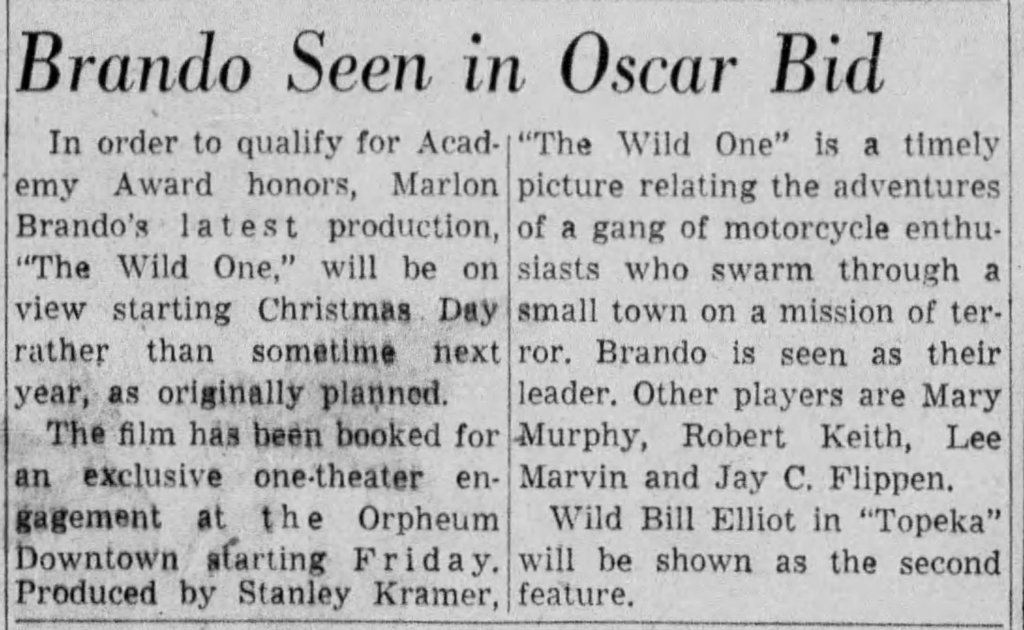
I recently watched The Wild One and noticed there are long stretches where there is an notable absence of music.

Besides composing and conducting “The Wild One” soundtrack, Leith Stevens composed scores for radio shows, movies and T.V. from the 1930s until his death in 1970.
This includes Film Noir classic Private Hell 36, co-written by and starred Ida Lupino.
Another Stevens credit was for The Bigamist, directed by and starring Lupino. So there was a relationship there with the pioneer female director, Lupino. Or maybe he was just assigned to the project.
War of the Worlds 1953, The Hitch-Hiker, another Lupino film. and Destination Moon, 1950.
Just a very few: It’s a Wonderful Life, 1946, Ma & Pa Kettle Back on the Farm, 1951, 1954, Earth Vs. Flying Saucers in 1956, The Ann Sothern Show, 1960, Twilight Zone, early 1960s.
He composed 100s of stock music pieces for Hollywood media.
Virginia Young LaRocca in the 1950s.
Diana’s grandmother. She started out life as a Mormon in Utah, but somewhere along the way became a Christian Scientist.
She is listed as “Chr. Sci.pr.” (Christian Science Practitioner) in Los Angeles telephone directories in the 1940 and 1950s. Virginia was listed with her own telephone line.
(Read more about Virginia and her sister Josephine’s early years as a Vaudeville performer in the family history chapters.)
A Christian Science practitioner is an individual who prays for others according to the teachings of Christian Science. Treatment is non-medical, rather it is based on the Bible and the Christian Science textbook, Science and Health with Key to the Scriptures (1875) by Mary Baker Eddy (1821–1910), who said she discovered Christian Science in 1866 and founded the Christian Science church in 1879. According to the church, Christian Science practitioners address physical conditions, as well as relationship or financial difficulties and any other problem or crisis.
wikipedia
At some point, the Christian Science Church won the right to accept insurance for their practitioners. However, I have been unable to find exactly what year.
So, I can’t tell how much income Virginia might have earned from her vocation as a CSP.
In 1955, an LA telephone directory lists a Ned J. LaRocca at 4414 N. Ethel and a Virginia Young LaRocca with the same address.
Donna Cotterell is listed with the 13055 Moorpark address. 13055 Moorpark is on a corner with Ethel St.
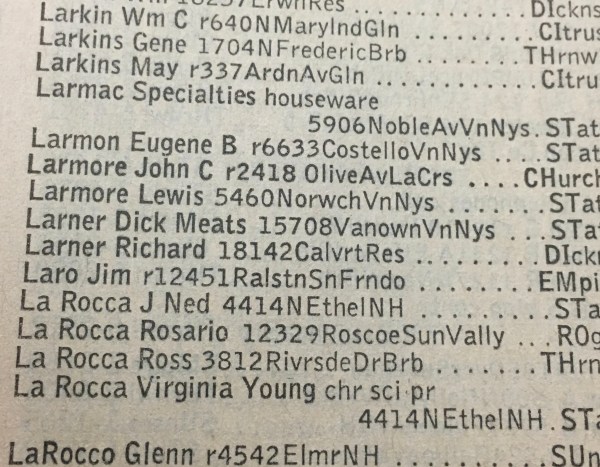
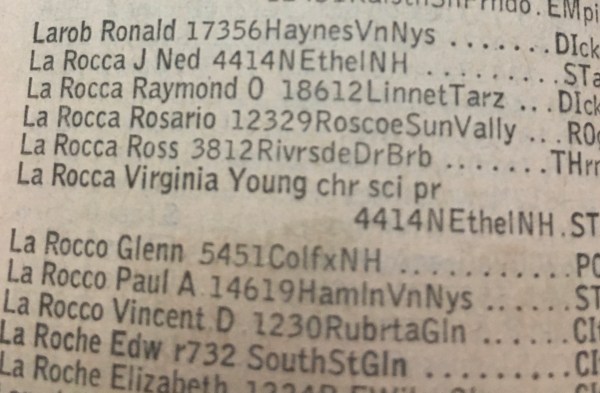
4114 Ethel St. doesn’t seem to be an “real” address; I don’t find a record of it anywhere besides the phone directory.
1957 Virginia Young LaRocca is listed in the phone directory at 4414 N. Ethel State 4-7052 North Hollywood. Cr. Sci. Pr.
This could be a result of the house modification for Donna, Diana and Constance Cotterell, it was made into a duplex.
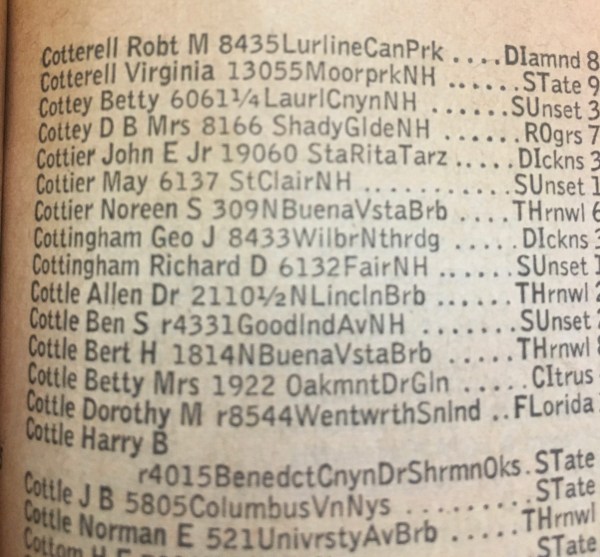
I’m sure Donna received child support from her ex-husband Robert Cotterell. And likely alimony until Donna remarried in 1958 to Jack Holroyd in a Las Vegas wedding.
It is probable that grandfather Ned LaRocca was the primary breadwinner of this household.
This would have been normal for the times.
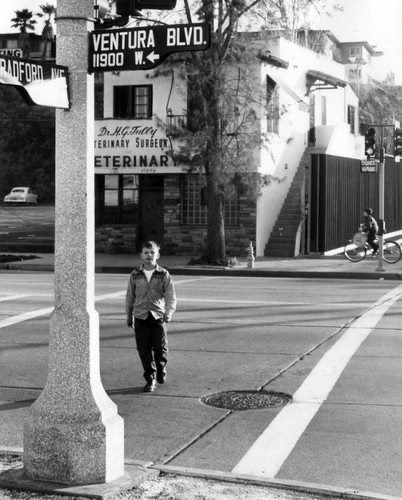

1940s (1930s) Los Angeles: Family. Marriage. Hollywood Wedding Chapel. Los Feliz Houses. Mildred Marinell. WW2. P.O.W. Divorce. Updated 11/24/2025.
Posted on April 29, 2020
You were introduced to Diana Cotterell/Paige Young’s parents in an earlier chapter, let’s learn more about them.
Robert M. Cotterell was 23 and Donna V. LaRocca 19, when they were married in 1940.
Donna is listed in the 1940 census as living with her parents at 3834 Evans St., and that she was a “New Worker” in “Dramatics.”
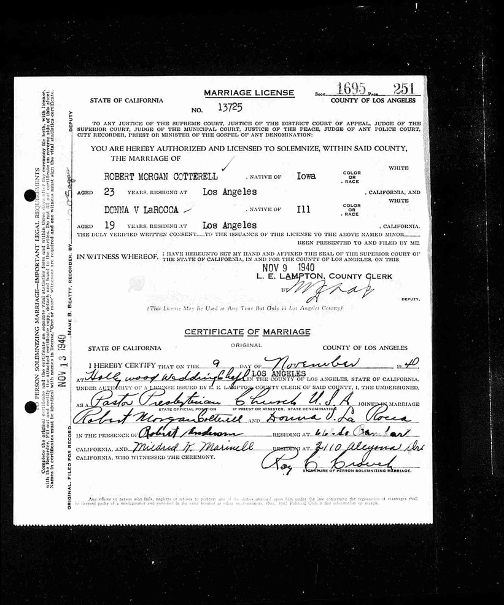
Mildred K. Marinell signature listed on next to last line.
Mildred is the daughter of Joseph LaRocca’s only sister Kathryn LaRocca Marinello, and Donna’s first cousin. Mildred dropped the “o” from her birth name. The family name is recorded as both Marinello and Marinelli; Mildred became Marinell, so it’s been confusing to research.
Below is the Hollywood Wedding Chapel where Robert and Donna were married per the marriage certificate.

The famed Garden of Allah apartment building was across the street.


Much more on Donna’s cousin Mildred coming up. (I suspect she occasionally used the name Penny Pepper in show business.)
This Hollywood Wedding Chapel building was purchased by famous director/writer Preston Sturges in 1940. He transformed it into “Players” restaurant which became a watering hole for the movie business.
Players has its’ own interesting Hollywood history.
Donna and Robert must have been one of the last couples to marry at the chapel before Sturges took over.
Now this location is a Pink Taco restaurant.
**UPDATE** Pink Taco abruptly closed in 2024.
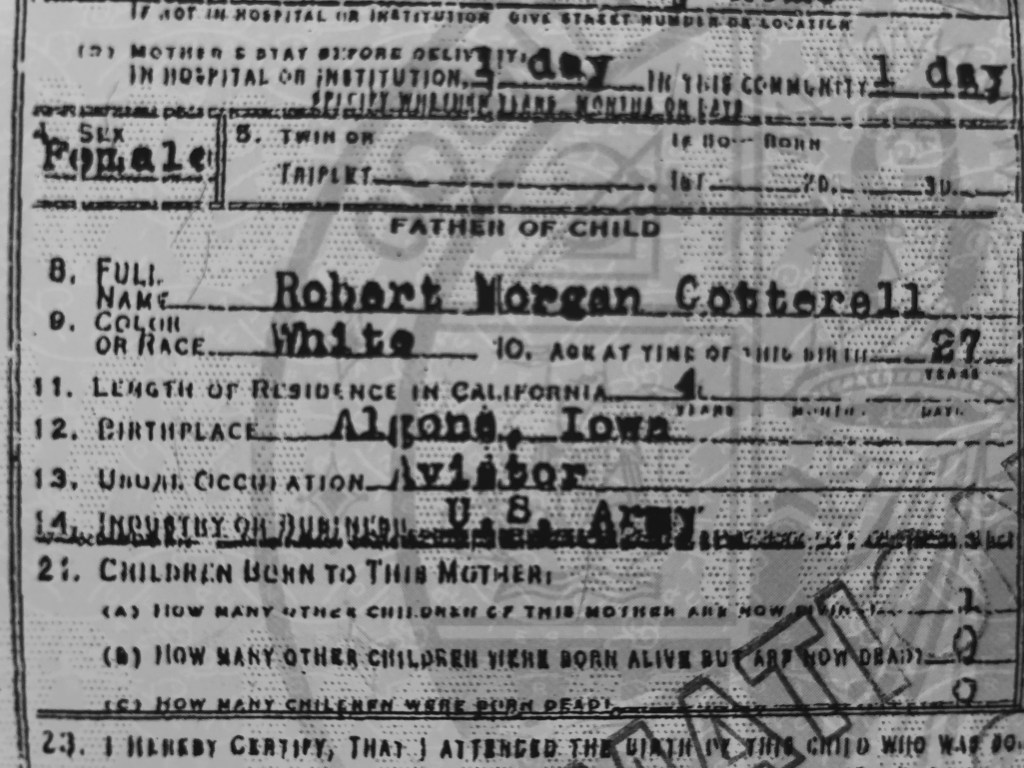
Diana’s father Robert Morgan Cotterell was born around 1917 in Algon, Iowa. He moved to Los Angeles around 1938 to follow his interest in aviation. (According to his son in a facebook message to me.)
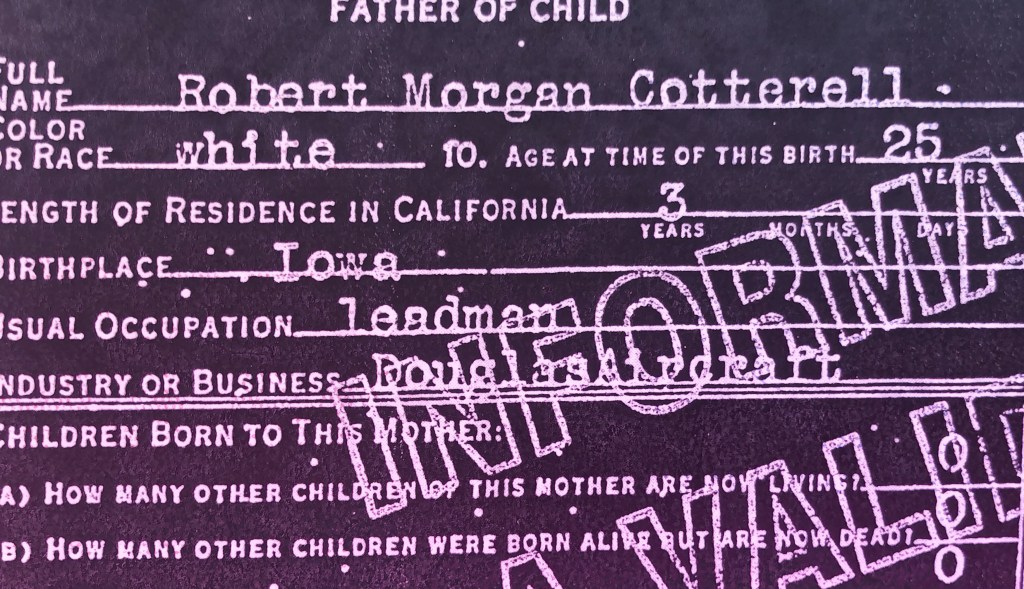
From Constance Susan Cotterell’s birth cert. in 1942. Father Robert a Leadman at Douglas Aircraft.
Donna Virginia LaRocca’s parents Ned and Virginia LaRocca were Vaudeville musicians and traveled the Pantages, Orpheum and other Vaudeville circuits for about the first 10 years of Donna’s life. For more, see related chapters.

This location, Shoredale and Gatewood Streets are in the Elysian Valley or maybe “Frog Town” part of Los Angeles. Very close to Elysian Park which was the very first City Park in Los Angeles
They moved to Evans St. near Marshall High School around 1938.
Donna Virginia was born in 1921, in Peoria, Illinois, the hometown of her father: Joseph Ned LaRocca.
Donna V. moved with her parents to Los Angeles around 1934.
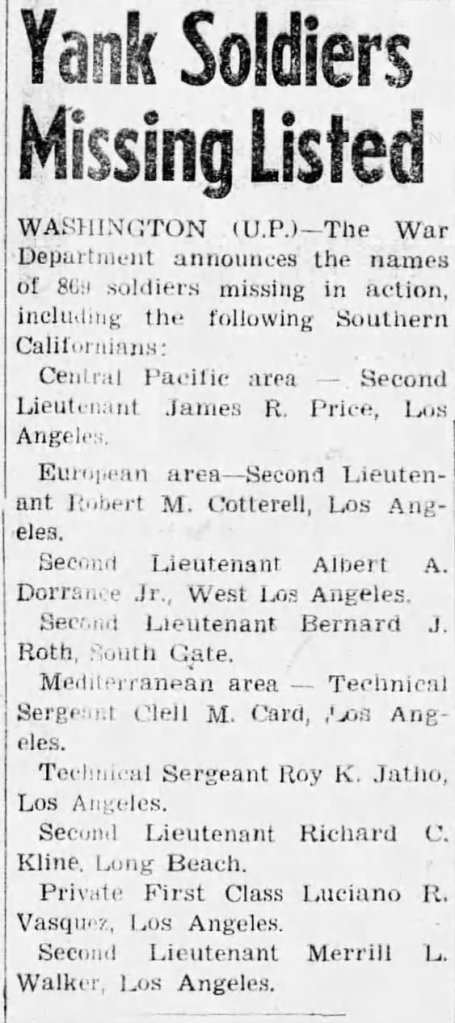
Robert M. Cotterell during World War 2:

<<<<<<<<<<<<<
Wilmington Daily Press Journal July 26, 1944

Robert Cotterell’s daughter Constance is 2 years old, and Diana only 5 months, on the date the POW announcement was published.

Los Angeles Evening Citizen News July 29, 1944 >>>>>>>>


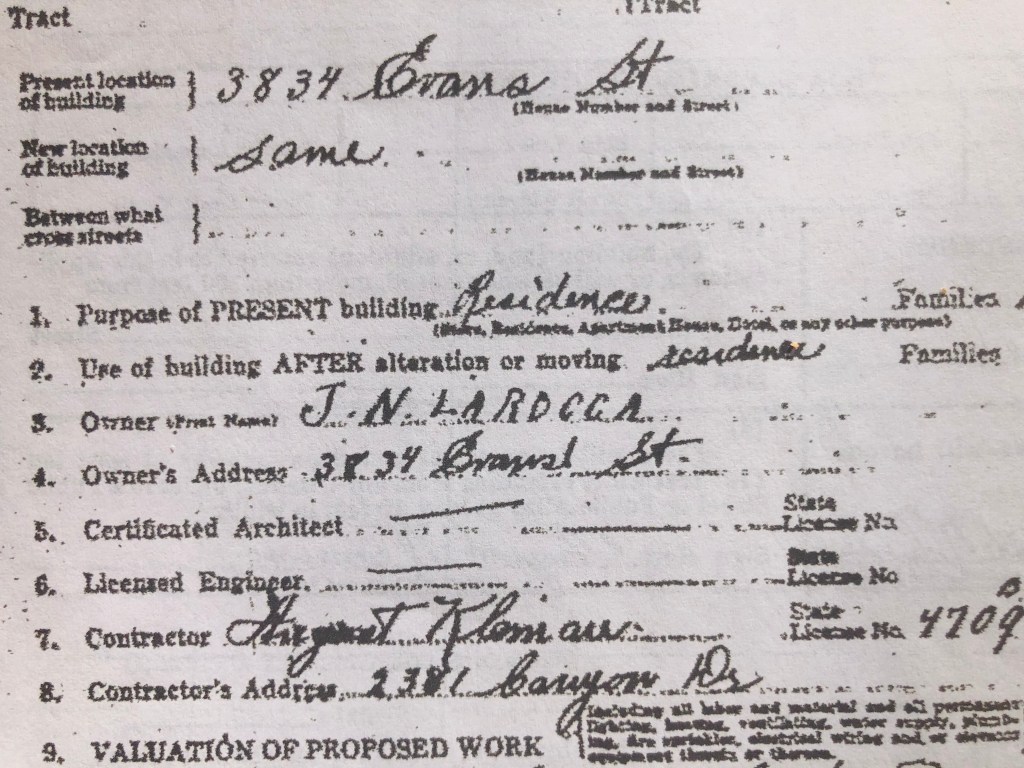
For his part in the war effort, Joseph Ned LaRocca signed up for the “Old Man’s Draft Card.” In 1942, Congress enacted a “law” to show solidarity for the war effort. It provided the Government an idea of the skills the skills “older” men in the US populations. For utilization in the war effort.
The document shows Ned was living at 3834 Evans in 1942.
He was driving to and working as a harpist in the famous NBC and CBS buildings on Sunset & Vine. (More on this in other family chapters.)
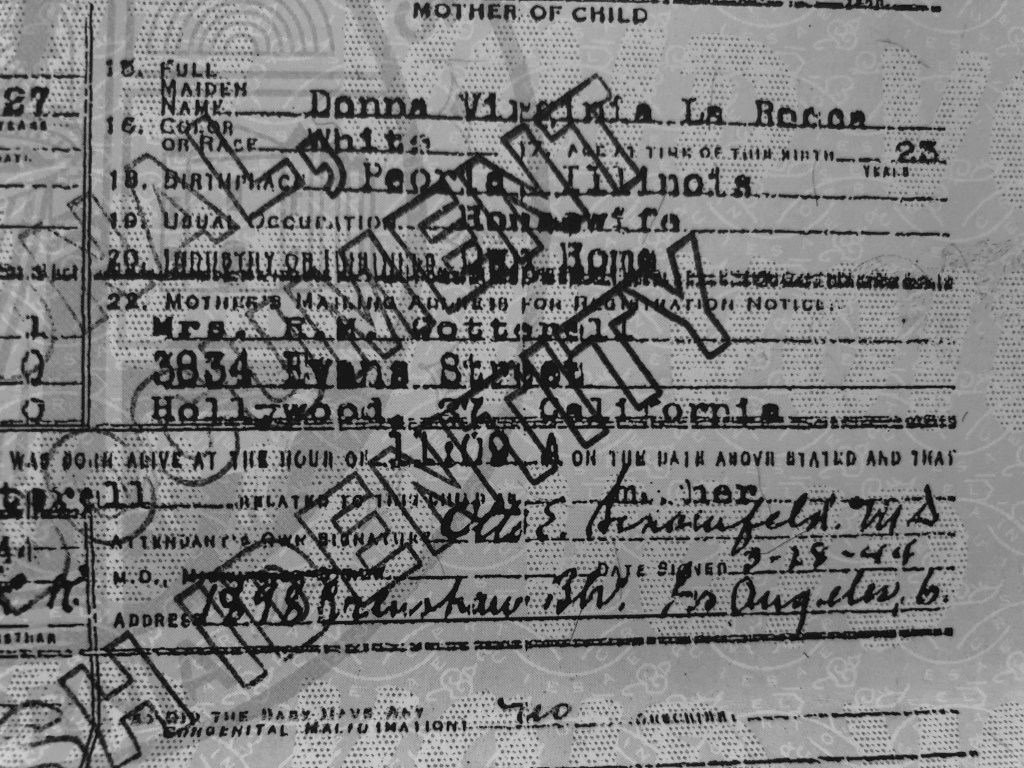
From the 1944 birth certificate of Diana Lee Cotterell, later Paige Young. Home residence listed on Evans Ave., located a stone’s throw away from Marshall High School.
1945 Diana’s father Robert Cotterell is liberated from the German Camp. where he spent approx. one year. I have no idea what he experienced but it probably wasn’t great. Robert’s daughter Diana was 1 year old in 1945 and first-born Constance, 3 years.
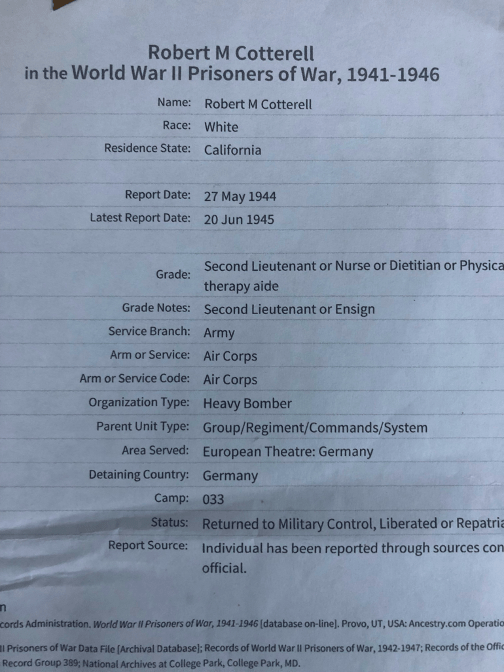
1947
Donna LaRocca Cotterell files for divorce against Robert Morgan Cotterell.

1947 Only 2 months later, the divorce is granted. This seems unusually quick.

Historic Context:
Robert and Donna Cotterell were one couple out of thousands who made up a nation-wide spike in divorce rates after WW2.
Statistics show that in 1946 one in four US marriages ended in divorce.
A 1946 article published in the New York Times said:
“More than half of America’s 1,500,000 war-wed G.I.s have returned. Already one out of every four of these 800,000 men is entangled in divorce proceedings. Experts are predicting that by 1950, 1,000,000 of these wartime marriages-or two out of three-will end in divorce.”
Robert Cotterell remarried in approximately 1949 to Patricia Frick and the couple had two children, in 1950 and 1951.
He got a job after the war working for Douglas Aircraft. The job took his family all over the San Fernando Valley. One stop was Laguna Beach.
I would imagine Robert paid alimony to Donna, normal at the time. He also would have paid child support for his daughters Constance and Diana. I have not been able to learn what kind of relationship the sisters had with their father.
Virginia LaRocca, Donna’s mother, Diana and Constance’s grandmother, was named owner of a double house at 3710 & 3712 Arbolada.
This house is only one mile from the home on Evans St.


Close up
Donna has a voter registration record with this address way back in 1944 below and in Robert Cotterell’s POW announcements in the newspapers.
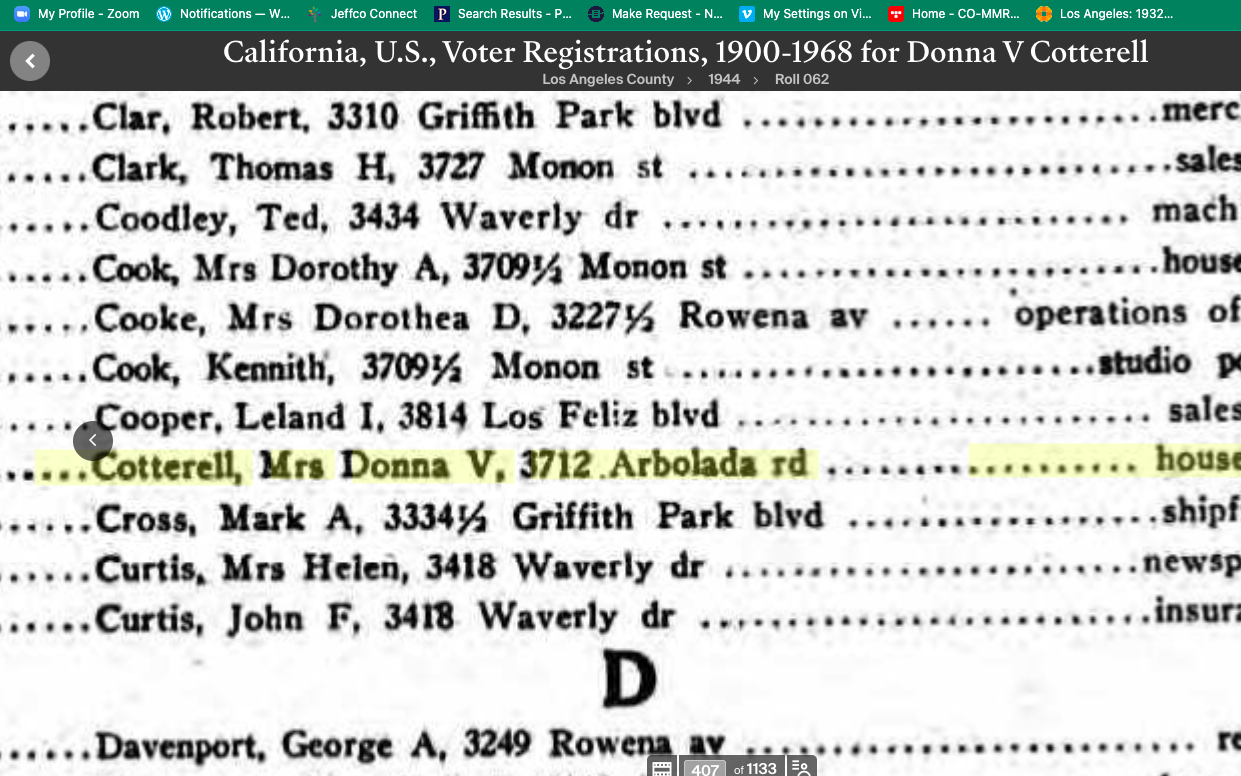
Joseph LaRocca is listed in the LA telephone directory with this Arbolada address in 1948.
Arbolada Rd. is a dead end street.
The homes are located high on a hill with an incredible panoramic view of the area. It’s minutes away from the Evans St. home, so still near Griffith Park.
The homes have a steep step climb.
Document from ancestry lost. Apologies. It was a Voter’s registration showing the following information.
Joseph and Virgina La Rocca listed above at the Arbolada address. Antonio and Corina La Bianca are at 3301 Waverly Dr.
Virginia’s listing leaves off “Christian Science” and just says her employment is “practitioner.” She now has an R by her name!
Antonio and Corina La Bianca purchased the house on Waverly Dr., sometime in the 30s or 40s but will confirm.
Unfortunately, the world knows the story of their son Leno.
The LaRocca Arbolada Road house is close to the LaBianca residence on Waverly Drive. Leno and Rosemary LaBianca were victims of the Manson family at this location. However, between the 2 houses is a large plot of undeveloped (!) land, so one has to travel a circuitous route between the two homes, as a friend did for me one time that I visited. There is no direct path between the two houses.
The 2 Italian families (Joseph’s wife Virginia was not Italian but Mormon with English ancestry) lived a 5 minute car drive from each other at one point, even if they never met.
Mildred Marinell
Diana/Paige’s mother Donna was very close to her first cousin “Mildred Marinell.”
Mildred lived close to Donna in Peoria, Ill., with her in Los Feliz section of LA at 3834 Evans St. And a few doors down from each other in Sherman Oaks, San Fernando Valley, in the 1950s. This is seen in census records mainly.
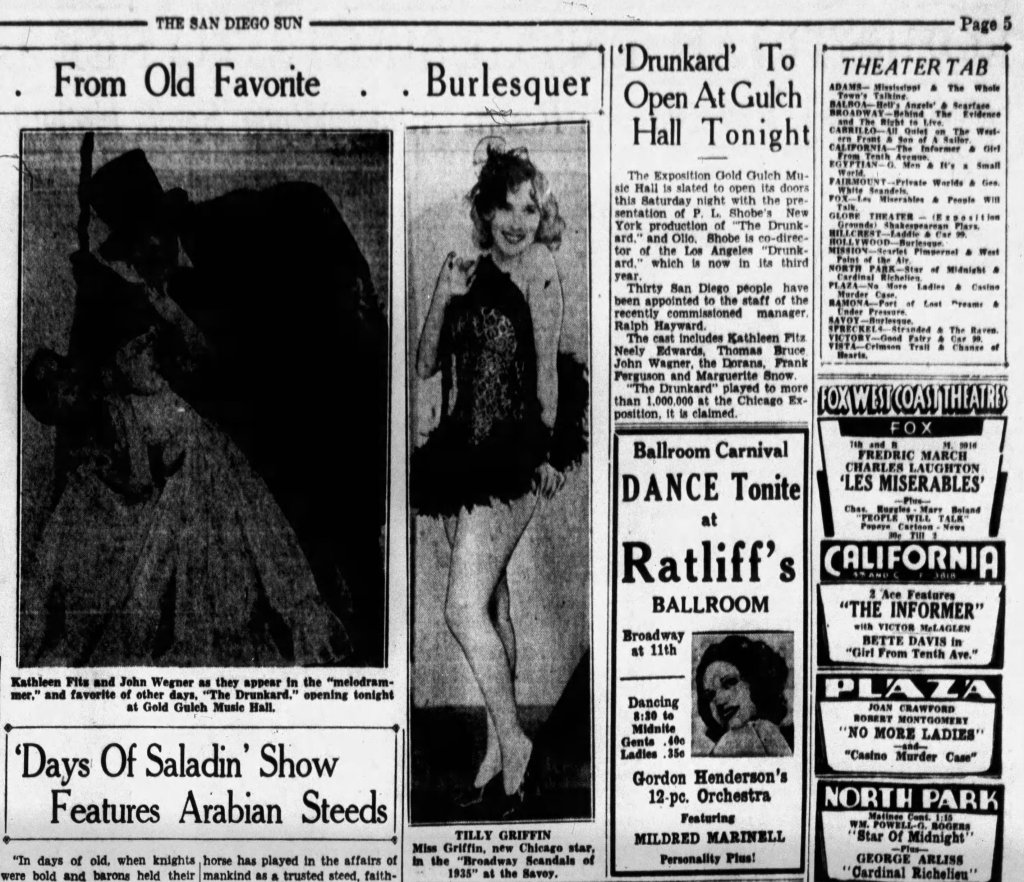
Seen below: Port Angeles, Washington Sept. 21, 1937. Mildred dropped the i/o (I’ve seen it both ways) from her name
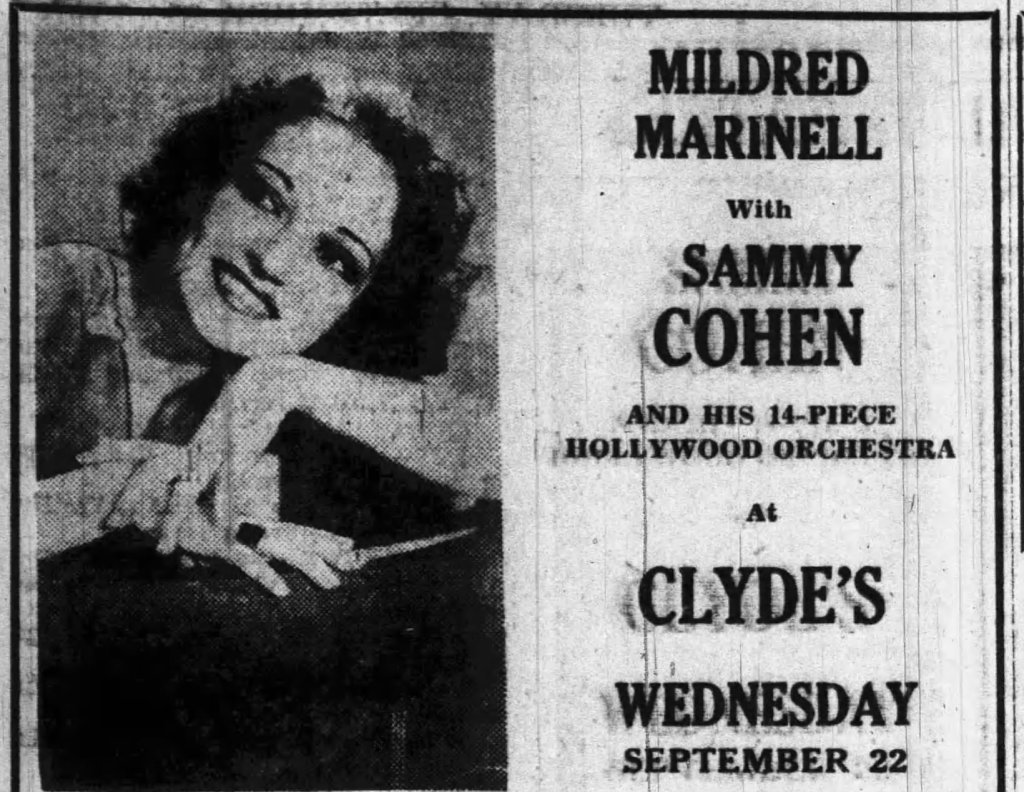
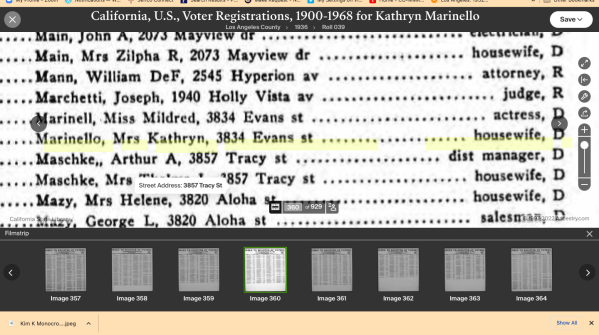
Mildred Marinell and her mother Kathryn living at 3834 Evans. 1936

Mildred ended up marrying Clayton Bartlett and having children with him and living in the San Fernando Valley.
The city of Los Angeles experienced a housing shortage during the post-war years. More so than the usual housing shortage that seems to have almost always existed in LA.
This fact caused me to wonder how the LaRoccas were able afford the 2 houses. They bought one right after the other, or overlapping, in the 1940s. Evans St and Arbolada Rd. houses.
Documents and articles show both addresses were used beginning in 1944 up until about 1948.

Mildred would name her daughter “Donna Lee,” (Lee was Diana/Paige’s middle name) Bartlett,” born in the early 1950s. I’ve tried and can’t reach her.
I didn’t find an exact answer but the next several chapters may shed some light on this “upwardly mobile” family.
Virginia LaRocca had been a full time Christian Science Practitioner sometime in the 1940s, as best as I can tell now.
She had her own phone listing in LA phone books for many years for the purpose for her work as a Practitioner or CSP.
“Gin” became a Christian Science Reader at some point. Her income from this is unknown. It is a high position in the Church of Christ Science.
Virginia’s sister Josephine Harker was listed in a directory at the Evans house around 1940. Harker was her sister’s sometimes singing/dancing partner back in the days of Vaudeville (see related chapters).
It’s easy to imagine that the Evans house was entirely too small to fit all these family members comfortably.
And of course there was daughter Donna and granddaughters Constance and Diana Cotterell born in 1942 and 44.
Father Robert was serving overseas most of this time, his name was connected with both addresses as articles show.
I’m not sure where exactly Robert moved soon after he was liberated and returned from a German POW camp.
His son Robert Cotterell JR. wrote me that his father told him he received a “Dear John” letter from wife Donna, when he was overseas.
I imagine POWs weren’t allowed any mail.
All these names, excluding Diana and Constance, were linked to the Evans or Arbolada address from 1938 through around 1947. These dates are per records I have shown or seen.
Donna and Robert were officially divorced in 1947 per notice in the LAT.

View of the surrounding area is spectacular as is the building itself. It’s one of those house you see in Los Angeles that look precariously balanced on a steep hill.
Perhaps Virginia and Ned sold this spectacular double house to finance their home in the San Fernando Valley?
A 1944 Birth. Birth Certificate. Intro to Family Members. Neighborhood. Walt Disney & Hollywood Connection. Griffith Park Maternity Center. 10-20-2025
Posted on April 27, 2020
The woman who many recognize as Paige Young, a Playboy Magazine Playmate in November 1968, was born Diana Lee Cotterell, March 16, 1944 in Los Angeles.
She was born at the Griffith Park Maternity Home, located at 1933 Griffith Park Boulevard.

Diana’s older sister Constance Susan Cotterell was born at the same maternity center in 1942. It was designed as a “birthing center” for mothers of the Christian Science religion aka Church of Christ Science.
The Griffith Park Maternity Center, well established by 1931, it continued in that capacity for decades. Later, it was a senior residence for several decades until the facility was demolished.
Aug. 38, 1938.
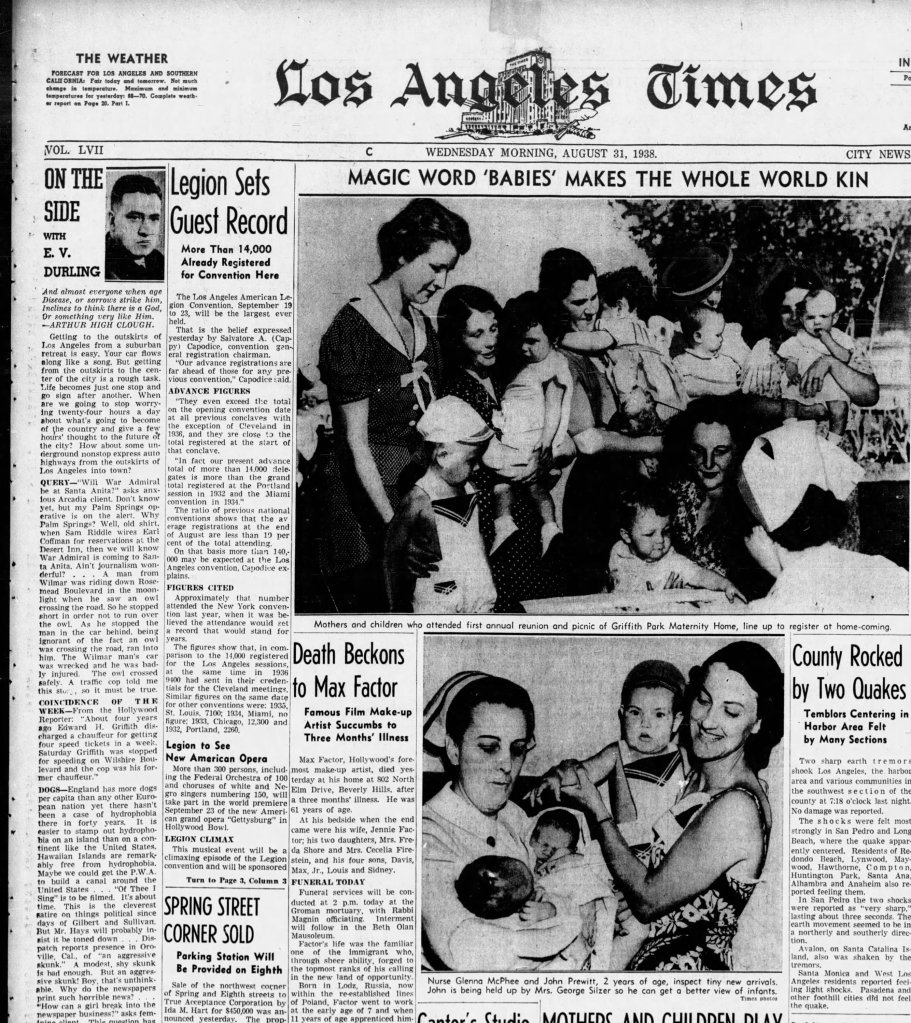
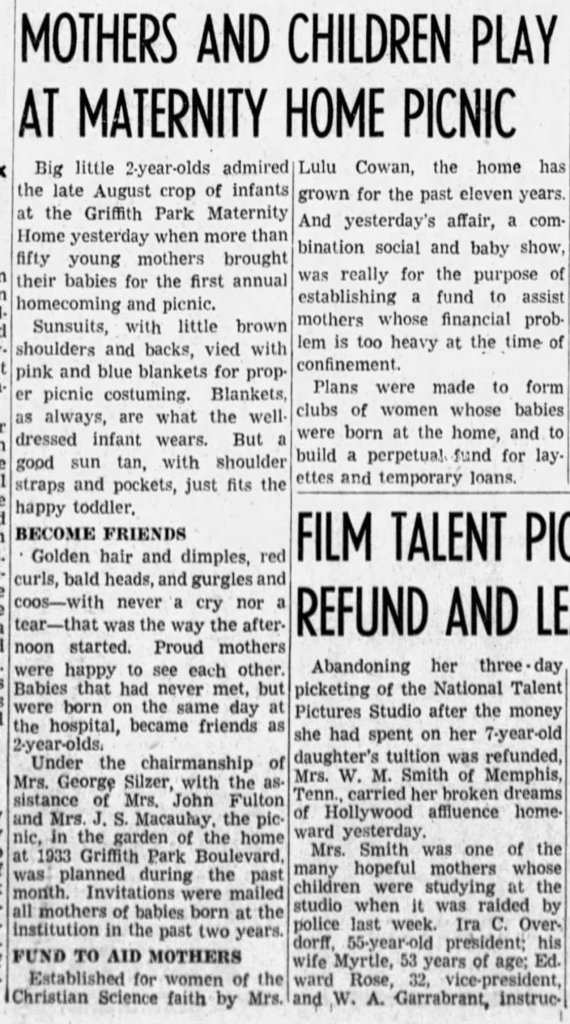
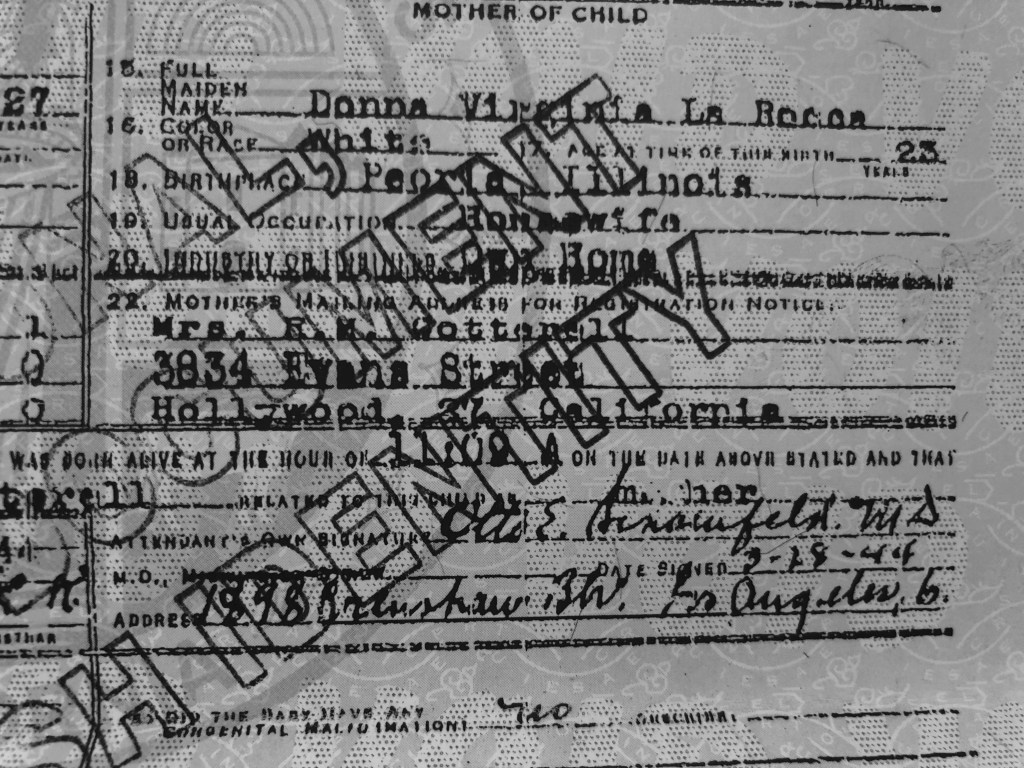
Notice the location of the home, 3834 Evans St., is listed as “Hollywood.” Today this location would be be considered Los Feliz, Franklin Hills or East Hollywood.
I read several posts on an “ex-Christian Science” message board forum. A Dr. Schoenfeld was mentioned several times along with the Griffith Park Maternity Home. These “ex-members” knew that this Dr. Schoenfeld helped deliver them. Several wrote that they remember when their siblings were born there and Schoenfeld helped to deliver them too.
At the Home and others like it, mothers were allowed to labor and give birth “drug free.” Which was against the norm of the times.
When asked about drugs given in labor in hospitals from 1940-1945 , Google AI says
Chloroform: Widely used as an anesthetic to induce unconsciousness and alleviate pain during labor.
Opium: Used for its pain-relieving and sedative effects.
Barbiturates: These sedative medications were sometimes used to induce a “twilight sleep,” aiming to provide a relaxing, dreamy state during labor and potentially cause the parturient to forget the pain and fear associated with childbirth.


Above is a shot I took the day I visited in 2016. Ugly multi-unit housing has been built there since as seen on Google Maps.
By 1938 Ned LaRocca and his wife Virginia, Diana’s grandparents, were living at 3834 Evans. The couple lived there with their daughter, Diana’s mother, Donna Virginia LaRocca.

Neighborhood
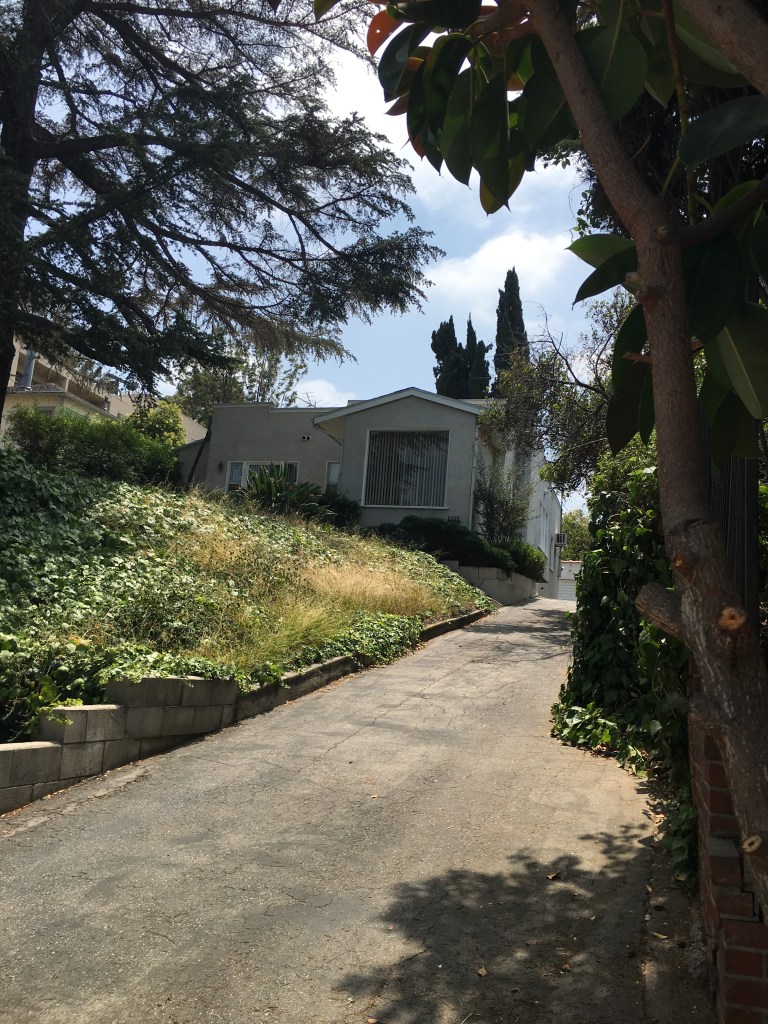
3834
3834 Evans street showing the rather steep driveway. Located close to Marshall High School.
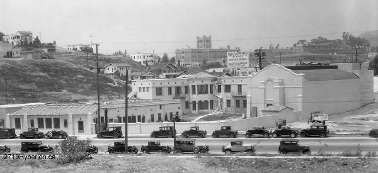
This studio is where Snow White, the first full-length animated feature, was produced. Its’ success made Walt Disney enough money to build a larger studio in Burbank, which was up and running by January of 1940. The Burbank Disney studio the location of Disney to this day.
A Ralph’s Market now stands at the old Hyperion studio.
Marshall High is on Tracy St.
Marshall High School has been seen in many films and TV shows.
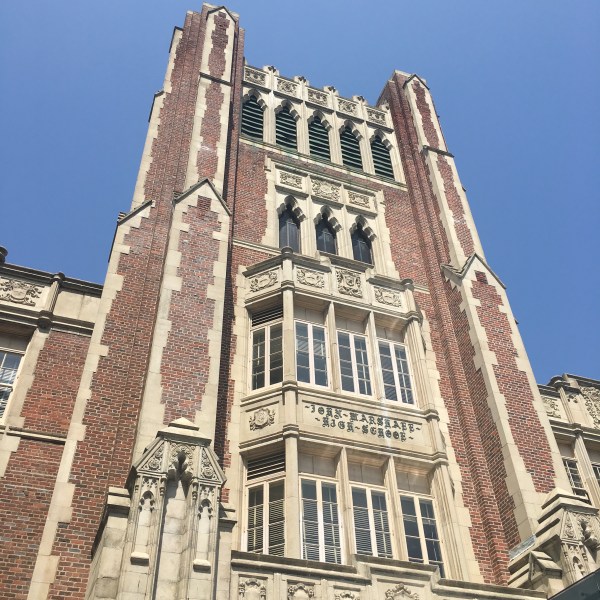
The iconic building and its grounds have appeared in several films and shows. These include Grease, Pretty in Pink, Grosse Pointe Blank, A Nightmare on Elm Street, Boy Meets World, i-Carly, Lucas Tanner, and Highway to Heaven.
To mention only a fraction of titles.
3834 Evans St. is also close to a Los Feliz and Franklin Hills landmark: The Shakespeare Bridge.
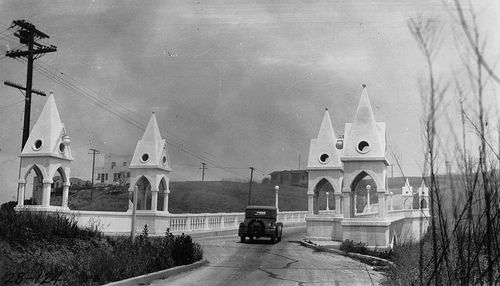
Shakespeare Bridge in Franklin Hills, close to the LaRocca home on Evans.
From Evans walk to St. George and turn left. Walking southwest you will pass a Walt Disney home on your left.
Keep going until you see Franklin Ave. and turn right. The Shakespeare Bridge will be .3 miles ahead.
Evans St. between Hyperion Ave. and St. George.
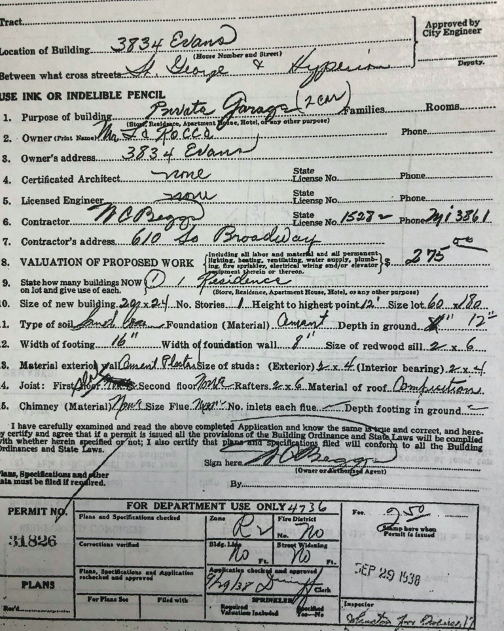
On the back of the document:

The map below shows location of 3834 Evans St.
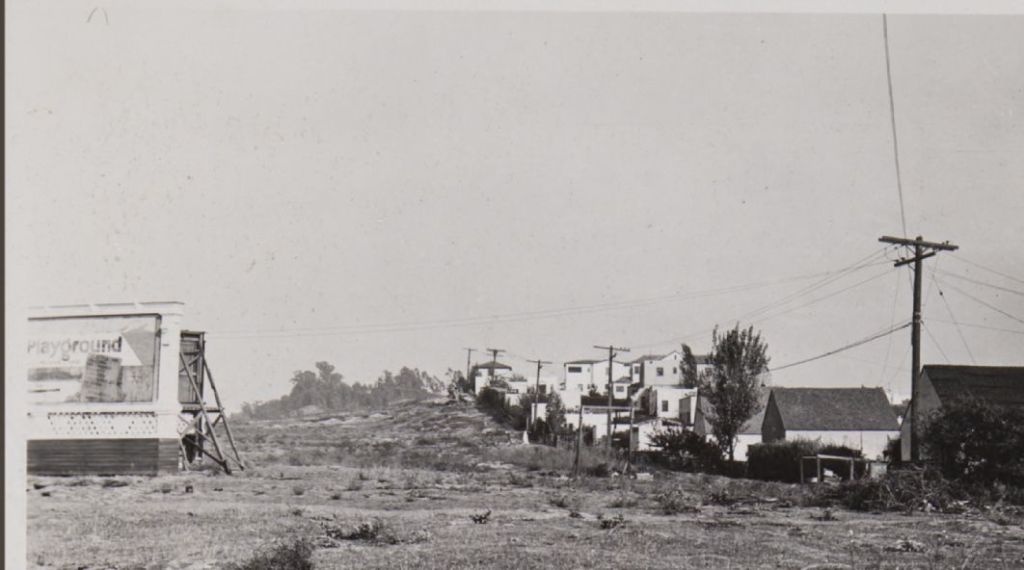
View at Los Feliz Blvd and Rowena looking east in 1933 by Anton Wagner, photographer. Close to 3834 Evans St., the LaRocca’s home from about 1938 to the mid-40s.

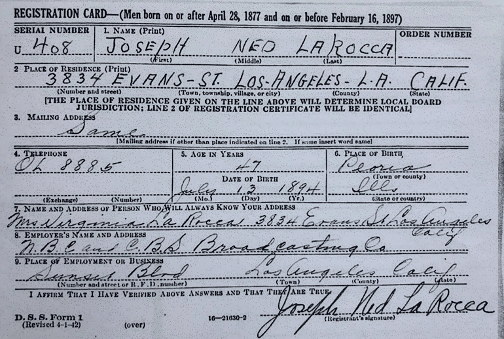
This 1942 registration card of Joseph Ned LaRocca’s, was required by a Selective Service Act after Pearl Harbor.
The directive of the “Old Man’s Draft” was to inventory information. It focused on the skill set of “older” American men aged 45 to 64 years.
In case these skills were needed for the war effort.
It was compared to a “snapshot of American males age 45-64 years old.” AI
 Paige Young in Los Angeles