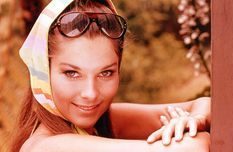
 Paige Young in Los Angeles
Nick Lees and Bob Sanders Reminisce about Paige Young.
Posted on August 21, 2020
Nick Lees, a writer for the Edmonton Journal, wrote the following article in 1981.
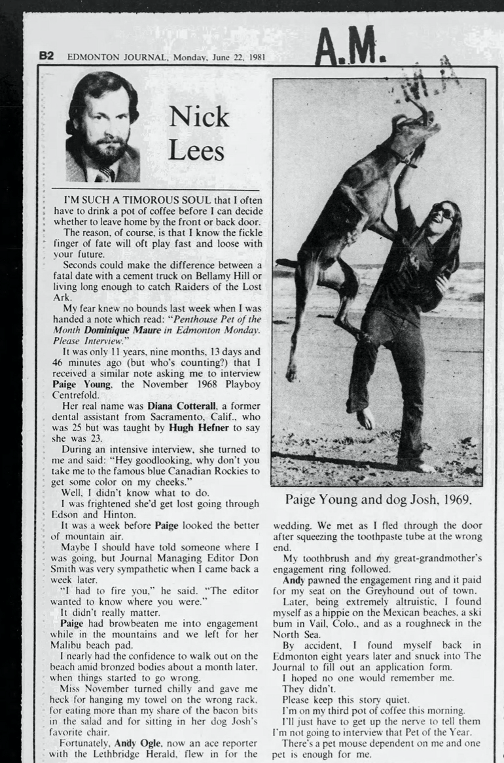
Nick Lees returned to his job at the Edmonton Journal 7 years after he was fired for leaving on his unscheduled vacation with Paige Young.
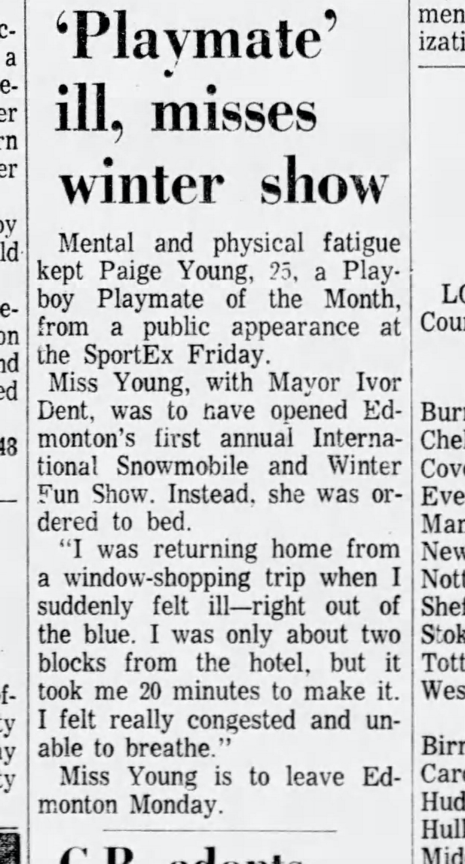
Is Nick the reason Paige missed her contracted appearance at the winter sports show? Did she make up this “sudden illness” excuse?
The part in Lees’ article about Paige Young being from Sacramento and a dental assistant, I don’t buy it. There is too much proof that she was born and lived in Los Angeles her entire life. Plus, I don’t see her going through the rigors of dental school and the “9-5 doldrums.”
Paige may have told this fib to Lees or he remembers incorrectly.
Lees had a long career at the Edmonton newspaper as a popular columnist.

The text at right is from an article about Lees, written by journalist Michael Hingston. The article appeared in Canadian Avenue magazine sometime in the early 2000s.
I thank Edmonton writer Michael Hingston for sending me this portion of his notes, not included in his published story about Lees.
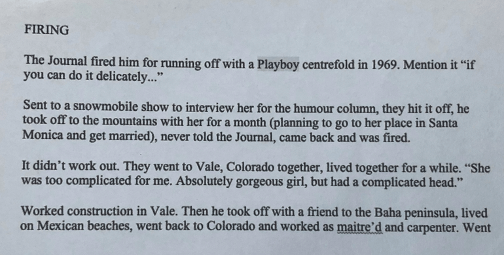
Lees’ opinion of Paige seems to have softened over the years. He sounds more resentful in 1981.
Lees specifies the Colorado Rockies as the mountains he and Paige escaped to (Vale above, it’s actually spelled Vail) rather than the Canadian Rockies as he says in 1981.
Nick doesn’t indicate any knowledge of Paige’s suicide in 1974, either in his 1981 column or his more recent interview with Michael Hingston.
I have been unable to get in touch with Nick Lees.
He was in the hospital a few years ago per a facebook post.
UPDATE: Nick Lees passed away on June 24, 2024 after a battle with cancer and dementia, per his obituary in the Edmonton Journal.
The following is an excerpt from the obit, published on June 28:
In 1968, (1969) Nick interviewed a Playboy bunny, but it turned out she had the question of the day — asking Nick if he would take her to see the Rocky Mountains.
Date night. Nick followed her to Banff and then motored with her to Malibu to get engaged. Not surprising, it didn’t work out.
Upon returning to Edmonton Nick was fired but went back to work for The Journal.
His antics in The Journal, far too many to mention, are legendary.
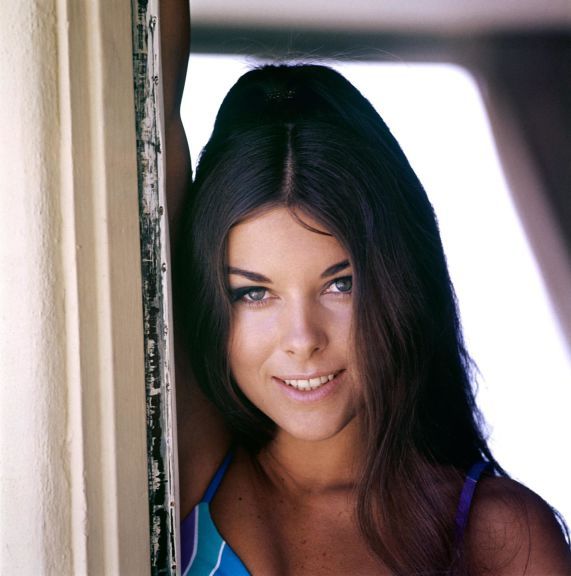
Paige Young by Peter Gowland.
Below is an entry from the website of the late Bob Sanders. He wrote about his lengthy and diverse career.
He has some fascinating stories about Hugh Hefner and working for Playboy as well as TV Guide. He was hired to help promote Hefner’s new TV Show “Playboy After Dark” which led him to meet Paige Young in the late 1960s. Sanders was a “regular American working man with a family.”
7/10/2009
Paige Young….by Bob Sanders
I never learned her real name, but Paige Young, Playboy magazine’s “Miss November” of 1968, was absolutely perfect for a rather challenging assignment: Creating interest in a mediocre TV series.
“Playboy After Dark,” was a follow-up to “Playboy’s Penthouse” which also starred Hugh Hefner, pipe in hand. In both the original and the reincarnation, an elevator whisked viewers to a penthouse where host Hefner, his free arm wrapped around his then current squeeze as we called them, feigned surprise at another drop-in, finally announcing who was in the house to perform. It was pretty awkward stuff.
I met Paige late in January, 1969. That was three months after her appearance in the magazine; an illness had prevented what would have been a timely trip to Chicago. Page was in town to collect $10,000 then awarded Playmates who now receive $25,000 with $100,000 going to the Playmate of the Year. They got to stay a week or so at the Playboy Mansion, attend parties, make personal appearances and meet Hefner, a cultural summit for most. One of my contributions to the process was to interview each of them to determine if they could be of promotional help. Among a year’s monthly winners, you could count on two being particularly good or outstanding. Paige was one of the latter and who could forget either her center-fold or the woman in person? Peter Gowland did the photography in Los Angeles posing a prone Paige, back scratcher in hand. The flashing brown eyes did no harm to the overall effect.
It was a few months before I met Paige that Hefner’s reclusive lifestyle began undergoing a change. The not-so-poor-man’s Howard Hughes had come out of his shell swearing off the uppers and downers that enabled him to stay awake editing his magazine three days at a time. Not only had Hefner hit the streets to observe police outrage during the 1968 Democratic National Convention but he would soon return to the TV trough with “Playboy After Dark” scheduled for Screen Gems release.
Owned by Columbia Pictures, the first major studio to learn to live with the new medium through the creation of a subsidiary, Screen Gems not surprisingly realized the series was a tough sell. They backed off midway through production refusing to promote the show for an additional good reason. Screen Gems had a huge backlog of product including a boatload of Perry Masons–271 to be exact. Up to that point, my involvement was little more than choosing pictures from contact sheets provided by a Hollywood photographer. I soon learned Hefner had little use for black and white photography, perhaps because Playmates’ skin tones looked much more ravishing in color. It was as though black and white was O.K. for Citizen Kane and little more in Hefner’s opinion. I began to bootleg photography; pictures I used to promote the firm’s Lake Geneva resort via newspapers were actually shot by a Chicago Tribune snapper assigned to a narrowly focused feature about the hotel. I paid him $100 after his gig to shoot what I needed: pictures that went beyond architectural renderings ordered by my predecessor. I was never questioned by my management about the photos I used because it was assumed the pics were transferred from color to black and white. Had I gone that route, the shots would have lost about 20% of their sharpness.
Corporate expenses will always be a subject of much conjecture. During what turned out to be 40 years spending other people’s money, I was questioned but once. That was while working for TV Guide in St. Louis, my first gig for the magazine. The year was 1955, eight months after we opened; the office manager, a hopeful sort, had determined we should send parents of newborn children copies of the magazine. Names and addresses of the parents were gleaned from pages of local newspapers and the copy, set in five point agate type, required a magnifying glass to determine accuracy. It was regional manager Arthur Shulman who asked me what the hell was I doing spending $1.99 of TV Guide’s money in such strange fashion?
Playboy was far and away the least concerned of my employers about spending money. Hefner made it clear that he wanted things done in the best possible manner. It was terrific working for a firm striving for promotion efforts done, as Hefner suggested,” first class.” I never took advantage of the situation there or anywhere else.
That early contact sheet assignment for “Playboy After Dark” involved work by an independent photographer, a rather strange determination considering the number of excellent snappers on the payroll. Admittedly, they were rather specialized.
It was while looking at pictures of the fifth show that I found the best shots–maybe ever–of Hefner. All of them found him next to one of the show’s chickie poos. Soon my hunch was verified. Barbie Benton, then a theater major at UCLA–had become a regular on the show eventually attaining status as Hef’s significant love of eight years. I ordered a dozen of one picture of the adoring couple I had cropped from a group shot.
On a trip to Los Angeles, promotion director Nelson Futch and I learned at a meeting called by Screen Gems that its management had determined a preference for releasing “Perry Mason” starring Raymond Burr, then successful in keeping quiet his homosexuality, over the ultimately virile Hefner. It was regarded as a savage blow and Futch, unperturbed, turned the project over to me immediately following the meeting. That was when I thought of Paige Young.
A couple of months passed during which I worked my ass off concentrating on the show. One day Futch and I got a hurry up call to meet with Hefner at The Mansion. Oh, yes. Bring the promotion work. After waiting four hours during which Futch put the Benton/Hefner photo on top the pile of my creativity, we finally entered his office. Our meeting followed one between Hef and his editor-in-chief A.C. Spectorsky–the man who, among many things, coined the word “exurbanites.” Moments later, Hefner spotted the photo, held it up to the light and did a series of gyrations reminiscent of Charlie Chaplin’s examination of the world in The Great Dictator.
“Where did you get this?” he asked–a pretty dumb question under the circumstances unless a UCLA photo-journalist had grabbed a shot of the Bunny King attired in a silly Edwardian suit while visiting one of Barbie’s acting classes.
“The fifth show,” I replied.
“Can I have one?” he asked in very boyish fashion as if I were the editor of the high school yearbook and he, infatuated by a photo of his best girl.
“Would you like six? I can get you at least five more.” That was it. He never looked at any of the rest of my promotional efforts. Apparently, he had decided the Hef/Barbie choice was sufficient. The picture became paramount in the print promotion of the show.
The series played in something like 21 markets with the stations located north and south from Minneapolis to Miami and east to west from New York to Los Angeles. Among them were two Lafayettes–Indiana and Louisiana–plus other locations across the fruited plain and Canada where the program was seen in Montreal. The series had but one show worth viewing; it starred Sammy Davis, Jr., Anthony Newley, Jerry Lewis and Peter Lawford, the latter of unique adroitness: dressing up a set.
Hefner’s published comments on the series and his host role give pause: “It’s better than the ‘Johnny Carson Show’ or the ‘Joey Bishop Show’ and I do a better job hosting than Ed Sullivan does.”
KTLA, the then Gene Autry-owned independent channel , bought the series and we scheduled a party for what was then called the Playboy Building at 8560 Sunset Boulevard. Built in the early 1960s, it had a parking lot to the west set beneath 10 stories of reinforced concrete. It is now part of the Sunset Millennium Project–three buildings totaling approximately 300,000 square feet of office space.
Back then, my attention was captivated by a huge windowless area of the building’s west façade. Recalling all the “Playboy After Dark” color photos taken on the set, I wondered if we could project pictures on the wall in a rotating series of six or so with enticing copy to promote the show. I found a Swedish company with equipment about the size of a small TV set which we secured at the entrance to the parking lot.
My idea had unusual origins. Years before, comedian Red Skelton had a neighbor in Palm Springs he didn’t like or so the story went. The guy, a moralistic type, had a white stucco home with a large wall visible to the street. In reaction to the neighbor’s latest outrage, Skelton began showing adult movies on the fellow’s home.
In the fall of 1969, eastbound Sunset Blvd. motorists were confronted by color photos of scantily clad young ladies in addition to 30-ft pipe-clutching Hefs and bug cute Barbies.
We had a minor “Playboy After Dark” promotion problem which never surfaced. Paige Young had not appeared in the series having turned down a request. Thoughtful and intelligent, she had other things to do, notably painting. Horses were a subject dear to her as I learned during time out on the north side of Phoenix where many Arabian thoroughbred farms used to exist.
Paige was a total delight. One time she flew to Minneapolis where I met her at the airport before we moved on to newspaper, magazine and broadcast interviews. After a couple of days, we flew to Miami for more of the same. Phoenix was particularly productive offering a good example of the Playboy mystique. Shortly after our arrival, I learned a local PR representative hired by us had not set up any interviews. I made five phone calls to the TV stations then located in the area and placed Paige on each channel for interviews–mostly on news programs. It may have been a very slow news day, but getting that kind of attention on such short notice with little going for us except the Playboy mystique was absolutely amazing; the series was about to be carried on one of those five stations. The trick was to set up the interviews along different lines emphasizing such things as the magazine and Paige’s appearance in it, her life and travels, and what Hugh Hefner was really like.
During my Playboy Enterprises days there was a story, probably apocryphal, told about Hefner by Victor Lownes who was, in my opinion, a promotional genius responsible for a lot of the magazine’s (and later the clubs’) success. Lownes had introduced a young woman to Hefner, referring to him as “a living legend.” The couple wandered off to a nearby bedroom where, scant minutes later, the woman emerged commenting to Lownes: “And you call that a living legend?” Hey, nobody bats 1.000.
It was no secret Lownes had been run out of Chicago after dallying with a teenage TV star. Adding to the speed of his departure was her being the daughter of a high profile newspaper columnist. Lownes settled in London where he established the London Playboy Club, then gained a gambling permit. It wasn’t long before he had created a lifestyle many thought at least the equivalent of Hefner’s; included was Stocks, an impressive manor house. While Benny Dunn was dressing up Hefner’ Chicago Gold Coast home with people from the entertainment world, Lownes was attracting a much broader spectrum of notables.
Things went nicely for Lownes. Treated as a company hero as Playboy Enterprises peaked during my years there, his short returns to Chicago were largely joyous occasions although Lownes could be a jerk. Circulation of the magazine hit 6,000,000, the hotels were showing promise, and the clubs were doing well thanks to Victor’s London gambling license. Suddenly, in 1981, England’s gaming commission yanked the permit. Some Arabs, among the club’s highest rollers, had been given markers by Lownes and the license was pulled. To this day, Lownes denies the charges. No question the timing was dreadful. Hefner was in the midst of what turned out to be an unsuccessful attempt to get a gambling permit for Atlantic City and the London catastrophe played a major role. An earlier New York City liquor license obtained under questionable circumstances was another.
The relationship between old friends Hefner and Lownes cooled. The latter eventually left the organization and wrote a tough but largely accurate book about his former pal and a public company having difficulty adjusting to a world enormously changed since Hefner planned the magazine in his kitchen nearly 30 years before. The magazine business was undergoing upheavals of its own. Penthouse, inspired by Hefner but tawdry by comparison, offered full frontal nudity and Playboy met the challenge. Marilyn Cole, who later married Lownes, was the first Playmate to be so photographed.
While my association with Paige Young remained purely professional, I’m sure a lot of people in the home office and air travelers thought otherwise. The airport scenes were rather wondrous. Paige wore big floppy hats in a great variety of singular colors. We arranged our airport meets so that scheduled arrivals in those halcyon days of dependability were very close. I could spot her hat from impressive distances and she could do the same with me although I never wore a floppy hat. The last half of our promotion tour found us running toward each other in airports and embracing in corny displays suggesting to many that we were something we weren’t.
So many memories remain including a rainy night in New Orleans during which we ran barefoot through the French Quarter (she was a physical fitness nut) and were later entertained by the Playboy Club’s musical director, Al Belletto, one of the few non-Dixie musicians in town. A Stan Kenton discovery, Belletto introduced us to such people as Al Hirt, Pete Fountain and Eddie Miller, the Fred Astaire of tenor saxophonists. When I met Miller, I made the observation and he said: “I think that’s the nicest thing anyone has ever said about me.”

West Bank Guide May 1969.
Paige and I lost track of each other and I attempted to find her on the internet some five years ago. I wish I hadn’t. She had committed suicide at age 30, six years after we stopped promoting Hefner’s TV show.
I can’t recall a single clue that might have suggested such a splendid blithe spirit was capable of such a decision. END
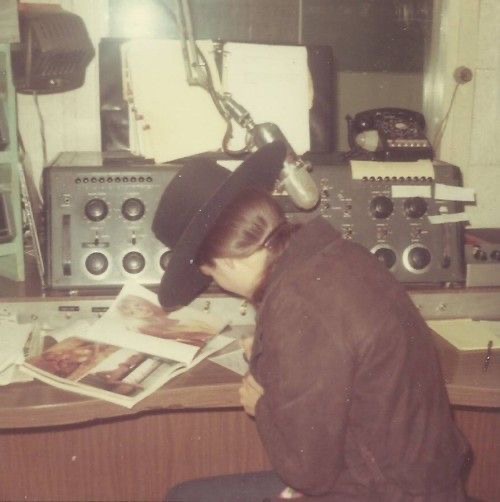
A woman contacted me by e-mail about 4 years ago and said she was the daughter of the late Bob Sanders.
She told me that when the Daily Mail article was published, she was relieved that her father was not alive to learn that Paige’s method of suicide was a gunshot to head, not an overdose of drugs. She said learning the true method of suicide would have greatly upset him.
Bob’s daughter also wrote that she thinks despite what her father wrote in his blog post, there many have been a fling of sorts between her father and Paige.
Because of the Nick Lees story, I don’t think Bob Sanders traveled with Paige to Edmonton, she was likely traveling on her own at this point.
If you read the chapter on 1969–there are several articles that mention Bob Sanders, not by name but by profession, as Paige’s “handler,” “assistant,” even “flack.”
# # # #
1969 January. Playboy Magazine. Playmate of the Year Contest. Winner: Connie Kreski. Anthony Newley. Roman Polanski. Can Heironymus Merkin Ever Forget Mercy Humppe…..? 1970s James Caan. Under Construction. Victor Lownes and Marilyn Cole. NSFW. 2-9-26
Posted on July 15, 2020
NSFW
PMOM = Playmate of the Month. PMOY = Playmate of the Year.
This photo of Paige Young appears in the January 1969 issue of Playboy magazine.
A brief update about her life is included, which was truthful I learned, if incomplete.
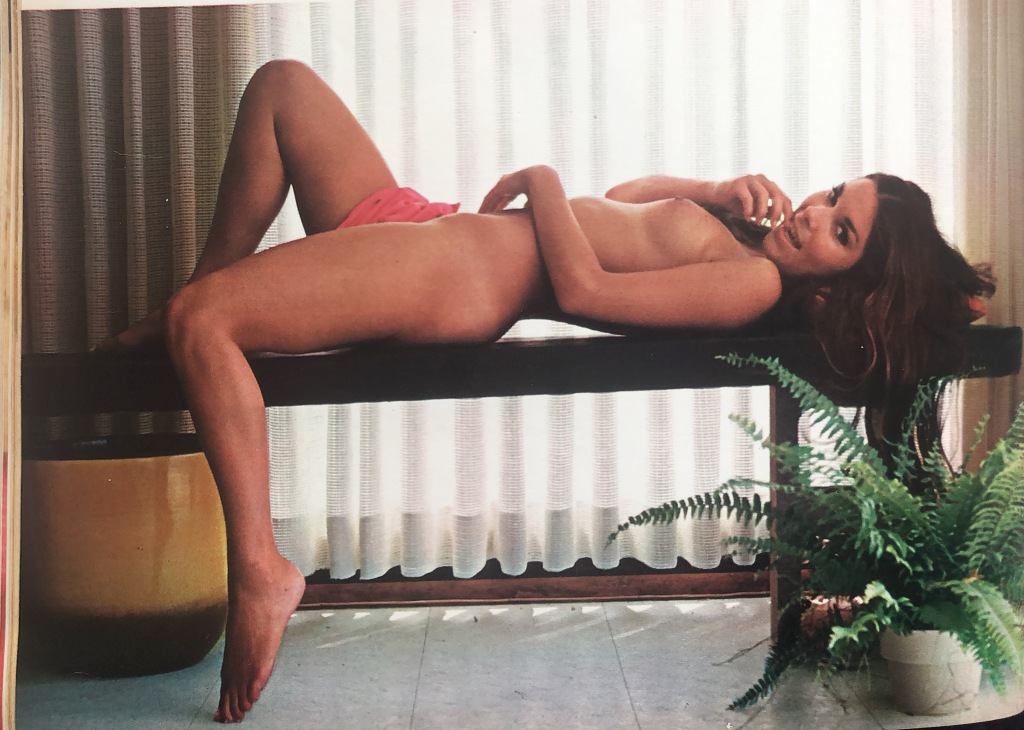
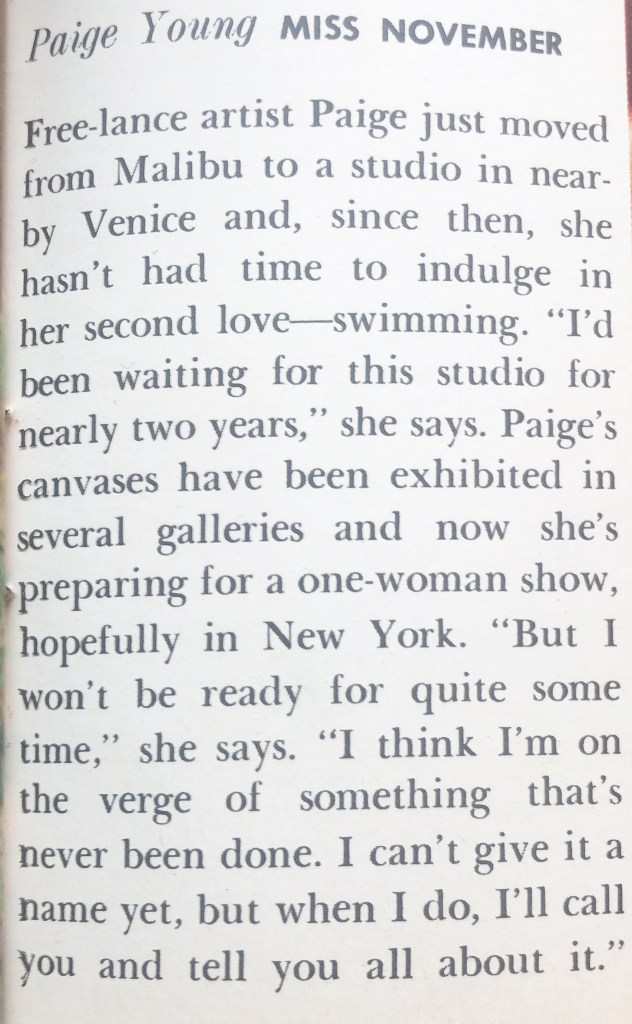
Update on Paige Young shown with her photo. Jan. 1969 Playboy Magazine.
More specifically than Malibu, which was always printed in Playboy, Paige lived in Topanga Canyon/ Topanga Beach. At that time, an area of artists, musicians, hippies, surfers and Hollywood celebrities. She knew Bill Cosby at the time and he may have helped her obtain her home there.
The January 1969 Playboy magazine issue shows all 12 Playmates of 1968.
A brief update accompanies each one, as we read in Paige’s entry.
Standard protocol for this annual issue.
It means the PMOY title will be announced soon.
1969 is also the 15th anniversary issue of the influential and wildly successful magazine.
Hugh Hefner became famous for his publishing and business empire.
Besides the magazine, the trendy Playboy Clubs Playboy Bunny cocktail waitresses were instantly iconic.
Successful enough to have created scores of imitators in the magazine publishing world during the 1950s and early 1960s.
Titles like Escapade, Nugget, Modern Man, Adam, Dude and Rogue, to name only a few. An easy Google image search.
The imitators experienced varying degrees of success.
The Playmate of the Year
has a higher status than Playmate of the Month (PMOM) obviously.
Kind of like, the “elite of the elite.“
Or the “creme de la creme.“
A PMOY title is akin to winning a beauty contest, much like Miss America or Miss USA. The winner reigns for one year and is then replaced the next.
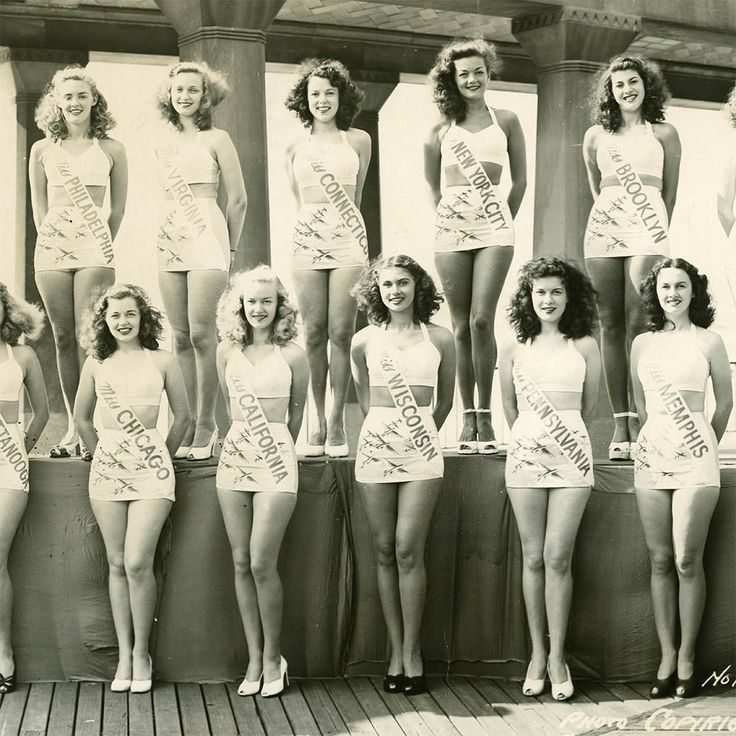
The 12 finalists are the 12 PMOMs.
The yearly 12 have already cleared a major hurdle by winning over many other young women for the coveted monthly spot.
Round 2: the 12 finalists compete for the PMOY title.
PMOY means more of everything you have already experienced as a regular PMOM: public appearances, photo sessions, media interviews, a modeling fee, career opportunities.
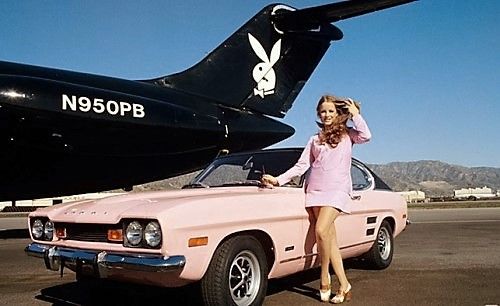
(However, a pink car is reserved exclusively for the PMOY.)
PMOY 1970 Claudia Jennings with her prize of a “Playmate Pink” color Mercury Capri. Behind it is Hugh Hefner’s favorite mode of transportation the few years he owned his jet called “The Big Bunny.”
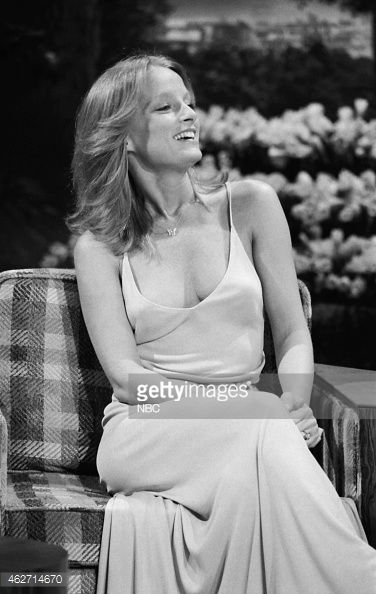
Claudia Jennings, an aspiring actress, is seen here being interviewed on the Tonight show, sitting on Johnny’s famous couch around the time she was given the title PMOY 1970.
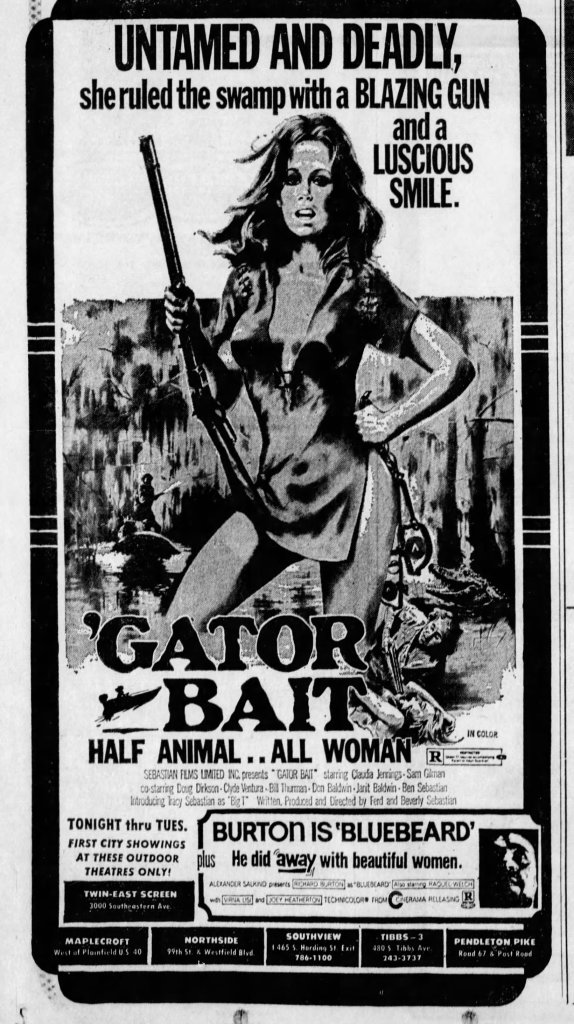
She did become a successful actress in films like: Truck Stop Women, Gator Bait. and Unholy Rollers.
More about Jennings in my Start Here page.
The PMOY gets a big party thrown in her honor, often at Hef’s Chicago mansion, later LA. Attendees include press, various celebrities including good looking film actors, Playboy and Hollywood big-wigs and assorted VIPs.
You would meet 100s of men in particular I imagine.
How was PMOY chosen?
I wonder if reader feedback influenced the decision, was it up to Hugh Hefner alone, or decided by committee?
Paige Young did not win and I doubt if she was even in the top 3.
The winner was Connie Kreski seen here on the cover of her PMOY issue
June 1969

Winner Connie was the girlfriend of Victor Lownes, head of the London Playboy Club & Casino, Chicago friend of Hugh Hefner.
Both are forgotten figures of the 1960s.
More on Victor Lownes coming up.
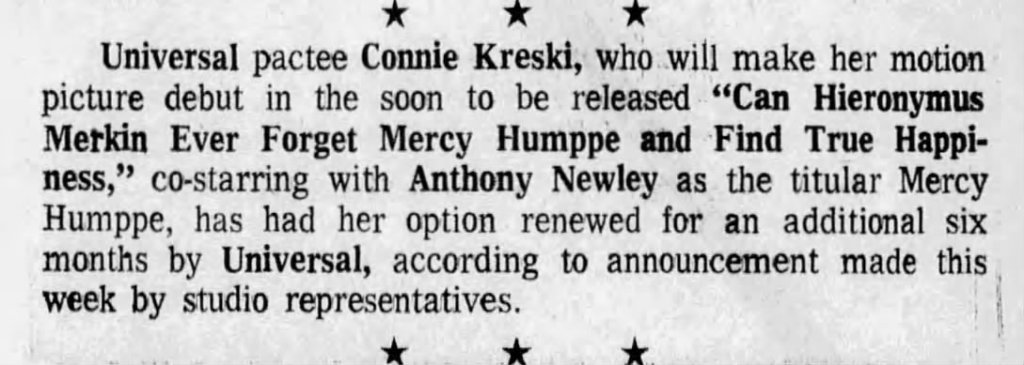
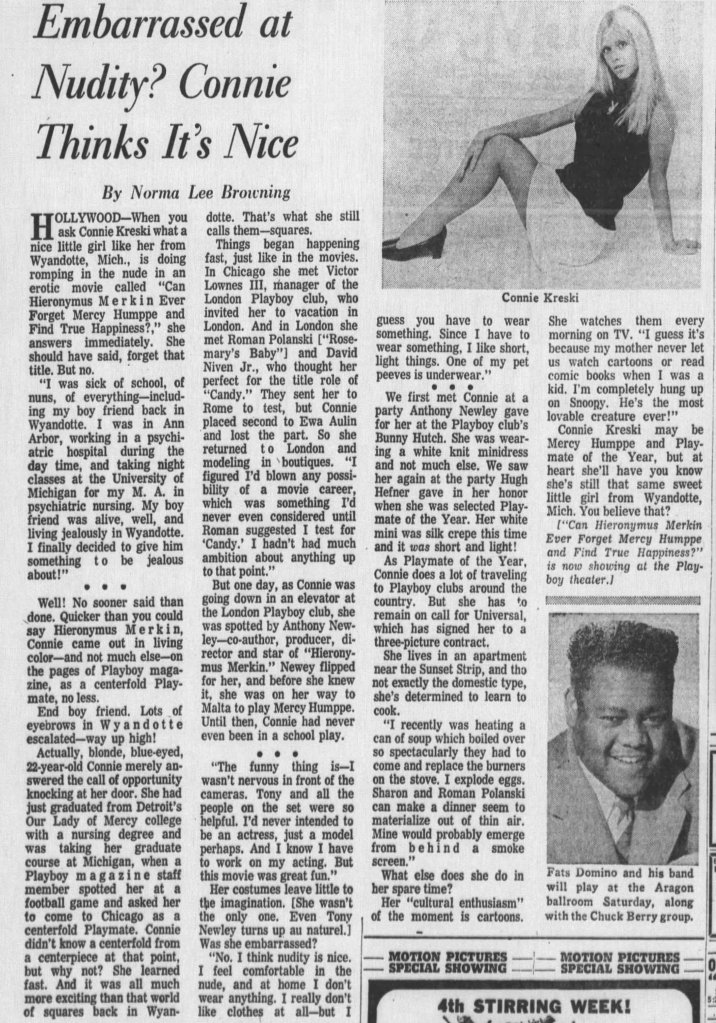
By the time of her PMOY title was announced in 1969, Connie had already filmed a movie directed by English singer, actor, composer Anthony Newley.
Newley wrote many classic songs like Goldfinger, What Kind of Fool and I?, Feeling Good and Candy Man!
Connie Kreski
born Constance Joanne Kornacki in Wyandotte, Michigan.


Connie said in several press interviews that she grew up in a “strict Polish Catholic family.”
Constance Kornacki was studying for a degree in psychiatric nursing at Mercy College in Detroit when Playboy came calling in the form of a man at a University of Michigan football game.

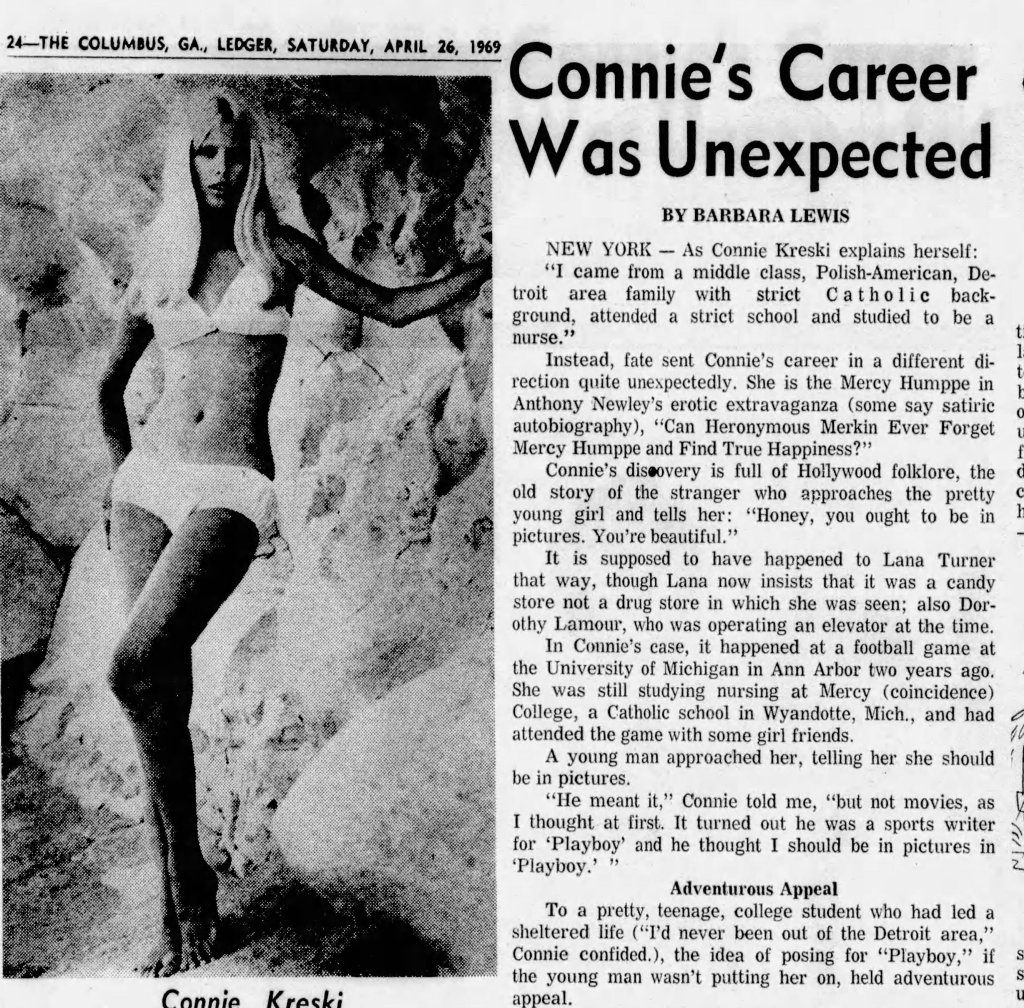
He worked for Playboy and told Connie he thought she had the ideal youthful face and figure required for Playmate candidates.
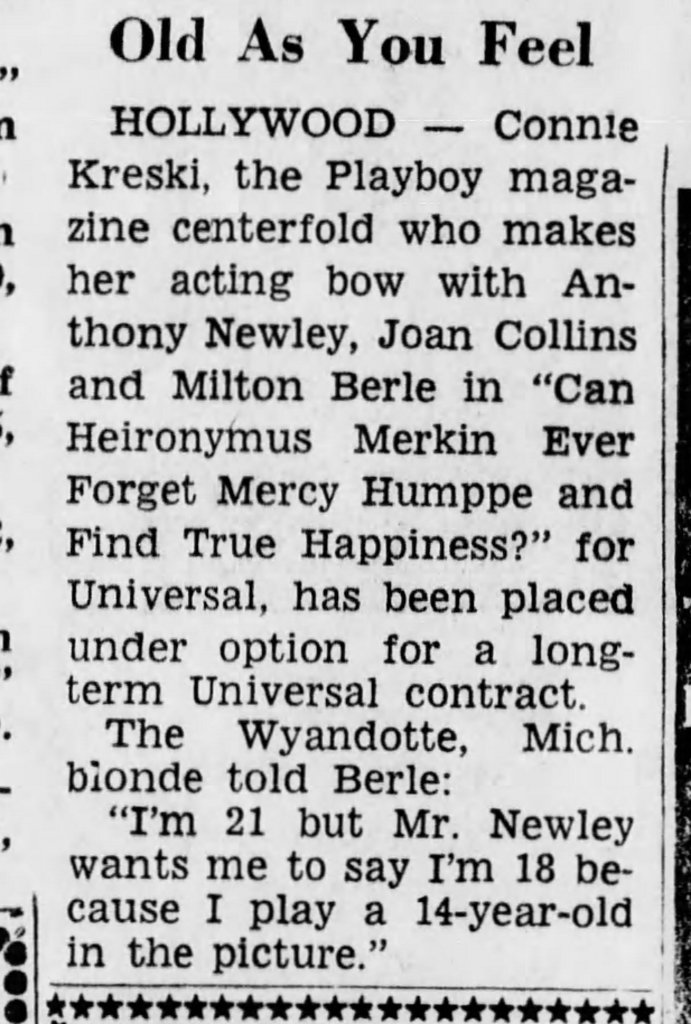
Connie appeared to look much younger than her 21 years.

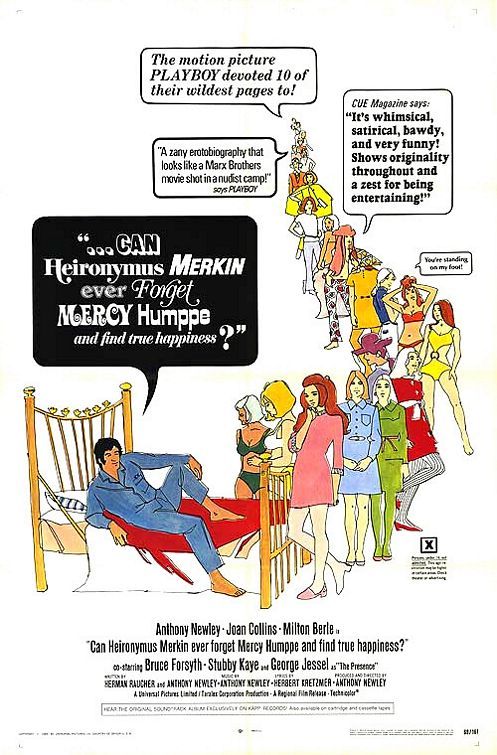
This is why Newley cast her as Mercy in his 1969 released film “Can Heironymus Merkin Ever Forget Mercy Humppe and Find True Happiness?”
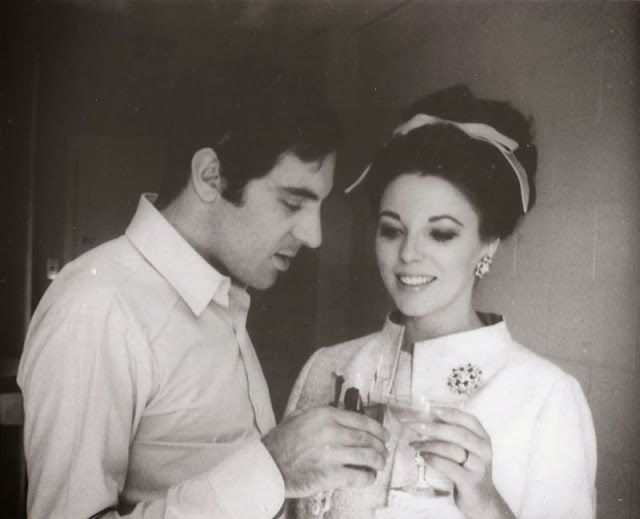
Anthony Newley had married a beautiful Hollywood starlet in 1963.
She was a native of England named Joan Collins.
Anthony Newley plays himself in the title role of Heironymus, wife Joan Collins plays his wife in the film, named Polyester Poontang.
It was pretty much a flop and skewered by the critics.
Anthony and Joan were married in 1963 and this photo was taken around that time.
Credit Vintage Everyday Pinterest
The article below was written before the disappointing reviews that followed the debut of the film in 1969.
It’s an interesting look at late-1960s popular culture by way of Newley’s film, filmed on the island of Malta in 1968.
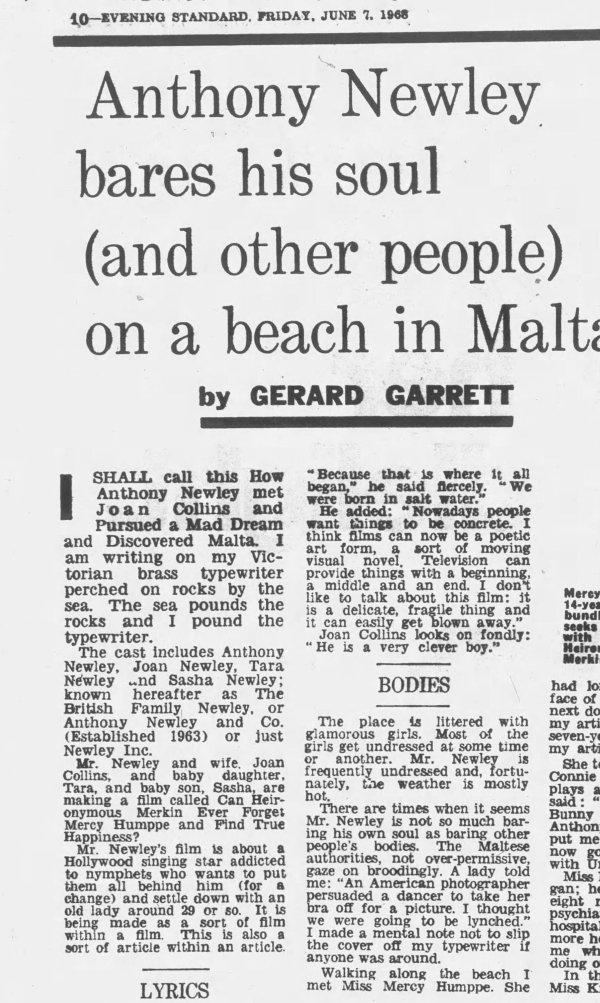
The Newley’s small children Alexander and Tara were in the film as well as and several starlets, models and dancers.
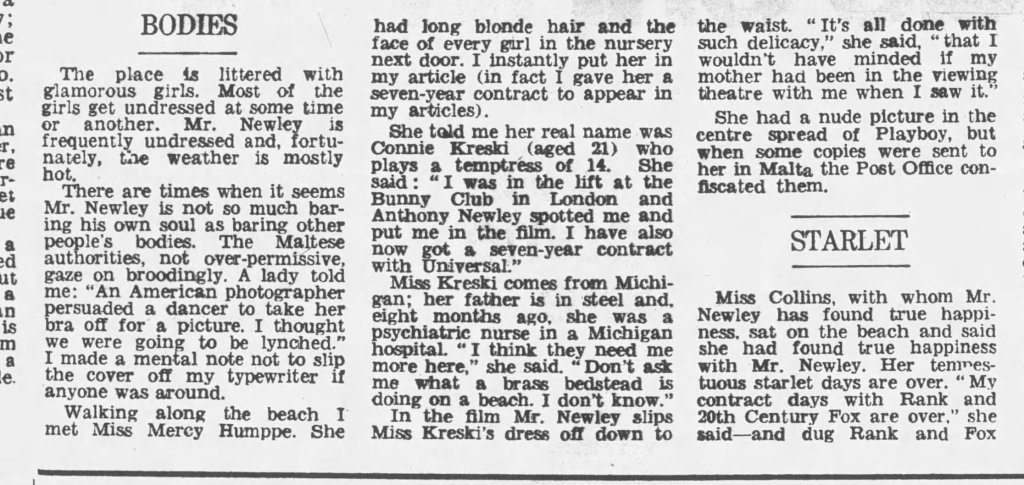
More likely, she met Lownes in Chicago and was invited by him.
Or perhaps, she followed him to London.
Note the part that Connie “plays a temptress of 14.” Paragraph 4.


Connie, just like Paige Young, had publicity all year long in 1969.
More than the 2 young women would ever have the rest of their short lives.
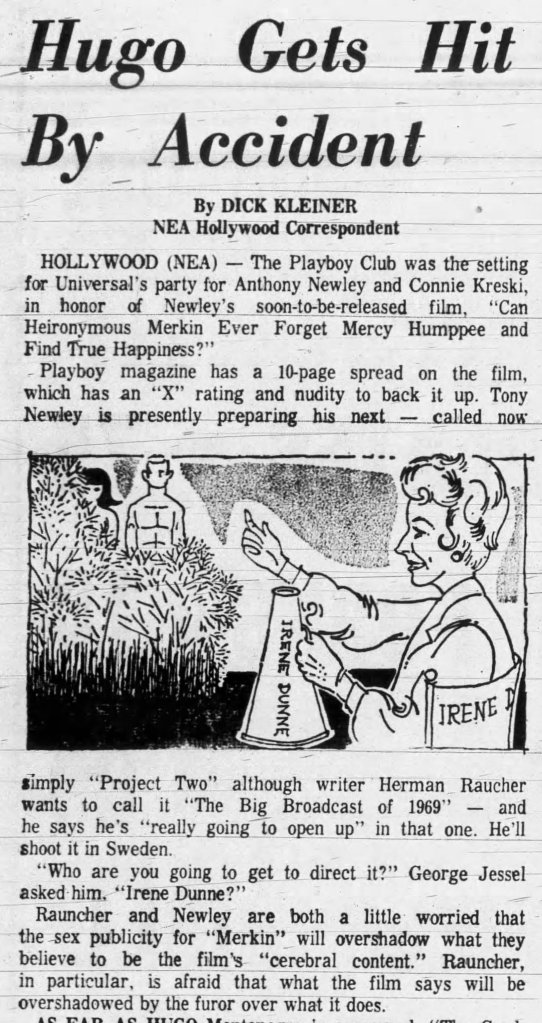
Connie had her picture in newspapers across the USA, England and Canada in ‘69
Connie appeared in many newspaper articles for her title role in Heironymus Merkin.
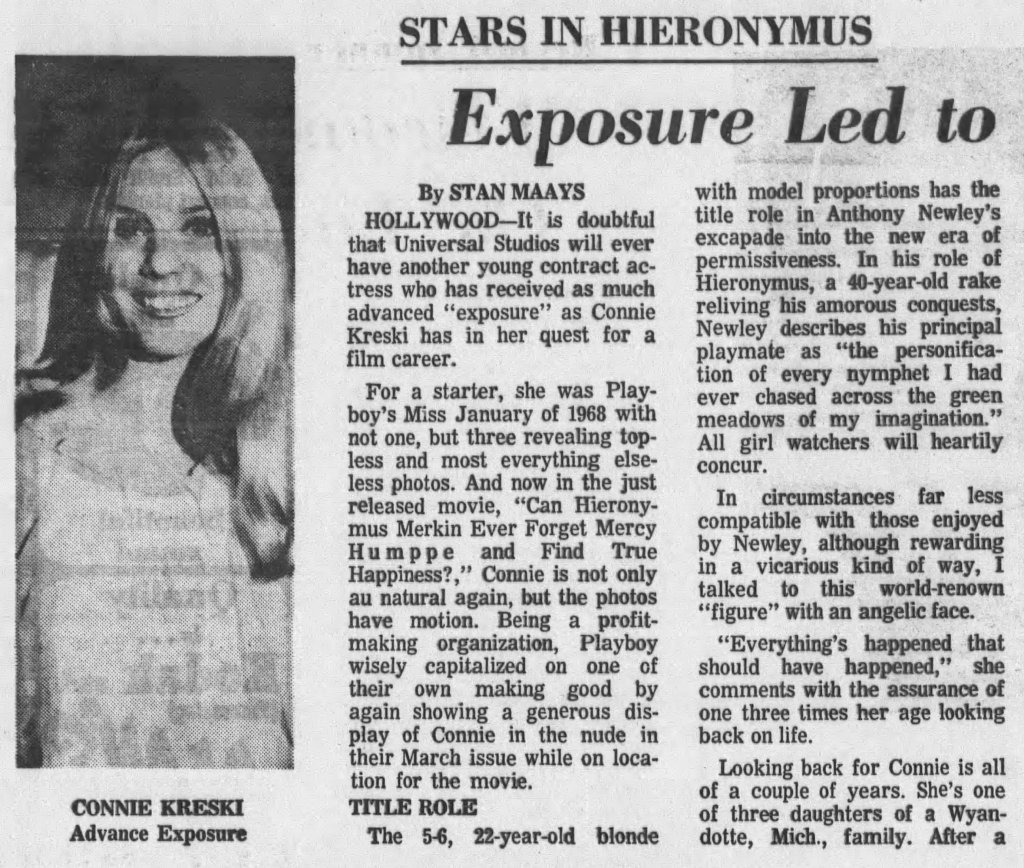
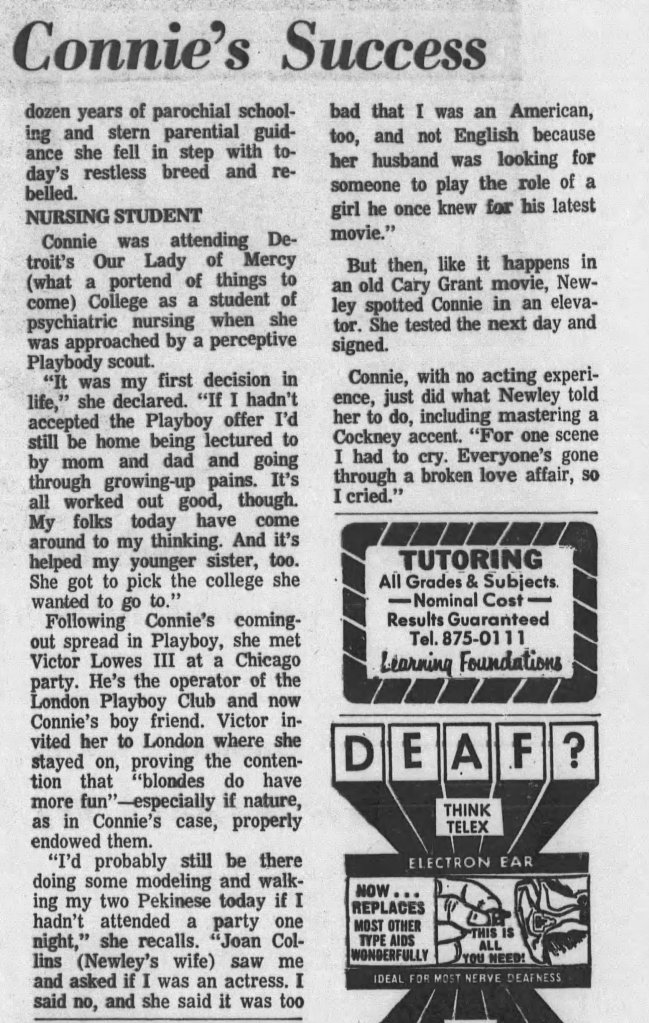

One issue of Playboy magazine featured a nine page photo spread, serving as a promo for Heironymus. And for Connie as their Playboy Star.
Newley was a great friend and appeared on Hugh Hefner’s show of 1968-1970 Playboy After Dark.
Connie has several nude shots in the issue and a nearly nude Joan Collins has one.
Victor Lownes
is a colorful and forgotten 1960s character.
Lownes was a close Chicago friend of Hugh Hefner.
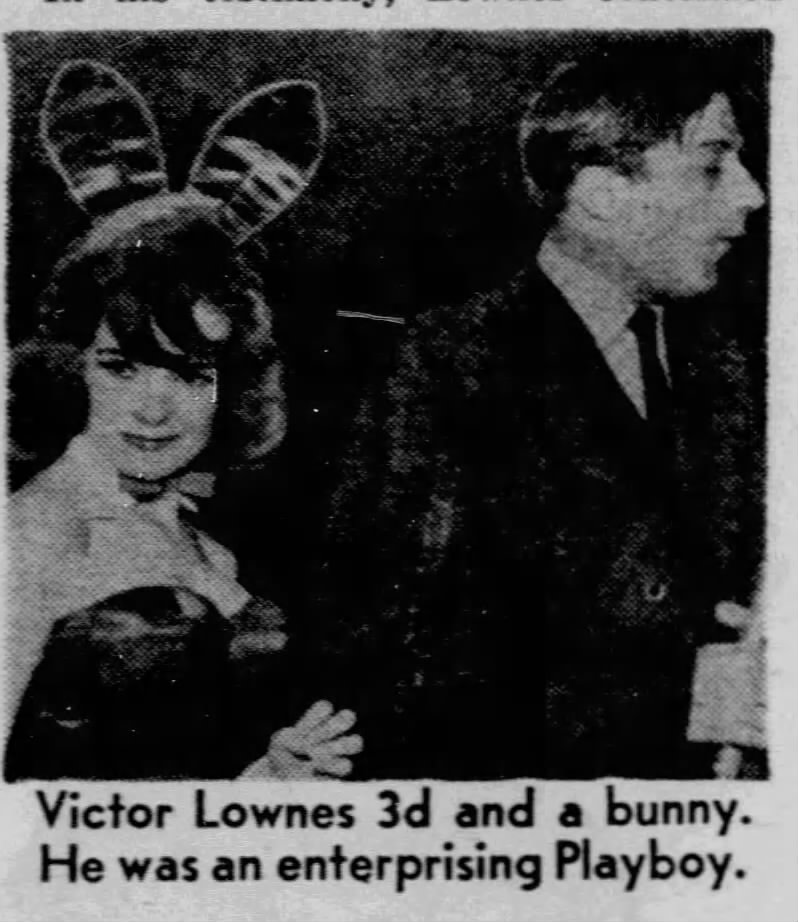
New York Daily News. Nov. 8, 1964.
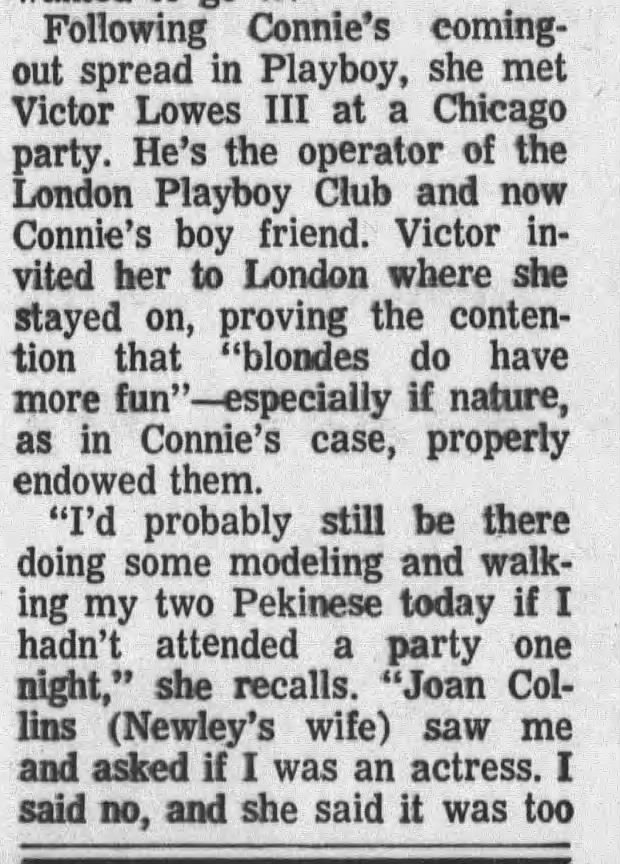
People said that Lownes, who moved to London to run the Playboy Club & Casino, embodied the“Playboy man” even more than Hugh Hefner.
He was also known to sexually harass Bunnies at the clubs.
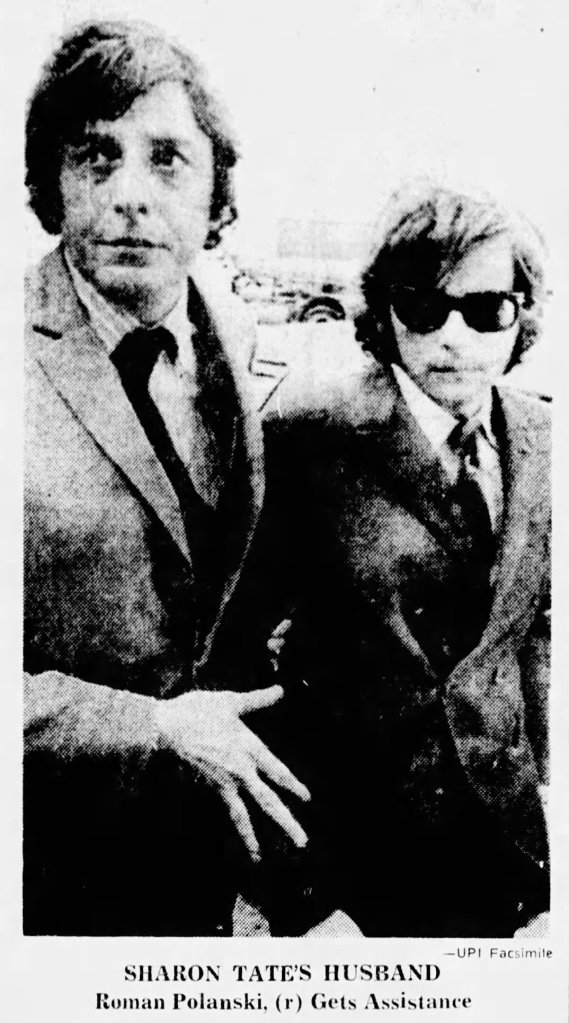
Victor and Connie are seen together in the much viewed film footage of the Tate (and maybe Jay Sebring?) funerals on youtube. However, they are never identified.
Little Known connection to Charles manson killings
Victor Lownes, Hefner and directorRoman Polanski, Anthony Newley, were close friends in the late 1960s and 1970s.
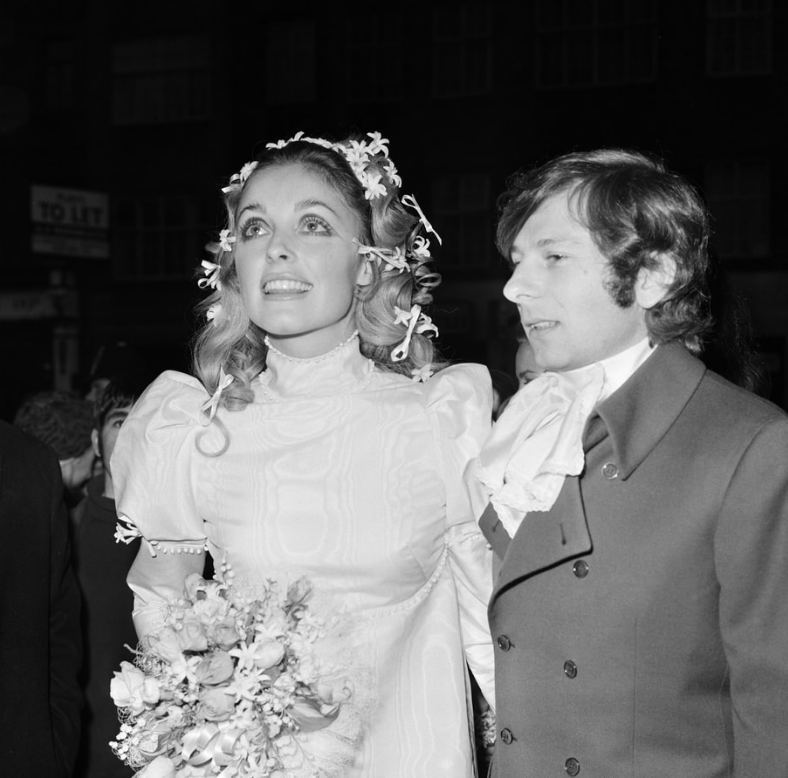
Polanski and actress Sharon Tate lived together in London for a time and had their wedding reception at the London Playboy Club in 1968. A party hosted by Victor Lownes.
Connie and Victor appear together with several mourners at Sharon Tate’s funeral in Los Angeles, on film footage seen on youtube.

Roman and Sharon also appeared together on an episode of Playboy After Dark, a show Connie appears on several times.
The couple was interviewed by host Hef; Roman does most of the talking. (Available on youtube and tiktok.)
Paige Young traveled the USA, Canada and Japan to promote the show in 1969 She may or may not have appeared on the show.
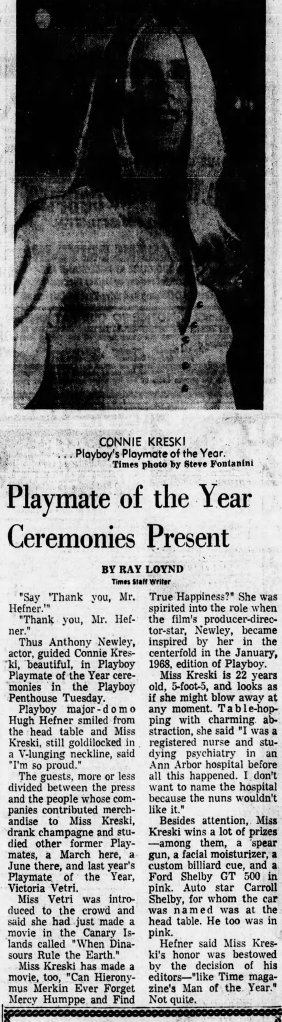
Victoria Vetri, PMOY 1968, and starlet is mentioned in left column. Her reign of ‘68 was honored at the party. The opening of her film, now a cult classic, When Dinosaurs Ruled the Earth, was also celebrated. Victoria Vetri had a small part in the Roman Polanski-directed hit film “Rosemary’s Baby.” Victoria was known as Angela Dorian when she was the September Playmate of the Month in 1967. and Playmate of the Year 1968 as Victoria Vetri. Roman Polanski convinced her to use her real name. of Victoria Vetri, where she had a bit part in Rosemary’s Baby.
The Manson murders would occur just a few months after this article appeared.


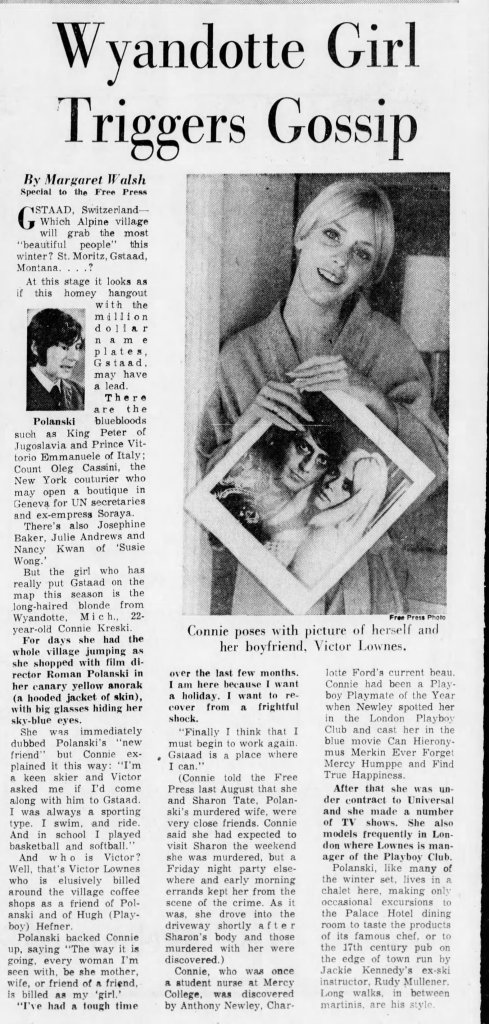
Connie holds photo of herself and Victor, who would dump her in about 2 years for the force of nature that was Marilyn Cole. Connie claims there is nothing romantic going on between her and Roman Polanski. This article is only months after the horrific murders.
Victor dumped Connie after he fell hard for a new Bunny at the London Club.
The aforementioned Marilyn Cole.
She has her own story to tell and has done so in interviews. But she’s never been asked about her love triangle involving Connie and Victor, other than the book Bunny by Russell Miller.
Marilyn Cole appears briefly in Secrets of Playboy.
This Bunny was quickly promoted PMOM in 1972 and PMOY in 1973.
Marilyn Cole’s Playboy centerfold is famous/infamous for being the first obvious straight-on view of a PMOM with full frontal nudity. Not subtle or hidden as in earlier photos.
Cole’s issue came at a time when Playboy magazine experienced a drop in readership, due to competition from the new and more explicit Penthouse magazine.
The Marilyn Cole issue provided a huge sales boost for Playboy which she talks about in Secrets of Playboy documentary.
Penthouse magazine featured more explicit and forward photography of their centerfold called a “Penthouse Pet.” In particular full-frontal nudity.
The viewer is more of a voyeur to the private bedroom of the “Pet,” than he may have seen in the Playboy centerfold.
Playboy was “forced” or pressured into publishing the centerfolds in the Penthouse style. This was to keep up with the new standards in popular culture, the more open nudity standards Playboy helped to bring in.
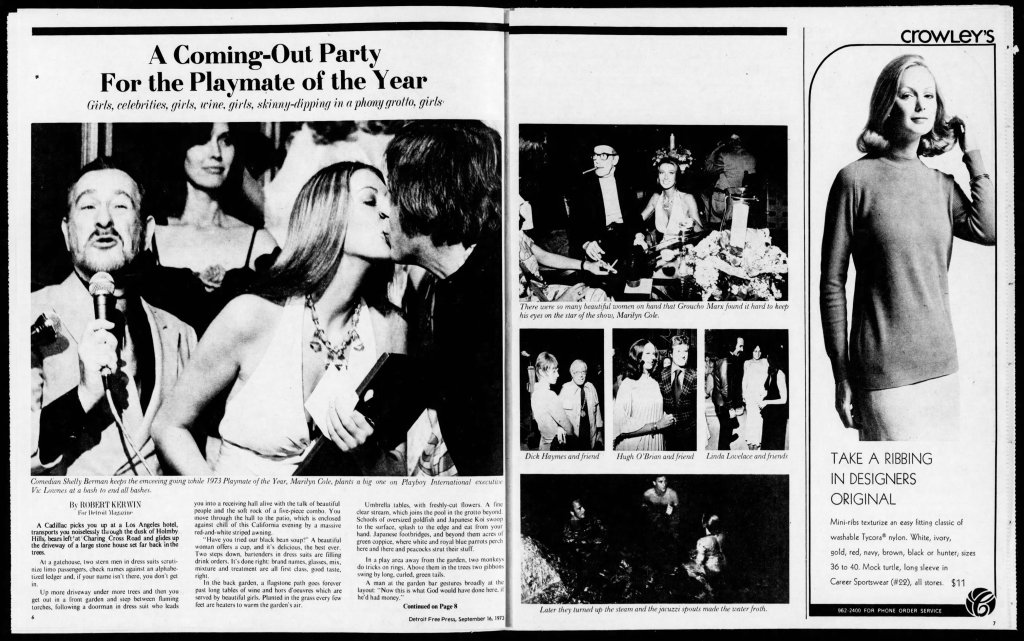
Detroit Free Press. Marilyn is Playmate of the Year and is thrown a big party. Here she kisses boyfriend Victor Lownes.
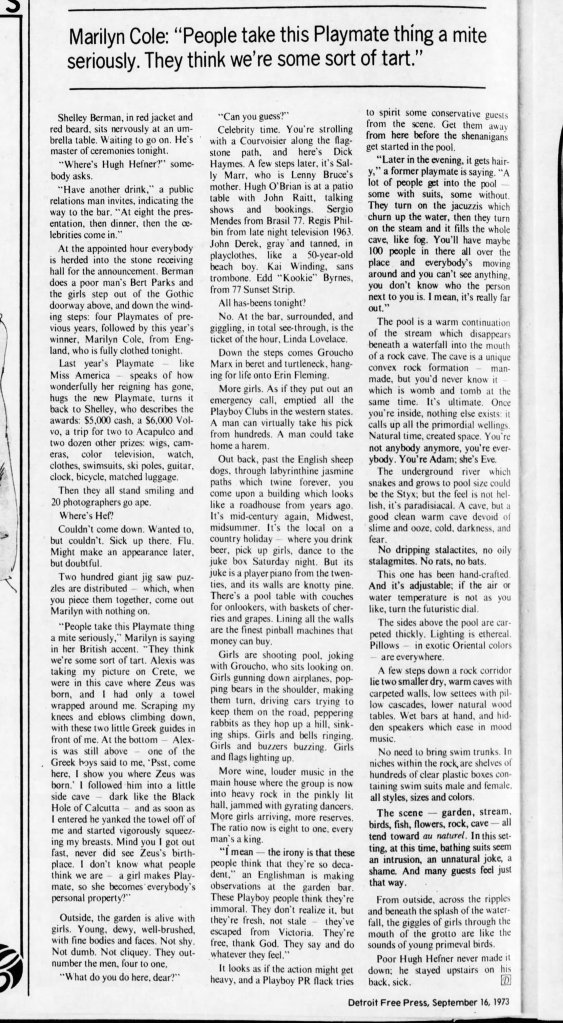
More on Marilyn Cole soon.

Connie during her time on Malta.
Connie Kreski has about 10 TV and film appearances after “Hieronymus.“
April 6, 1969. Long Beach Press Telegraph
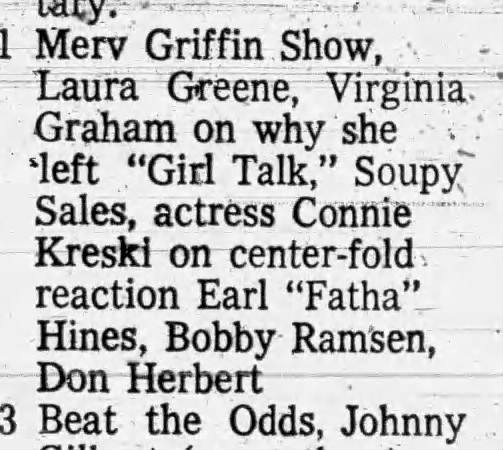
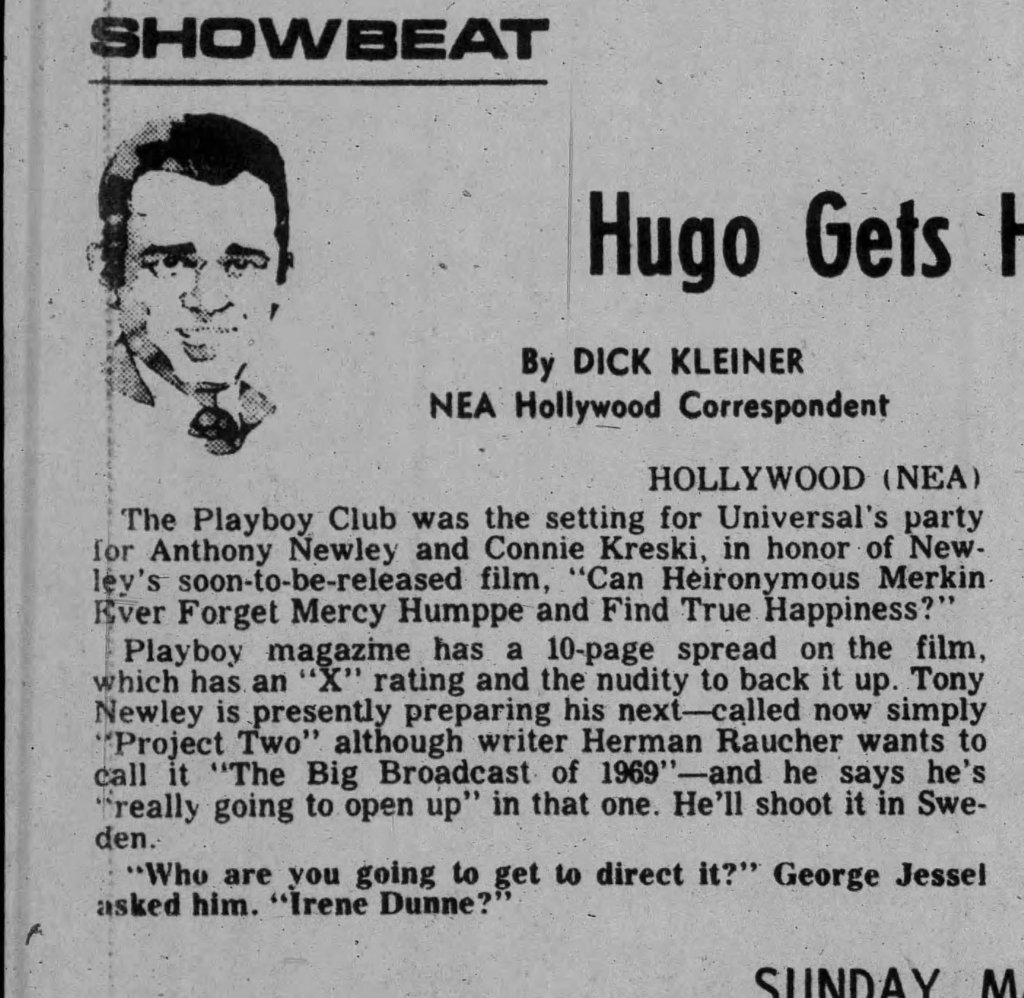

From 1969
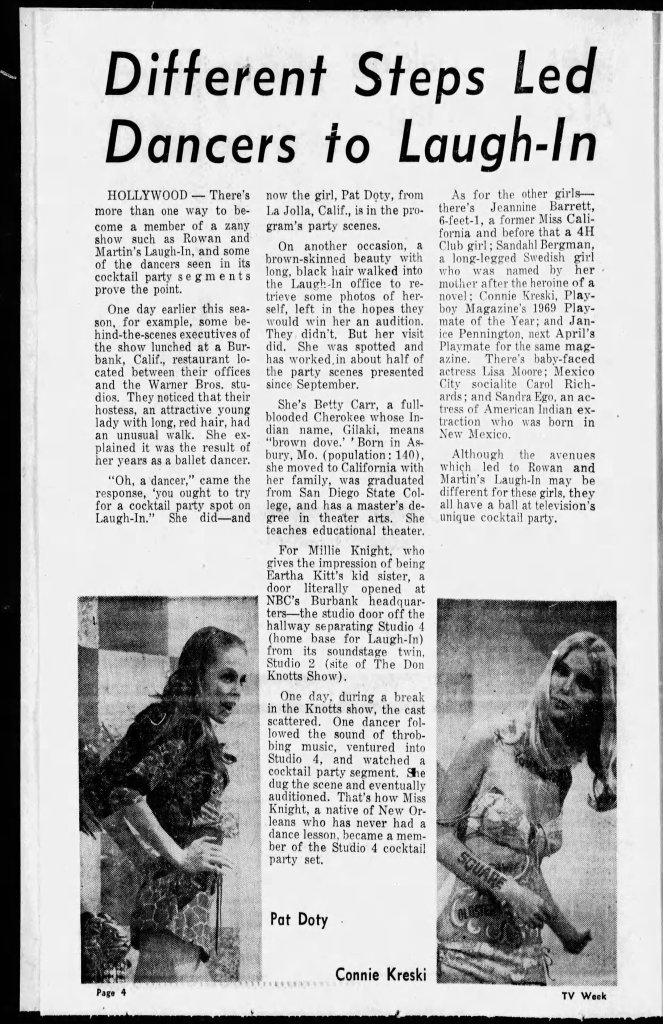
Connie appeared as a guest on the Merv Griffin and Joey Bishop talk shows.

From the Fremont Tribune, June 21, 1973
In a 1969 episode of Playboy After Dark, Connie is introduced by Hugh Hefner as “Connie Kreski, our Playmate of the Year.” Connie does not say one word the entire show.
She does have more lines on other episodes of PAD, mostly the ones from 1970, the last year of the program.
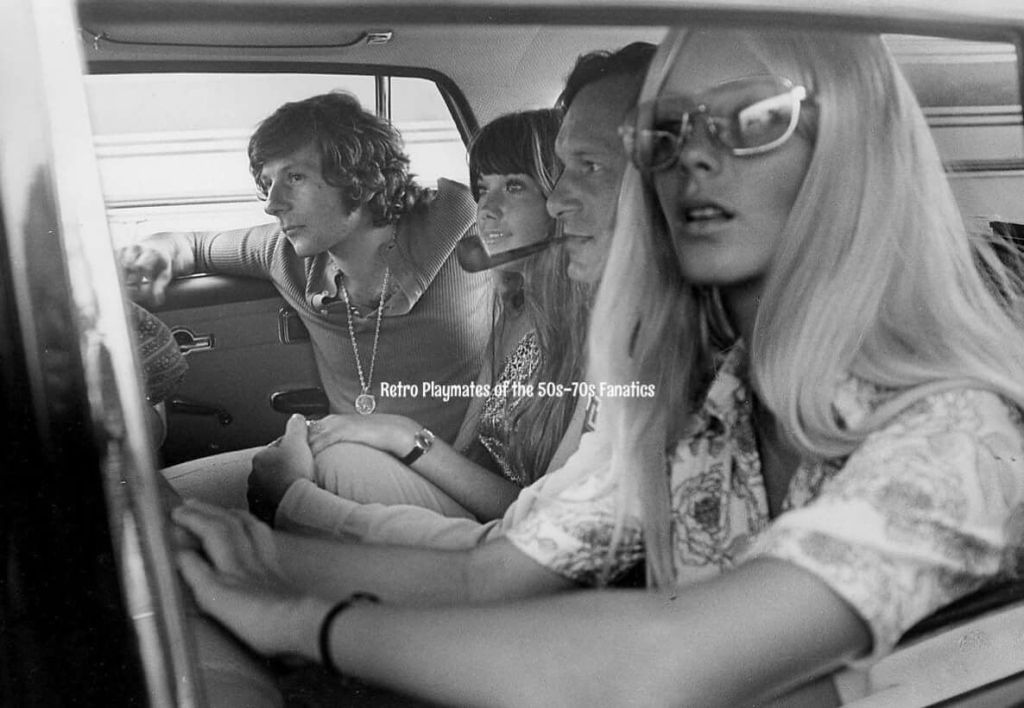
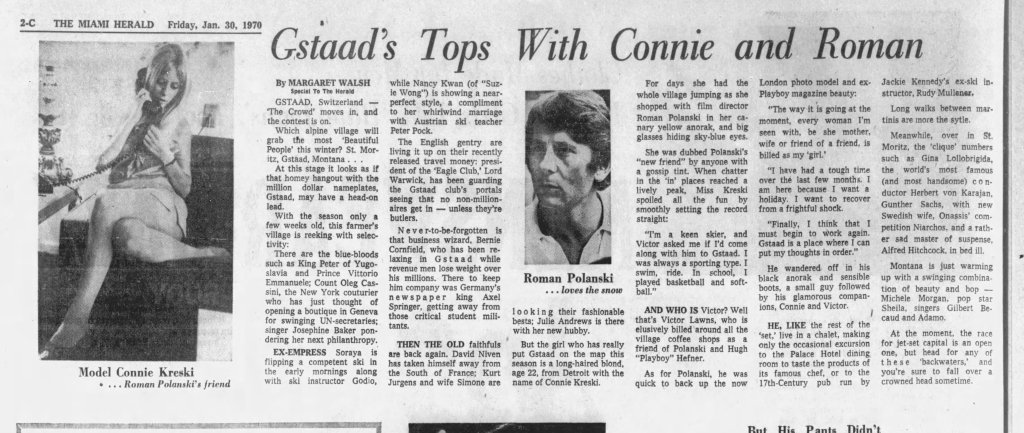

The People, London. Aug. 23, 1970 A little over a year since Sharon Tate and the others were murdered, Connie remains friends with widower Roman Polanski. Sorry for poor quality.
Kreski’s newspaper press indicates she was signed to a contract with Universal Studios.
Universal signed an extraordinary number of pinup models, beauty contest winners and starlets in the 1950s and 60s.
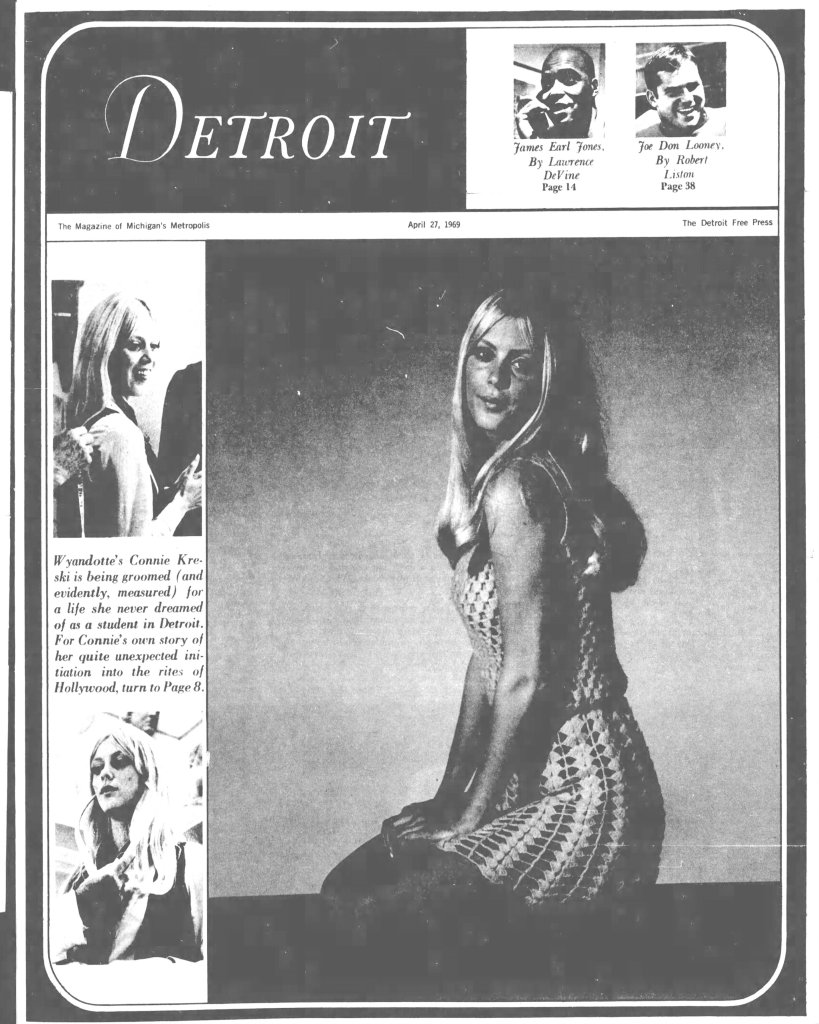
Detroit Free Press April 27, 1969 The hometown/homestate paper covered their Hollywood star.
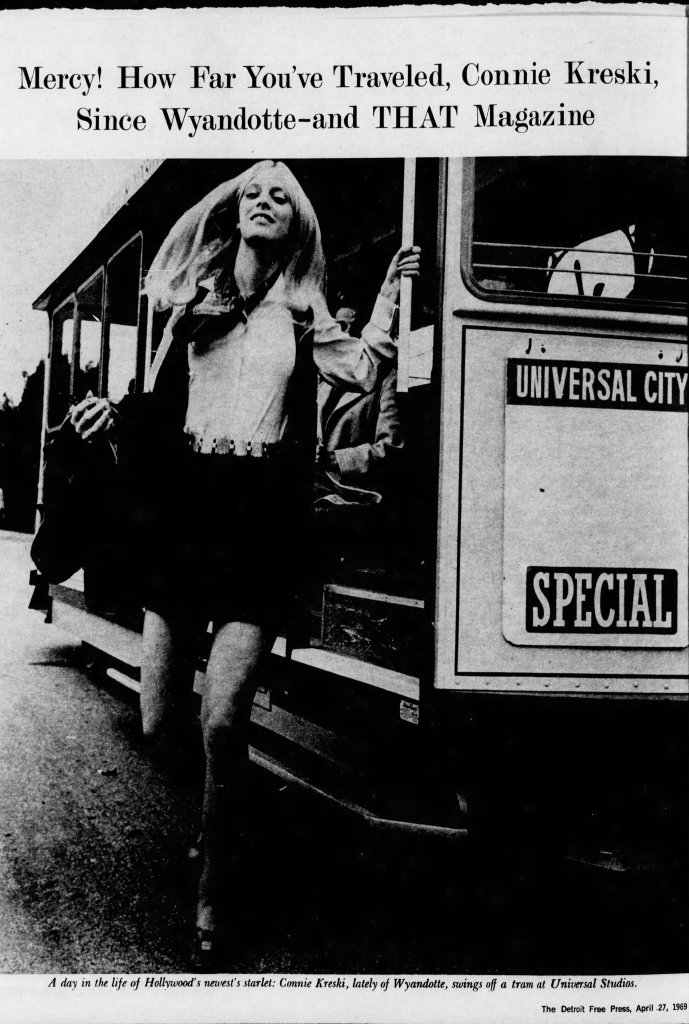
It seems Connie had about 15 minutes of fame as an actress.
She appeared on a memorable 1970 episode of Love American Style starring Kaye Ballard, playing a topless waitress: Love and the V.I.P. Restaurant.
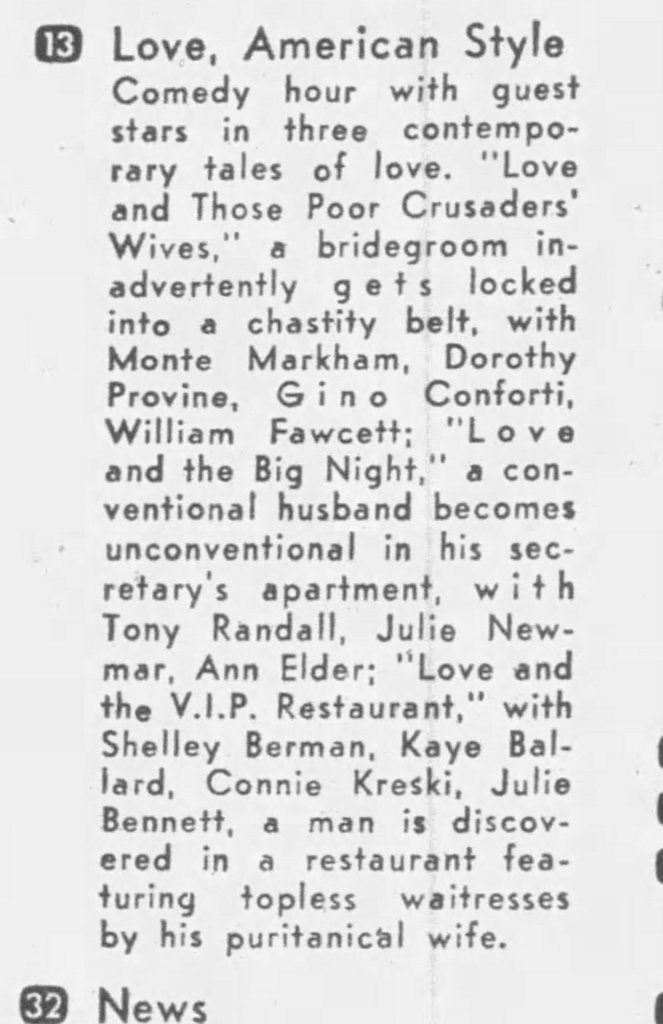
After a few years Connie’s contract with Universal was dropped which merited one sentence in a Hollywood gossip column I read.
Her last credit is a TV mini-series Aspen in 1976. Unavailable.
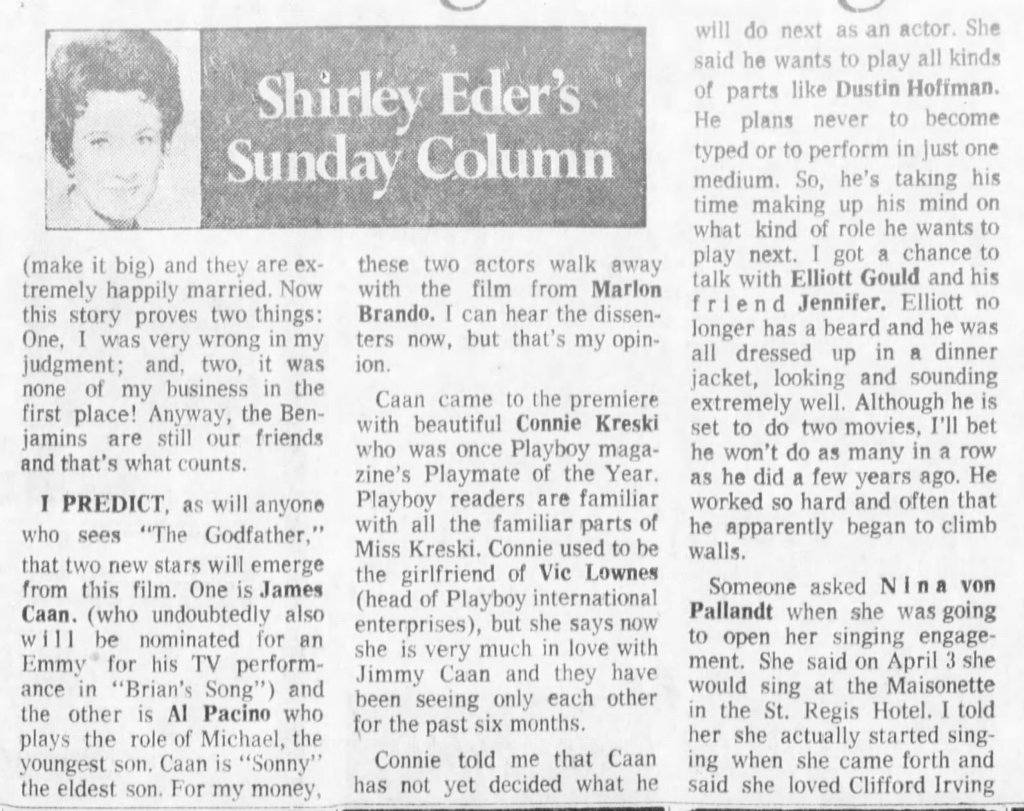
Boyfriend James CaaN
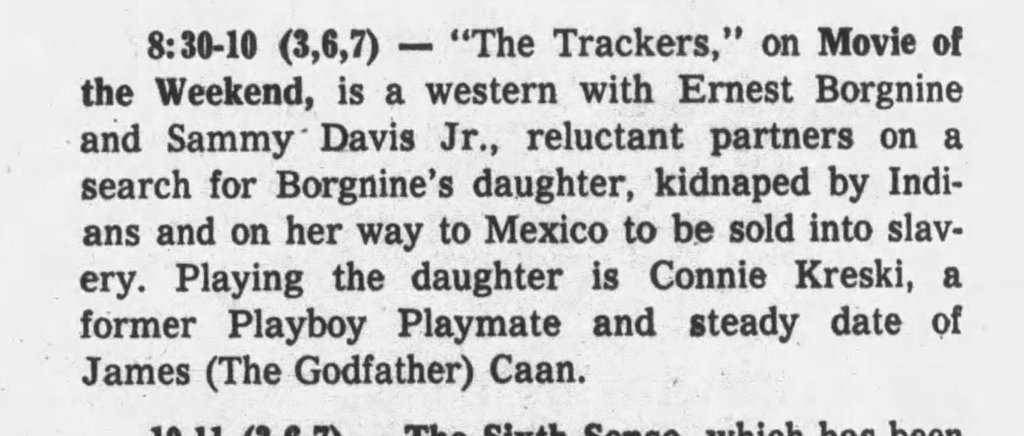
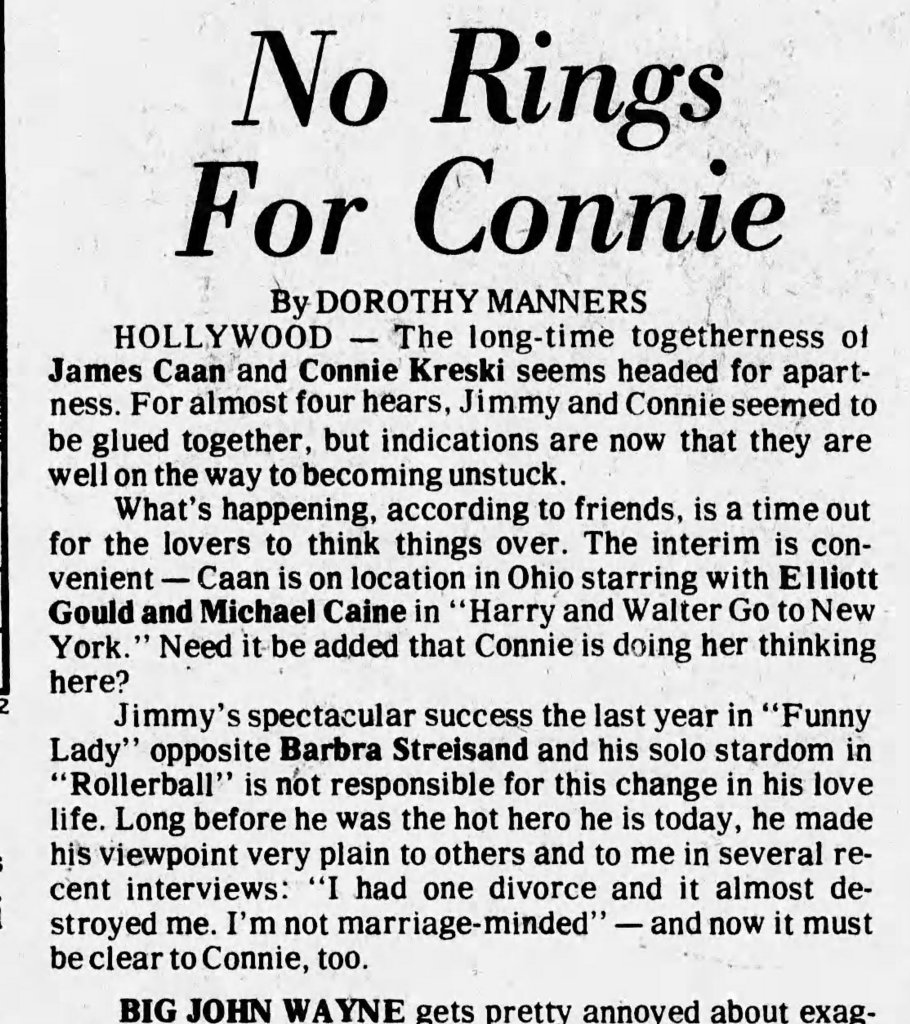
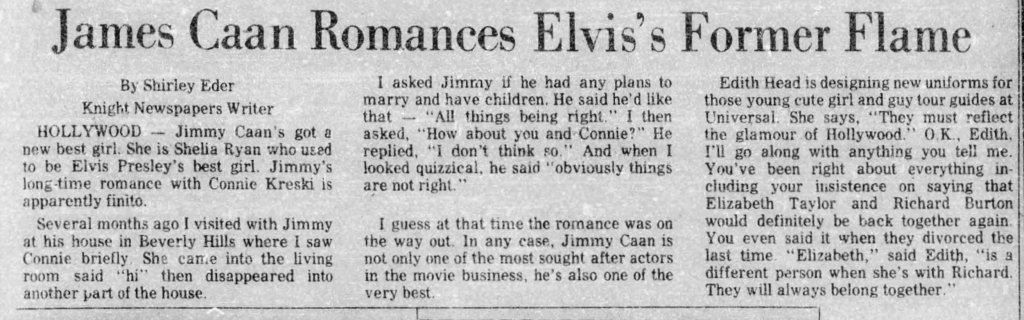
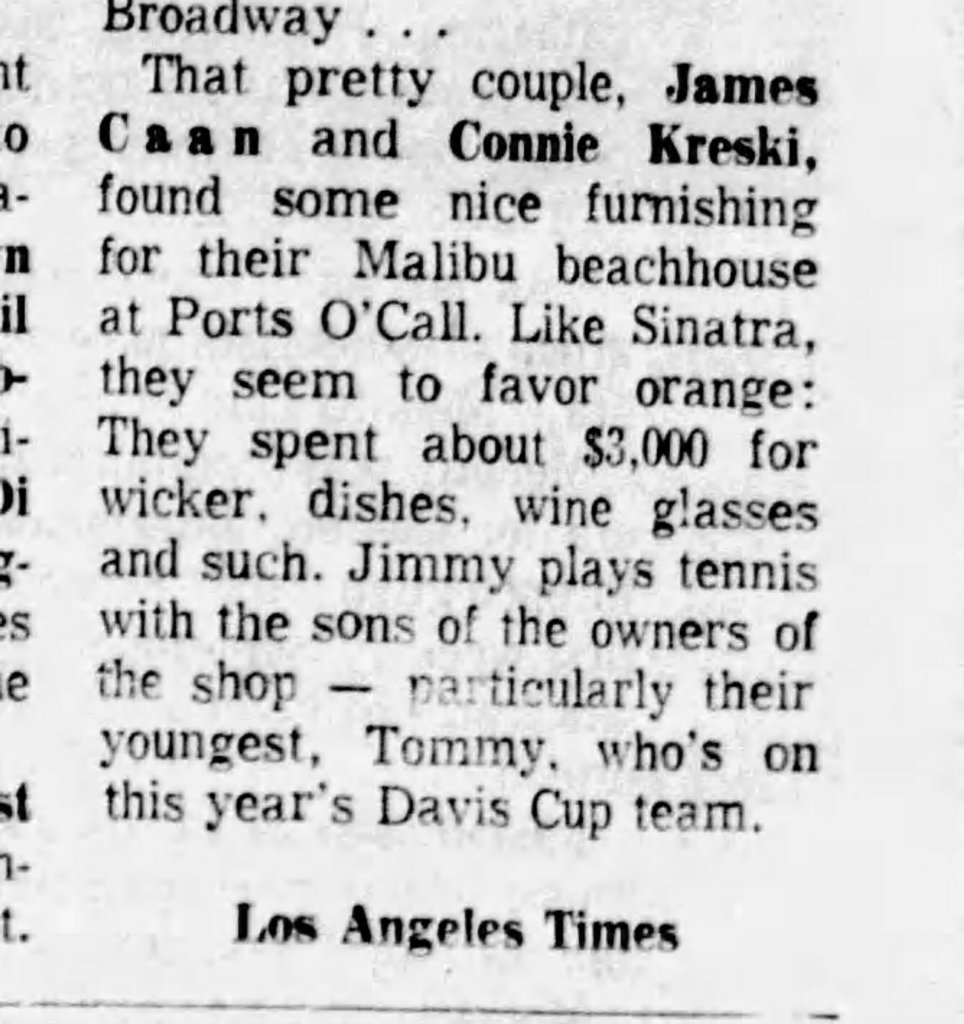
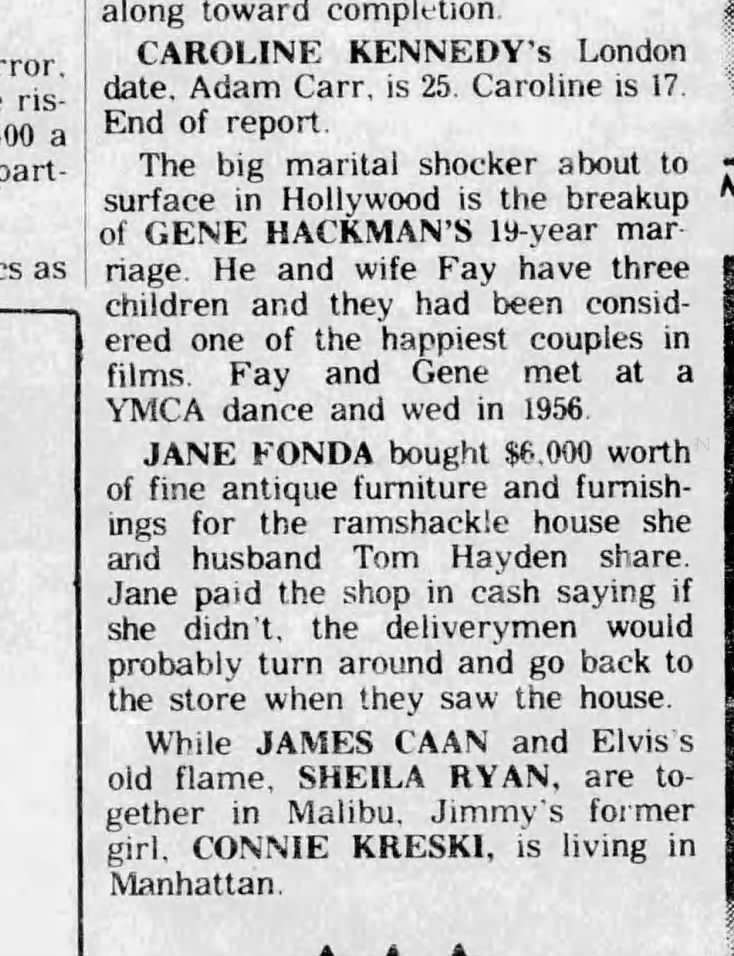
Connie had a high profile romance with actor James Caan beginning in the early 1970s and lasting around 4 years.
She was identified in Hollywood news articles as his “girlfriend” and “ex-Playmate.”
The two got together soon after Caan’s star making turn in The Godfather; he was much in demand by directors and studios.
And by many beautiful young women, according to several interviews at the time.
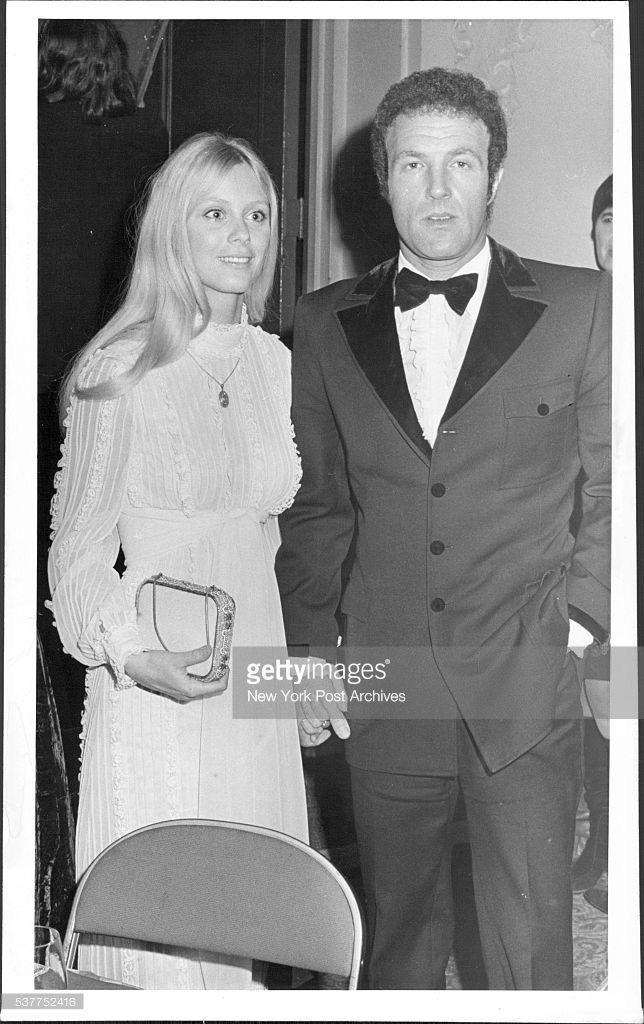
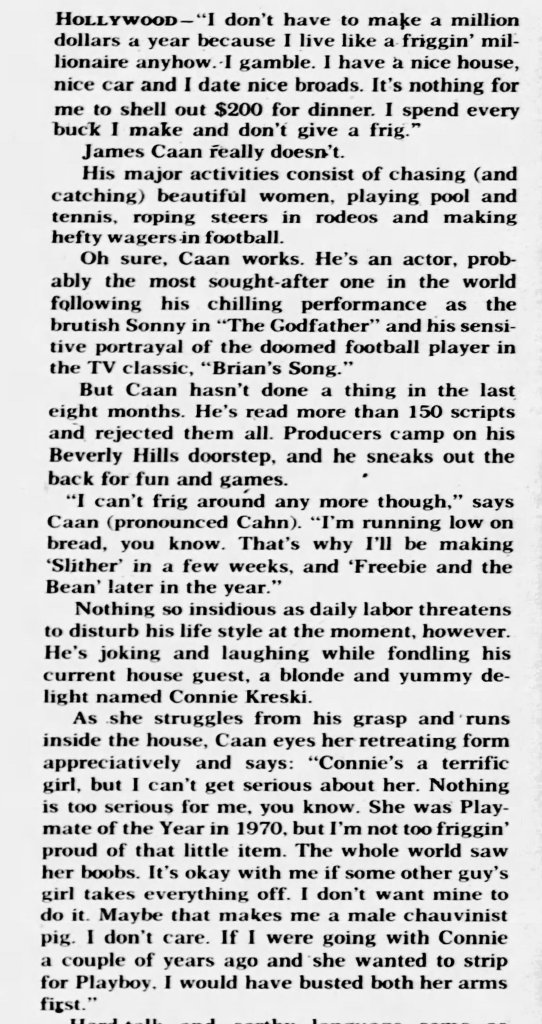
Playboy Mansion regular James Caan speaks about girlfriend Connie Kreski in NY Daily News Oct. 8, 1972
>>>>>>>>>>>>>>>>>>>>>>>>>>>>>!!!!!!!!
Below image is from 1970s Playboy article on men’s jewelry featuring Caan and girlfriend PMOY Connie.

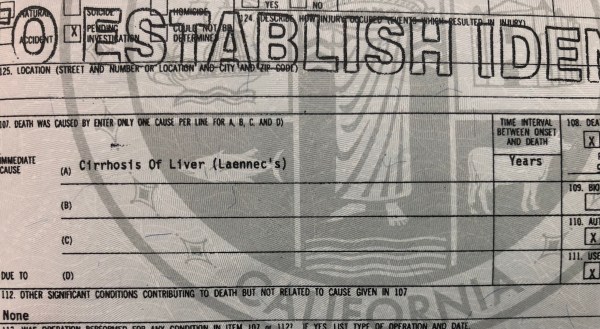
It was determined that Connie Kreski died of cirrhosis of the liver at age 48 in 1995. Laennec’s is a cirrhosis most associated with alcohol abuse over time.
What happened in her life that caused it to end this way at the age of 45?
What happened to her friendships with Hefner and Polanski and that crowd? And James Caan?

Connie Kreski is rarely mentioned in any pop culture forum.
I find that strange, given the people that she was seen hanging out with: Roman Polanski, Sharon Tate, Hugh Hefner, Anthony Newley and James Caan.
Many of these people continue to generate attention and conversation. Some are still alive, many dead.
Most recently, Connie’s ex and Playboy mansion regular and good friend of Hefner, James Caan passed away on July 6, 2022. His death drew numerous accolades and a film festival is in the works.
Unusually, Caan lacks a dedicated biography.
This will likely be forthcoming.
Caan hadn’t been asked about Connie since the 1970s, that I have ever seen.
Like Fellow 1968 Playboy Playmate Paige Young, Connie’s cause of death is incorrectly identified on the internet. It usually says “blocked carotid artery” or “cancer.” Connie’s entry in The Playmate Book, mentions her death in Beverly Hills, 1995, but doesn’t state a cause. I have included closeups of her death certificate.
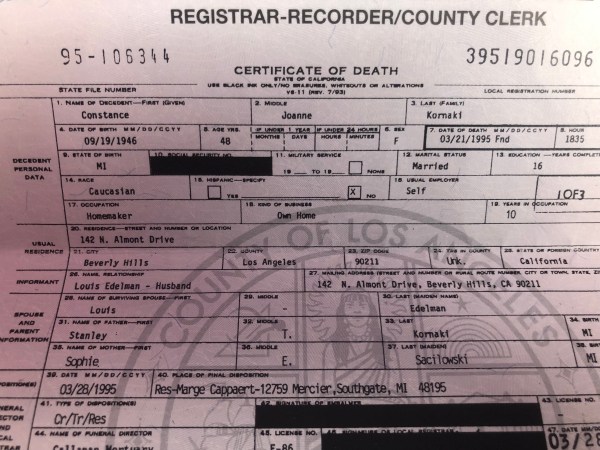
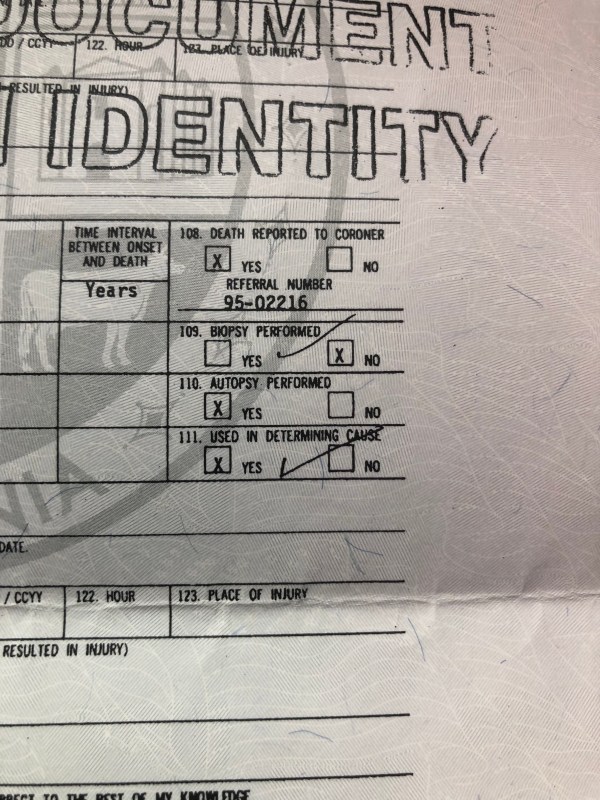
Connie died in March of1995 at the young age of 49. She died before her about 10 years older husband, Louis Edelman.
I had long wondered what happened to Connie so I ordered her death certificate.
And after seeing it, of course I wondered how she had become an alcoholic with all her seeming advantages in life.
Beauty and a budding career in movies and TV and the potential for money.
Cirrhosis of Liver is clearly stated as the cause of Connie’s premature death. Interval between onset and death says years.
Connie and a man named Louis Edelman were married in New York in 1986 per records seen on ancestry.com.
They set up a marital home in Beverly Hills. Connie was pregnant at the time but unfortunately lost the baby.
I was lucky to get some answers by correspondence with Connie’s stepdaughter Barbara Cooper. Her father was Louis Edelman, husband to Connie.
To sum it up, Barbara told me that Connie was very nice and sweet and wonderful to her step-granddaughter.
However, she seemed to eat very little, often just picking at her food. She also witnessed Connie working out on a treadmill with saran wrap tightly covering her body, in order to promote sweating out extra calories.
Barbara wrote that her Dad would hide liquor bottles from his wife.

Barbara Cooper told me that after the loss, Connie began an obsession with calorie counting and losing weight. On top of that she abused alcohol and her husband Louis felt compelled to hide liquor bottles from his wife.
With those two illnesses, it’s no wonder that Connie died so young and before her older husband.
Barbara’s daughters spent vacations with “Grandpa and Connie in California.” Barbara told me how consistently kind and sweet Connie was to her daughters and to everybody.
She said that Connie did not talk about Playboy, Hefner, any of the Playmates, or her days in Hollywood.
More on Connie Kreski and her brief time in the spotlight

Telegraph Journal New Brunswick. July 10, 1969
Still a couple years away from meeting Marilyn Cole and giving Connie the heave-ho.
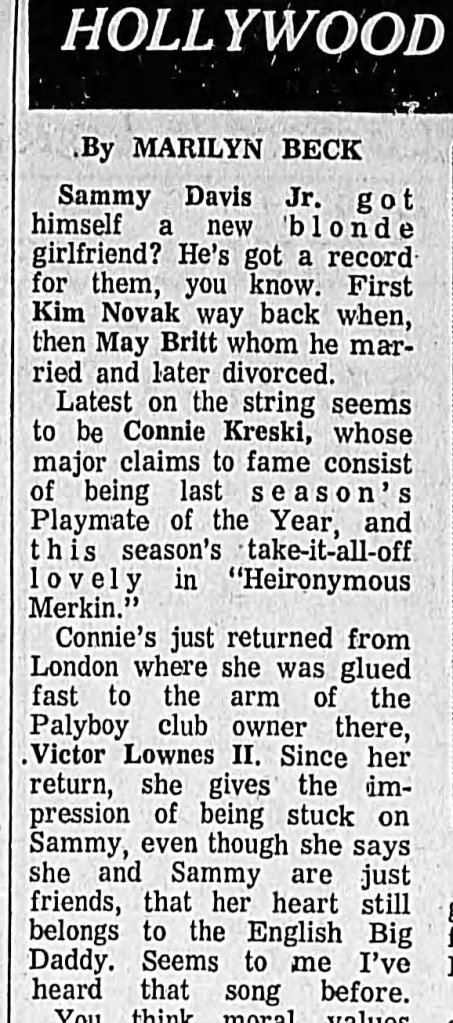
Another famous gossip columnist of the era: Marilyn Beck. Here, she dispels any truth to the rumors of a romance with Connie and Sammy Davis Jr.
She was Sammy’s type in that era given the physical qualities of Sammy’s women mentioned here.
I doubt that Victor Lownes remained faithful to Connie. She was in LA working on her new career as an actress.
Connie had a fair amount of press on and off, for about 6 years. Press for projects and Hollywood gossip due to her relationships with Victor Lownes, Roman Polanski (denied as a relationship) and later James Caan.
I’ll be posting several of all kinds.
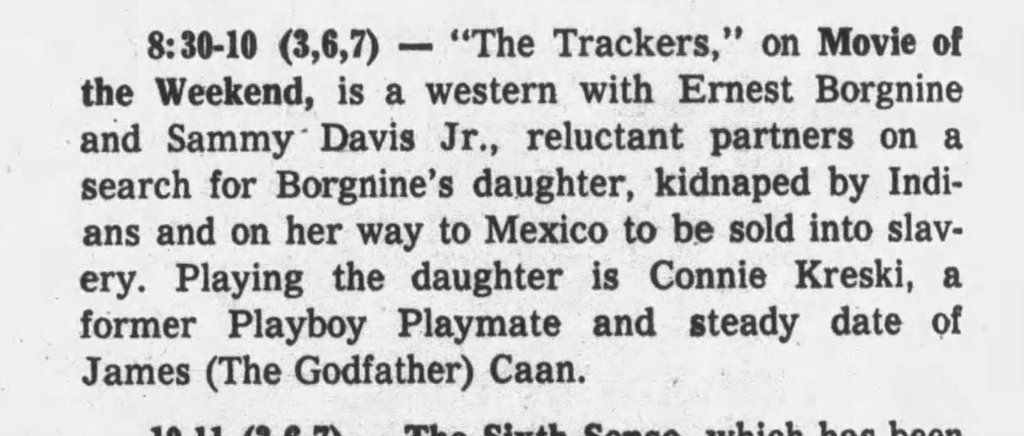

She was wafer thin with proportions of being tall; she could have been a perfect commercial model, if not a high fashion one. There are many fashion shots of Connie that I haven’t yet published.

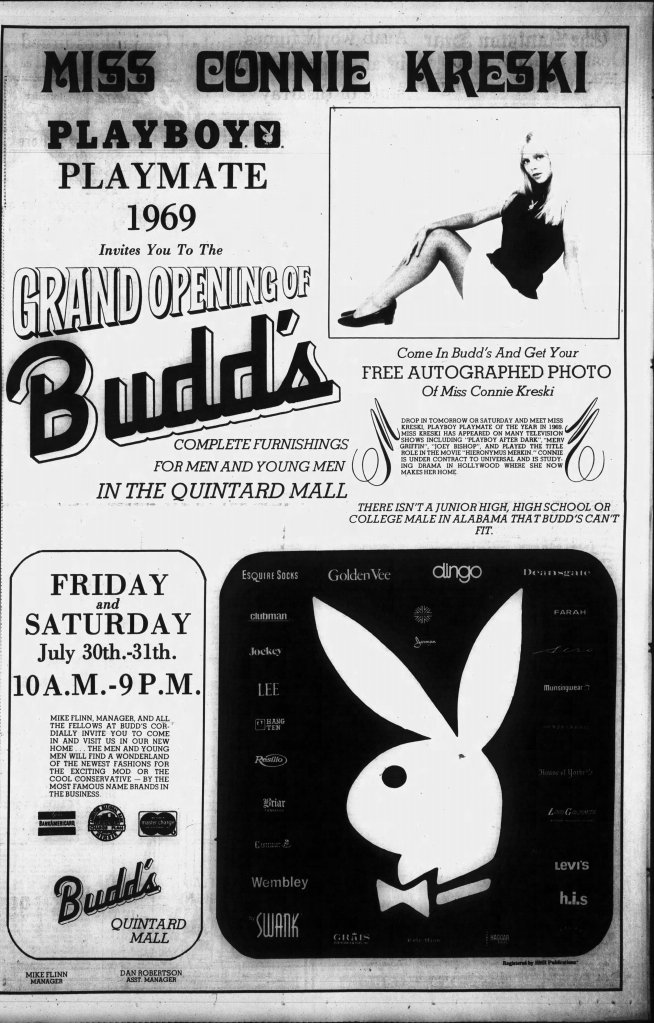

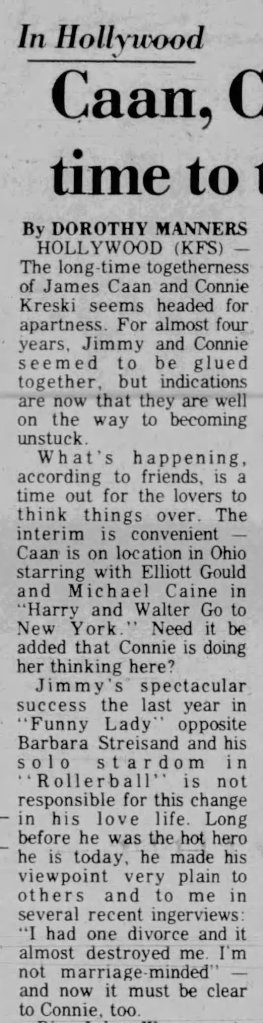
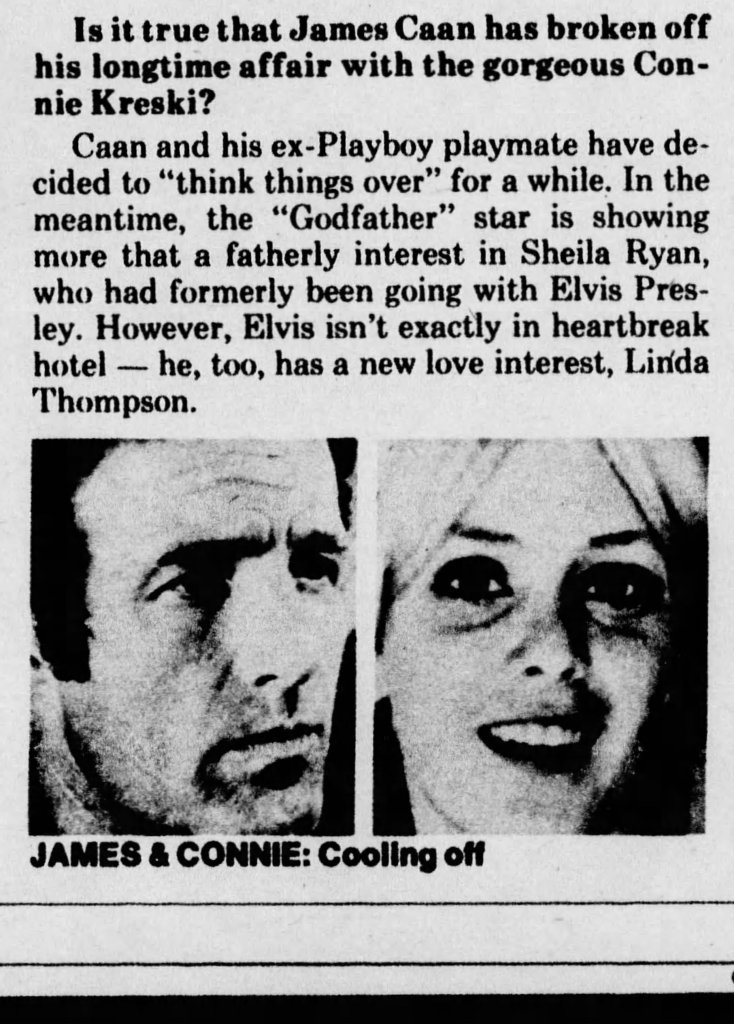
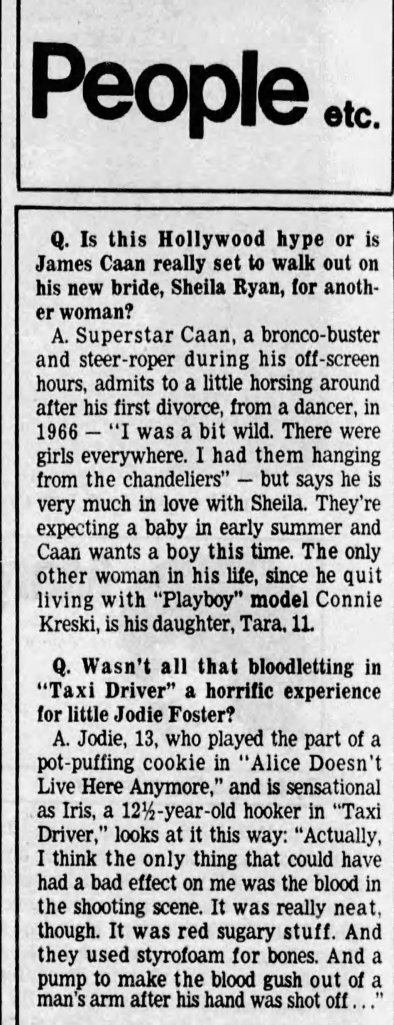
1976. Looks like Connie Kreski was discarded.
Caan and Playboy cover girl Sheila Ryan were married after Caan eschewed marriage to Connie during their time together.
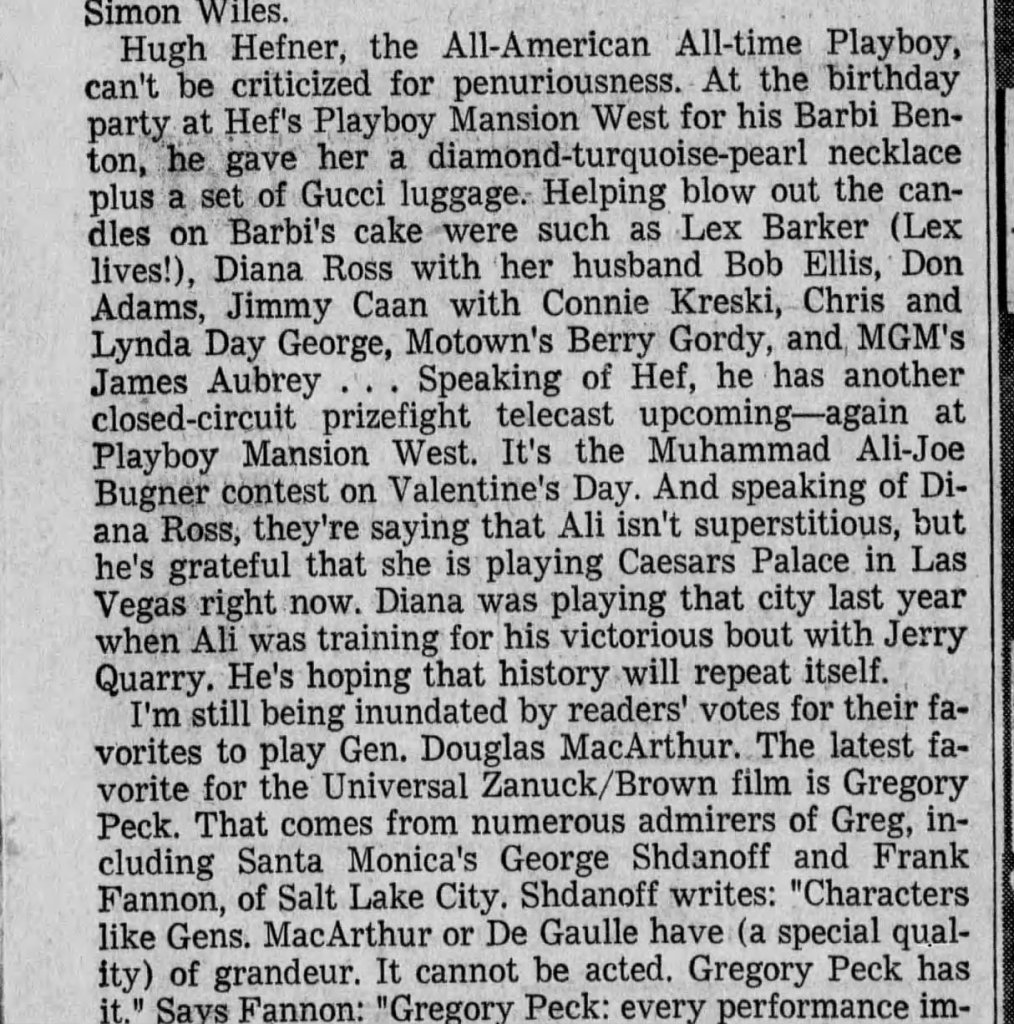
Patriot News 9/12/1975

BACK TO 1969



 Paige Young in Los Angeles