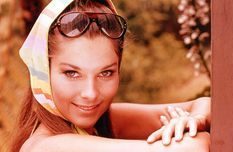
 Paige Young in Los Angeles
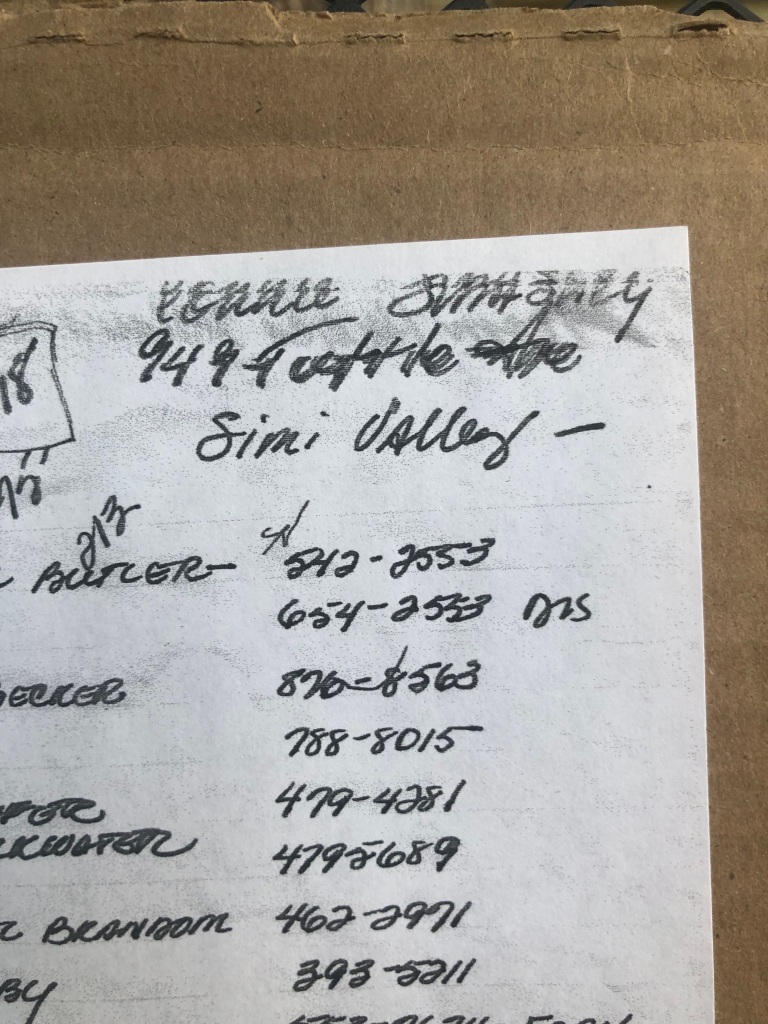
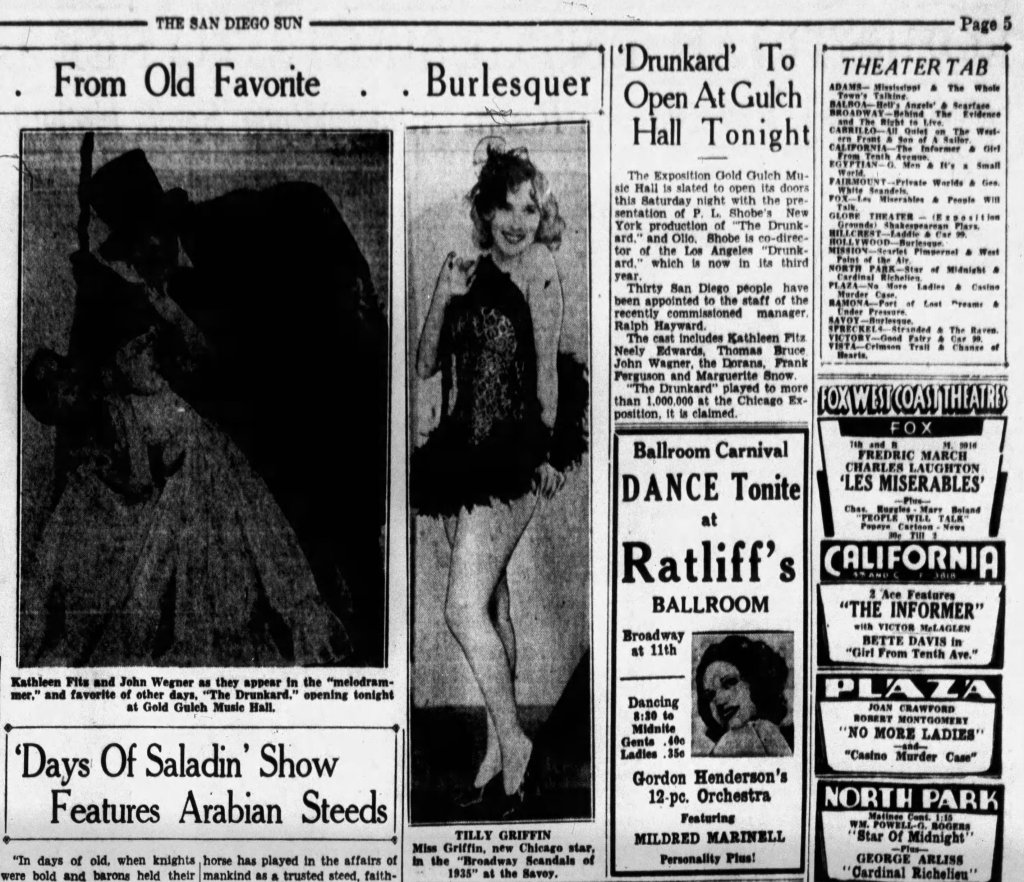
Names in Paige’s Phone Book: Desmond & Jonathan Guinness, Michael Butler of “Hair,” Hef & Joni, Cosby, Feminist Women’s Health Care Center, Samson DeBrier. Last Home. 3/29/26.* Very LONG.
Posted on October 6, 2023
This entry will make more sense if you have read at least the 2nd half of this website.
I was in Los Angeles in April of 2023.
I visited with Melanie Myers from the 2014 Daily Mail story. She also appeared in the 2022 Secrets of Playboy documentary on the A&E channel.
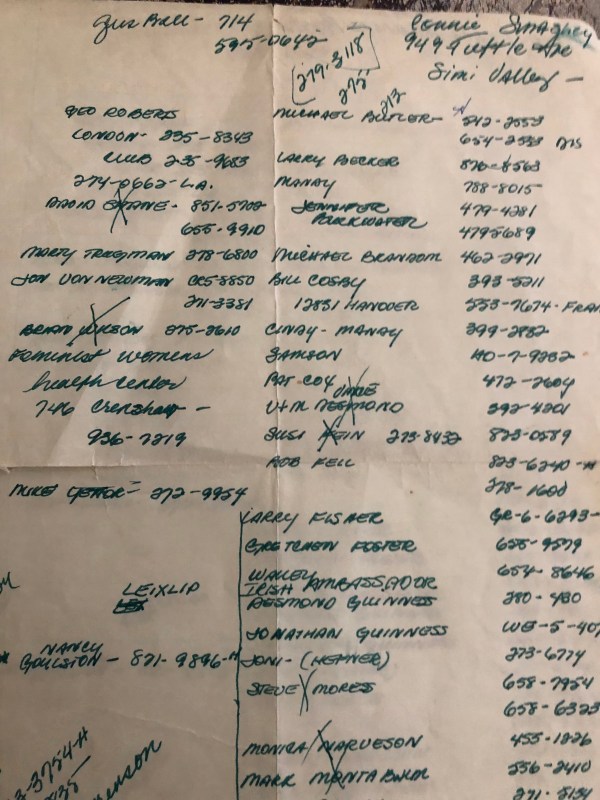
During our interview, Melanie showed me an old piece of paper with phone numbers and names written on it. She had copied these from Paige’s personal phone directory after her suicide.
Melanie and B.J. Royale were preparing to share the task of calling Paige’s friends to tell them the news of her suicide.
And to tell them that Paige wanted them to have a certain of her paintings or other personal art objects.
Basically, a will.
B.J. and Melanie lived in a duplex in front of Paige’s garage apartment in 1974.
The 3 shared a yard where Paige walked around nude or topless and Melanie “did not like it. “
She added, “Paige and B.J. were pretty good friends,” but that she herself was not close with Paige.
Even so, Melanie said she ended up hearing an earful from Paige about a “sex tape” involving “Cici Huston‘s brother.” (David Shane)
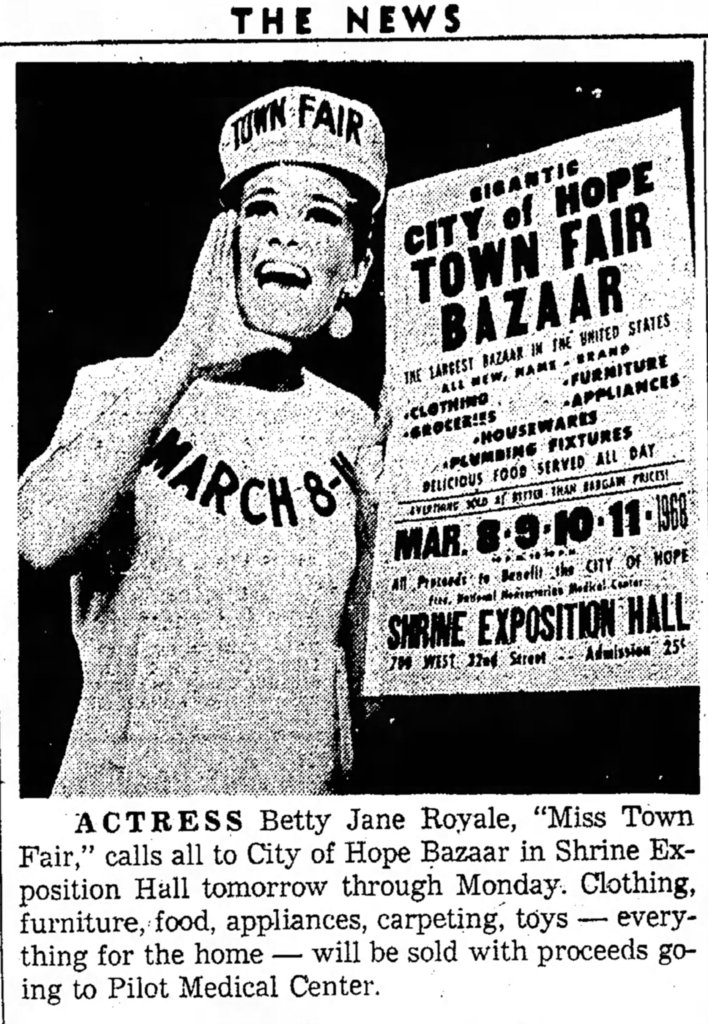
B.J. Royale was a niece of actress Loretta Young, star of Hollywood films and TV in its’ Golden Age.
Royale, aka Betty J. Hermann, has a film credit for The Trouble with Angels, 1966. IMDB
This film was a box office hit. It stars Hayley Mills, a Disney actress. She was a bonafide box office star in the 1960s. I remember Angels was shown on TV a lot in the early 1970s.
Melanie made me a copy of her original notes and I took photos.
The names I saw on Paige’s phone list gave me clues and provided insight into the last years of her life.


Both Desmond and his brother Jonathan were in Paige’s phone book upon her death. Jonathan is the older of the two and outlived his younger brother. Jonathan is a well-known author and alive as of November 2025.

I learned that Foster is a niece of Loretta Young.
Her mother was Loretta’s sister, actress Sally Blane.
Paige’s neighbor B.J. Royale, Hermann and Gretchen Foster were cousins.
B.J. or Betty Jane Hermann, was the daughter of Loretta’s sister Polly Ann Young.
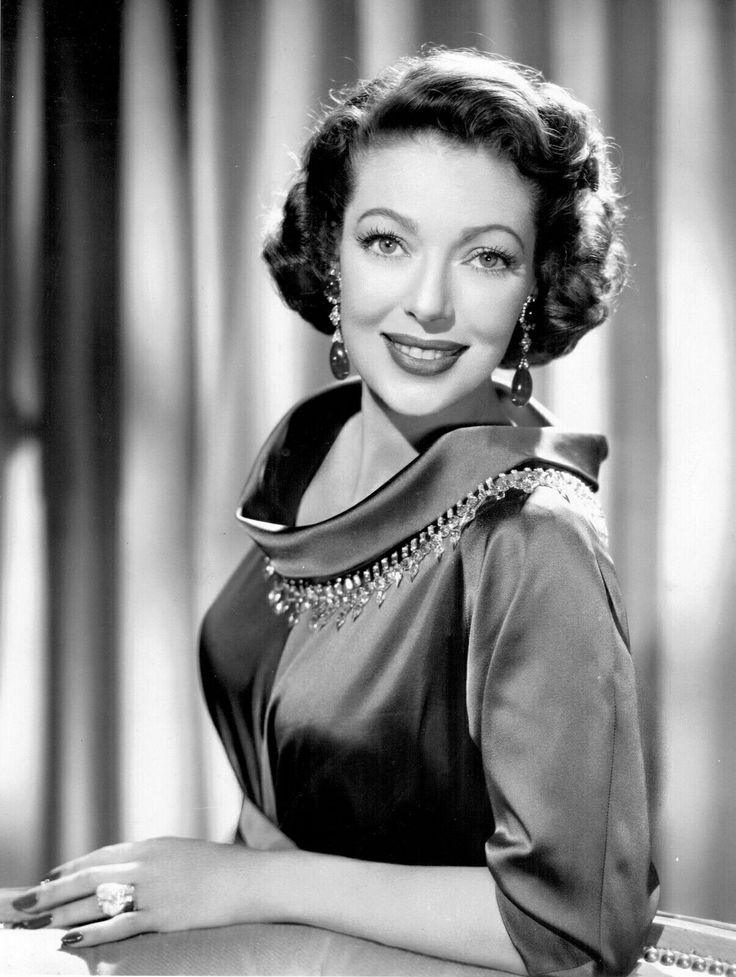
Melanie told me she met and knew Gretchen Foster due to knowing B.J.
Melanie had no idea that Paige had also known Gretchen.
Paige and BJ were fairly good friends, according to Melanie, so this must be the connection.
BJ Royale died a few years ago. She did not speak with the directors of Secrets of Playboy. I know they reached out to her.
Melanie said she got the impression that B.J. had zero interest in talking about Paige, and one reason may be that she “married and moved to Bakersfield where she was in high society.”
According to Melanie, Paige “willed a beautiful large pastel-colored painting, of horses,” to B.J. . But that Mrs. Hermann never wanted to talk about Paige.
Betty June was contacted by Secrets of Playboy. B.J. told them “I wasn’t there the weekend of the suicide.” And begged out of speaking on camera.
(I was told this by a researcher on the series. Too bad, because there was so much to ask Betty June besides the suicide weekend.)
This lady took whatever she knew, or remembered to her grave.
Melanie and B. J. and Paige attended the Playboy mansion party together with Paige, although they arrived separately.
Betty Jane Royale doing the starlet routine, Van Nuys News March 7, 1968
Her name was in a few gossip columns of the day, one of them as being a member of an exclusive club: The Daisy
Joni-(Hefner)
She is Hugh Hefner’s longtime assistant and personal secretary from the Chicago mansion days.
In my opinion, Joni Mattis took actions to “cover up” Paige’s suicide scene, notes and letters left at her home, only a 10-minute car drive from the Playboy Mansion.
Perhaps Joni initiated the cover up by anticipating what Hef would want.
Another scenario is Joni contacted Hef and he told her what to do.

I can’t find out if Hefner was in the LA mansion on the dates of Paige’s suicide or in the Chicago mansion or somewhere else. Articles and Hollywood columns and Melanie’s story suggest he was present in the months leading up to Paige Young’s suicide and gave several parties.
This was clear from items published in newspapers.
Joni and Hef/Playboy took action to prevent the sensational news of Paige Young’s suicide from going anywhere near the press.
This action would have required cooperation from LAPD.
Please see chapter of LAPD report and death certificate.
Melanie in Daily Mail-“police read some of the note to me… most vitriol for Hugh Hefner and John Huston.”

Melanie told me that that Paige’s mother (Donna) and sister (Constance) came the next day to pack up her belongings including paintings. “Connie” appears on Melanie’s list of phone numbers, identified as Paige’s sister. Melanie did not remember their names.

The Playboy corporate headquarters remained in Chicago until 2012.
Hefner’s ” constant companion” and mansion finder and partial decorator Barbi Benton, parted sometime in 1976.
Hef then started a relationship in 1977 with his next #1 girlfriend: 19-year-old Sondra Theodore from San Bernardino.
The Proximity Factor
Paige lived in Westwood, a 10 minute car drive to Holmby Hills. The local police had a friendly relationship with Hefner and the mansion employees.
Many former LAPD officers became Mansion security according to Secrets of Playboy. (PJ Masten) I believe Masten dated one of them at one time.
Hefner received reports on a regular basis from employees. They informed him about goings on at the mansion. This included employees and visitors, said PJ Masten.
The LAPD certainly knew who the hell Hugh Hefner was when they were greeted by Paige’s mural at her suicide scene 2 miles from the Playboy mansion.
As I continue to read about the history of the LAPD, I realize their Mythic status is based on historic facts. It has been a corrupt institution from the beginning. A fact well expressed in the movie L.A. Confidential.
So really, it is not surprising that information unflattering to Hugh Hefner could be buried and made up to be like it just didn’t happen.
I am not in any way saying Hugh Hefner is directly responsible for Paige Young’s suicide.
But it is about the image.
Particularly at this date.
Bobbie Arnstein was arrested in Chicago, only 9 days before Paige’s suicide, on highly exaggerated cocaine charges.
Joni and Hef could have sincerely believed that by burying Paige’s story they were helping Bobbie and Hef from unjust prosecution. ( And persecution.)
There was more motivation than usual to justify hiding, burying and lying about Paige’s suicide (and everything she left behind incriminating Hugh Hefner, his friends and other men.)
PJ Masten in Secrets of Playboy talked about “an awareness that negative press was to be avoided.”
Jennifer Saginor, Secrets of Playboy and author of the book Playground said on a podcast Power,“Hef was always image conscious.” Hefner had the power to have Saginor’s book tour interviews suddenly canceled as she has recounted.
Jim Ellis, a former body guard for Hefner, early 1980s, said in Secrets of Playboy, his “job was not only protecting his clients physical being, but also their reputation.”
I believe that there was an opportunity for Playboy to shut this whole Paige Young thing down.
And the opportunity was quickly grabbed.
Hugh Hefner and Joni felt relieved I imagine.
Why does Paige Young’s entry in the Playmate Book, say “drug overdose” ?If they knowingly made that up, why that manner of death was chosen is beyond me.
END

Michael Brandon, too many. Cindy Manay brings nothing.

Looking at the list, so far have not found anything on Larry Fisher.
Steve Moress, listed below Joni-Hefner, opened a museum and shop of acrylic arts in 1974 at 2360 S. Robertson Blvd. It was open for several decades selling to interior decorators, but is now closed. I called several numbers for a “Stephen Moress” but none of them were working numbers. He’s about 80 years old now.


The following screenshots are from a real estate website. They show the interior of Paige’s carriage house/apartment over a garage in Westwood. It is located down the street from the Mormon Temple. The apartment was built over a garage in 1940. It is where Paige lived the last years of her life. She committed suicide there. Among her belongings was a suicide note mentioning names she said were complicit in her downfall. There was also a will. A mural proclaimed “Hugh Hefner is the devil.” Her belongings included many of her paintings. A few unfinished. All her personal belongings.
These real estate photos are all the world has left of this particular place of what is “old Los Angeles.”
In this case, a carriage house over a garage. It was built in 1940 by Kathryn Eddy, who appeared in walk-on parts in silent movies.
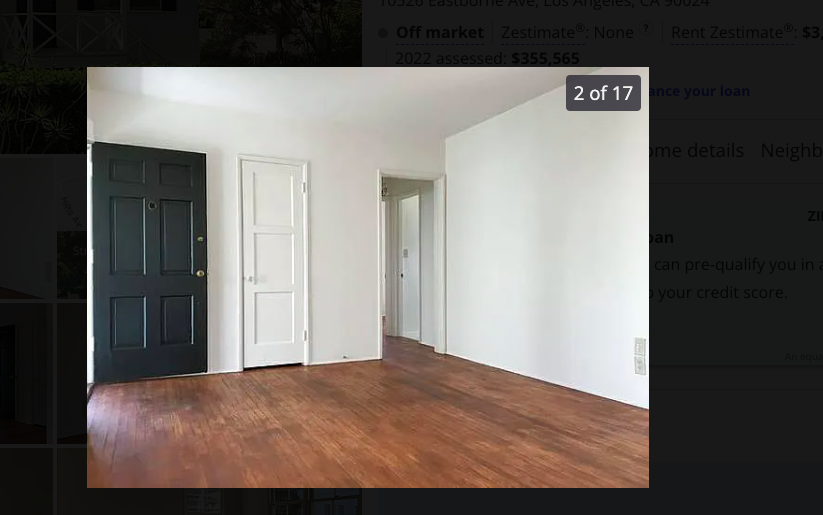
Unless there are photographs lying in some attic or in a landfill placed decades ago?
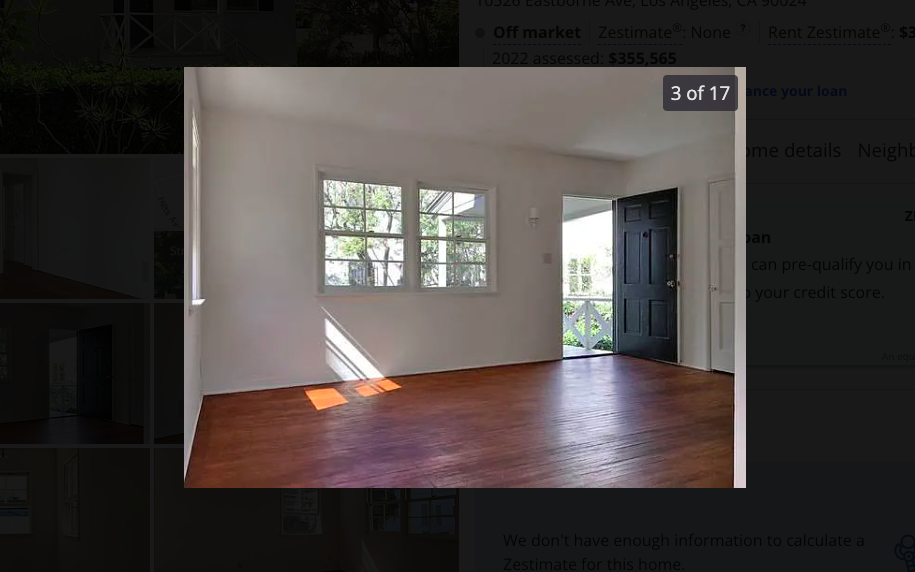


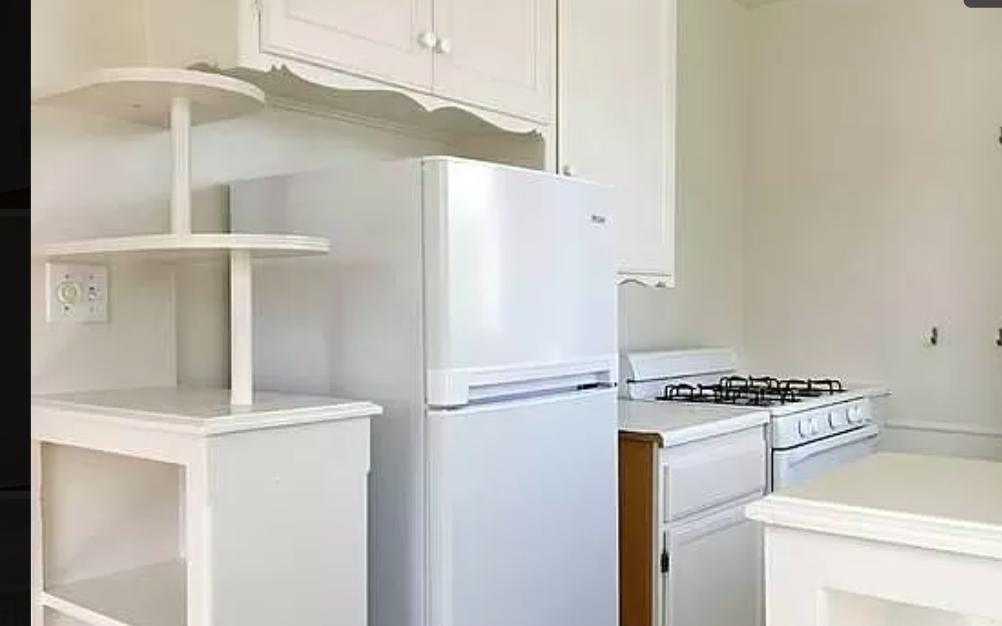
All original built-ins, since gutted. Paige had a large black refrigerator a man bought for her and called it a “coffin,” said Melanie. This visit reminded me of another LA trip.
The place Paige was born as Diana Lee Cotterell is 1933 Griffith Park Blvd. It was originally a Christian Science Maternity center. The building was being torn down on the day I was visited. (See related chapter)
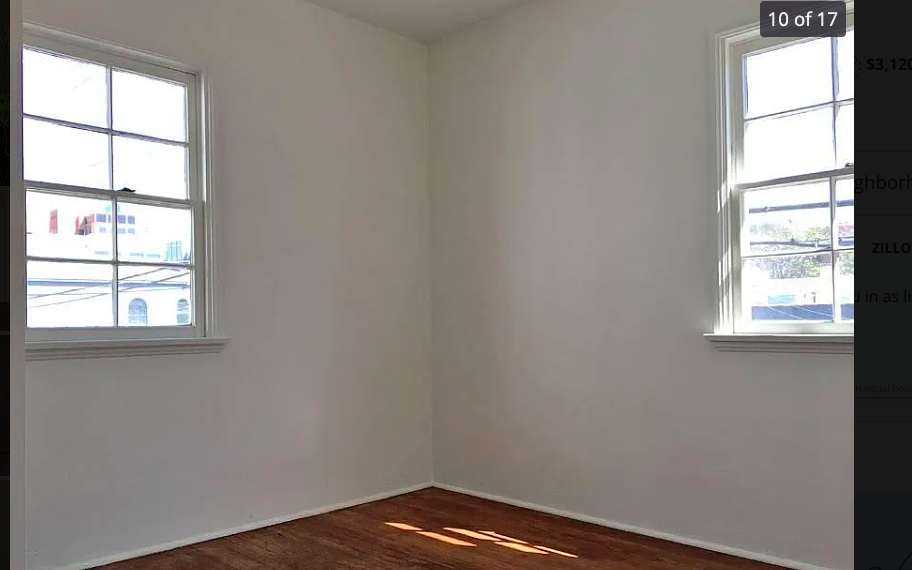
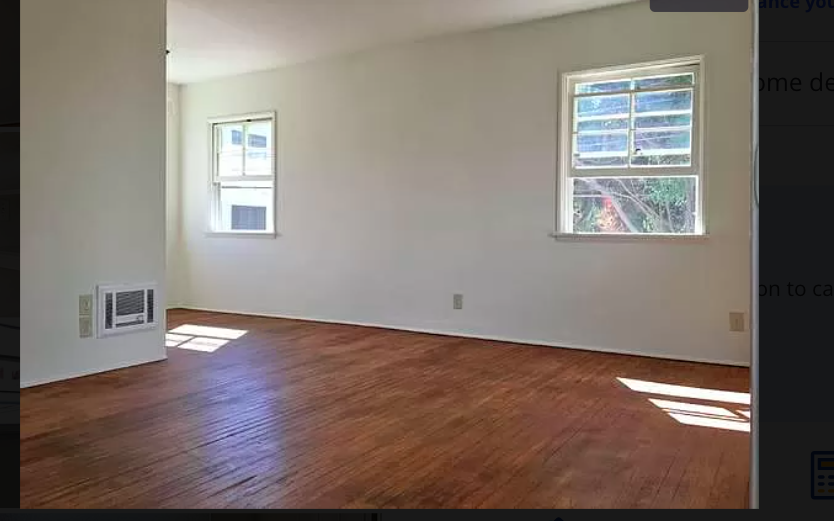

The builts-in of the 800 sq. foot apartment were being ripped out the day I visited; the place was being completely renovated.
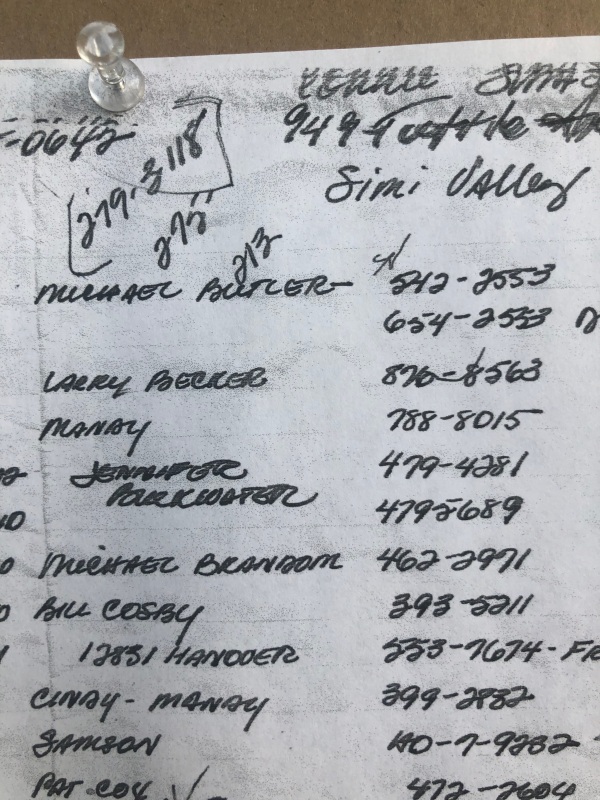
UPDATE* I found Samson and it is the infamous LA character SAMSON DE BRIER.* PLEASE SEE RELATED CHAPTER
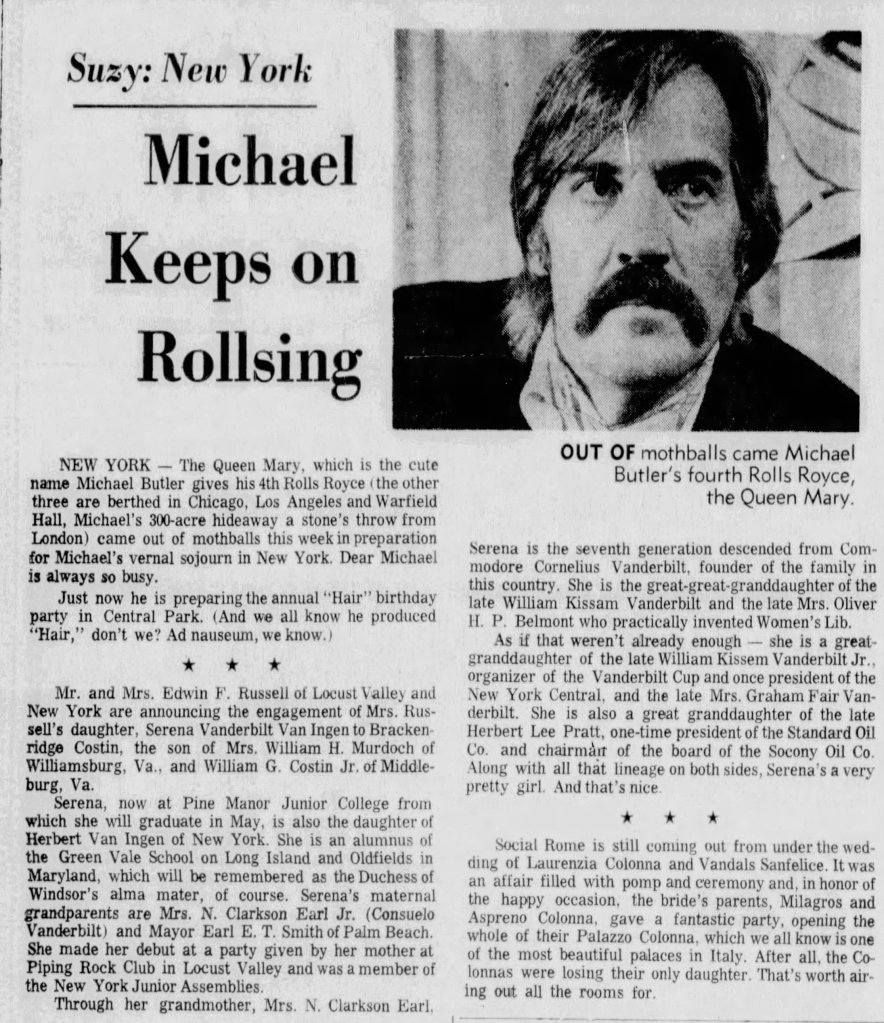
The next section provides information on the Michael Butler entry found in Paige’s phone book. . Top right below sister Connie Smashey’s contact information.
I am confident he is the same Michael Butler most famous as the millionaire producer of Hair: the famous “Tribal Love Rock” musical.
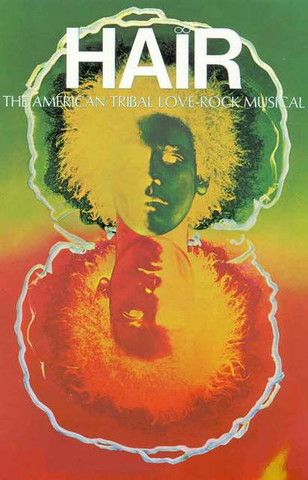
Butler brought Hair to Broadway where it was a smash hit.
Dubbed by the media as a “hippie-millionaire”
A detailed description of Michael Butler and his upper crust background in the article below by Eugenia Sheppard. It appeared in newspapers across the country in 1968, the year Hair opened. Also the year Paige Young was a Vietnam–era Playboy Playmate.

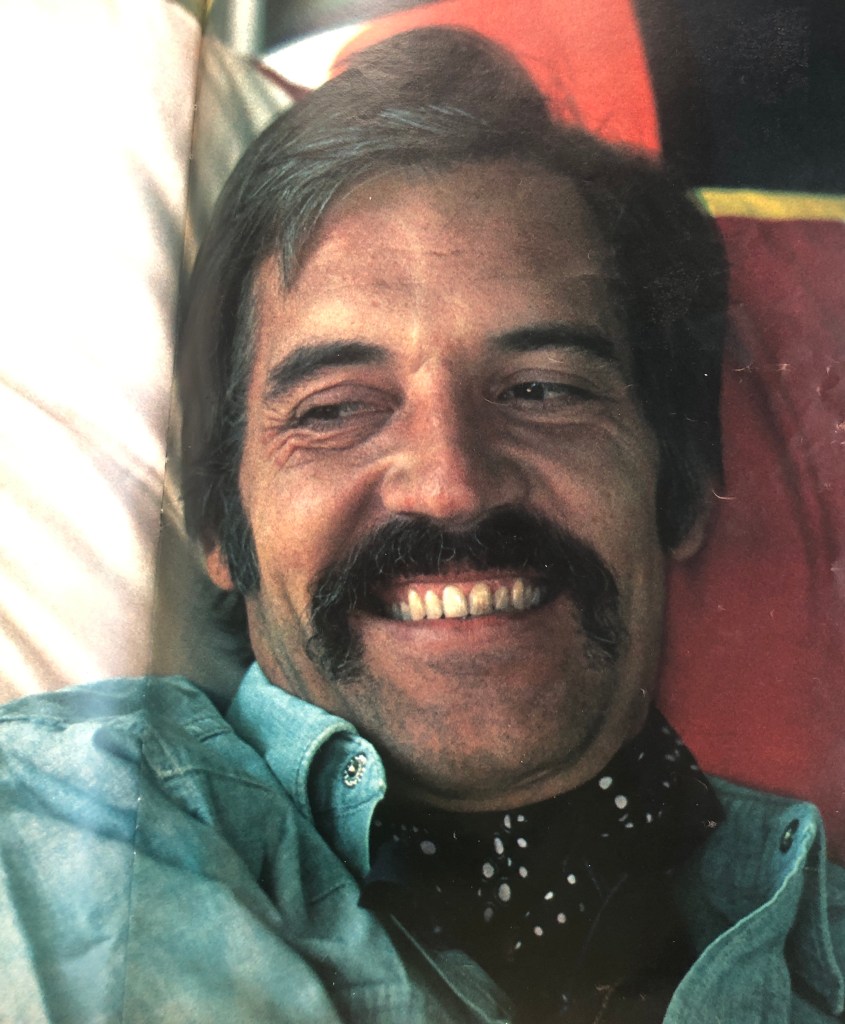

Mary Blume wrote an eye-opening article about Butler in the LAT. Oct. 11, 1970.
Three marriages so far and a production company in LA “Natoma” And an avid polo player.
Page 1

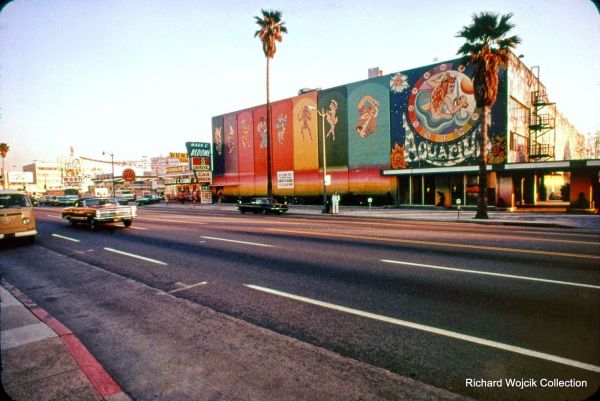
It’s been several incarnations over the decades. The building was repainted this look for the filming of Once Upon A Time in Hollywood.
Page #3 of the LAT article. Butler was and avid polo player and played the sport with the wealthy elite around the world. Including Santa Barbara County as seen in the next articles.


San Fran Examiner June 25, 1971
San Francisco Examiner, May 1, 1972
Last I checked, this Butler website was being maintained well. You can see the entry about his good friend Celeste Huston.

Like Paige Young and John Huston and Celeste, there was the “horse connection.”
It appears Michael Butler lived a long and fulfilling life full of adventure and artistic creation.
I’ve read that he was comfortable as an “out” bi-sexual for most of his life.
What I found from this 1960s and 1970’s era, was that he was quite the “Ladies (only) Man.” This can be seen in the articles I’ve posted.

The Playboy Club moved from the classic 1960s Sunset Strip location and relocated to the new ABC Entertainment Center, set in new, modern, latest Century City.
At some point in the 1970s, the Playboy Clubs were starting to seem passe. I’m not sure exactly when. By 1974, the “pubic wars” were played out by the media. Penthouse magazine won by outselling Playboy magazine. On the stand or subscription, I don’t know but Playboy’s profits started to slide probably around this time.
Paige lived about a 3 minute drive from Century City. When you have time, this is the best resource for the history of Century City.
https://martinostimemachine.blogspot.com/2020/12/the-old-century-city-mall.html
Celeste Shane Huston and Paige Young had 5 people in common: John Huston, Bill Gardner, Samson DeBrier, David Shane and Michael Butler.
Nothing comes up for Gus Prall at the top left.
Note below that David Shane is listed right below a Geo. Roberts on the left hand column, an X through it.
Shane is an important character from several other chapters. He was a man with a large 1970s mustache like Michael Butler, business owner set up by his successful Beverly Hills rental car owner father, and the brother of Cici Shane (Mrs.John) Huston.
Shane was a visitor to the LA Mansion and possible holder or keeper, and partner in Paige’s “sex tape.”
See chapters with Shane in the title, and Secrets of Playboy, episode 8.
LAT Nov. 1, 1973. I think the CC Playboy Club opened earlier in the fall. Paige lived about a 3 minute drive from Century City. There is no record of Paige as a Bunny at either club in Los Angeles. Richard Sample says she did some kind work at the Playboy Club on the Sunset Strip in the mid-1960s. but he never saw her in the Bunny costume. Paige lived close to Century City and the Playboy mansion was close by as well.

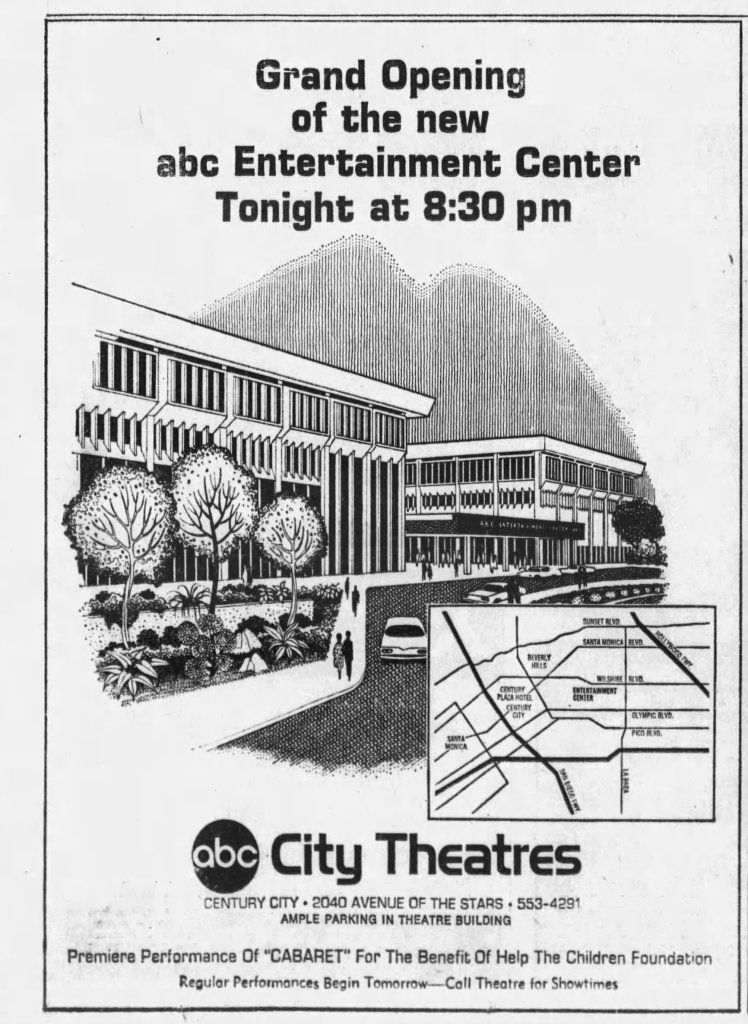
Charity performance of Cabaret was performed at the opening. It has since been demolished.
*Notice the advert below for the Classic Cat. They too, present Cabaret to an audience. (June 1973)
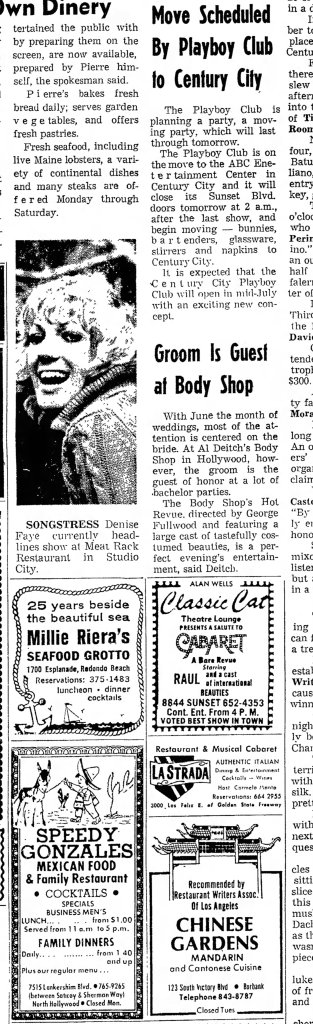

Playboy Club Move announcement, and for the Classic Cat Performance of Cabaret and A mexican restaurant actually named speedy Gonzales.


Marty Tregman is a long time realtor in Santa Monica, he doesn’t remember Paige. Jon Von Newman…. came up with nothing. Brian Wilson is a common name so I can’t say this with the genius writer of the Beach Boys music group.
And right below Brian Wilson,
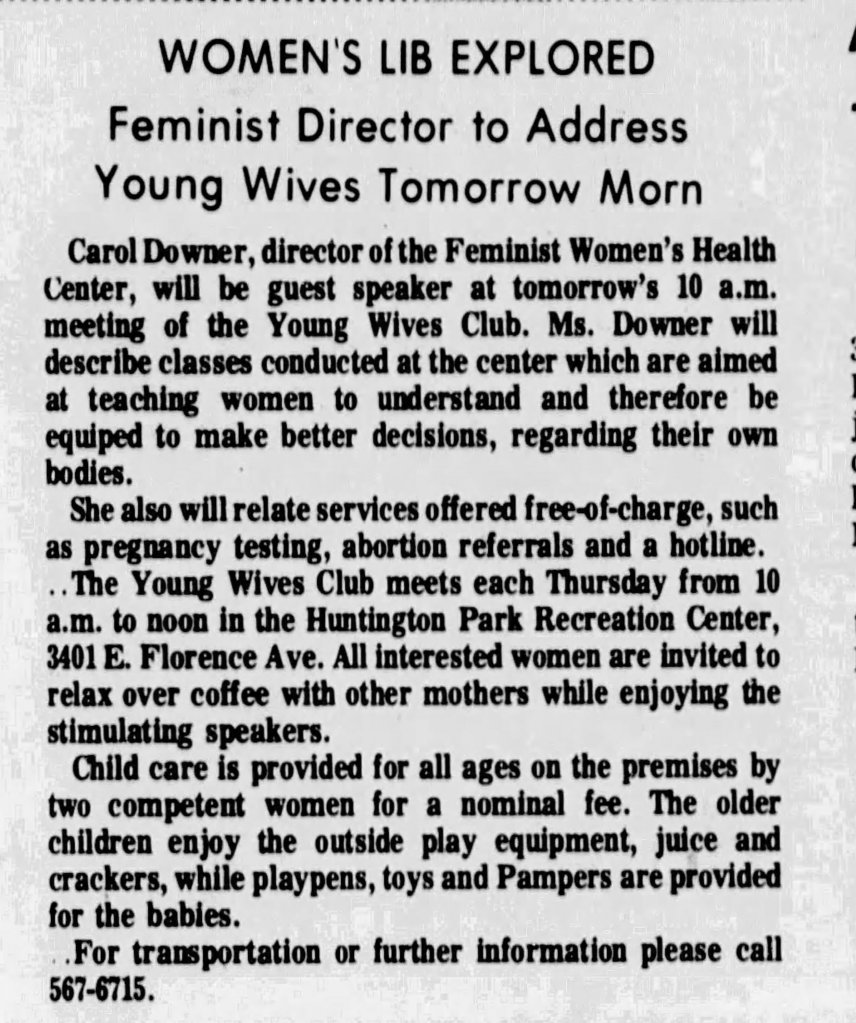
I was intrigued with the entry “Feminist Women’s Health Center 746 Crenshaw”
And I found many articles in the newspaper archives.


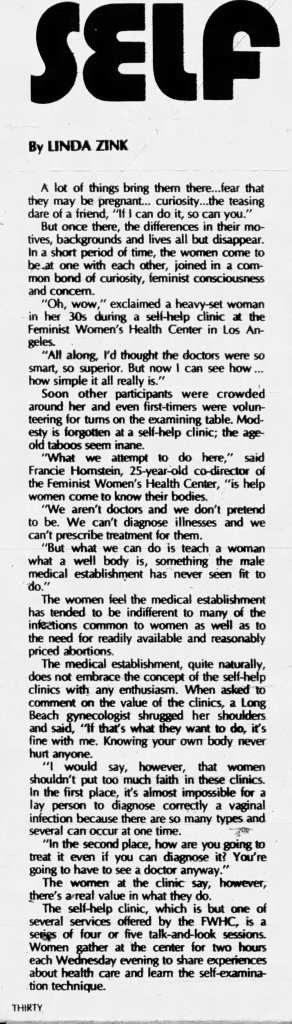
Turns out this Health care center played an important, but under recognized role in the 2nd Wave Feminist movement.
There were many services that Paige might have used at the “Feminist Women’s Health Center 746 Crenshaw” (FWHC)
You will see evidence of this through newspaper articles written at the time, both local and national.
This FWHC was one of, if not the first, women’s self-help health centers in the nation.
A brief context of the times is important and mostly forgotten.
“The Women’s Lib Movement” was in the mainstream news and discussions at home and parodied on TV shows.
I can remember this when I was in 6th grade.
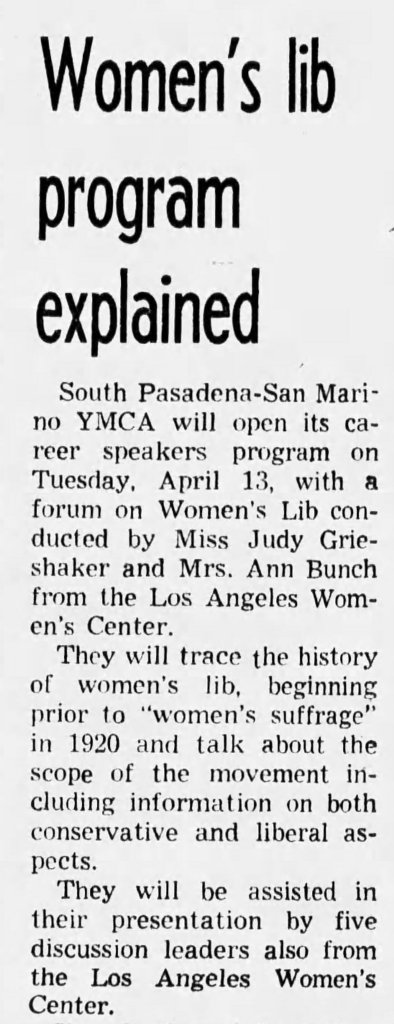
Feminism/ Women’s Liberation was more active in the early 1970s.
More so, than the 1960s.
I say this despite the publication of The Feminine Mystique by Betty Friedan in 1963. The movement flourished in a main-stream way in the early 1970s.
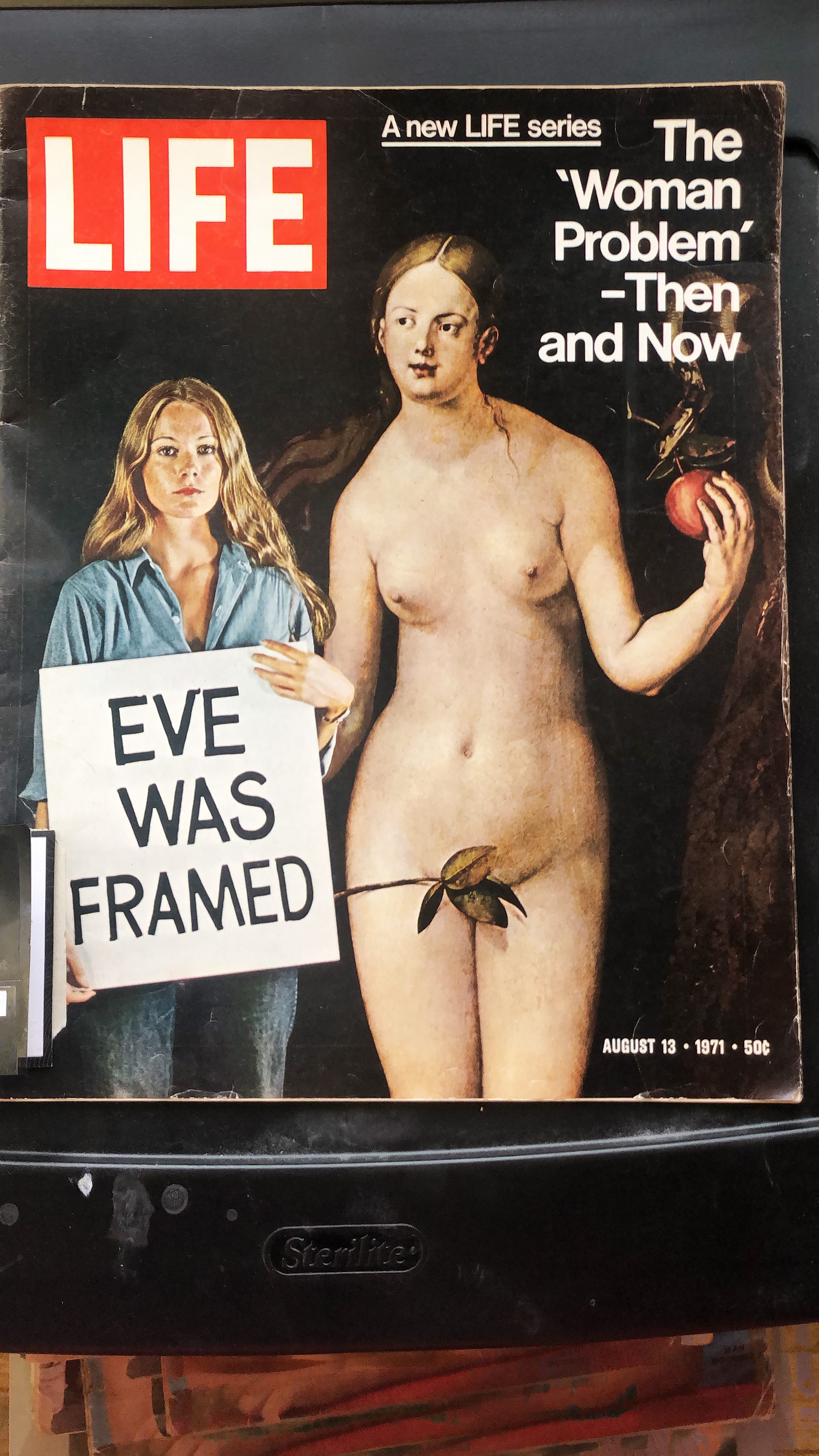
Let’s review some history to show you what I mean:
1972: The Equal Rights Amendment was reintroduced. 22 states, quickly ratified. This same year Title 9 was made a law.
Domestic violence safe houses, rape crisis centers, help lines and self-defense classes for women proliferated in the 1970s.
There were Media reports and editorials about equal pay for equal work and sexual harassment in the workplace.
There were reports about limited job opportunity and gender discrimination in housing and credit. Another topic was the implementation of subsidized childcare and wages for housework.
1973: The Roe V.Wade case. A woman’s right to an abortion become national law in January of 1973.
One exception was California:
Abortion was legalized in California in 1967 with the passage of the Therapeutic Abortion Act. This law allowed abortions in cases of rape, incest, or when the mother’s physical or mental health was in danger. In 1969, the California Supreme Court further ruled that women had a constitutional right to privacy, which included the right to an abortion. This was before the nationwide legalization of abortion in 1973 with the Roe v. Wade decision. credit Google AI
<<<<<<<Article by Linda Zink in Long Beach, explains what the Feminist Women’s Health Care Center was about. Excerpts from this article are throughout this section.
1974 – Housing discrimination on the basis of sex and credit discrimination against women is outlawed by Congress.
1975: An influential book about sexual violence and rape, “Against Our Will” by Susan Brownmiller was published.
In this environment many women were exhausted yet fed up with their treatment by almost always male doctors.
OB/Gyns were considered the experts and authorities on female bodies. This caused anger and resentment by women of all ages.
They turned the anger into public activism.
The health and reproductive branch of “Women’s Liberation” is symbolized by the worldwide success of the book “Our Bodies, Ourselves.” The book’s influence is significant. The book was published in 1970 and is now on its’ 9th edition.

You or someone you know probably own a copy. Or seen it somewhere. It’s probably been banned somewhere.
Our Bodies, Ourselves originally sprang from feminist “consciousness-raising” courses held in Boston in the late 1960s. Group members gave presentations about topics considered taboo at the time, like masturbation, postpartum struggles, and birth control — which was then illegal for unmarried women in Massachusetts. NPR website 4-8-2018
2 women who became activists lived in Los Angeles and Orange County were mothers:
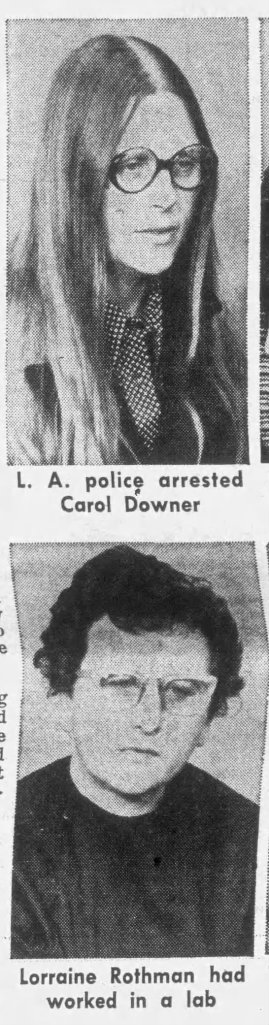
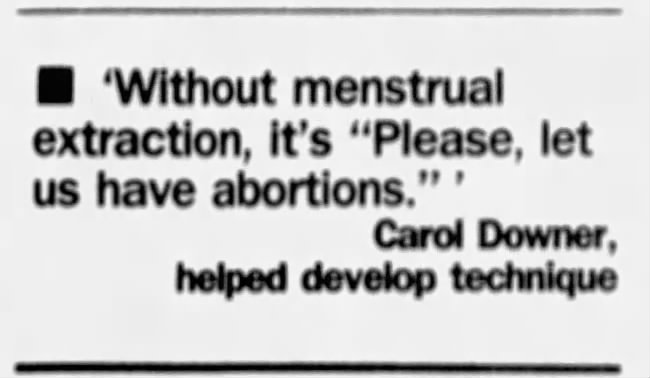
Carol Downer and Lorraine Rothman. Together, they started the Los Angeles Feminist W0men’s Health Clinic. They taught classes to women on how to be the expert on their own reproductive health. This includes fertility control with the method called “menstrual extraction”
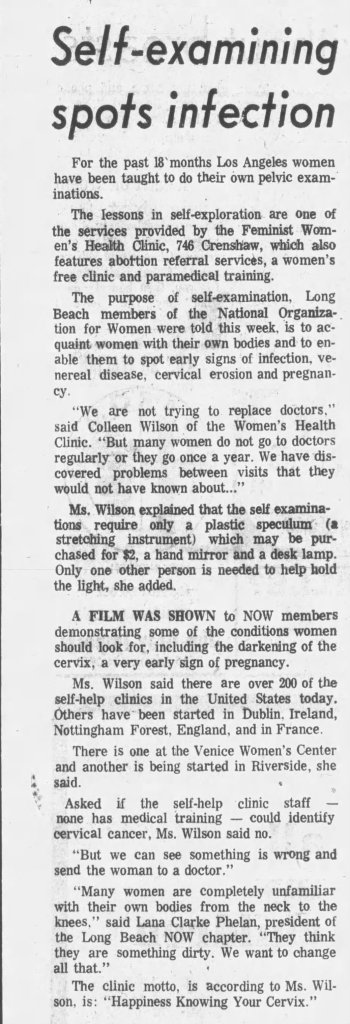
August 25th 1972 Long Beach Newspaper.
Quote below from Los Angeles Conservancy, an historic architecture preservation society.
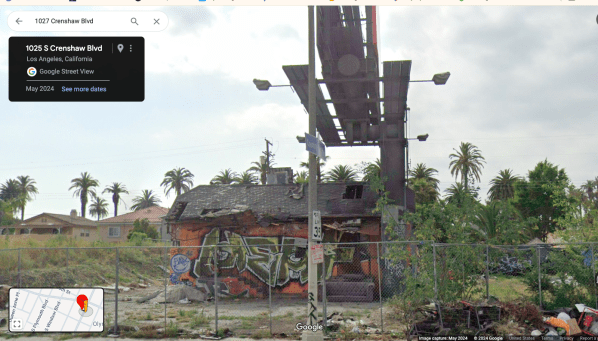
It is from their website as part of their nomination for historic status of the FWHC building at 1027 Crenshaw.
“Women’s Self-Help One clinic was the first in the nation and consequently placed the Crenshaw Women’s Center at the genesis point of the women’s self-help movement. Founded by Carol Downer and Lorraine Rothman, the clinic became a model for the national movement. In 1972, the Center was raided by police. Ms. Downer had applied yogurt as a cure for a yeast infection and was arrested for practicing medicine without a license. She was acquitted and the platform and publicity of The Great Yogurt Conspiracy raised the consciousness of the nation and helped make woman’s clinics a national movement.”
Historic status was denied.
The raid happened at 1027 Crenshaw Now I am not so sure. Press articles give the address as 746 Crenshaw as seen below. I am now thinking both locations were raided.
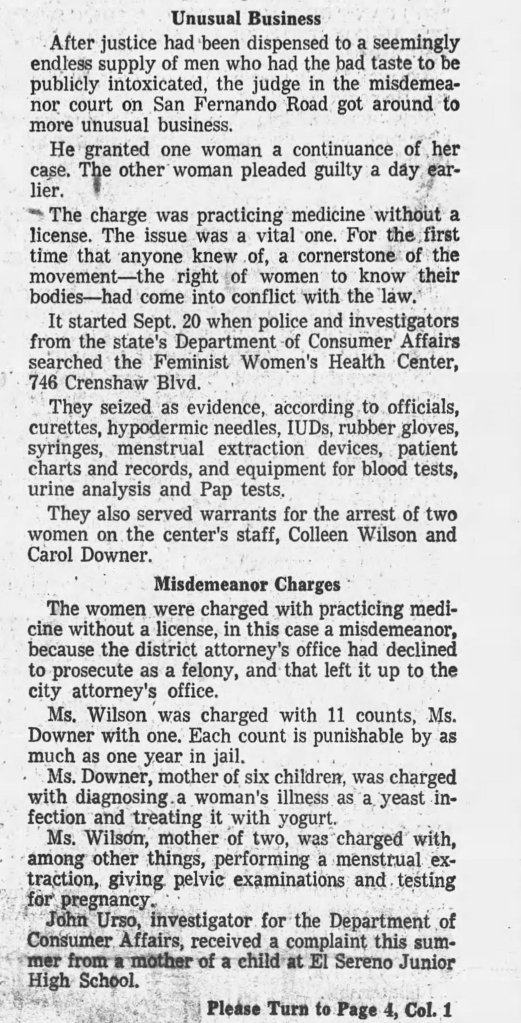

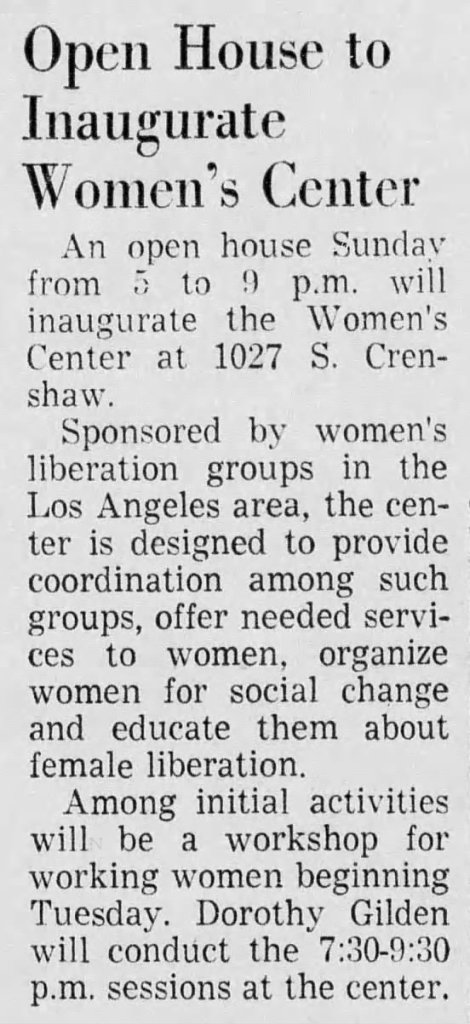
The Women’s Center opened at 1027 S. Crenshaw. LAT Jan. 9, 1970
Many classes and lectures were taught at this location.
This location was nominated for historic status.
Screen shot from Summer of 2024 of 1026 Crenshaw.
The Great Yogurt Conspiracy received wide press coverage due to its’ humorous title and the absurdity of the charges. This article explains more what it is:
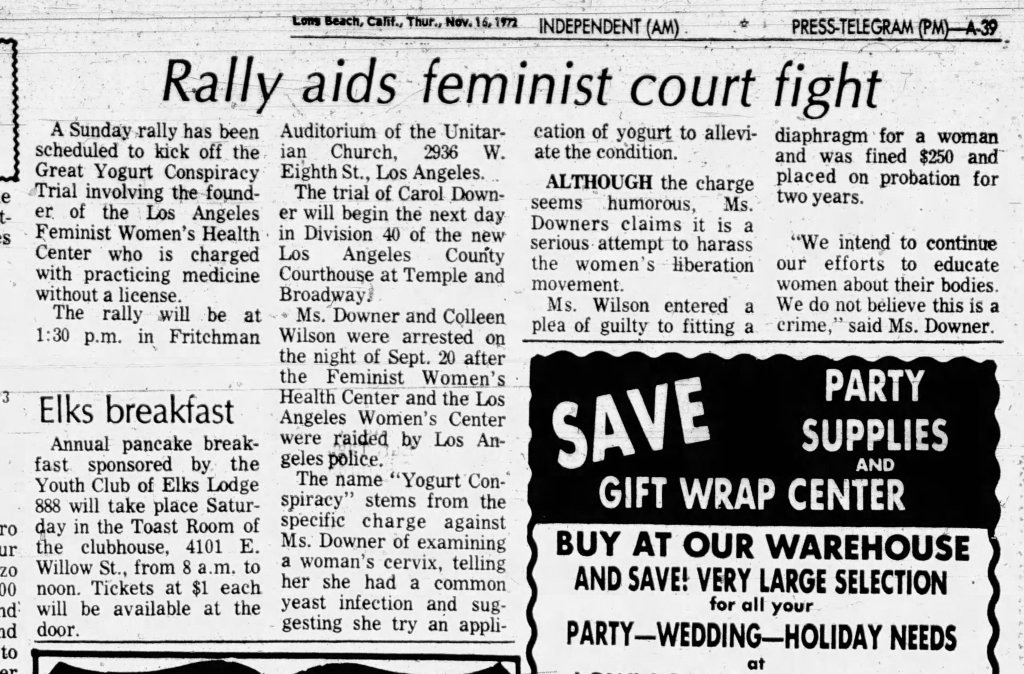
“Carol Downer revolutionized the women’s health movement, learning how to perform abortions and vaginal self-examinations, and teaching other women how to, as well. From the website Feminist Current, an interview with Carol Downer conducted about 3 years ago.
Last column in Zink article. 5/13/73 Mentions support from Gloria Steinem and others for the Great Yogurt Conspiracy, and happiness after the acquittal:
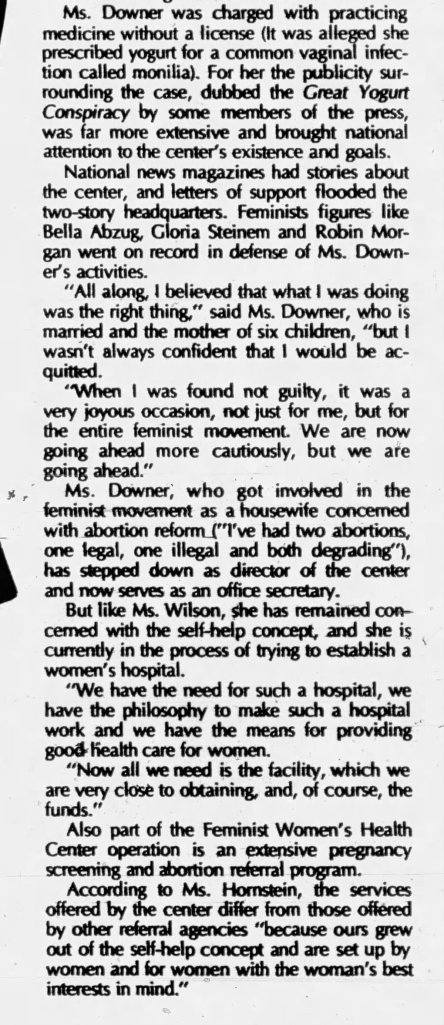
The “yogurt conspiracy,” arrest and acquittal caught the attention of cultural icons like Gloria Steinem, Bella Abzug and Dr. Benjamin Spock, bringing national attention to the LA activists.


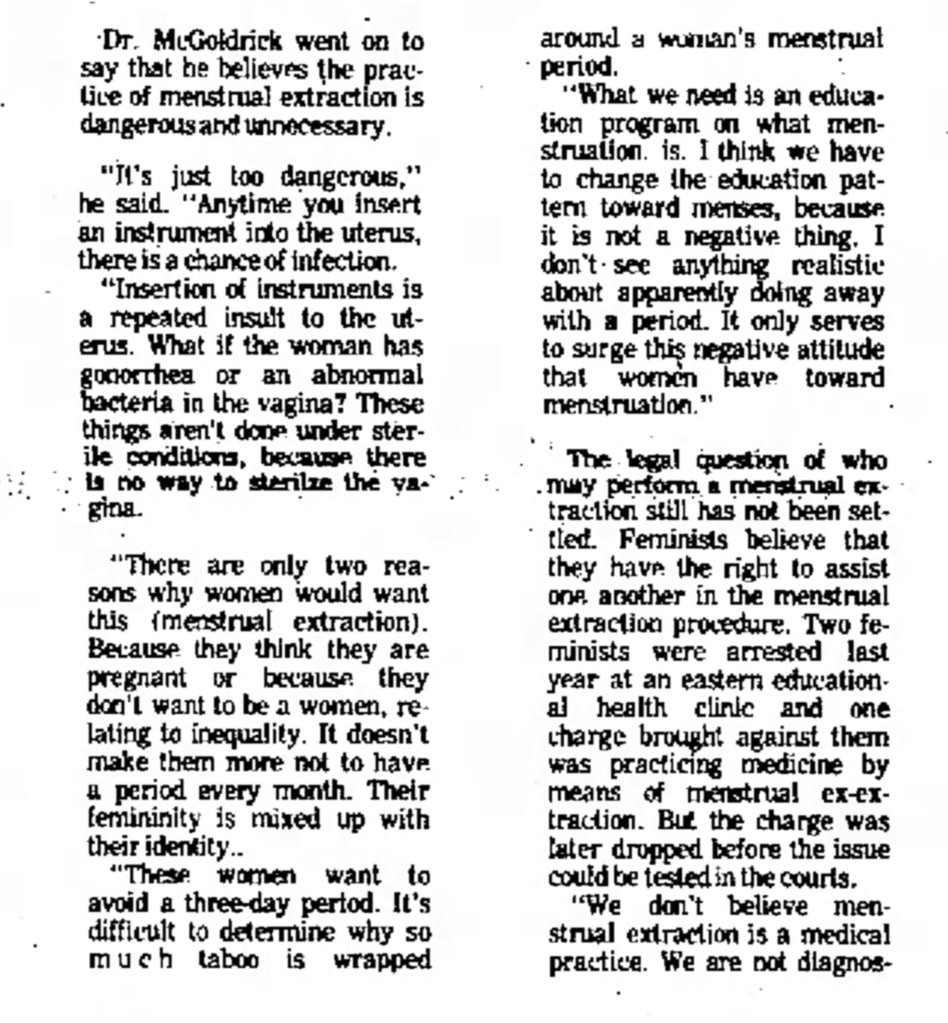

“Lorraine Rothman was a founding member of the feminist centered Self-Help Clinic movement and a major mover of many successful behind-the-scenes projects. With Carol Downer, she worked on the concept of menstrual extraction as a viable women’s home health care technique; and, in 1971, she invented the Del-Em menstrual extraction kit, which was patented n 1974……… Rothman’s collaborative relationship with Downer and the self-help clinic movement began when she attended an April 7, 1971 meeting organized by Downer to discuss women’s reproductive rights and abortion. At the second meeting, one week later, Rothman shared her idea of a safe home health care tool, demonstrating the prototype of the Del-Em menstrual extraction kit. Shortly afterwards, Downer and Rothman founded the Feminist Women’s Health Center (FWHC) in Los Angeles; Rothman went on to open a second FWHC in Orange County, closer to her home and family. Over the next two decades, Rothman traveled widely, taking the Self-Help Clinic concept to women’s groups both in and outside the US....”Archived interview subject description at CSU Long Beach.

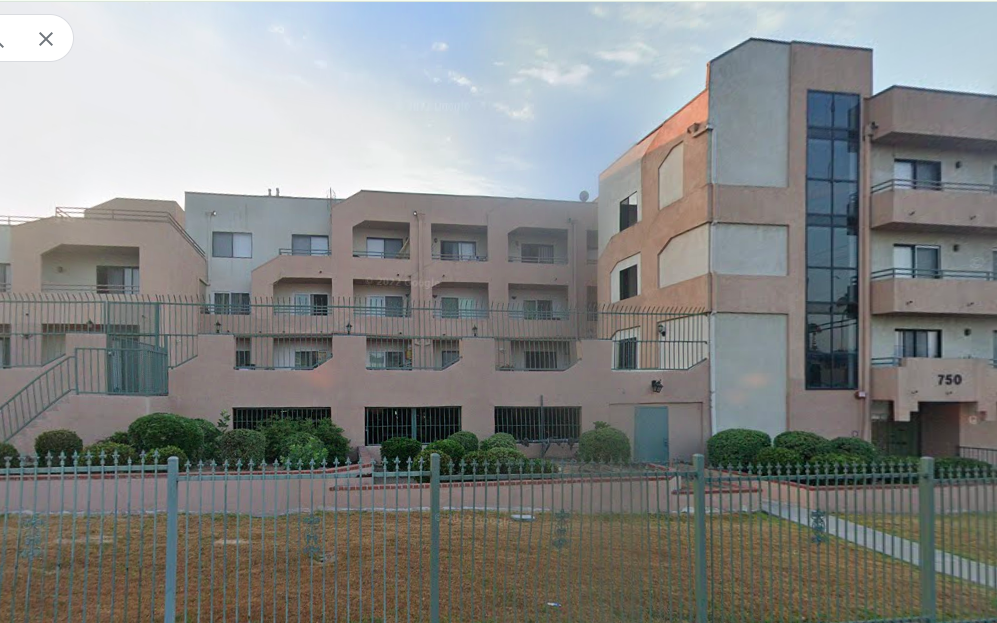
746 Crenshaw, the address Paige had in her phone book, location was demolished in the 1980s and replaced with this monstrosity.
Carol Downer continues to lives in Eagle Rock and has been working in disability and immigration law for many years. She has lived a life of activism in women’s reproductive rights and the international peace movement.
She believes that women should not depend on the current legal status of a woman’s right to an abortion. .
Downer still advocates for women to learn the self-care or self-help method of abortion. She wrote a book on the topic in the 1990s.
For more details, see the Carol Downer entry in the Embryo Project Encyclopedia.
END

She wishes to remain anonymous so I will refer to her as “Veronica.”
Veronica told me she heard Paige’s death announced on the car radio as she was driving. What she heard caused her to pull over, too shocked to continue driving. She tried later to call the radio station but couldn’t get through.
Veronica met Paige at the Malibu beach home she shared with husband Frank.
Paige had been brought to the home by Joe Rank, an art lover collector, he worked in radio and lived nearby.
Veronica never saw them together again. Paige and Joe remained friends. She thinks Joe possibly knew about Paige’s background and family.
By the end of the 1970s Rank was the founder of a very successful clothing company. (More details at the end.)
Veronica said that Joe Rank knew Paige quite well and I should contact him.
I have tried, unfortunately, with no luck. He would be in his 80s or 90s now.
The only place Joe or Joseph Rank turns up in newspaper archives is as a Spanish language radio station owner.
And this is probably the same Joe Rank who knew Paige Young; Veronica said he was in radio at the time he brought Paige to the house.
Veronica said it was during Paige’s “Playboy days,”
The two women stayed in touch until the end of Paige’s life.
Veronica said Paige told her that Bill Cosby was an “art patron.” He was helping her to stay in her Topanga Canyon cabin home and art studio.
Veronica thought it was “nice of Bill Cosby to help her out.” She thought nothing sinister about it. Paige did not say anything sinister about Bill or the arrangement.
Veronica concurred with others I have interviewed, that Paige often walked around topless or nude. She remembers Paige being naked or topless and playing in volleyball games. The “the beach boys” who hung around “were very pleased.”
Veronica thought it might be explained by Paige’s personality which could be described as “high and low” or “hi-lo.”
Veronica told me about an occasion that Paige used LSD and experienced a “bad trip.” Veronica stayed with Paige and helped her through the ordeal. Veronica was motherly to many of the young people who showed up at her home even though she was still young herself, in her 30s and had a husband and two young daughters.
Her husband Frank enjoyed “collecting people,” wrote Veronica. And many young people would hang around their beach house socializing and playing games.

I’m grateful to Veronica for her permission to use this image.
Veronica remembers buying groceries for Paige, at a store located at the bottom of “Fernwood & Topanga Canyon Dr.”
And the Safeway on Sunset & PCH, later Vons.
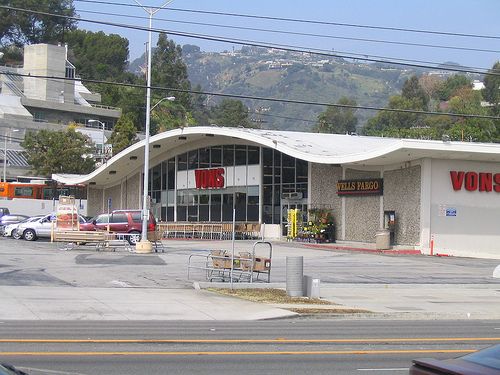
This happened about once a month for quite a while. The “2 friends would chit chat and catch up on news.” Paige never wanted more food than she could physically carry.
This was before her move to Westwood. After that Veronica didn’t see Paige as much but they talked often on the phone.
She remembers just vaguely that Paige mentioned her about her own art studio in Venice Beach, a block away from the beach. (See 2 chapters: Venice Beach, Richard Sample.)
(Dennis Hopper has a connection to Paige as he knew the artists that Paige knew, Larry Bell and in the same building: DeWain Valentine. Robert Irwin lived across the street at this time in Venice. Veronica remembers Hopper at events around town)
Paige sometimes expressed her suicide ideation in phone conversations with Veronica.
She did not discuss Hugh Hefner or John Huston, David Shane, Desmond Guinness or a”sex tape.”(See related chapters)
Several times Paige needed a ride to visit her sister, but Veronica never met the sister: Constance/Connie.
The last time the friends had a phone conversation, Veronica noted an “echoey sound in the background, sounded like Paige was in a bathroom.” Veronica tried to lighten the mood by asking her about the echoey sound and said,”Paige are you already in heaven?” Paige laughed and they hung up the phone with Veronica feeling Paige was in a better space.
Paige one time had checked herself into the UCLA Psych Center but was released in a just a few days.
Once Paige told Veronica “she said she had cured all the patients at the ward.”
Veronica said she never believed that Paige would actually go through with suicide.
Separately, Melanie told me about one time driving Paige to the UCLA Psych Ward. She remembers Paige “returning from the ward with a very strange man who worked at the hospital.”
He lunged at Melanie, Paige suddenly appeared with a gun and he bolted. Without pants on she said and added “it was the same gun she used on herself.”
Paige probably took advantage of the 51/50 law, which began in California in 1967.
“In California we have a law (5150) that the police (or yourself if you may harm yourself) can commit you for 3 days to a hospital for psych care. If you are pronounced no longer liable to harm yourself or others or decide you want to leave voluntarily you can after three days.”
Veronica does remember Paige’s expressing she did not have enough money for paint.
She told her to just wait a few days and would help her out with that.
Paige was dead before that happened.
Lack of money was a recurring problem for Paige.
She did not know Paige to own a car, says Veronica.
Paige did not talk of her past or any future plans. She seemed to always exist and speak in the present moment.
Melanie said does not remember Paige owning a car.
I personally think Paige sold her yellow Mustang seen by Sample in Malibu 64-67. Also seen by her cousin Christian/Chris in Sherman Oaks in 1964 as described to me. Paige made Chris a cup of coffee during his visit to her apartment. She told him about her divorce from Mark F. Segal.
Paige did not mention the violence and threats I viewed in her divorce papers. I told Chris about and he said “Oh, she would not have put up with that.”
No one I’ve communicated with who knew Paige say they can remember a time when she talked about her childhood. She never mentioned her family or her background. Veronica says Joe Rank may have known something of Paige’s family members.
Chris said he and his mother were contacted by Connie Smashey, Paige’s sister, to tell them the bad news of Paige’s suicide. Chris told me that Connie had a seemingly indifferent attitude about Paige’s death and he got the impression of “good riddance.” Chris said this made he and his mother sick to their stomach and angry and they did not stay in touch with Connie.
Aca Joe History
“Joe Rank, a Los Angeles broadcasting executive who had managed KMEX-TV, the Spanish language TV station in Los Angeles, moved to Mexico in 1973 to establish a printed tee shirt business on the beach resorts which were booming with international tourism. By 1978, Rank had shops in 75 stores in Acapulco, Cancun, Puerto Vallarta, Mazatlán, and Mexico City, plus tee shirt shops in 15 of the popular Carlos n’ Charlie’s bars and restaurants throughout Mexico.
In 1983, the name was changed to Aca Joe and product distribution was limited only to Aca Joe owned or franchised stores. The line was expanded to include pants, jackets, sweaters, and more than just tee shirts. After changing to this more exclusive distribution of the product, the stores were swamped with customers. Lines were formed in front of the stores with people waiting to get in at all hours of the day.
The success of Aca Joe did not go without notice by international investors, and soon a deal was made with American partners for the expansion of Aca Joe outside of Mexico. William Meyer became Rank’s partner in Aca Joe International and the first stores in the U.S. were opened in the Bay Area of San Francisco, with shops in Union Square, Sausalito, and the Stanford Shopping Center.
The U.S. shops were very successful, and to provide financing for expansion, the new U.S. company filed for listing on the NASDAQ stock exchange. Prospects for the future of the stores were bright, and in 1985 Aca Joe International was the fastest rising stock on NASDAQ” From the ACA Joe website.

Joe left LA and had moved to Mexico in 1973, before Paige killed herself.
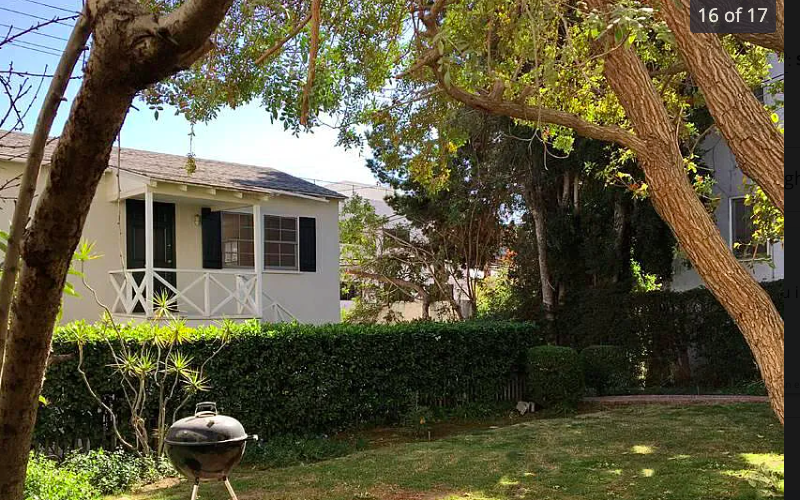
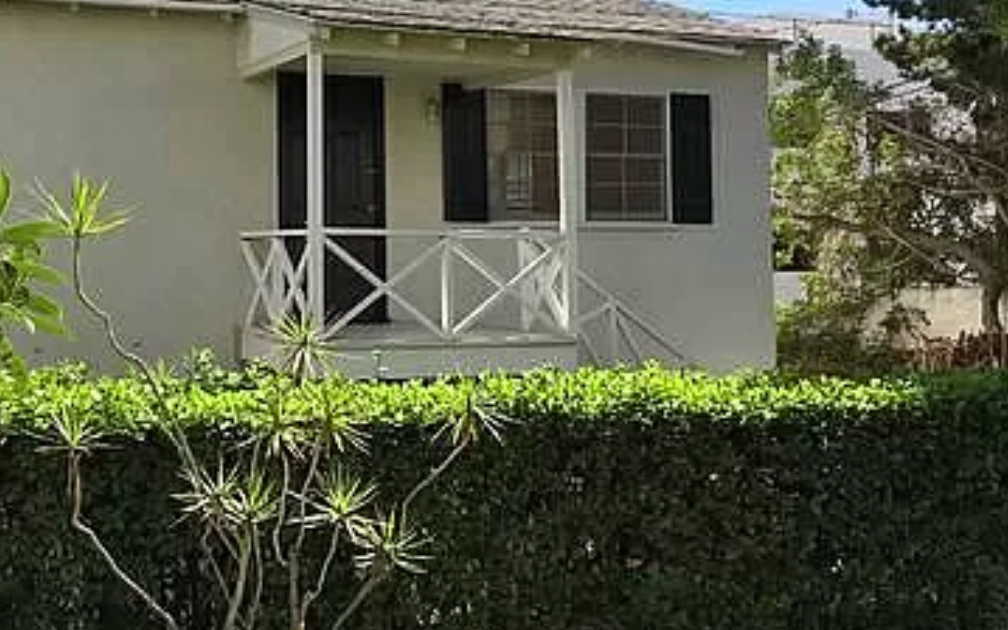
Below are some photos of Paige’s over-a-garage apartment and where she stage her death.
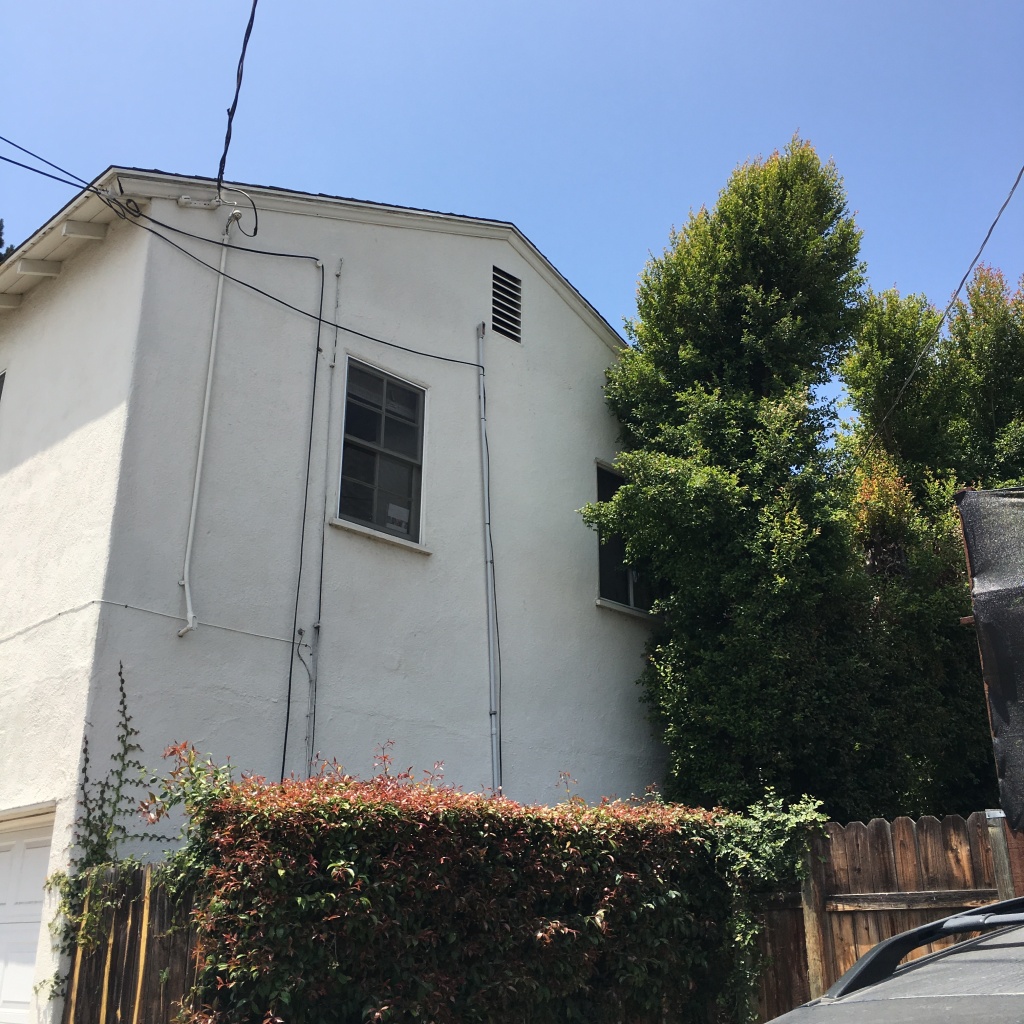
Away from the backyard and duplex.

I’m looking up from the alley. This window faces the building next door. There is a bit of yard between trees house and fence, I did not see that part. It’s where Paige kept the Akitas she wanted to breed and Melanie complained about them barking. LAPD reports talks about a man named DeWitt to whom Paige wrote instructions to take her dogs. (See chapter on death certificate.) Veronica thinks Paige was going to try and make money from breeding the Akitas.

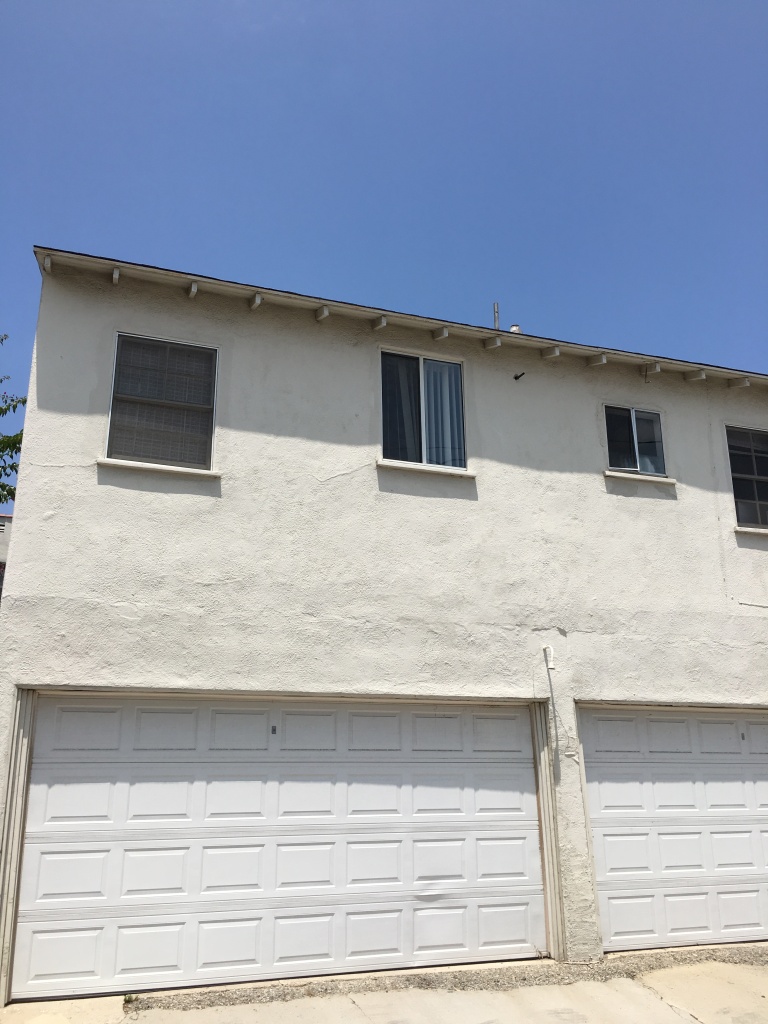
These windows face the alley. Garage had storage in it but no cars says Melanie. The window on far left is likely Paige’s bedroom.

1940s (1930s) Los Angeles: Family. Marriage. Hollywood Wedding Chapel. Los Feliz Houses. Mildred Marinell. WW2. P.O.W. Divorce. Updated 11/24/2025.
Posted on April 29, 2020
You were introduced to Diana Cotterell/Paige Young’s parents in an earlier chapter, let’s learn more about them.
Robert M. Cotterell was 23 and Donna V. LaRocca 19, when they were married in 1940.
Donna is listed in the 1940 census as living with her parents at 3834 Evans St., and that she was a “New Worker” in “Dramatics.”
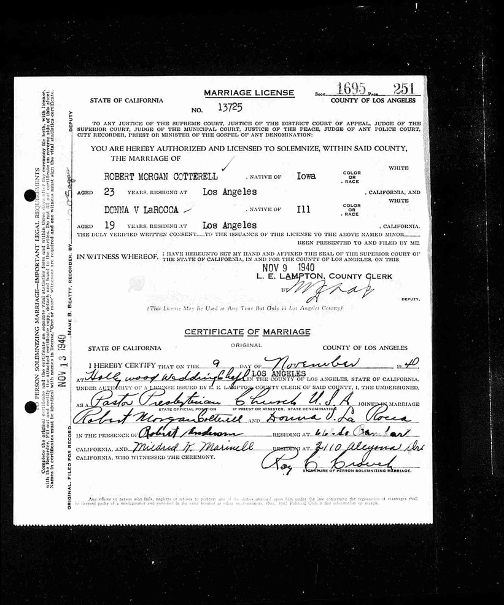
Mildred K. Marinell signature listed on next to last line.
Mildred is the daughter of Joseph LaRocca’s only sister Kathryn LaRocca Marinello, and Donna’s first cousin. Mildred dropped the “o” from her birth name. The family name is recorded as both Marinello and Marinelli; Mildred became Marinell, so it’s been confusing to research.
Below is the Hollywood Wedding Chapel where Robert and Donna were married per the marriage certificate.

The famed Garden of Allah apartment building was across the street.


Much more on Donna’s cousin Mildred coming up. (I suspect she occasionally used the name Penny Pepper in show business.)
This Hollywood Wedding Chapel building was purchased by famous director/writer Preston Sturges in 1940. He transformed it into “Players” restaurant which became a watering hole for the movie business.
Players has its’ own interesting Hollywood history.
Donna and Robert must have been one of the last couples to marry at the chapel before Sturges took over.
Now this location is a Pink Taco restaurant.
**UPDATE** Pink Taco abruptly closed in 2024.
Diana’s father Robert Morgan Cotterell was born around 1917 in Algon, Iowa. He moved to Los Angeles around 1938 to follow his interest in aviation. (According to his son in a facebook message to me.)
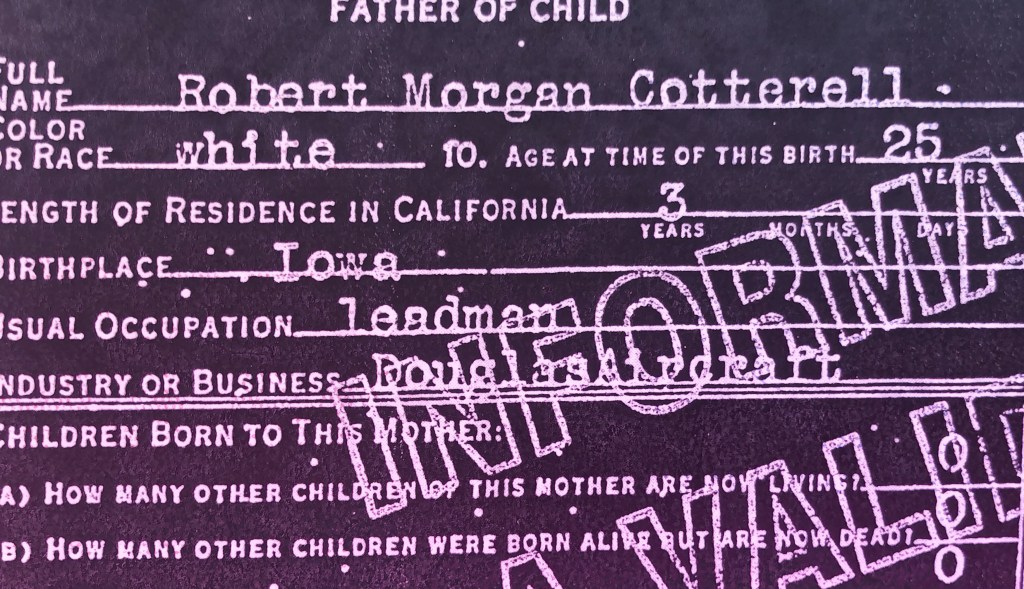
From Constance Susan Cotterell’s birth cert. in 1942. Father Robert a Leadman at Douglas Aircraft.
Donna Virginia LaRocca’s parents Ned and Virginia LaRocca were Vaudeville musicians and traveled the Pantages, Orpheum and other Vaudeville circuits for about the first 10 years of Donna’s life. For more, see related chapters.

This location, Shoredale and Gatewood Streets are in the Elysian Valley or maybe “Frog Town” part of Los Angeles. Very close to Elysian Park which was the very first City Park in Los Angeles
They moved to Evans St. near Marshall High School around 1938.
Donna Virginia was born in 1921, in Peoria, Illinois, the hometown of her father: Joseph Ned LaRocca.
Donna V. moved with her parents to Los Angeles around 1934.
Robert M. Cotterell during World War 2:

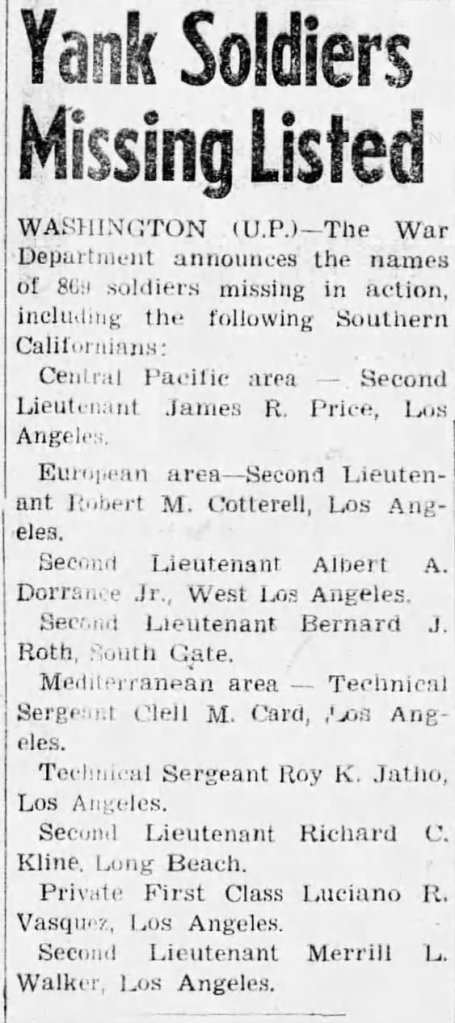
<<<<<<<<<<<<<
Wilmington Daily Press Journal July 26, 1944

Robert Cotterell’s daughter Constance is 2 years old, and Diana only 5 months, on the date the POW announcement was published.

Los Angeles Evening Citizen News July 29, 1944 >>>>>>>>


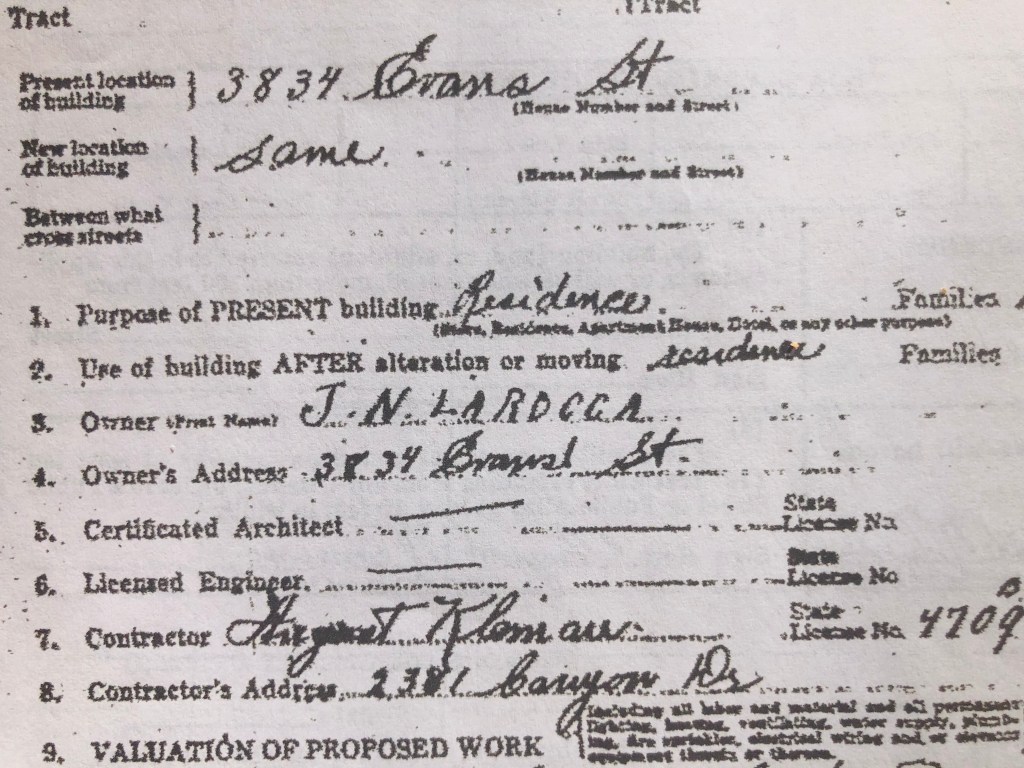
For his part in the war effort, Joseph Ned LaRocca signed up for the “Old Man’s Draft Card.” In 1942, Congress enacted a “law” to show solidarity for the war effort. It provided the Government an idea of the skills the skills “older” men in the US populations. For utilization in the war effort.
The document shows Ned was living at 3834 Evans in 1942.
He was driving to and working as a harpist in the famous NBC and CBS buildings on Sunset & Vine. (More on this in other family chapters.)
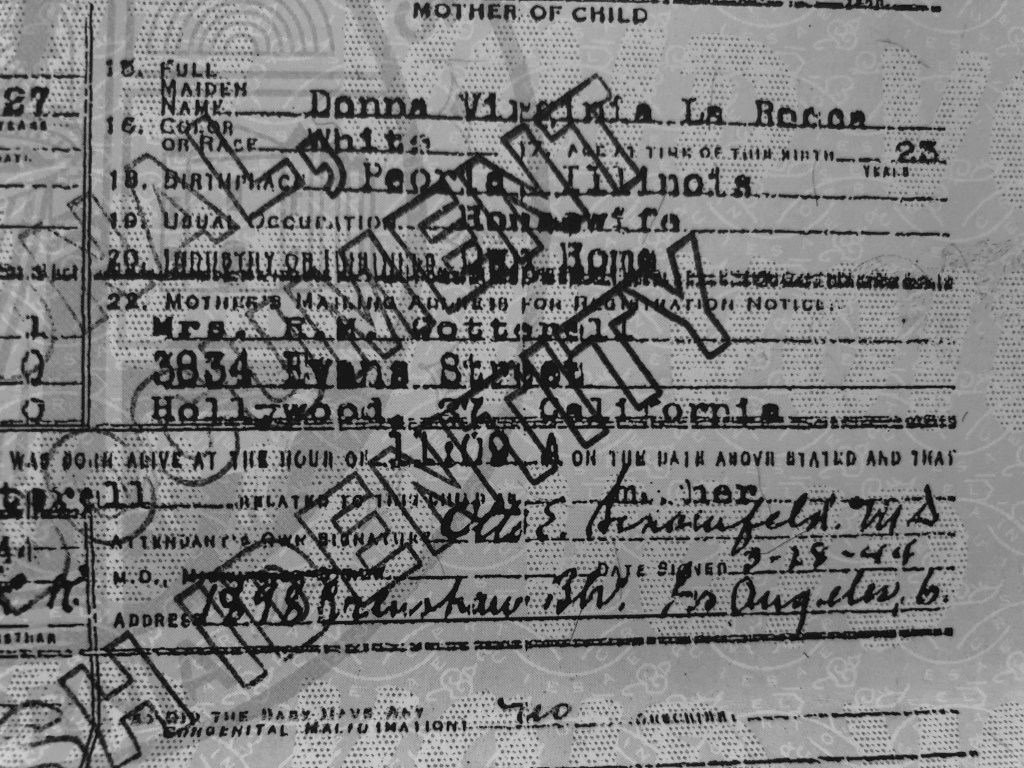
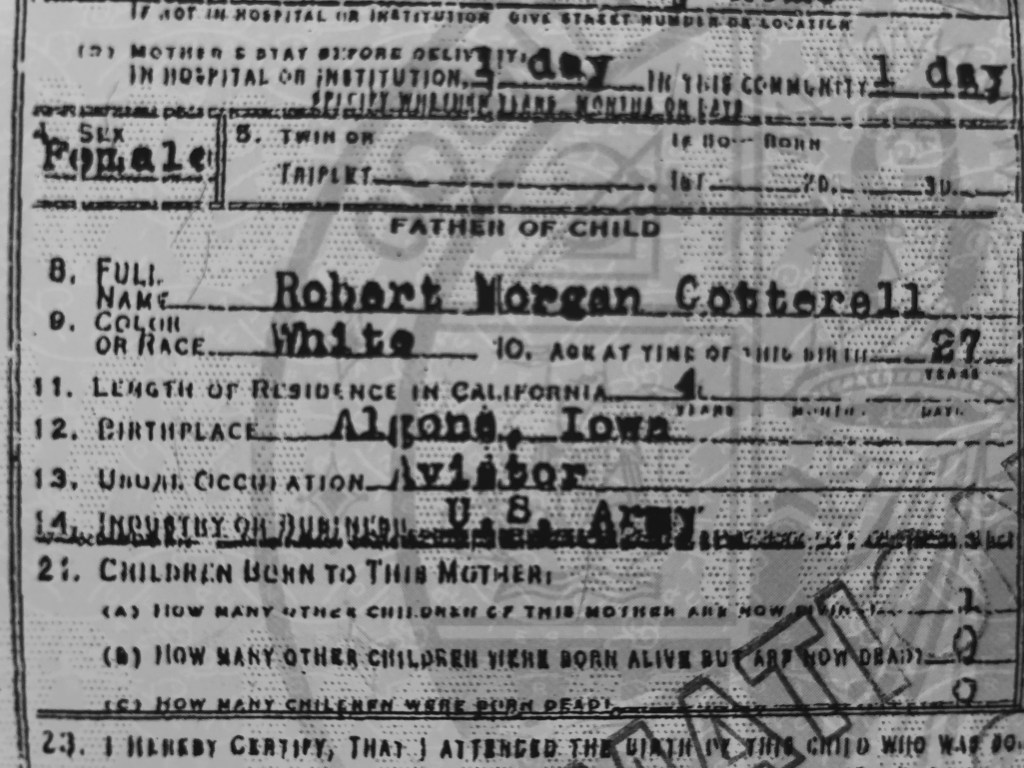
From the 1944 birth certificate of Diana Lee Cotterell, later Paige Young. Home residence listed on Evans Ave., located a stone’s throw away from Marshall High School.
1945 Diana’s father Robert Cotterell is liberated from the German Camp. where he spent approx. one year. I have no idea what he experienced but it probably wasn’t great. Robert’s daughter Diana was 1 year old in 1945 and first-born Constance, 3 years.
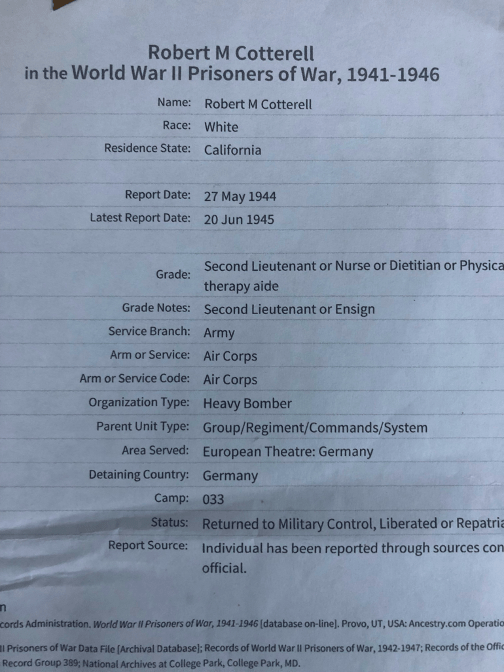
1947
Donna LaRocca Cotterell files for divorce against Robert Morgan Cotterell.

1947 Only 2 months later, the divorce is granted. This seems unusually quick.

Historic Context:
Robert and Donna Cotterell were one couple out of thousands who made up a nation-wide spike in divorce rates after WW2.
Statistics show that in 1946 one in four US marriages ended in divorce.
A 1946 article published in the New York Times said:
“More than half of America’s 1,500,000 war-wed G.I.s have returned. Already one out of every four of these 800,000 men is entangled in divorce proceedings. Experts are predicting that by 1950, 1,000,000 of these wartime marriages-or two out of three-will end in divorce.”
Robert Cotterell remarried in approximately 1949 to Patricia Frick and the couple had two children, in 1950 and 1951.
He got a job after the war working for Douglas Aircraft. The job took his family all over the San Fernando Valley. One stop was Laguna Beach.
I would imagine Robert paid alimony to Donna, normal at the time. He also would have paid child support for his daughters Constance and Diana. I have not been able to learn what kind of relationship the sisters had with their father.
Virginia LaRocca, Donna’s mother, Diana and Constance’s grandmother, was named owner of a double house at 3710 & 3712 Arbolada.
This house is only one mile from the home on Evans St.


Close up
Donna has a voter registration record with this address way back in 1944 below and in Robert Cotterell’s POW announcements in the newspapers.
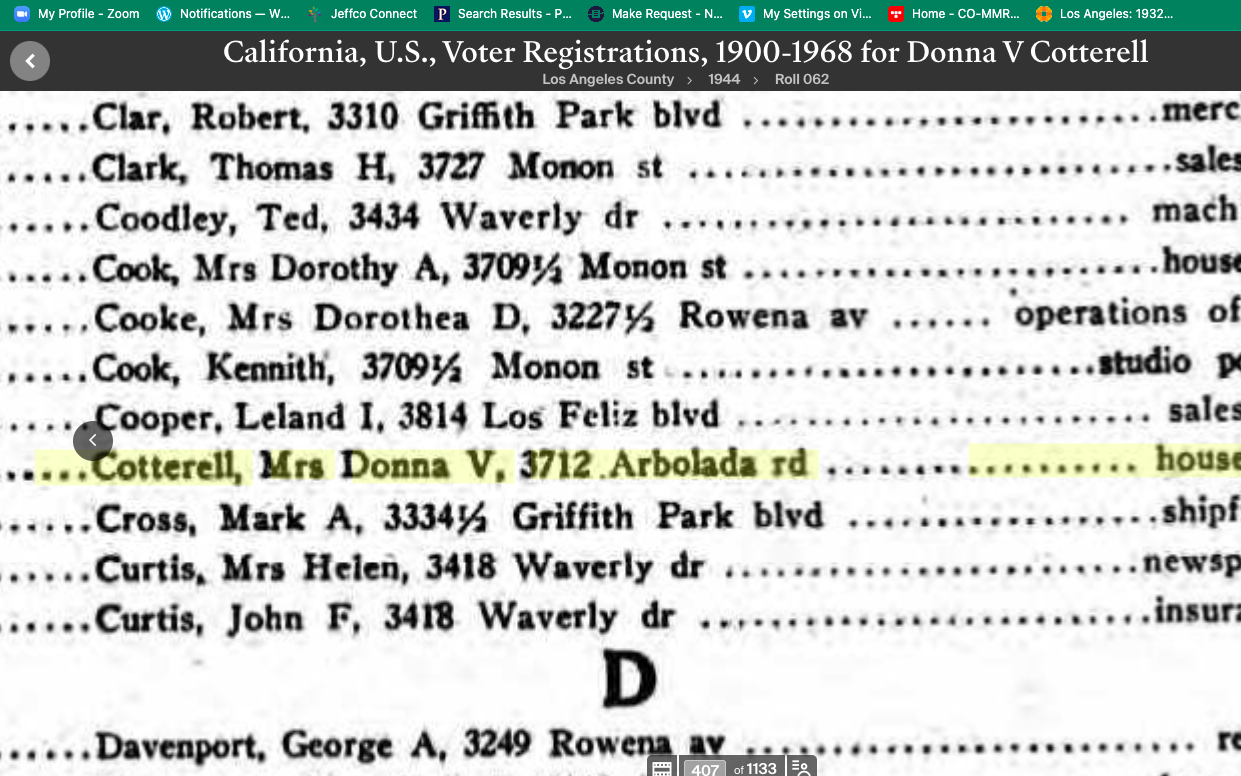
Joseph LaRocca is listed in the LA telephone directory with this Arbolada address in 1948.
Arbolada Rd. is a dead end street.
The homes are located high on a hill with an incredible panoramic view of the area. It’s minutes away from the Evans St. home, so still near Griffith Park.
The homes have a steep step climb.
Document from ancestry lost. Apologies. It was a Voter’s registration showing the following information.
Joseph and Virgina La Rocca listed above at the Arbolada address. Antonio and Corina La Bianca are at 3301 Waverly Dr.
Virginia’s listing leaves off “Christian Science” and just says her employment is “practitioner.” She now has an R by her name!
Antonio and Corina La Bianca purchased the house on Waverly Dr., sometime in the 30s or 40s but will confirm.
Unfortunately, the world knows the story of their son Leno.
The LaRocca Arbolada Road house is close to the LaBianca residence on Waverly Drive. Leno and Rosemary LaBianca were victims of the Manson family at this location. However, between the 2 houses is a large plot of undeveloped (!) land, so one has to travel a circuitous route between the two homes, as a friend did for me one time that I visited. There is no direct path between the two houses.
The 2 Italian families (Joseph’s wife Virginia was not Italian but Mormon with English ancestry) lived a 5 minute car drive from each other at one point, even if they never met.
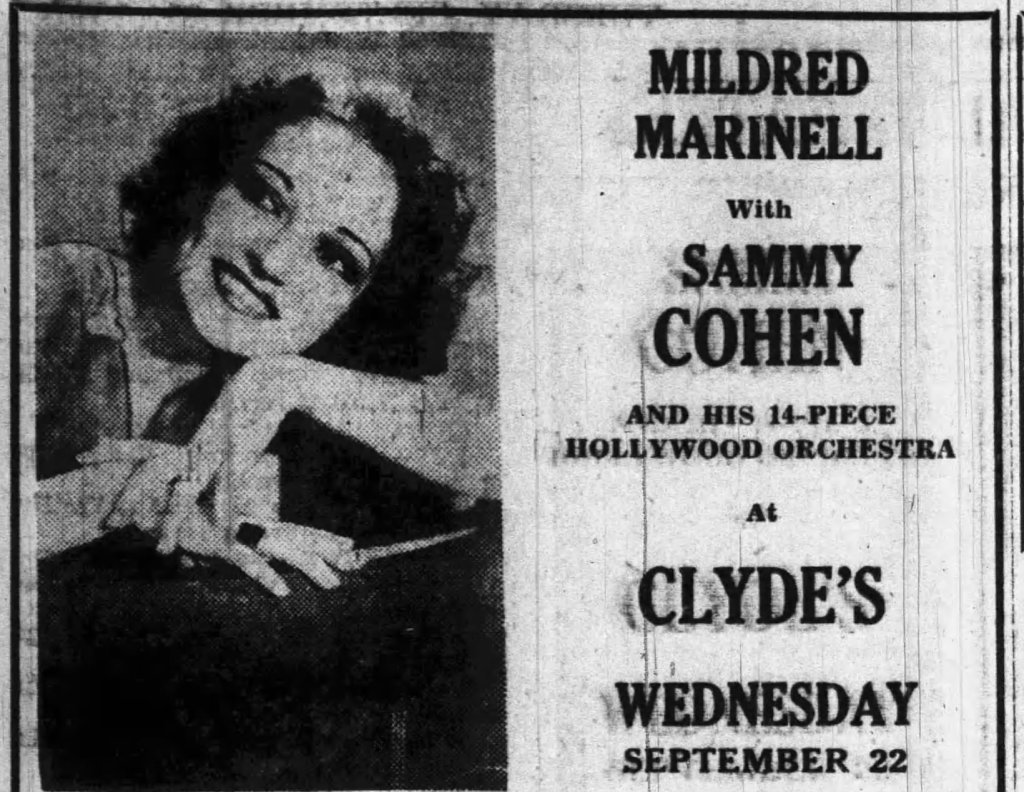
Mildred Marinell
Diana/Paige’s mother Donna was very close to her first cousin “Mildred Marinell.”
Mildred lived close to Donna in Peoria, Ill., with her in Los Feliz section of LA at 3834 Evans St. And a few doors down from each other in Sherman Oaks, San Fernando Valley, in the 1950s. This is seen in census records mainly.
Seen below: Port Angeles, Washington Sept. 21, 1937. Mildred dropped the i/o (I’ve seen it both ways) from her name
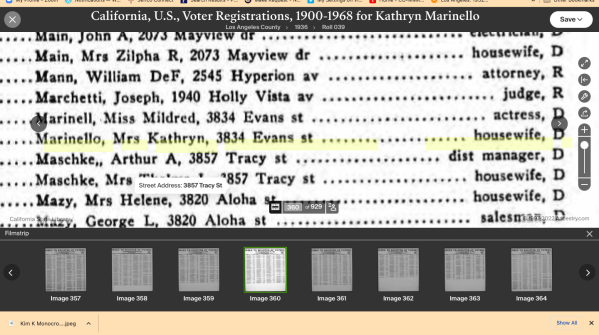
Mildred Marinell and her mother Kathryn living at 3834 Evans. 1936

Mildred ended up marrying Clayton Bartlett and having children with him and living in the San Fernando Valley.
The city of Los Angeles experienced a housing shortage during the post-war years. More so than the usual housing shortage that seems to have almost always existed in LA.
This fact caused me to wonder how the LaRoccas were able afford the 2 houses. They bought one right after the other, or overlapping, in the 1940s. Evans St and Arbolada Rd. houses.
Documents and articles show both addresses were used beginning in 1944 up until about 1948.

Mildred would name her daughter “Donna Lee,” (Lee was Diana/Paige’s middle name) Bartlett,” born in the early 1950s. I’ve tried and can’t reach her.
I didn’t find an exact answer but the next several chapters may shed some light on this “upwardly mobile” family.
Virginia LaRocca had been a full time Christian Science Practitioner sometime in the 1940s, as best as I can tell now.
She had her own phone listing in LA phone books for many years for the purpose for her work as a Practitioner or CSP.
“Gin” became a Christian Science Reader at some point. Her income from this is unknown. It is a high position in the Church of Christ Science.
Virginia’s sister Josephine Harker was listed in a directory at the Evans house around 1940. Harker was her sister’s sometimes singing/dancing partner back in the days of Vaudeville (see related chapters).
It’s easy to imagine that the Evans house was entirely too small to fit all these family members comfortably.
And of course there was daughter Donna and granddaughters Constance and Diana Cotterell born in 1942 and 44.
Father Robert was serving overseas most of this time, his name was connected with both addresses as articles show.
I’m not sure where exactly Robert moved soon after he was liberated and returned from a German POW camp.
His son Robert Cotterell JR. wrote me that his father told him he received a “Dear John” letter from wife Donna, when he was overseas.
I imagine POWs weren’t allowed any mail.
All these names, excluding Diana and Constance, were linked to the Evans or Arbolada address from 1938 through around 1947. These dates are per records I have shown or seen.
Donna and Robert were officially divorced in 1947 per notice in the LAT.

View of the surrounding area is spectacular as is the building itself. It’s one of those house you see in Los Angeles that look precariously balanced on a steep hill.
Perhaps Virginia and Ned sold this spectacular double house to finance their home in the San Fernando Valley?
 Paige Young in Los Angeles