From my copy of names with phone numbers that Melanie Myers recorded from Paige Young’s phone book. The LAPD confiscated the phone book after Melanie wrote down the names and numbers.
For a long time I had no clue as to “who (the hell) is Samson?”
In the spring of 2024
I interviewed Mrs. Darlene Valentine.
She lives in my state about one hour north of me.
Darlene Valentine was an artist and worked art-related jobs in Hollywood, for many years. Set design and wardrobe.
She was acquainted with Paige Young.
Darlene’s ex-husband DeWain Valentine was a prominent Venice Beach based artist. He dated Paige Young in the late 60s-early 70s.
I don’t know for how long.
Darlene and DeWain divorced around 1968.
They shared 3 young sons and a mutual social circle in the LA Art world.
Link to chapter on Pasadena Art Museum/Venice Beach art world:
Darlene Valentine was on friendly terms with Paige. She said ex-husband DeWain usually brought his girlfriends over to her house to meet them.
Darlene saw or interacted with Paige on a handful of different social occasions from about 1970-1974.
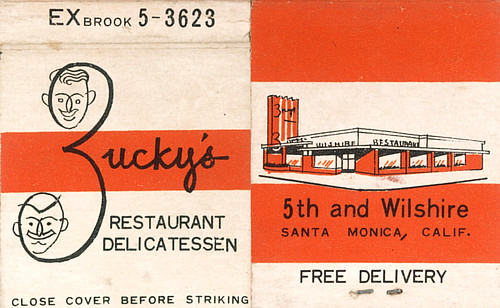
One incident she recalls, took place at the the deli Zucky’s, approx, 1970–72:
“Many of us went to Zucky’s because it was one of the only places open all night.”
Darlene was there with a friend and they were sitting with her ex-husband DeWain and his date, Paige Young.
Darlene remembers that at one point that evening, Paige “cried out like she was in pain.”
The cry was in response to DeWain grabbing Paige’s thigh or knee and squeezing really hard. His action looked like it was in response to Paige “saying something he did not want her say,” said Darlene.
The gesture was meant for Paige to “shut up.”
Darlene said her ex-husband “was not shy about saying things considered outrageous or shocking.” So she remembers being surprised at his strong reaction to whatever it was that Paige said.
The main (for me, only) appeal of Zucky’s when I used to go there was that it was open 24 hours so it was a great location to take your date for ice cream or a snack after you took her to one of the movie theaters out on Third Street. It was also “the” place for breakfast and sometimes lunch for folks who worked in Santa Monica. It struck me as a restaurant that wasn’t very good but it drew a crowd for lack of alternatives. When better places to eat opened in the neighborhood, Zucky’s floundered.
Paige mentioned DeWain in her suicide note/will, according to Darlene. She left him a statue of a horse made of wood. (Please see related chapters.)
Zucky’s closed in 1993.
Another of these social occasions Darlene remembers, was a “daytime, all-female tea party, at Paige’s place in Westwood.”
Darlene remembers seeing Michelle Phillips of the Mamas and thePapas at the tea party.
She also recognized “Samson De Brier, the only man there.”
Darlene saw Samson at Art related events, openings and parties, during the time she lived in LA.
Later in the chapter I discuss more of what Darlene told me during our interview.
So who the hell was Samson De Brier?
If you don’t know, I hope you get a good idea by the end of this chapter. Samson, along with several of his colleagues mentioned here, are worthy of their own dedicated biography.
late summer of 2024:
I visited the Samson De Brier archives located at ONE Archives USC Libraries.
I spent about 3 hours looking through the 2 large containers, the size of a large size liquor box. Together, they make up the archive.
Samson with prominent gallery owner Molly Barnes in the 1980s. Darlene Valentine mentioned Molly Barnes a few times during our interview.
Ultimately, I did not find Paige Young’s name in any of the files.
I checked the many pieces of paper and envelopes with names, phone numbers, lists or notations, written on the back.
I looked through a big file of Christmas cards sent to Samson over the years.
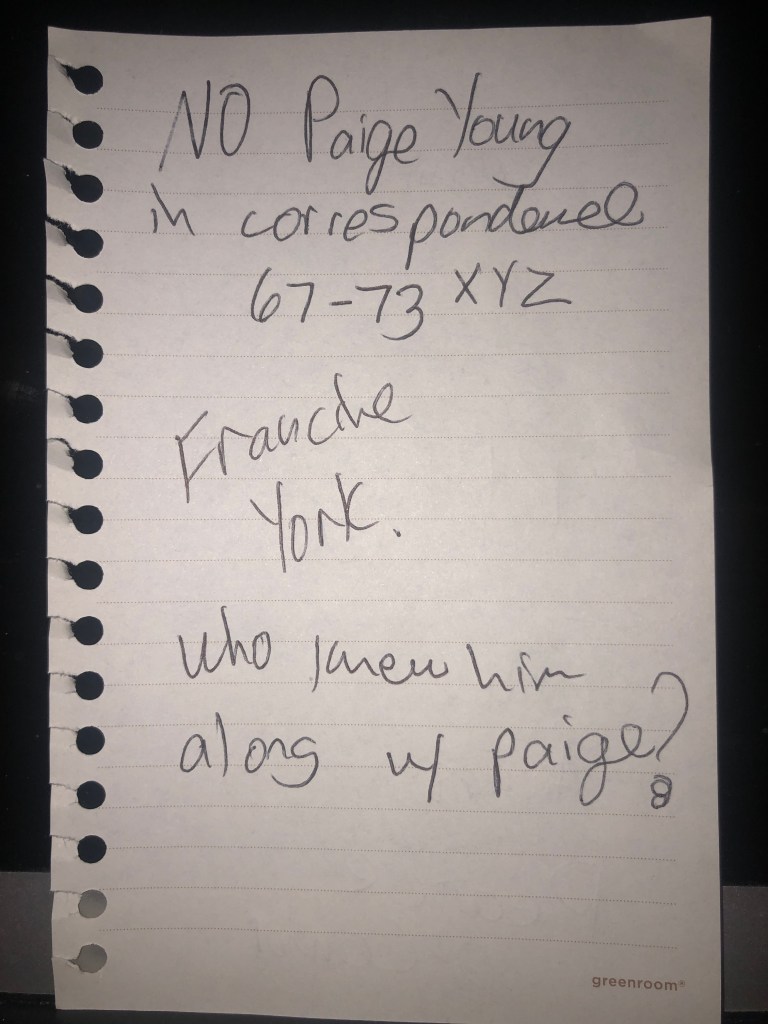
From my written notes atOne ArchivesUSC. The archives’ focus is LGBTQ histories of Los Angeles. Samson knew many leaders in the early LGBTQ movement as you shall see. I have not yet researched actress Francine York. I did read a Christmas card York sent to Samson that read, “Maybe this year we will finally have that lunch.”
The archives include a file with xeroxed press articles about Samson.
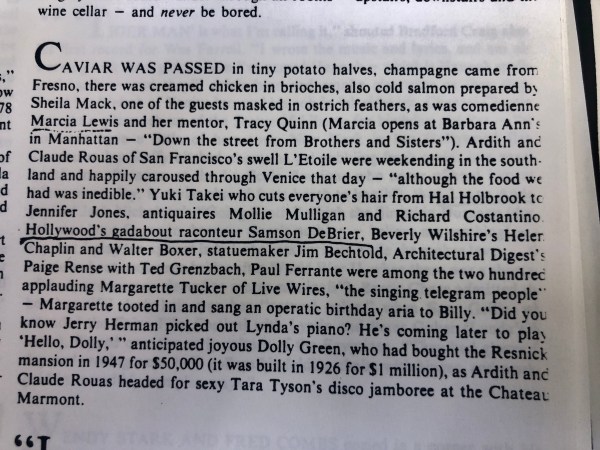
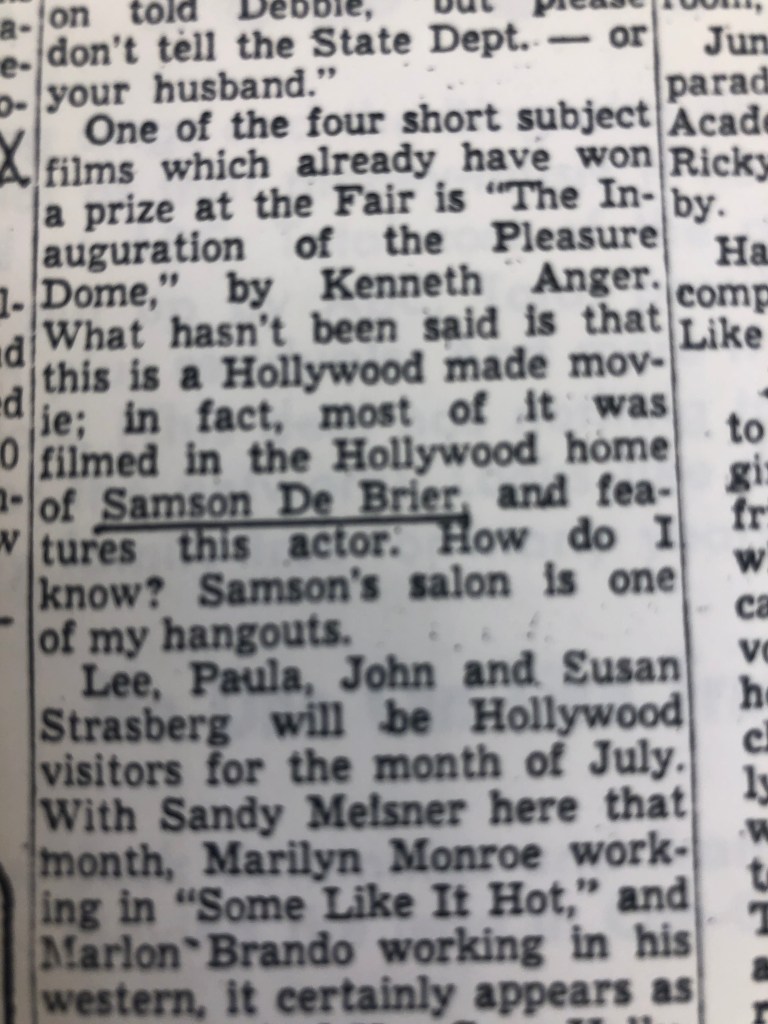
From a gossip column mentioning Samson De Brier. As a “gadabout raconteur,” DeBrier hosted a salon in the 1950s, 1960s and early 1970s. During this time until his death in 1995, he was a frequent guest at Hollywood parties, Art world parties, and parties with a mix of both. Samson was an occultist (at one time) and a friend of cult filmmaker Kenneth Anger. Kenneth Anger directed Samson in his 1953 experimental film Inauguration of the Pleasure Dome. The film is based on writings of occult figure head Aleister Crowley. I recently read the film was inspired by a Renate Druks party with a theme: Come As Your Madness.
The salon De Brier hosted from the 1950s through the 1970s, took place at his home close the Hollywood Forever Cemetery.
Samson rented out the rooms in his Georgian house, visible on Barton Way.
His residence/salon was in a smaller house behind the Georgian and not visible to the street.
Renting the rooms in his house provided De Brier with an income for several decades. It was enough for him to get by without working the grind of a “real job.” (Interesting as Paige Young was quoted in Playboy as averse to “the 9-5 doldrums.”)
This did cause De Brier to live more sparsely than some of his friends and Salon guests. Legend has it that the Salon host served only water.
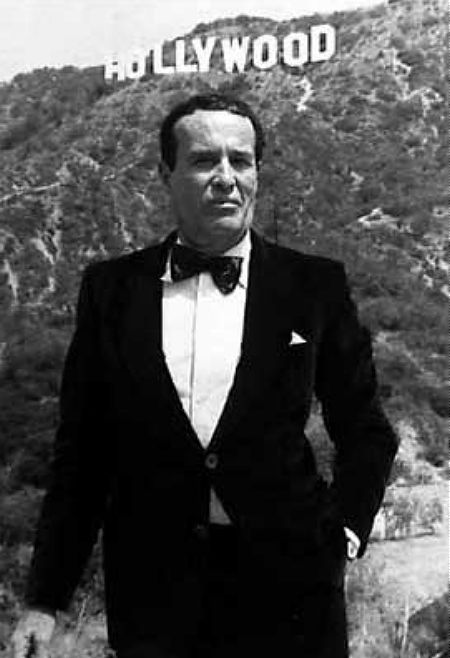
credit: Kitchen Cultist. Kenneth Anger poses at the Hollywood sign. Some of his most well-known/infamous underground films are Scorpio Rising and Lucifer Rising. I found Hollywood Babylon at a college bookstore around 1978. It fueled my interest in Hollywood history and its’ many tragic-bizarre deaths, lurid sex scandals and Boulevard of Broken Dreams.
Samson DeBrier co-starred alongside occultist/artist Marjorie Cameron, writer Anais Nin, and painter Renate Druks in what became a classic of Avant-garde/ experimental film: Inauguration of the Pleasure Dome,1954. Samson’s friend Kenneth Anger directed the film.
Samson’s home was the perfect filming location for Pleasure Dome, filled with his collection of antique objects, mirrors, exotic rugs, statues, tapestries.
Anger authored a book, Hollywood Babylon, about early film industry scandals and tragedies. It’s legendary to a certain audience.
Kenneth Anger and his influential book Hollywood Babylon are worth exploring in greater detail. As well as the book itself, I highly recommend a BBC documentary of the same name. Directed by Nigel Finch and first aired in 1991. Last time I checked, it was available on youtube.
I’ve heard conflicting stories about the truthfulness of the stories Anger wrote in Hollywood Babylon; his stories on the deaths of Lupe Velez and Jayne Mansfield have been debunked.
I recently read that DeBrier helped research the material for Hollywood Babylon.
END
Darlene told me about her time spent at Paige Young’s house. The occasion was an “all-female tea party.”
As I said earlier, she remembers Michelle Phillips of the Mamas and thePapas attending the party.
“The only male at Paige’s tea party was Samson De Brier.”
Darlene said Samson acted openly gay at a time when very few did so. “He was kind-of flamboyant.”
And “He called himself a warlock.”
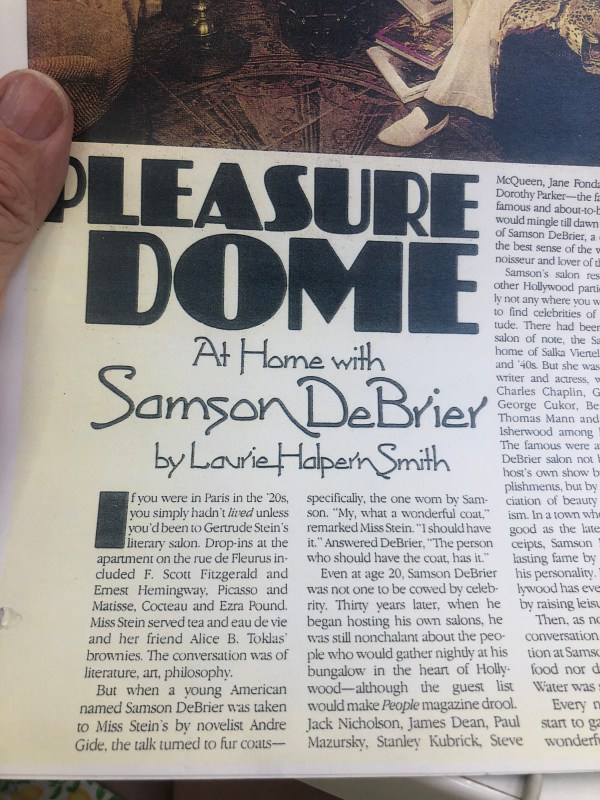
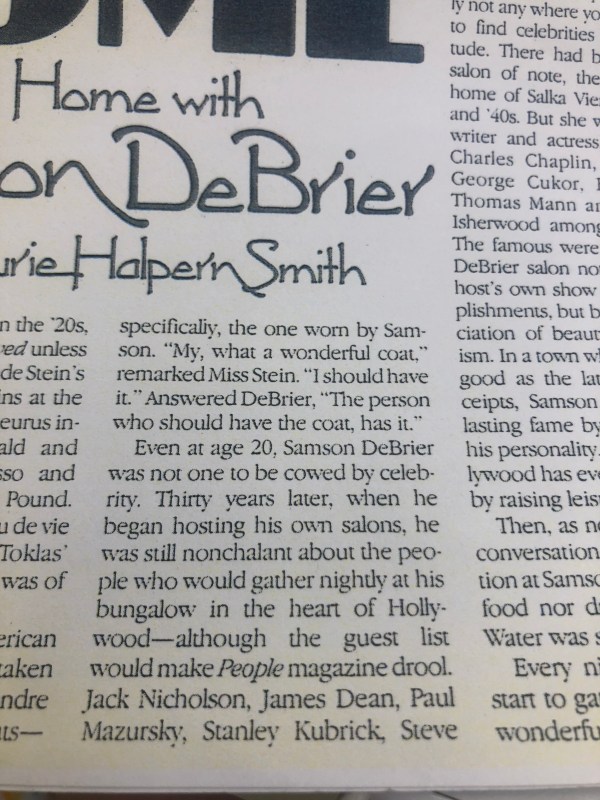
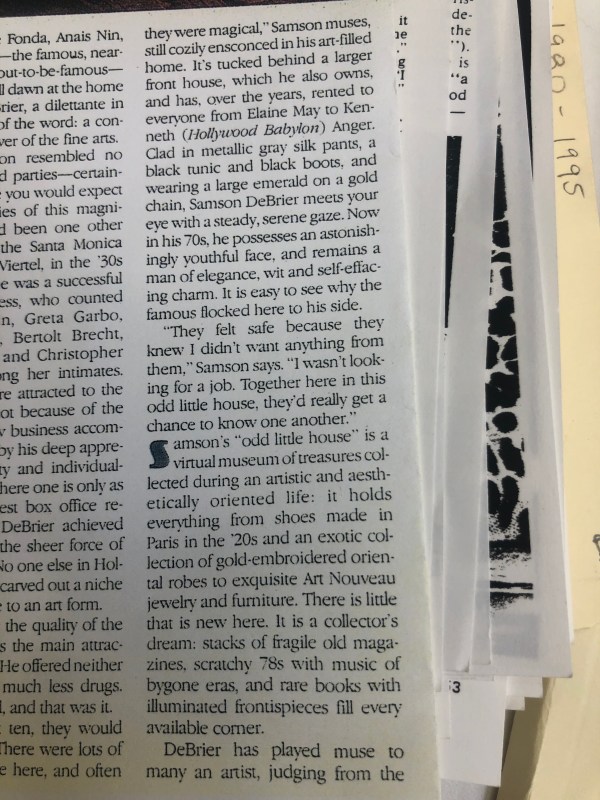
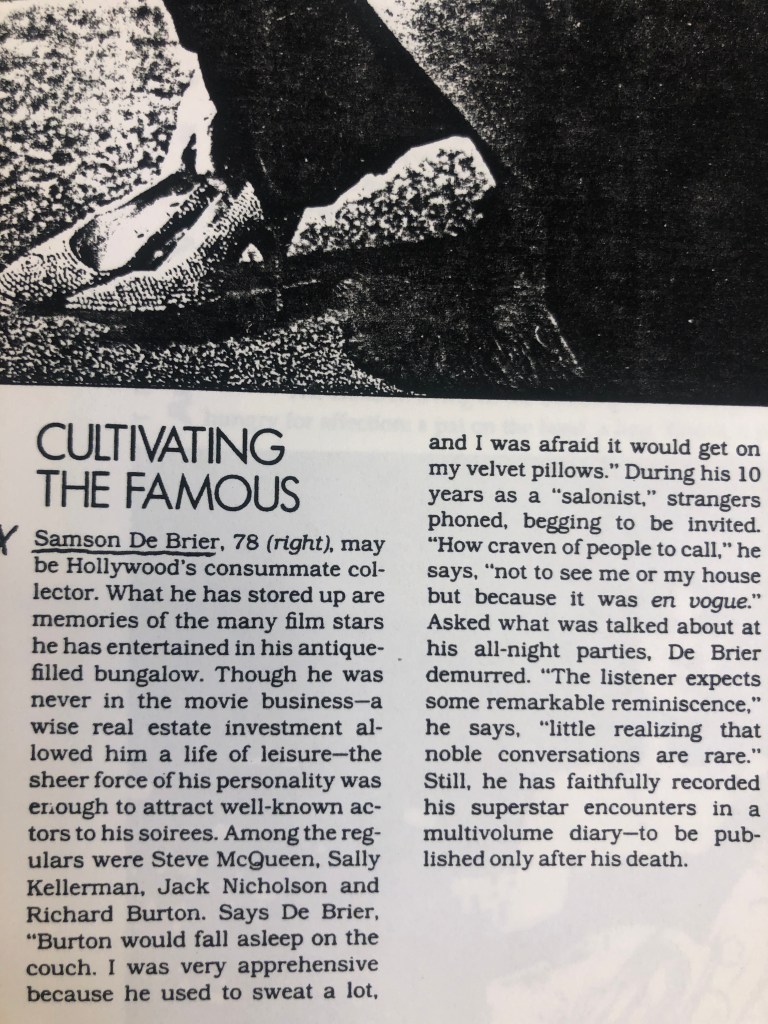
The next several images are from a magazine interview found in the De Brier ONE archives.
De Brier died in 1995.
Attendees at the De Brier salons were Jack Nicholson, James Dean, directors Paul Mazursky and Stanley Kubrick. Kubrick was not a fan of LA. Jane Fonda, Anais Nin. Nin acted in Inauguration of the Pleasure Dome.
In one box I found two legal size envelopes stuffed with around 200 scraps of paper and torn envelopes.
The paper scraps had names, numbers and personal notes recorded on them. They often included descriptions of people as if intended to help Samson remember them at a future date.
Article from a special “movie issue” that goes with photo of Samson and Molly Barnes.
In the early 1980s, the Ferus Gallery days must have seemed like a long time in the past.
I wrote down the names or took photos.
Throughout this chapter, I will review some of the names and what I learned about them through research.
A perfect example: Kimberly Hyde.
“Young woman long blonde hair met at Finley Gallerys.”
Hyde was an actress who appeared in small and bit parts in a handful 1970s “sexploitation,” horror and action films: Simon, King of the Witches in 1971 as a “religious object”(set decoration). The Young Nurses 1974,The Cheerleaders, Candy Stripe Nurses, 1973.
Credited as Annie-Annie Martin in a classic of New Hollywood Cinema:The Last Picture Show, 1971.
Movie credits according to imdb.
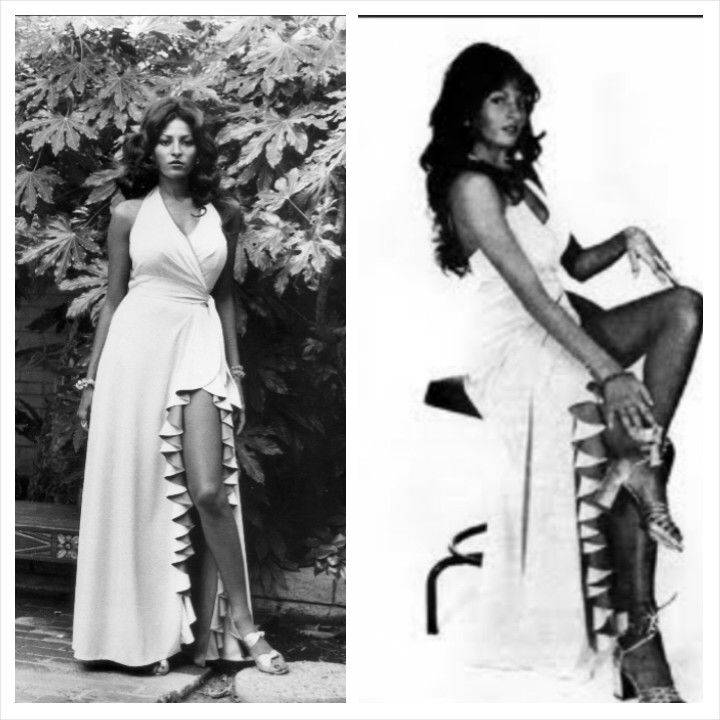
Hyde plays Jennifer in a famous movie of the 1970sBlaxploitation genre: FoxyBrown, 1974.
The queen of the genre, PamGrier in the title role, of course.
I could not find a usable photo for Kimberly Hyde.
Pam Grier in Foxy Brown.Casey Shelton Pinterest.
Gingere Blakely
partner to Joan Corbin-I can’t find any more about Blakely other than that fact.
Corbin has her own archive at ONE on the USC campus.
Joan Corbin was born on May 25, 1921, in Armada, Michigan. She grew up in Richmand, Michigan, and moved to Los Angeles, California, in January 1946. She soon moved in with Irma “Corky” Wolf, pseudonym Ann Carll Reid, and both joined ONE Incorporated as founding board members in 1953. Using the pseudonym Eve Elloree, Joan Corbin planned, designed, and illustrated ONE Magazine as an editorial staff member, 1953-1954, and art director, 1954-1963. Joan Corbin continued to draw and write poetry when in August 2000 she was diagnosed with breast cancer. She died in 2004.
Biography from ONE National Gay & Lesbian Archives, USC Libraries.
Luana Anders. Actress with many supporting roles in movies and TV 1950s-1980s. Good friends with Jack Nicholson and Dennis Hopper, she acted in several of their films. Night Tide, Easy Rider, The Last Detail, Goin’ South, The Two Jakes.
Anders guested in many classic TV shows like Mannix, Bonanza, Ironside,Mayberry RFD, Adam 12, 3 episodes of Dragnet.
A practicing Buddhist for many years, Anders died of breast cancer in 1996 at age 58. It was one year after her friend Samson’s death.
Image of Luana Anders from Dementia 13,1963. A Roger Corman film production with Francis Coppola directing his first film.
A biography of Luana Anders is sorely needed as she is the ultimate cult actress.
LAT obituary July 27, 1996. The Times saying Anders died at age 54. Wikipedia and Find-a-Grave say 58.
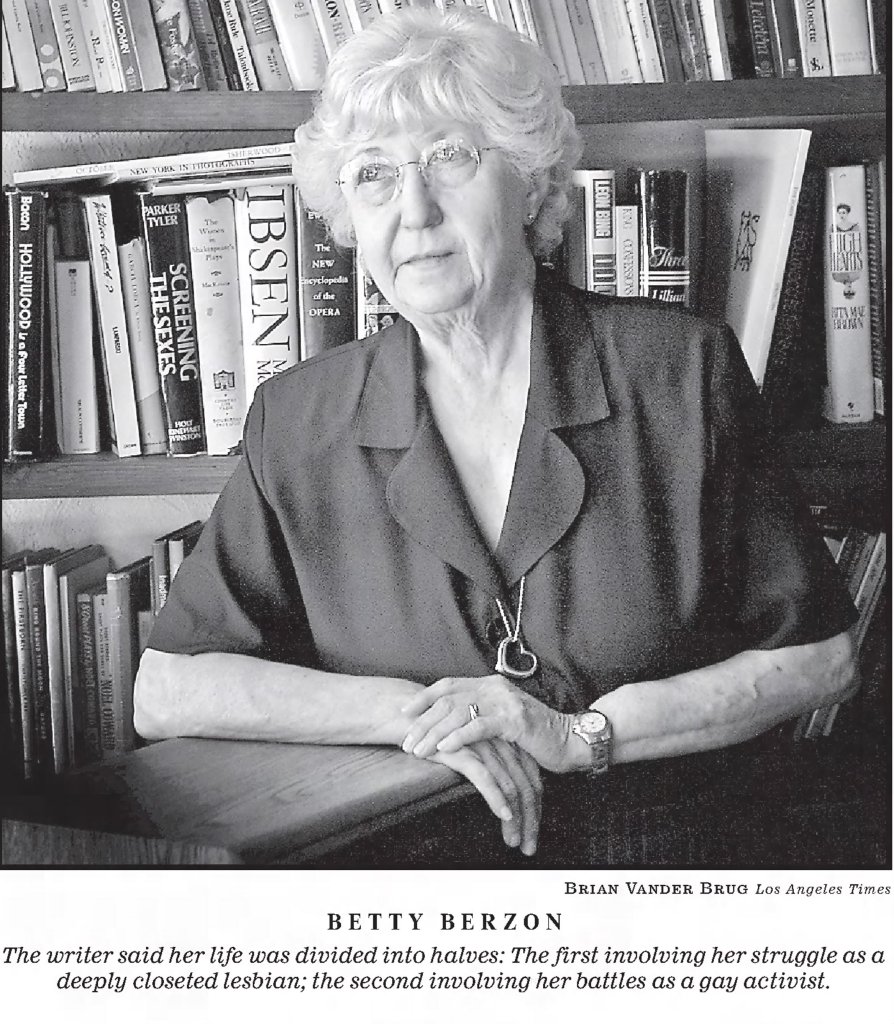
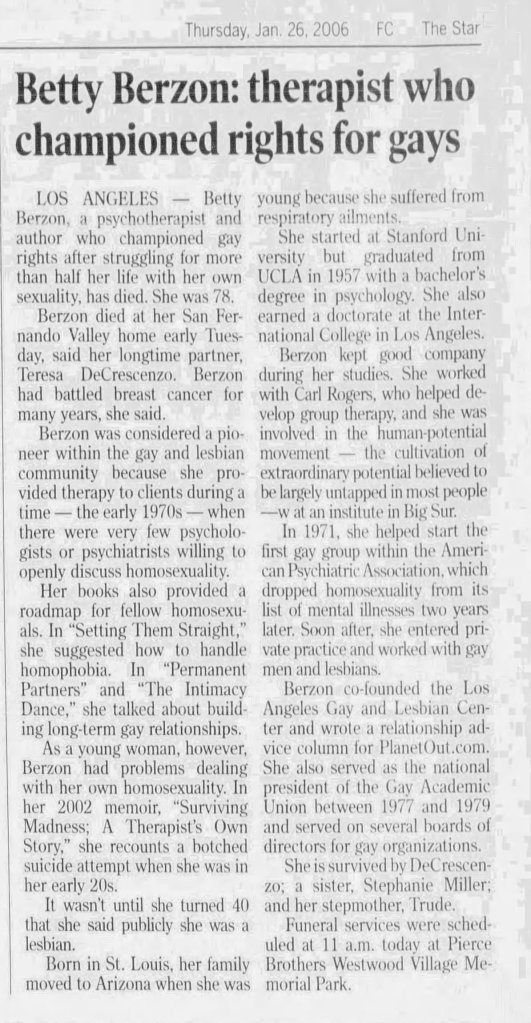
Betty Berzon 8560 Hollywood Blvd.
Another forgotten pioneer of LGBTQ history
LAT obit. Jan. 25, 2006
Ventura County Star
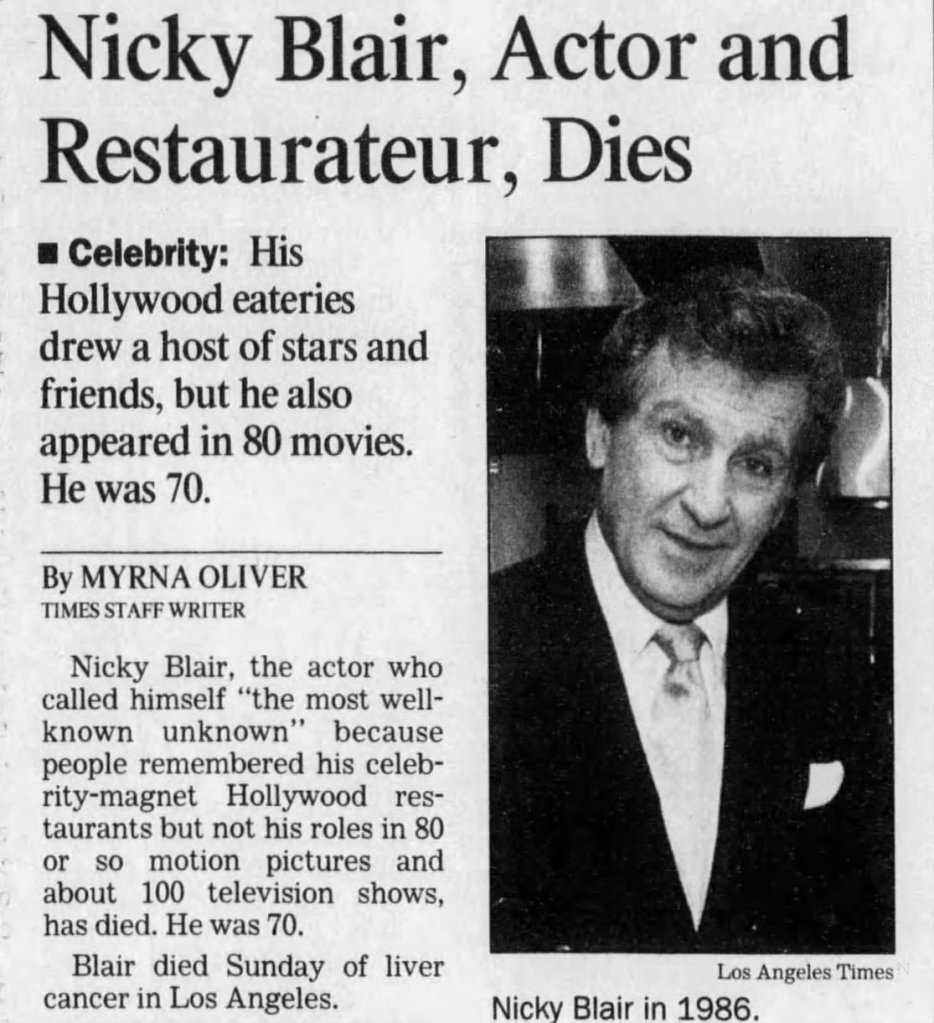
Nicky Blair
An actor who made a career of bit parts and small roles in famous movies and TV shows with legendary actors from 1949 to 1998.
LAT Nov. 24, 1998
A fraction of his diverse appearances:
Voiced the character Hammerhead in 4 episodes of a mid-1990s version of Spider-man.
Appeared in Truck Stop Women, starring tragic Playmate of the Year 1970,Claudia Jennings.
(Read about Jennings in the Start Here chapter.)
Shaft, Breakfast at Tiffany’s, A Bronx Tale, Beaches.
In 1977: Old Wino in Record City with Rick Dees of Disco Duck fame, to a Cab Driver in Scorsese’sNew York, New York with DeNiro and Minnelli;
His TV work consisted of classic and cult mid-century shows: Combat!, The Felony Squad, McHale’s Navy, The Munsters, The Man From U.N.C.L.E., Batman, Mannix, Gomer Pyle, Wild, Wild West, Medical Center, Magnum P.I., Hardcastle and McCormick.
Beverly Hills 90210 in 1998, the same year he died. His first credit was a “boy” in a 1949 juvenile delinquent themed movie City Across the River.
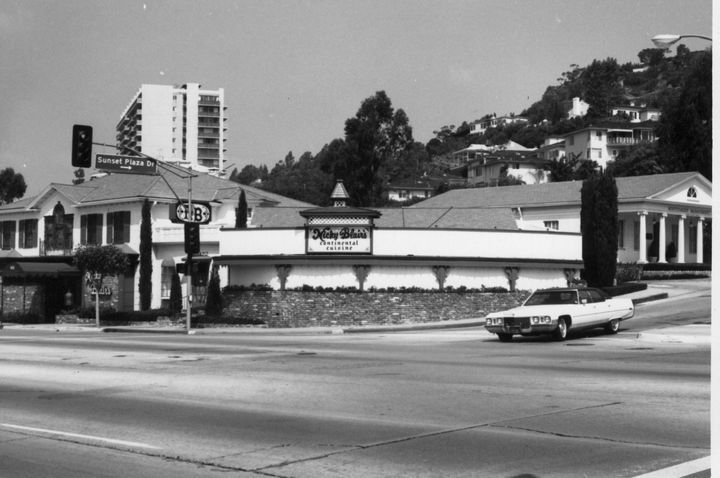
He became locally famous as a successful restaurateur on the Strip from 1986 to 1993. Blair’s first restaurant opened in 1971 in LA, but burned down in 1976 according to SFGate.
Born Nicholas Macario in Brooklyn, the bit-part actor played Shorty Farnsworth, Elvis Presley’s sidekick in the 1964 “Viva Las Vegas,” and was an usher with one line in Frank Sinatra’s “Ocean’s Eleven.” Blair’s Las Vegas restaurant had several autographed photos on the walls, including one from Sinatra signed, “To the star from his favorite bit player.”
Among Blair’s other film credits over 40 years were “Rogue Attack,” “Operation Petticoat,” “Hell to Eternity,” “The Manchurian Candidate” and “Diamonds Are Forever.” He began playing parts close to home–maitre d’s and casino hosts–in later years including in “Beaches” and “The Godfather, Part III.” He also played a fight promoter in “Rocky V.
LAT Nicky Blair obituary Nov. 24, 1998.
hollywoodphotographs.com Nicky Blair’s restaurant
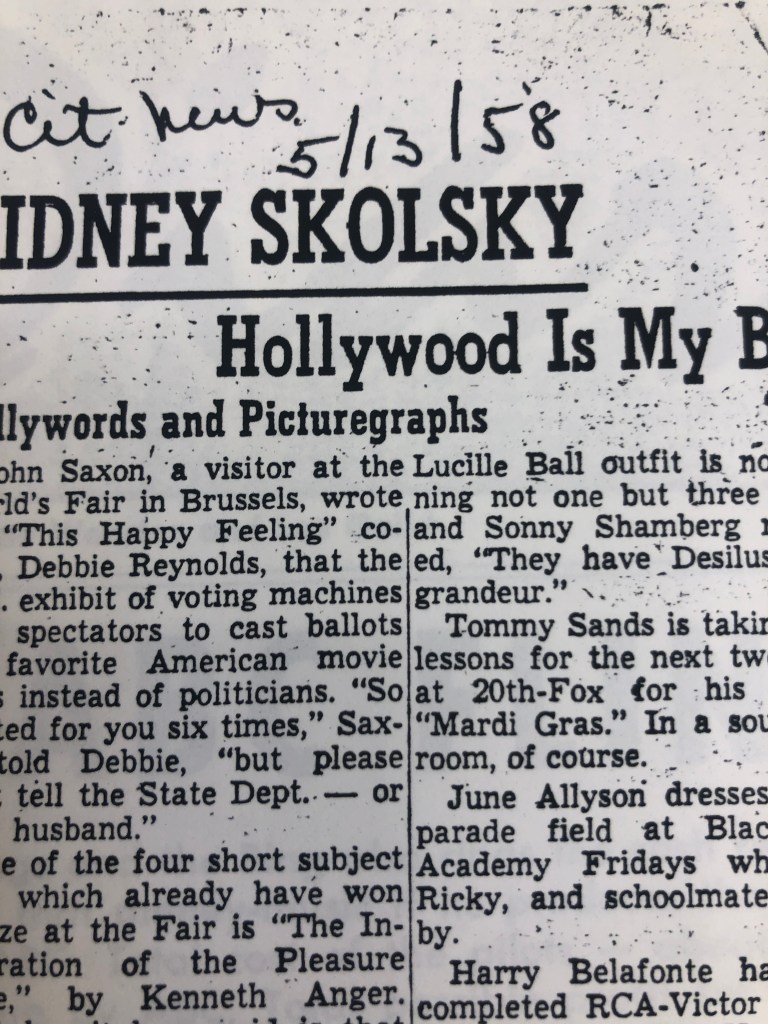
More from LAT Obit. Hollywood “tea” describing the heyday of Nicky Blair’s.
Columnist Sidney Skolsky was also a friend of Marilyn Monroe.
Richard Burton.
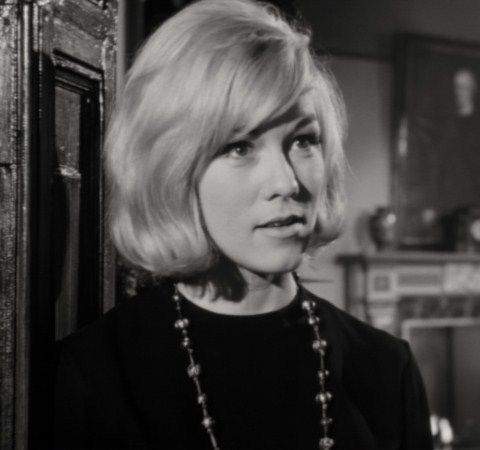
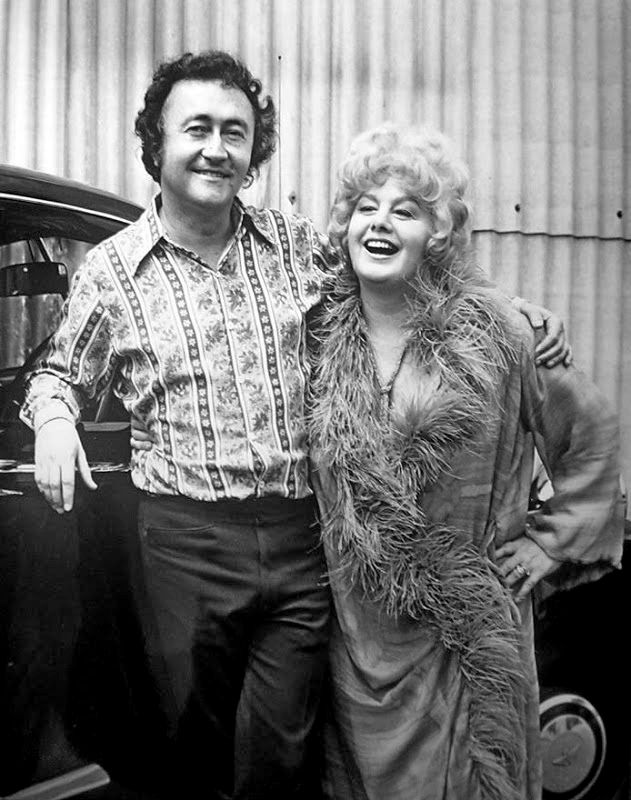
Director Curtis Harrington with actress Shelley Winters during the filming of Whoever Slew Auntie Roo?
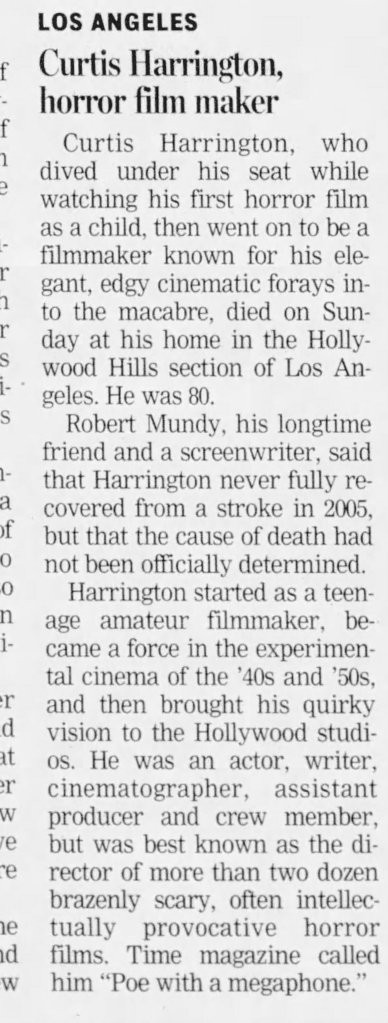
I viewed several Christmas cards to Samson from Curtis Harrington. Harrington was a director from the 1950s through the 1970s. He is most known for his cult film Night Tide, 1961, featuring a young Dennis Hopper, occultist-artist Cameron and Luana Anders. Harrington directed 1970s cult horror films: What’s the Matter with Helen?How Awful AboutAllan, 1970, The Killing Kind, 1973 with Luana Anders. Whoever slew AuntieRoo?1972 with Shelley Winters seen above. Lots of episodic TV: Charlie’s Angels,Wonder Woman, Hotel, Vega$, Dynasty, The Colbys. Harrington’s last credit was for acting in a short horror film: Usher, 2000. He died in LA in2007. From what I’ve read on the internet, Harrington never got the chance to fully realize his vision as a director. This is why Night Tide is considered his most realized work. I am interested in looking at the TV episodes he directed. There is no dedicated biography of Harrington. He wrote a memoir with a marvelous title: Nice Guys Don’t Work InHollywood. I plan to read it soon!
Stuart Florida News May 11, 2007
I discovered several Christmas cards signed by Roberta Haynes. Haynes lived near Samson for a time, I read in one of the archived articles.
At one time, both RichardBurton and Marlon Brando competed for Roberta’s attention.
Valley Times July 25, 1953. Return to Paradise was the breakthrough role for Encino resident Roberta Haynes. 1953 was also the year of Marilyn Monroe’s Movieland breakthrough. Considered a high compliment to be cast as the love interest of Gary Cooper, Haynes career is forgotten.
I purchased 2 Playboy interviews, 1972 and 2003, with star Jack Nicholson. Cost is about $2 on Amazon.
The next quotes are from the 1972 issue. Not from the archives.
Jack Nicholson:…actually Dennis (Hopper) and I originally became actors because we like parties and people and girls and art and acceptance and all the things that are really very momentary and immediate.
Playboy: Can you recall any particular festivities that the two of you attended together?
Jack Nicholson: We used to go to a lot of the salons held by Samson DeVreer (sic) a male witch. He’s one of the great L.A. puries, no question about that.
Playboy: Puries?
Jack Nicholson:By puries, I mean people who are very expressive of LA culture–the overstuffed California hamburger, the 48, 000 ice-cream flavors, the Hollywood electric whiz-bang kids.
Anway, DeVreer had a running house for crazos over there, all the local eccentrics like Vampira and occasionally James Dean. People would be reading tarot cards at those gatherings –long before it was fashionable. Just big walking around parties. Every once in a while, Samson would turn of the lights and read from his memoirs. I didn’t know many people who had been Andre Gide’s lover, so it was very exotic to me.
END
Playboy interviewer heard Nicholson saying “DeVreer.” He is not the only journalist to hear Samson’s last name that way.
Too bad Playboy didn’t ask more about the De Brier salons and both the hip and obscure characters who attended.
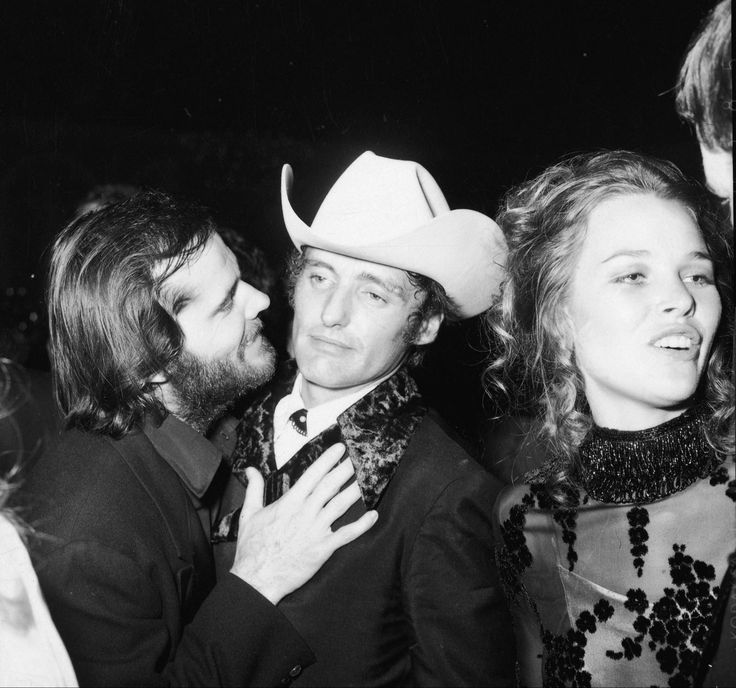
Credit Getty Photo. Jack, Dennis and Michelle. Paige hosted a tea-party where Michelle was a guest, as seen by Darlene Valentine. (She thinks 1974)
Jack Nicholson,Dennis Hopper and Michelle Phillips at an Oscar after-party about 1970. Dennis and Michelle famously had an 8-day marriage before before getting it annulled.
Was Paige Young acquainted with Dennis and Jack? I think so.
We know Paige was acquainted with Michelle Phillips.
How well Paige knew these 3 major Hollywood players is not known.
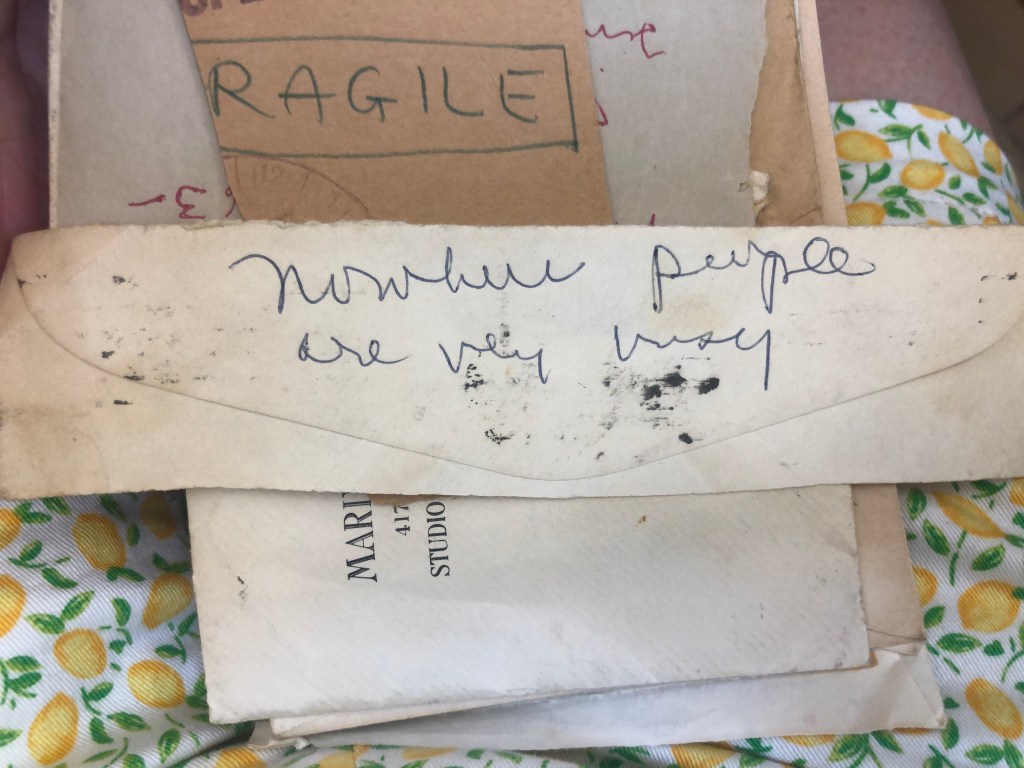
“nowhere people are very busy.”
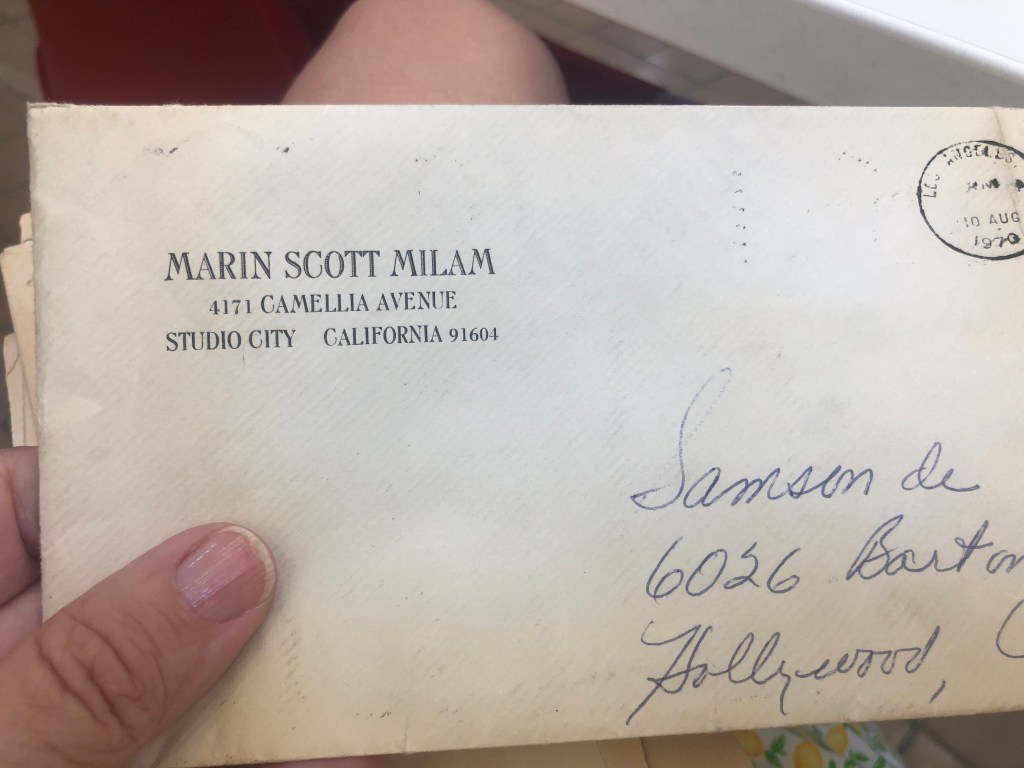
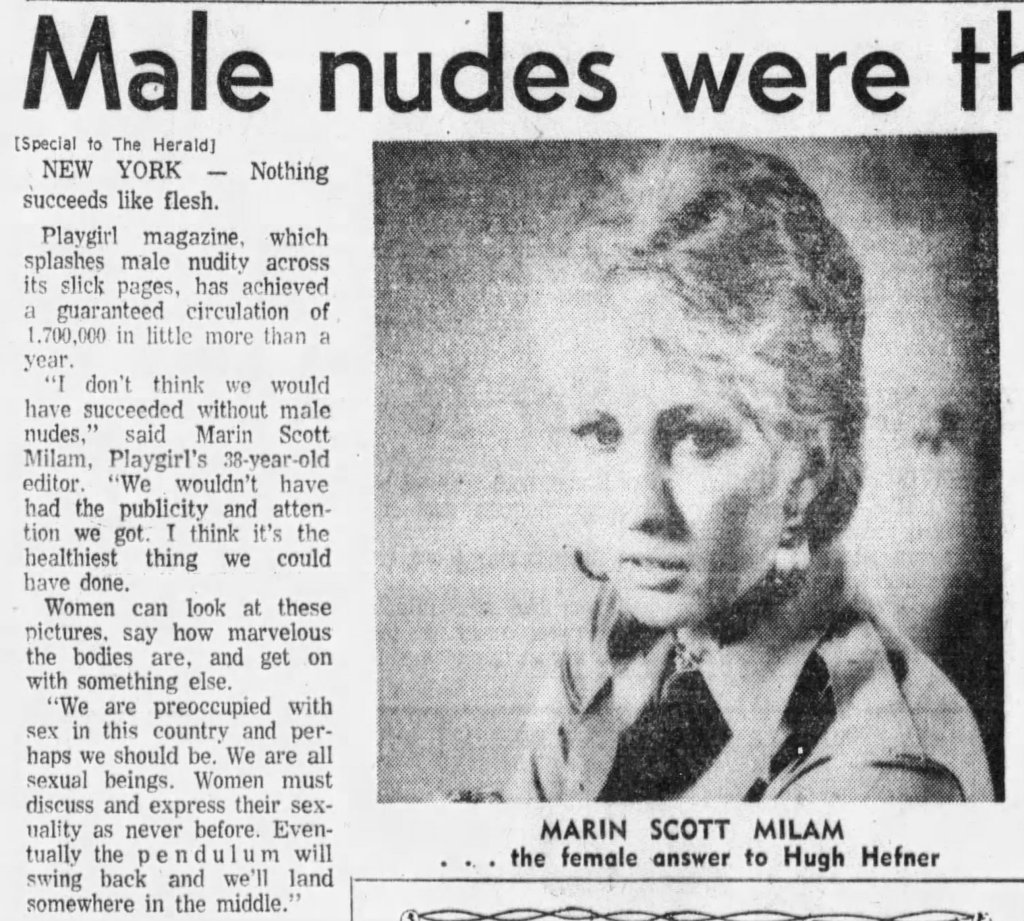
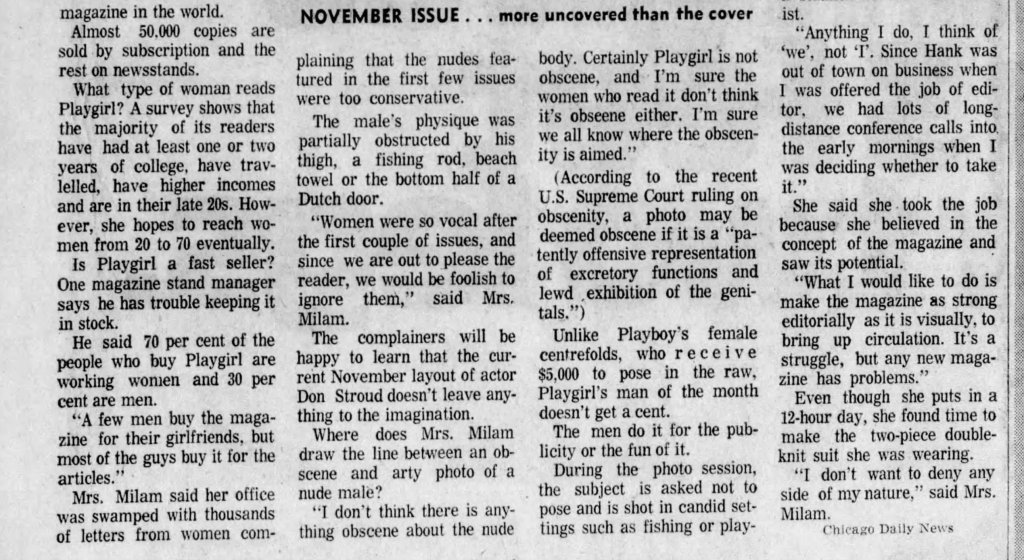
I don’t recall hearing or reading the name Marin Scott Milam– But I certainly remember media reports, sightings at newsstands and convenience stores, of the notorious magazine she launched: Playgirl
Calgary Herald Sept. 27, 1974 Males Nudes Were the Key, reads the headline. Marin’s letter to Samson seen above, is postmarked 1970. There was not a letter in the envelope.
Part 2 of article above, Marin Scott Milam.
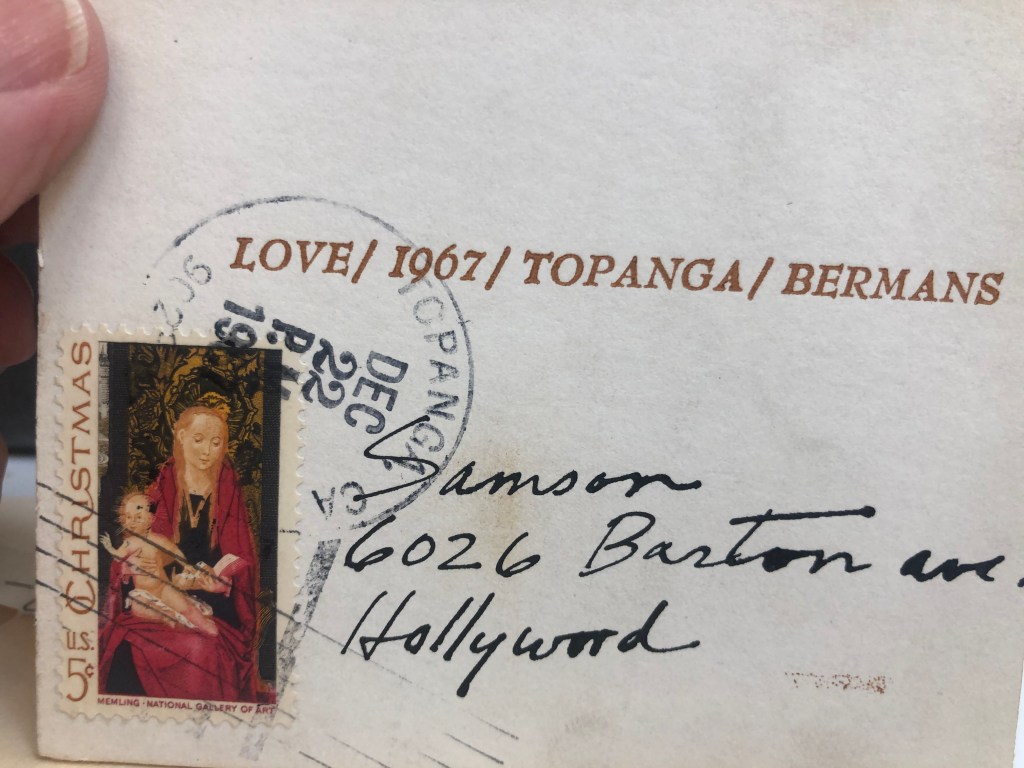
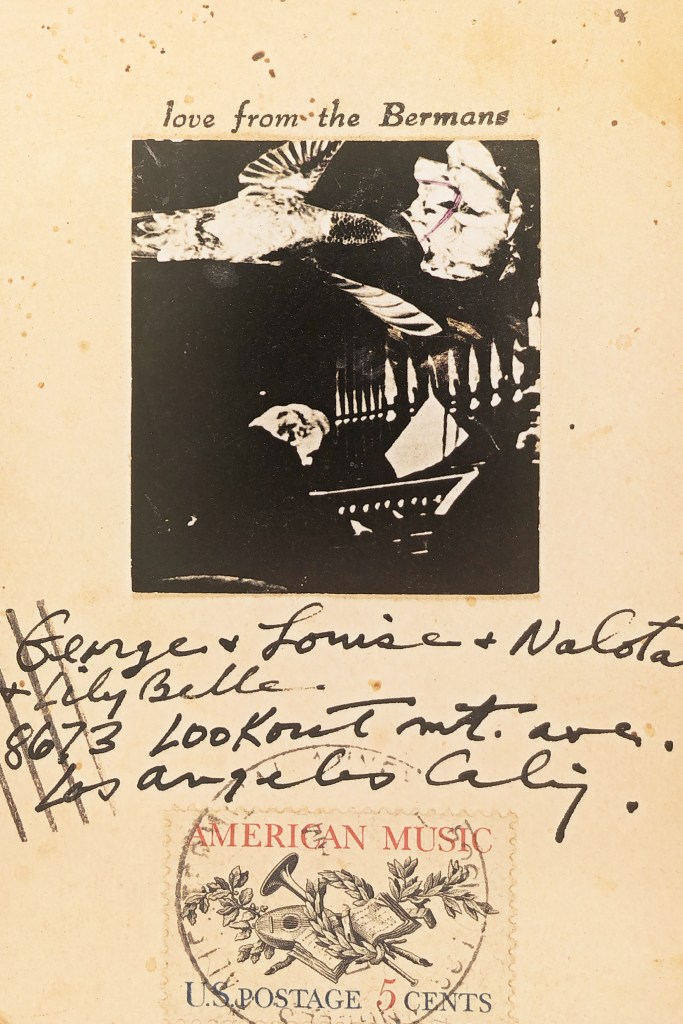
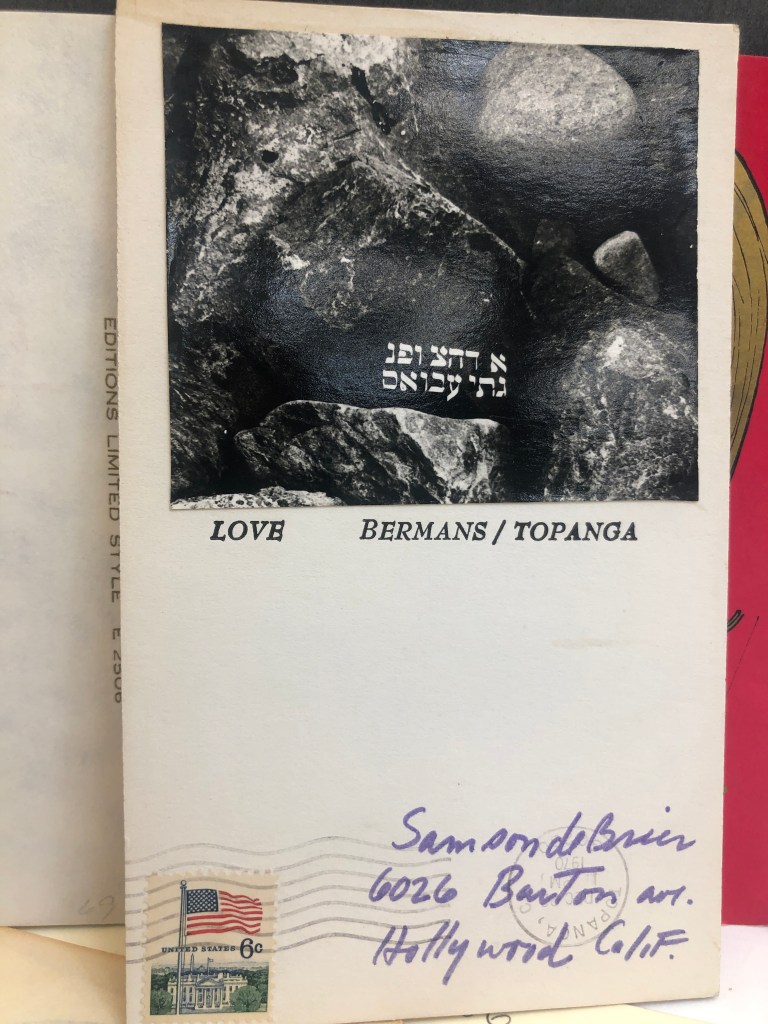
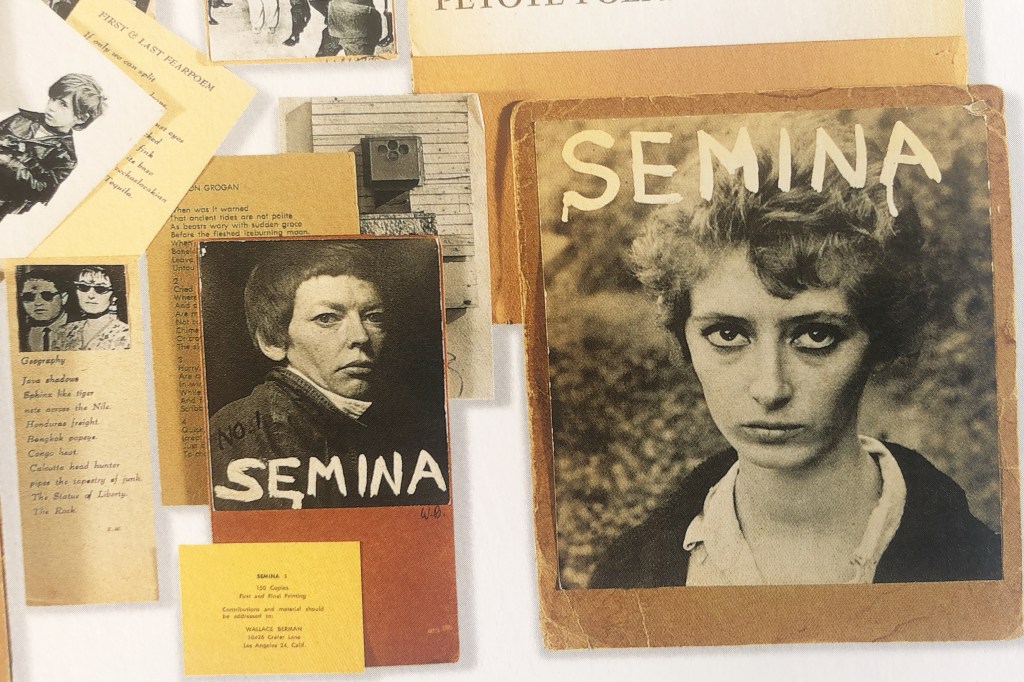
Innovative LA artist Wallace Berman made these thick cardboard Christmas “postcards.” He sent them out every year to friends/ fellow artists. This is one for Samson.
From the Samson archives. Year on the postmark lookslike 1964.
These Christmas postcards are now seen in museum collections like the Getty, LACMA and my Art History book collection.
About the Artist
Wallace Berman was an American artist – a self-taught modernist, hipster, and poet-mystic, who worked at a time of extraordinary socio-political and cultural change. Born shortly before the Great Depression, he came of age in the aftermath of World War II, when the horrors of global warfare, the Holocaust, and atomic bombings lingered vividly in people’s hearts and minds. Far from the traditional centers of art and culture, Berman matured as an artist in Los Angeles, on the creative frontier of the American West. His was a reality bifurcated by the clash of an old world and a new, in which lifestyles born of war and deprivation coexisted with unparalleled prosperity, economic growth, and technological innovation. In the 1950s and ’60s, Berman witnessed the rise of the enthusiastic consumerism and militarized bureaucracies of Cold War America, soon to be challenged by the countercultural revolutions of the civil rights, antiwar, and women’s rights movements. He died before the global information age had fully formed, his prolific career cut short by a drunk driveron the eve of his fiftieth birthday in 1976. In the half-century of his all too-short life, America – and, indeed, the world – transformed dramatically, rushing to the brink of a new technological era that few could have envisioned or anticipated.
Michael Kohn Gallery website
This image scanned from my book PacificStandard Time: Los Angeles Art 1965–1980. Named for the city-wide Art exhibit of the same name.
Wallace or “Wally” Berman postcard sent to photographer friend Edmund Teske in 1967
From Made in California” Art, Image and Identity, 1900-2000. Exhibit at LACMA.
Another Berman Christmas postcard from the Samson archives.
Copies of Wallace Berman’s Semina magazines are highly prized now: (Marjorie) Cameron: on the left looking masculine. She was a key player in this underground artistic world. Wally Berman’s wife Shirley, on the right. Samson, Cameron, Shirley and Kenneth Anger were all friends.
I have read that while Berman was very fond of Cameron, he did not care for Anger; maybe even actively disliked him.
Date on back of the above postcard.
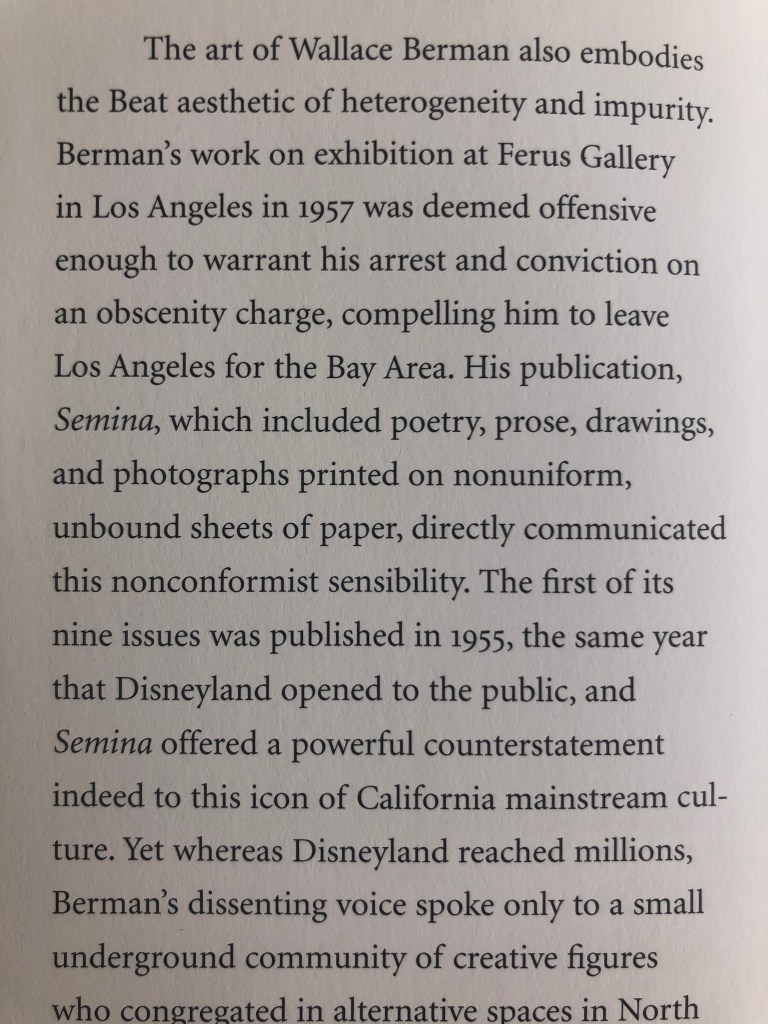
Excerpt and image from Made in California: Art, Image and Identity 1900-2000
Image of Wallace Berman being arrested at Ferus Gallery in 1957.
Berman had placed a small drawing by Cameron, explicitly erotic/pornographic, on his installation piece in Ferus.
An anonymous “complaint” about the drawing was registered with the police. The gallery was raided and Berman was arrested.
I did read that some folks have a theory that Ferus gallery owner Irving Blum called the police to make the complaint, for purposes of publicity!
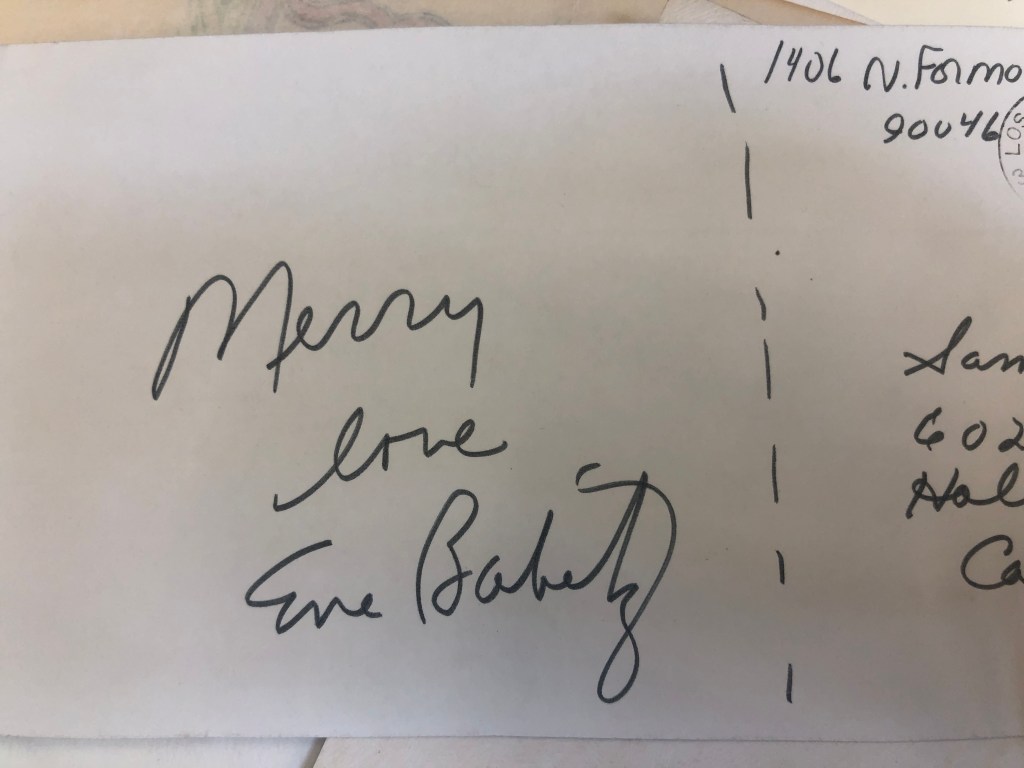
The sender of this Christmas card is…..
Darlene Valentine remembers seeing Eve Babitz out on the LA scene. While she did not have a story or comment about Eve, she did have a smile.
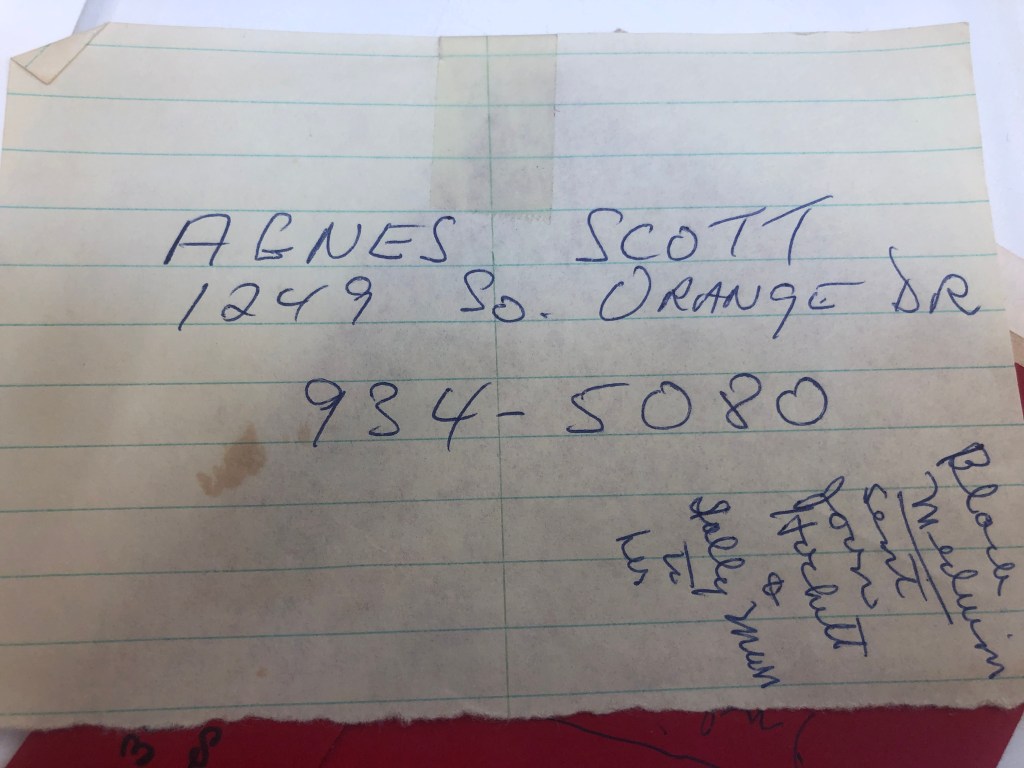
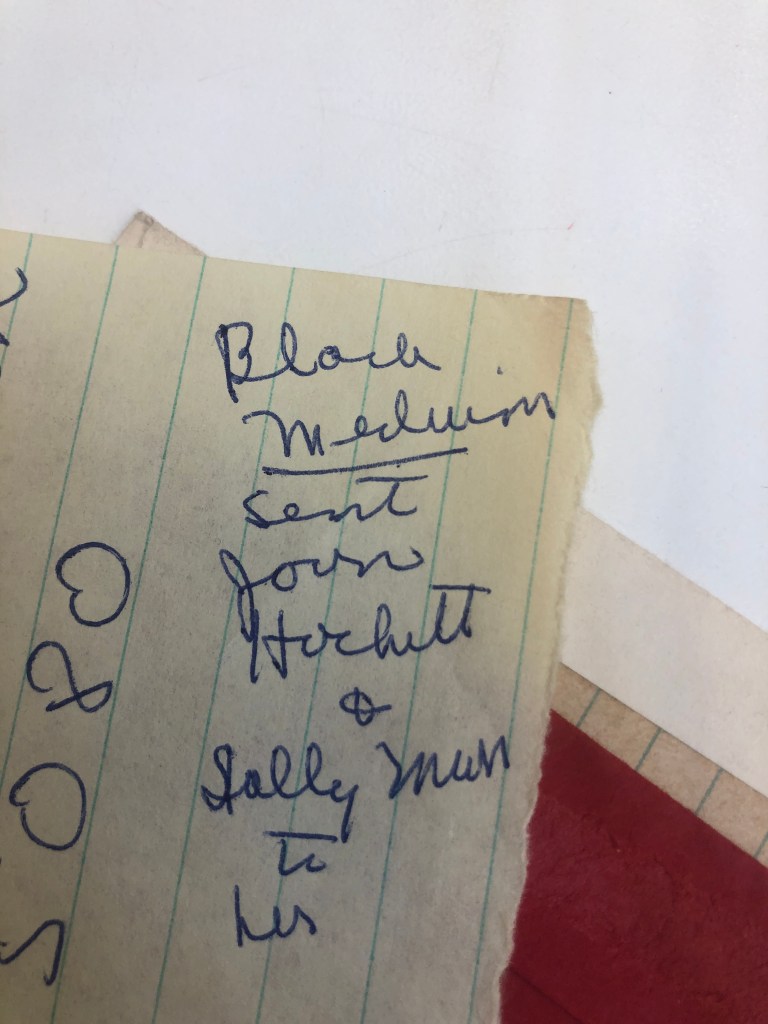
“He’s got a woman who’s going to be 50 in 5 years.” Samson wrote down bits of conversation he heard at social gatherings. This one said by a David Stark. I am unable to find which David Stark, as there are at least a few in the industry of Hollywood, according to imdb. Agnes Scott Black Medium (hair) sent Joan Hackett (actress) and Sally Man(n) (not the photographer) to her.
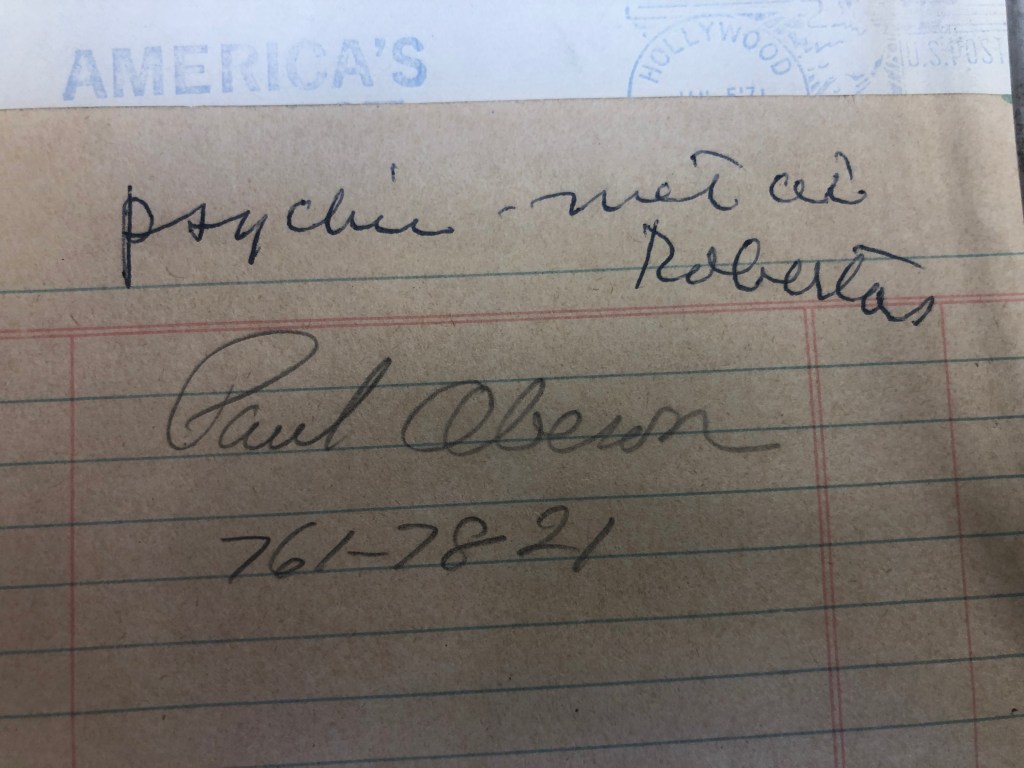
“Psychic-met at Robertas.” This would be Samson’s friend, actress Roberta Haynes.
“Knew Warren Beatty and wants to meet Natalie Wood.”
Paula Shaw
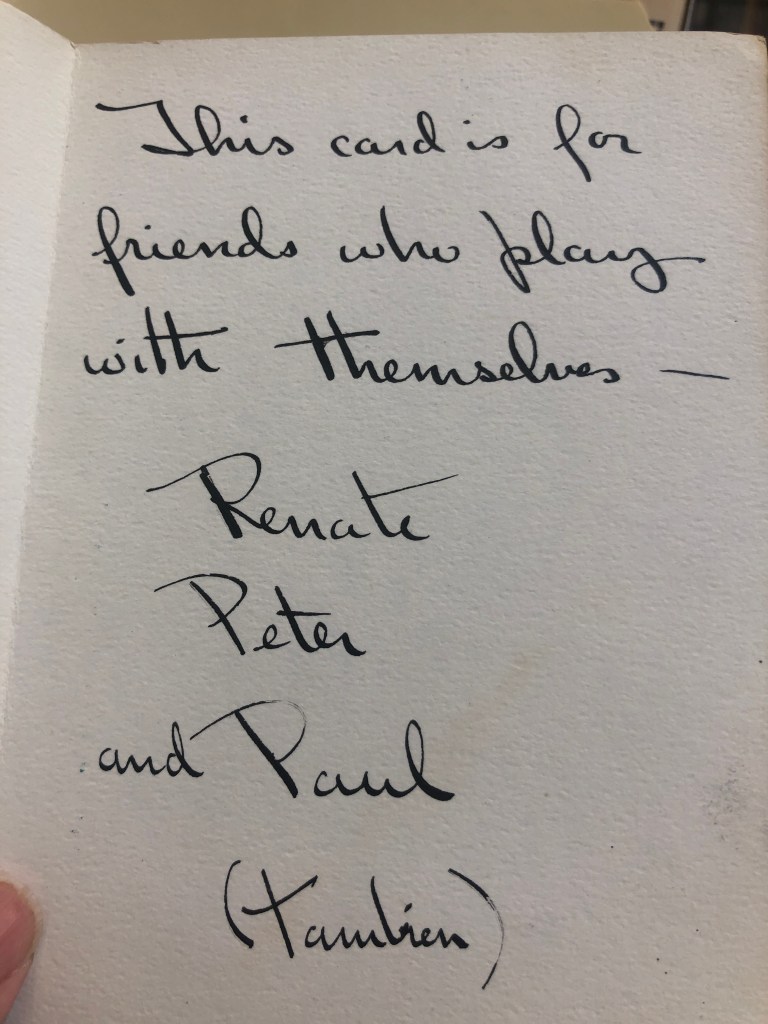
Christmas card from Renate Druks. Druks was a cult actress, experimental filmmaker, surrealist painter and salon mistress.
In Malibu, Druks became famous for hosting outlandish costume parties. One such masquerade ball, called “Come as Your Madness,” became the inspiration for Anger’s short 1954 film “Inauguration of the Pleasure Dome,” in which Druks would appear. In 1957, she debuted her first major solo show at the Lane Galleries in Westwood, California, which opened to critical accolades.
Over the decades, Druks’s home became a nexus where artists, writers, and actors gathered.
Katie White artnetMay 5, 2020
More about Druks in Samson #2
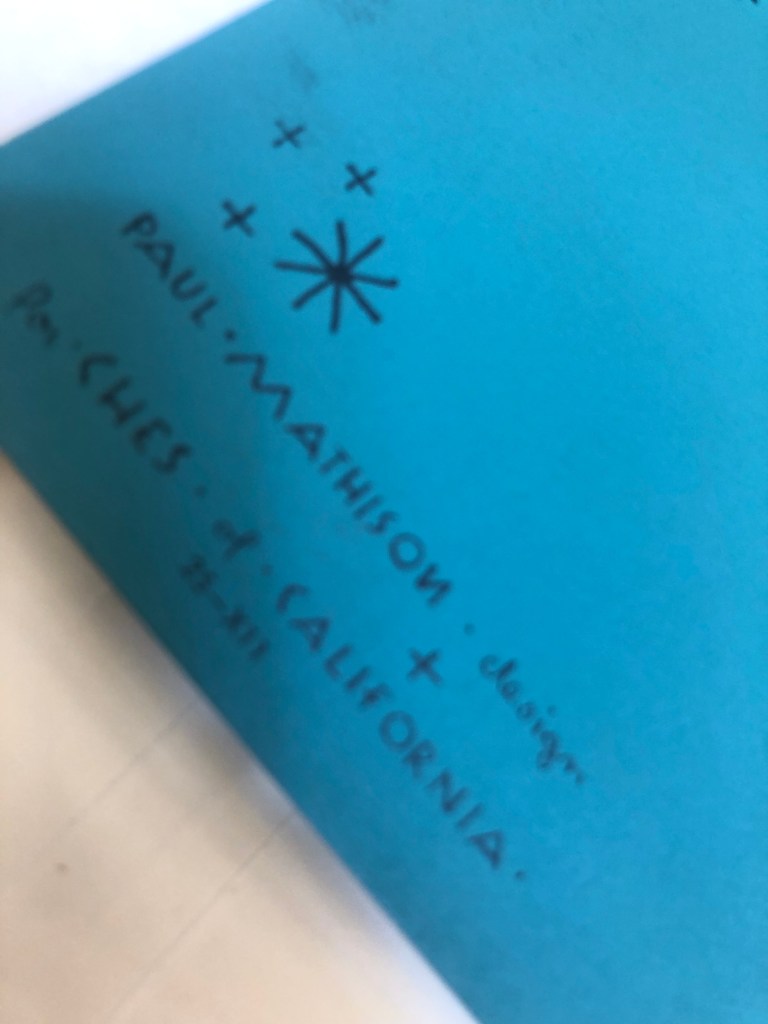
I learned recently that this person, Paul Mathison was romantically involved with Renate. He is the “Paul,” signed in Druks Christmas card above.
On IMDb, Mathison has 4 credits.
Art department, Inauguration of the Pleasure Dome, 1953, and The Wormword Star1954. (A film about Cameron.)
Production Director on Night Tide,1961, cited previously.
Art Director on Third of aMan, 1962.
If you’ve seen Inauguration of the Pleasure Dome, (available on youtube) Mathison is the very blonde, white, menacing looking Pan. Really memorable.
2nd only to the presence of Cameron with her flaming red hair, blood red lips and 1 inch long eyelashes and fingernails.
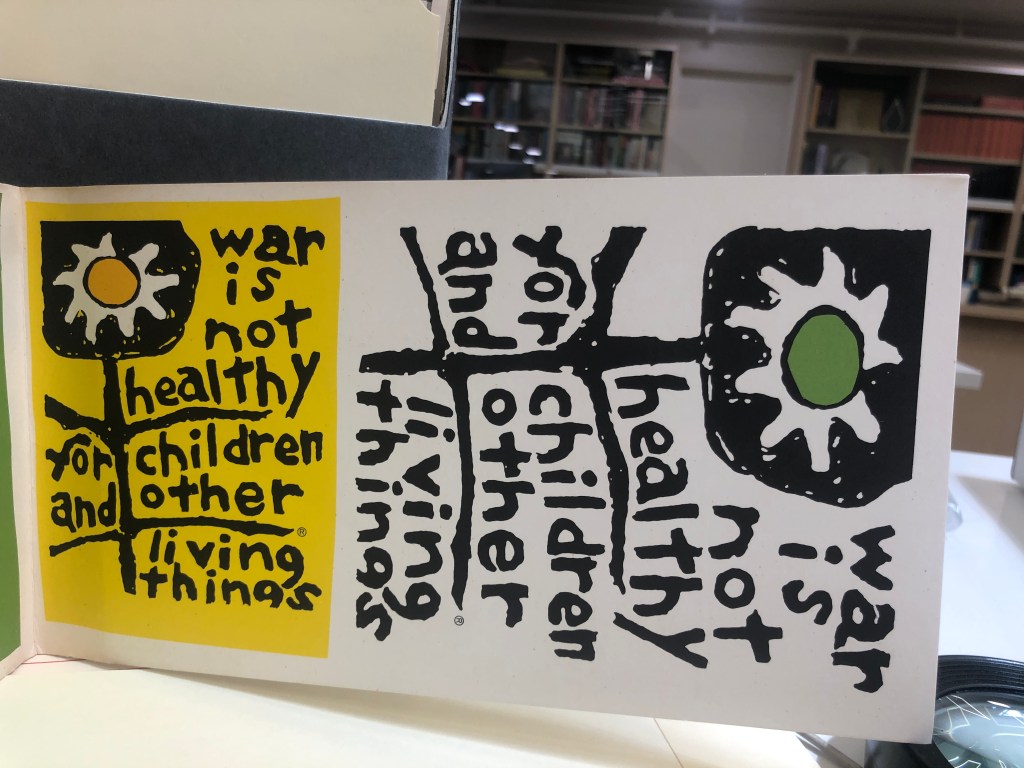
Christmas card from a box of dozens. I remember this image as a popular poster early 1970s (or earlier.) from actress Elizabeth Ashley.
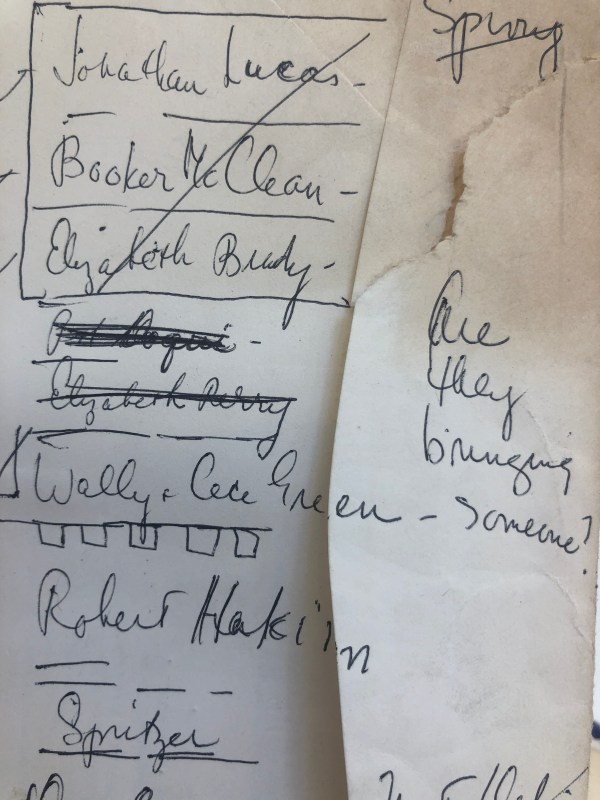
Notice: “Wally & CeCe Green-Are they bringing someone?”
See chapters on Celeste Shane Green Huston and John Huston. Yet another person that Paige Young and Cici Huston had in common. Bob Gardner, Desmond Guinness, John Huston, Samson, Sepulveda Stables, Douglas Campbell.
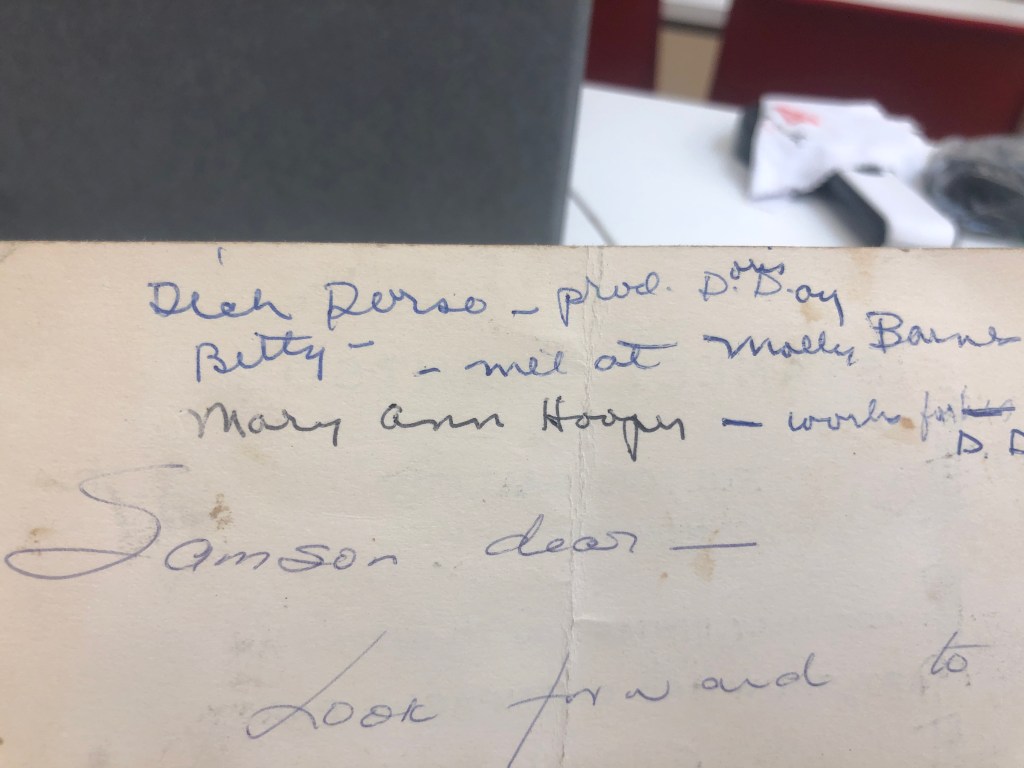
Dick Derso-Prod. Doris Day. Betty-met At Molly Barnes (Gallery) Mary Ann Hooper-works for DD. Typical of notes Samson jotted down to remember people he met.
Buck Henry on list, 4th name down.
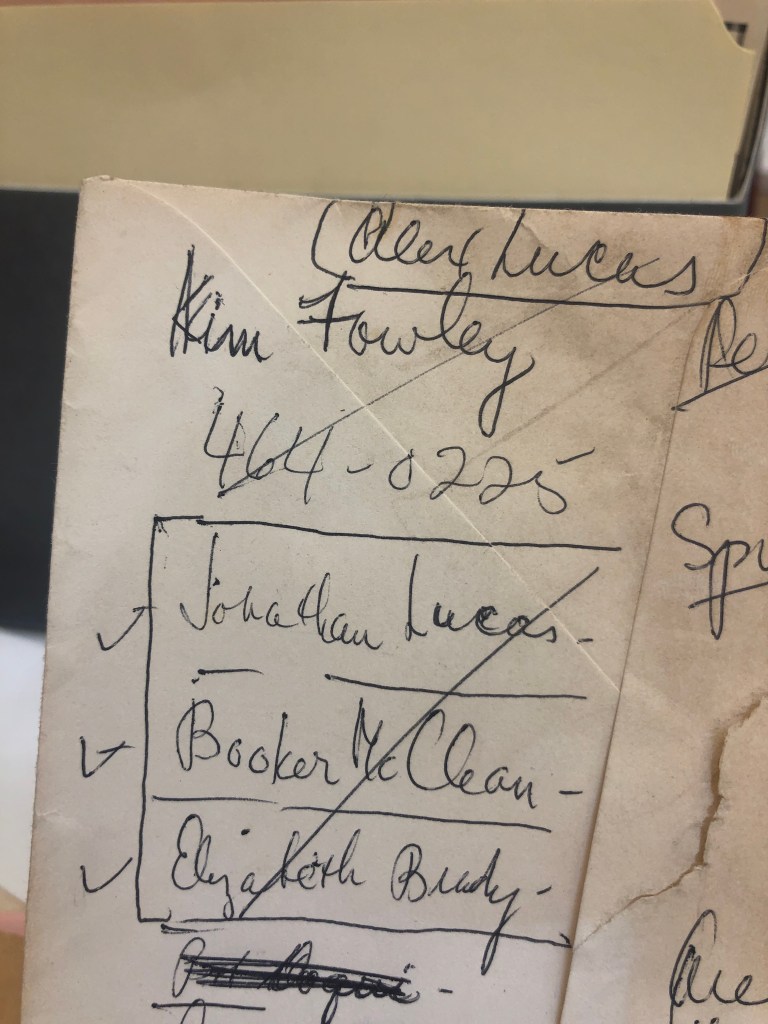
Another list written on the back of a torn envelope. >>>>
It looks like it is a party going to happen.
Vicki Dougan is one name seen lower down the list .
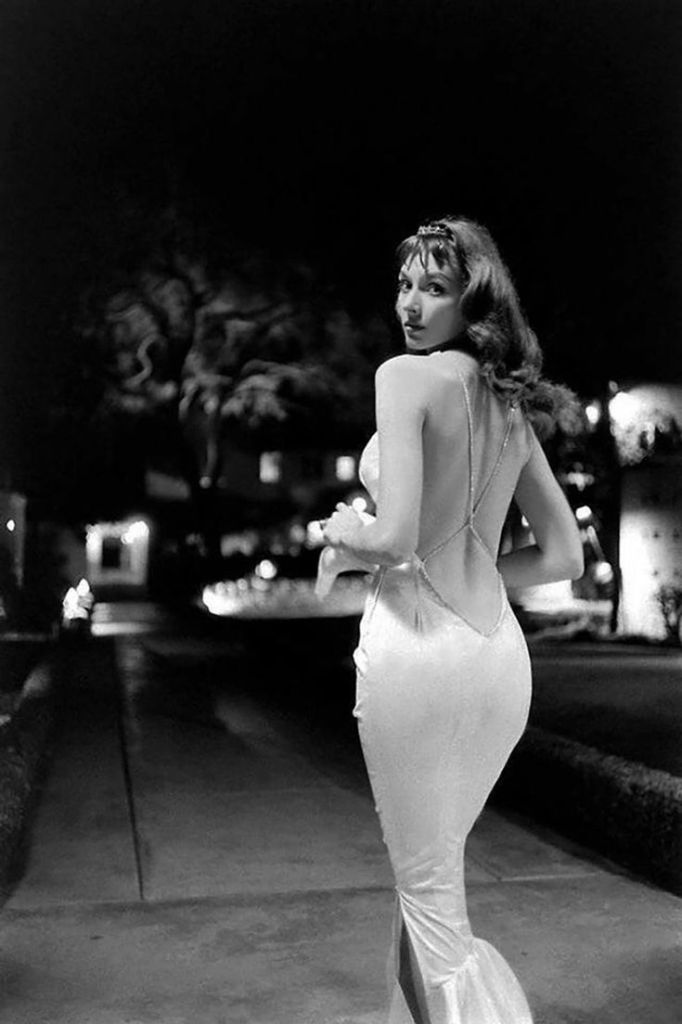
From The Mind Circle Pinterest. Vicki Dougan.
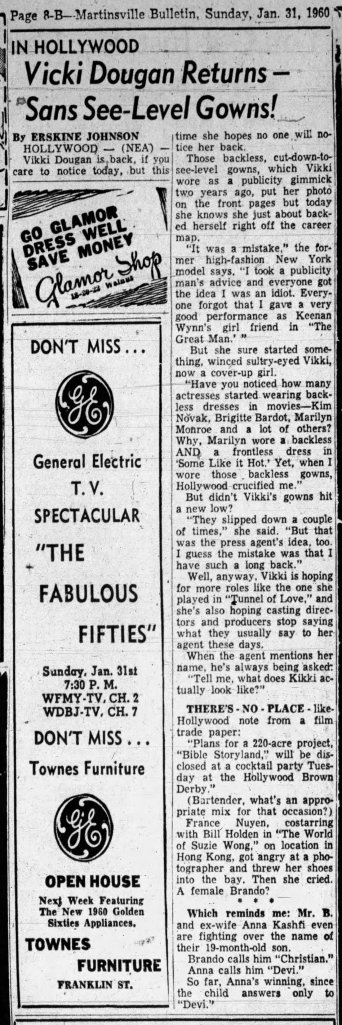
Already a veteran pinup model by 1957, Vicki Dougan was photographed walking around town wearing backless dresses. This was done as a publicity stunt.
Dougan’s backless gowns and day dresses were an intentional nod to the 1950s craze of the frontside busty bombshells : Marilyn, Jayne, Mamie, Diana, Sabrina et al…
Virginia newspaper. Syndicated Hollywood gossip columnist Erskine Johnson.
Please read Samson PART 2.
Alex Lucas. Kim Fowley was an eclectic record producer, arranger and manager. Most famous for managing The Runaways, with Joan Jett. Rumor has it, Fowley was not a good person. From my research, he was a well-known “scenester” Other names are Jonathan Lucas, Booker McClean, Elizabeth Budy (?)
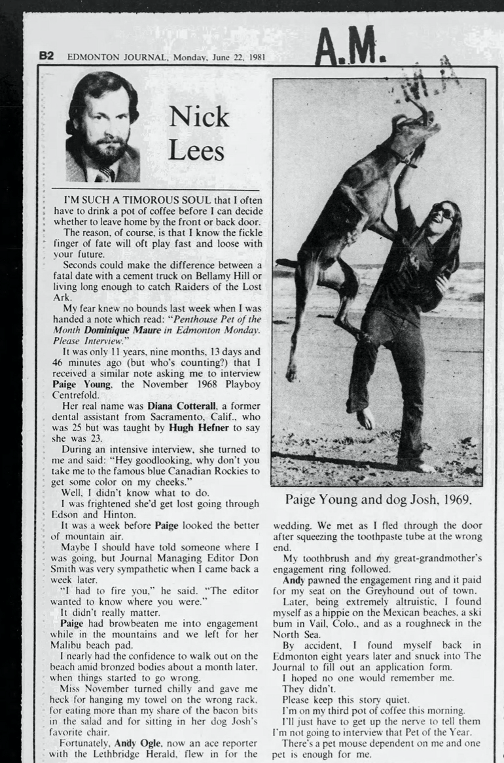
Nick Lees, a writer for the Edmonton Journal, wrote the following article in 1981.
Nick Lees returned to his job at the Edmonton Journal 7 years after he was fired for leaving on his unscheduled vacation with Paige Young.
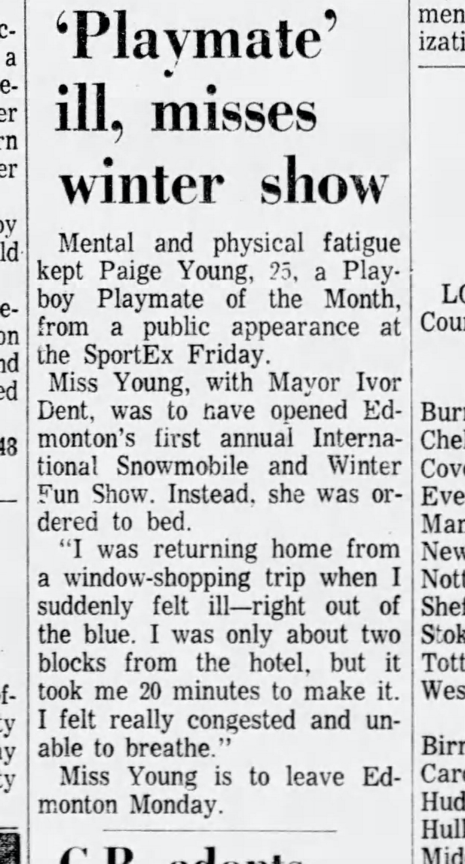
Is Nick the reason Paige missed her contracted appearance at the winter sports show? Did she make up this “sudden illness” excuse?
Sept. 1969 Edmonton Journal
The part in Lees’ article about Paige Young being from Sacramento and a dental assistant, I don’t buy it. There is too much proof that she was born and lived in Los Angeles her entire life. Plus, I don’t see her going through the rigors of dental school and the “9-5 doldrums.”
Paige may have told this fib to Lees or he remembers incorrectly.
Lees had a long career at the Edmonton newspaper as a popular columnist.
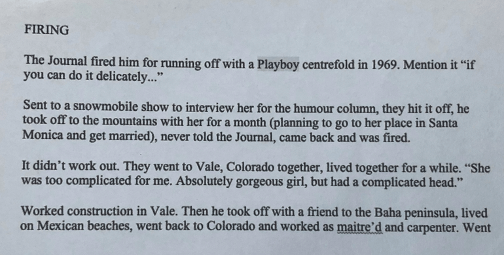
The text at right is from an article about Lees, written by journalist Michael Hingston. The article appeared in CanadianAvenue magazine sometime in the early 2000s.
I thank Edmonton writer Michael Hingston for sending me this portion of his notes, not included in his published story about Lees.
Lees’ opinion of Paige seems to have softened over the years. He sounds more resentful in 1981.
Lees specifies the Colorado Rockies as the mountains he and Paige escaped to (Vale above, it’s actually spelled Vail) rather than the Canadian Rockies as he says in 1981.
Nick doesn’t indicate any knowledge of Paige’s suicide in 1974, either in his 1981 column or his more recent interview withMichael Hingston.
I have been unable to get in touch with Nick Lees.
He was in the hospital a few years ago per a facebook post.
UPDATE: Nick Lees passed away on June 24, 2024 after a battle with cancer and dementia, per his obituary in the Edmonton Journal.
The following is an excerpt from the obit, published on June 28:
In 1968, (1969) Nick interviewed a Playboy bunny, but it turned out she had the question of the day — asking Nick if he would take her to see the Rocky Mountains.
Date night. Nick followed her to Banff and then motored with her to Malibu to get engaged. Not surprising, it didn’t work out.
Upon returning to Edmonton Nick was fired but went back to work for The Journal.
His antics in The Journal, far too many to mention, are legendary.
Paige Young by Peter Gowland.
Below is an entry from the website of the late Bob Sanders. He wrote about his lengthy and diverse career.
He has some fascinating stories about Hugh Hefner and working for Playboy as well as TV Guide. He was hired to help promote Hefner’s new TV Show “Playboy After Dark” which led him to meet Paige Young in the late 1960s. Sanders was a “regular American working man with a family.”
7/10/2009
Paige Young….by Bob Sanders
I never learned her real name, but Paige Young, Playboy magazine’s “Miss November” of 1968, was absolutely perfect for a rather challenging assignment: Creating interest in a mediocre TV series.
“Playboy After Dark,” was a follow-up to “Playboy’s Penthouse” which also starred Hugh Hefner, pipe in hand. In both the original and the reincarnation, an elevator whisked viewers to a penthouse where host Hefner, his free arm wrapped around his then current squeeze as we called them, feigned surprise at another drop-in, finally announcing who was in the house to perform. It was pretty awkward stuff.
I met Paige late in January, 1969. That was three months after her appearance in the magazine; an illness had prevented what would have been a timely trip to Chicago. Page was in town to collect $10,000 then awarded Playmates who now receive $25,000 with $100,000 going to the Playmate of the Year. They got to stay a week or so at the Playboy Mansion, attend parties, make personal appearances and meet Hefner, a cultural summit for most. One of my contributions to the process was to interview each of them to determine if they could be of promotional help. Among a year’s monthly winners, you could count on two being particularly good or outstanding. Paige was one of the latter and who could forget either her center-fold or the woman in person? Peter Gowland did the photography in Los Angeles posing a prone Paige, back scratcher in hand. The flashing brown eyes did no harm to the overall effect.
It was a few months before I met Paige that Hefner’s reclusive lifestyle began undergoing a change. The not-so-poor-man’s Howard Hughes had come out of his shell swearing off the uppers and downers that enabled him to stay awake editing his magazine three days at a time. Not only had Hefner hit the streets to observe police outrage during the 1968 Democratic National Convention but he would soon return to the TV trough with “Playboy After Dark” scheduled for Screen Gems release.
Owned by Columbia Pictures, the first major studio to learn to live with the new medium through the creation of a subsidiary, Screen Gems not surprisingly realized the series was a tough sell. They backed off midway through production refusing to promote the show for an additional good reason. Screen Gems had a huge backlog of product including a boatload of Perry Masons–271 to be exact. Up to that point, my involvement was little more than choosing pictures from contact sheets provided by a Hollywood photographer. I soon learned Hefner had little use for black and white photography, perhaps because Playmates’ skin tones looked much more ravishing in color. It was as though black and white was O.K. for Citizen Kane and little more in Hefner’s opinion. I began to bootleg photography; pictures I used to promote the firm’s Lake Geneva resort via newspapers were actually shot by a Chicago Tribune snapper assigned to a narrowly focused feature about the hotel. I paid him $100 after his gig to shoot what I needed: pictures that went beyond architectural renderings ordered by my predecessor. I was never questioned by my management about the photos I used because it was assumed the pics were transferred from color to black and white. Had I gone that route, the shots would have lost about 20% of their sharpness.
Corporate expenses will always be a subject of much conjecture. During what turned out to be 40 years spending other people’s money, I was questioned but once. That was while working for TV Guide in St. Louis, my first gig for the magazine. The year was 1955, eight months after we opened; the office manager, a hopeful sort, had determined we should send parents of newborn children copies of the magazine. Names and addresses of the parents were gleaned from pages of local newspapers and the copy, set in five point agate type, required a magnifying glass to determine accuracy. It was regional manager Arthur Shulman who asked me what the hell was I doing spending $1.99 of TV Guide’s money in such strange fashion?
Playboy was far and away the least concerned of my employers about spending money. Hefner made it clear that he wanted things done in the best possible manner. It was terrific working for a firm striving for promotion efforts done, as Hefner suggested,” first class.” I never took advantage of the situation there or anywhere else.
That early contact sheet assignment for “Playboy After Dark” involved work by an independent photographer, a rather strange determination considering the number of excellent snappers on the payroll. Admittedly, they were rather specialized.
It was while looking at pictures of the fifth show that I found the best shots–maybe ever–of Hefner. All of them found him next to one of the show’s chickie poos. Soon my hunch was verified. Barbie Benton, then a theater major at UCLA–had become a regular on the show eventually attaining status as Hef’s significant love of eight years. I ordered a dozen of one picture of the adoring couple I had cropped from a group shot.
On a trip to Los Angeles, promotion director Nelson Futch and I learned at a meeting called by Screen Gems that its management had determined a preference for releasing “Perry Mason” starring Raymond Burr, then successful in keeping quiet his homosexuality, over the ultimately virile Hefner. It was regarded as a savage blow and Futch, unperturbed, turned the project over to me immediately following the meeting. That was when I thought of Paige Young.
A couple of months passed during which I worked my ass off concentrating on the show. One day Futch and I got a hurry up call to meet with Hefner at The Mansion. Oh, yes. Bring the promotion work. After waiting four hours during which Futch put the Benton/Hefner photo on top the pile of my creativity, we finally entered his office. Our meeting followed one between Hef and his editor-in-chief A.C. Spectorsky–the man who, among many things, coined the word “exurbanites.” Moments later, Hefner spotted the photo, held it up to the light and did a series of gyrations reminiscent of Charlie Chaplin’s examination of the world in The Great Dictator.
“Where did you get this?” he asked–a pretty dumb question under the circumstances unless a UCLA photo-journalist had grabbed a shot of the Bunny King attired in a silly Edwardian suit while visiting one of Barbie’s acting classes.
“The fifth show,” I replied.
“Can I have one?” he asked in very boyish fashion as if I were the editor of the high school yearbook and he, infatuated by a photo of his best girl.
“Would you like six? I can get you at least five more.” That was it. He never looked at any of the rest of my promotional efforts. Apparently, he had decided the Hef/Barbie choice was sufficient. The picture became paramount in the print promotion of the show.
The series played in something like 21 markets with the stations located north and south from Minneapolis to Miami and east to west from New York to Los Angeles. Among them were two Lafayettes–Indiana and Louisiana–plus other locations across the fruited plain and Canada where the program was seen in Montreal. The series had but one show worth viewing; it starred Sammy Davis, Jr., Anthony Newley, Jerry Lewis and Peter Lawford, the latter of unique adroitness: dressing up a set.
Hefner’s published comments on the series and his host role give pause: “It’s better than the ‘Johnny Carson Show’ or the ‘Joey Bishop Show’ and I do a better job hosting than Ed Sullivan does.”
KTLA, the then Gene Autry-owned independent channel , bought the series and we scheduled a party for what was then called the Playboy Building at 8560 Sunset Boulevard. Built in the early 1960s, it had a parking lot to the west set beneath 10 stories of reinforced concrete. It is now part of the Sunset Millennium Project–three buildings totaling approximately 300,000 square feet of office space.
Back then, my attention was captivated by a huge windowless area of the building’s west façade. Recalling all the “Playboy After Dark” color photos taken on the set, I wondered if we could project pictures on the wall in a rotating series of six or so with enticing copy to promote the show. I found a Swedish company with equipment about the size of a small TV set which we secured at the entrance to the parking lot.
My idea had unusual origins. Years before, comedian Red Skelton had a neighbor in Palm Springs he didn’t like or so the story went. The guy, a moralistic type, had a white stucco home with a large wall visible to the street. In reaction to the neighbor’s latest outrage, Skelton began showing adult movies on the fellow’s home.
In the fall of 1969, eastbound Sunset Blvd. motorists were confronted by color photos of scantily clad young ladies in addition to 30-ft pipe-clutching Hefs and bug cute Barbies.
We had a minor “Playboy After Dark” promotion problem which never surfaced. Paige Young had not appeared in the series having turned down a request. Thoughtful and intelligent, she had other things to do, notably painting. Horses were a subject dear to her as I learned during time out on the north side of Phoenix where many Arabian thoroughbred farms used to exist.
Paige was a total delight. One time she flew to Minneapolis where I met her at the airport before we moved on to newspaper, magazine and broadcast interviews. After a couple of days, we flew to Miami for more of the same. Phoenix was particularly productive offering a good example of the Playboy mystique. Shortly after our arrival, I learned a local PR representative hired by us had not set up any interviews. I made five phone calls to the TV stations then located in the area and placed Paige on each channel for interviews–mostly on news programs. It may have been a very slow news day, but getting that kind of attention on such short notice with little going for us except the Playboy mystique was absolutely amazing; the series was about to be carried on one of those five stations. The trick was to set up the interviews along different lines emphasizing such things as the magazine and Paige’s appearance in it, her life and travels, and what Hugh Hefner was really like.
During my Playboy Enterprises days there was a story, probably apocryphal, told about Hefner by Victor Lownes who was, in my opinion, a promotional genius responsible for a lot of the magazine’s (and later the clubs’) success. Lownes had introduced a young woman to Hefner, referring to him as “a living legend.” The couple wandered off to a nearby bedroom where, scant minutes later, the woman emerged commenting to Lownes: “And you call that a living legend?” Hey, nobody bats 1.000.
It was no secret Lownes had been run out of Chicago after dallying with a teenage TV star. Adding to the speed of his departure was her being the daughter of a high profile newspaper columnist. Lownes settled in London where he established the London Playboy Club, then gained a gambling permit. It wasn’t long before he had created a lifestyle many thought at least the equivalent of Hefner’s; included was Stocks, an impressive manor house. While Benny Dunn was dressing up Hefner’ Chicago Gold Coast home with people from the entertainment world, Lownes was attracting a much broader spectrum of notables.
Things went nicely for Lownes. Treated as a company hero as Playboy Enterprises peaked during my years there, his short returns to Chicago were largely joyous occasions although Lownes could be a jerk. Circulation of the magazine hit 6,000,000, the hotels were showing promise, and the clubs were doing well thanks to Victor’s London gambling license. Suddenly, in 1981, England’s gaming commission yanked the permit. Some Arabs, among the club’s highest rollers, had been given markers by Lownes and the license was pulled. To this day, Lownes denies the charges. No question the timing was dreadful. Hefner was in the midst of what turned out to be an unsuccessful attempt to get a gambling permit for Atlantic City and the London catastrophe played a major role. An earlier New York City liquor license obtained under questionable circumstances was another.
The relationship between old friends Hefner and Lownes cooled. The latter eventually left the organization and wrote a tough but largely accurate book about his former pal and a public company having difficulty adjusting to a world enormously changed since Hefner planned the magazine in his kitchen nearly 30 years before. The magazine business was undergoing upheavals of its own. Penthouse, inspired by Hefner but tawdry by comparison, offered full frontal nudity and Playboy met the challenge. Marilyn Cole, who later married Lownes, was the first Playmate to be so photographed.
While my association with Paige Young remained purely professional, I’m sure a lot of people in the home office and air travelers thought otherwise. The airport scenes were rather wondrous. Paige wore big floppy hats in a great variety of singular colors. We arranged our airport meets so that scheduled arrivals in those halcyon days of dependability were very close. I could spot her hat from impressive distances and she could do the same with me although I never wore a floppy hat. The last half of our promotion tour found us running toward each other in airports and embracing in corny displays suggesting to many that we were something we weren’t.
So many memories remain including a rainy night in New Orleans during which we ran barefoot through the French Quarter (she was a physical fitness nut) and were later entertained by the Playboy Club’s musical director, Al Belletto, one of the few non-Dixie musicians in town. A Stan Kenton discovery, Belletto introduced us to such people as Al Hirt, Pete Fountain and Eddie Miller, the Fred Astaire of tenor saxophonists. When I met Miller, I made the observation and he said: “I think that’s the nicest thing anyone has ever said about me.”
West Bank Guide May 1969.
Paige and I lost track of each other and I attempted to find her on the internet some five years ago. I wish I hadn’t. She had committed suicide at age 30, six years after we stopped promoting Hefner’s TV show.
I can’t recall a single clue that might have suggested such a splendid blithe spirit was capable of such a decision. END
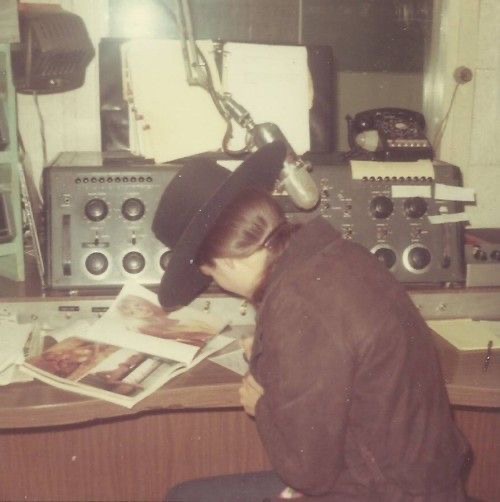
Paige Young is interviewed at a radio station in Arkansas by DJ Jonnie. His story of meeting her appears in the Daily Mail December of 2014. She is shown autographing her photo in the January 1969 Playboy issue. Jonnienever mentioned if chaperone Bob Sanders was along on this stop.
A woman contacted me by e-mail about 4 years ago and said she was the daughter of the late Bob Sanders.
She told me that when the Daily Mail article was published, she was relieved that her father was not alive to learn that Paige’s method of suicide was a gunshot to head, not an overdose of drugs. She said learning the true method of suicide would have greatly upset him.
Bob’s daughter also wrote that she thinks despite what her father wrote in his blog post, there many have been a fling of sorts between her father and Paige.
Because of the Nick Lees story, I don’t think Bob Sanders traveled with Paige to Edmonton, she was likely traveling on her own at this point.
If you read the chapter on 1969–there are several articles that mention Bob Sanders, not by name but by profession, as Paige’s “handler,” “assistant,” even “flack.”
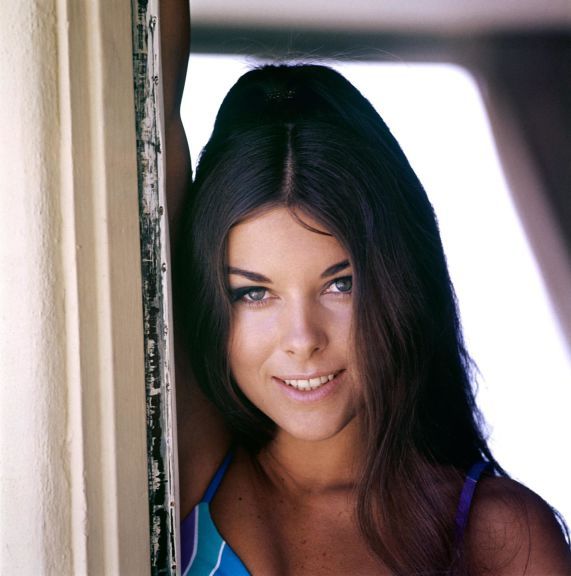
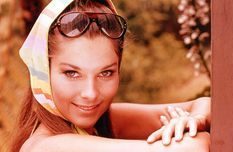 Paige Young in Los Angeles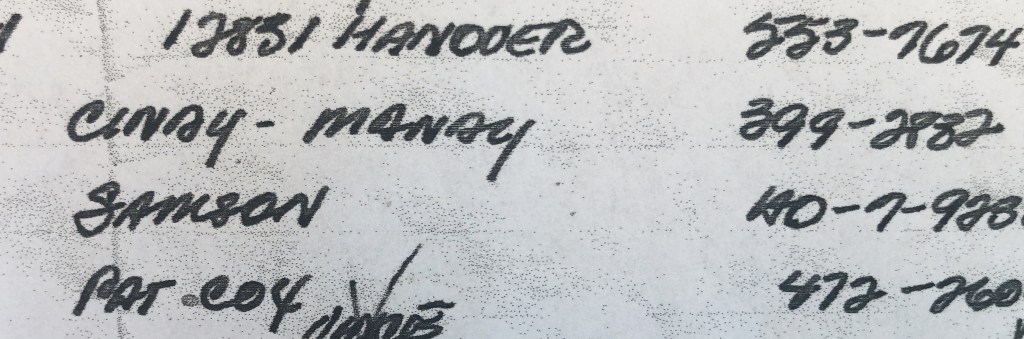


















 Paige Young in Los Angeles